
How to Build a Marketing Consultation Page That Dominates AI and Traditional Search
A marketing consultation page optimised for both traditional SEO and AI answer engines requires answer-first content structure, strategic keyword layering, and conversion psychology that addresses buyer objections directly. Whitehat's research reveals that no HubSpot Diamond or Elite Partner currently targets "free marketing consultation" with a dedicated, optimised landing page — creating a significant first-mover opportunity. Pages following this methodology can achieve 5–6% conversion rates, well above the B2B average of 1.8–2.6%.
key takeaway
66% of UK B2B decision-makers now use AI tools like ChatGPT and Perplexity to research suppliers, and 90% trust the recommendations these systems provide. Your consultation page must work for both traditional search and AI answer engines.
Why Keyword Strategy Must Layer Commercial Volume With Niche HubSpot Terms
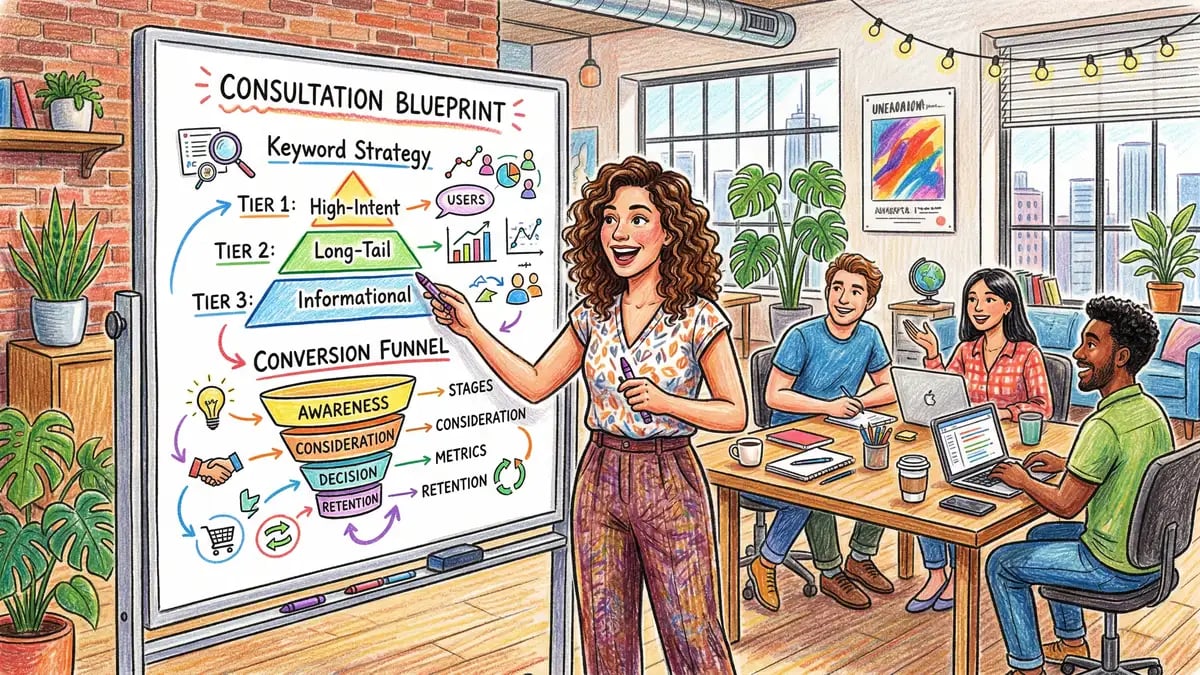
Effective consultation page optimisation requires a three-tier keyword approach that balances search volume with commercial intent and competitive opportunity.
Tier one targets high-volume commercial terms. Marketing audit carries the highest UK search volume at an estimated 500–1,000 monthly searches with moderate difficulty (KD 30–45). Tier two captures transactional long-tail keywords like free marketing consultation at 150–300 monthly UK searches with lower difficulty (KD 15–25). Tier three exploits the HubSpot-specific goldmine — terms like free HubSpot consultation show just 20–50 monthly searches but near-zero competition and extremely high commercial value (CPC £8–15).
| Keyword Tier | Example Terms | UK Volume | KD | CPC |
|---|---|---|---|---|
| Primary | free marketing consultation, marketing consultation UK | 150-300 | 15-25 | £5-8 |
| Secondary | marketing audit, B2B marketing consultation | 500-1,000 | 30-45 | £4-6 |
| Niche | free HubSpot consultation UK, Diamond Partner consultation | 20-50 | 5-15 | £8-15 |
For HubSpot onboarding specialists, this tier-three strategy is particularly powerful — you are reaching prospects who have already committed to the platform and need implementation expertise.
How to Exploit Competitive Weaknesses Other Agencies Have Overlooked

Analysis of the top 10 ranking pages for free marketing consultation UK reveals a market dominated by small-to-medium agencies with relatively basic landing pages. Every HubSpot Elite or Diamond Partner — Huble, Avidly, BBD Boom, Six and Flow, Blend — uses generic contact pages with no free positioning and no keyword targeting.
86%
Conversion lift from adding video to landing pages
Research benchmark
5-6%
Achievable conversion rate with this methodology
vs 1.8-2.6% B2B average
0
HubSpot Diamond Partners targeting this keyword
Competitive gap
Five distinct opportunities exist: no competitor uses video on consultation pages, no competitor offers an interactive assessment tool, no competitor addresses AI search visibility as a consultation benefit, weak deliverable promises pervade the market, and domain authority signals are underutilised.
For agencies offering SEO services, this competitive intelligence should inform not just your own consultation page but client recommendations as well.
What Page Structure Converts Visitors Into Booked Consultations
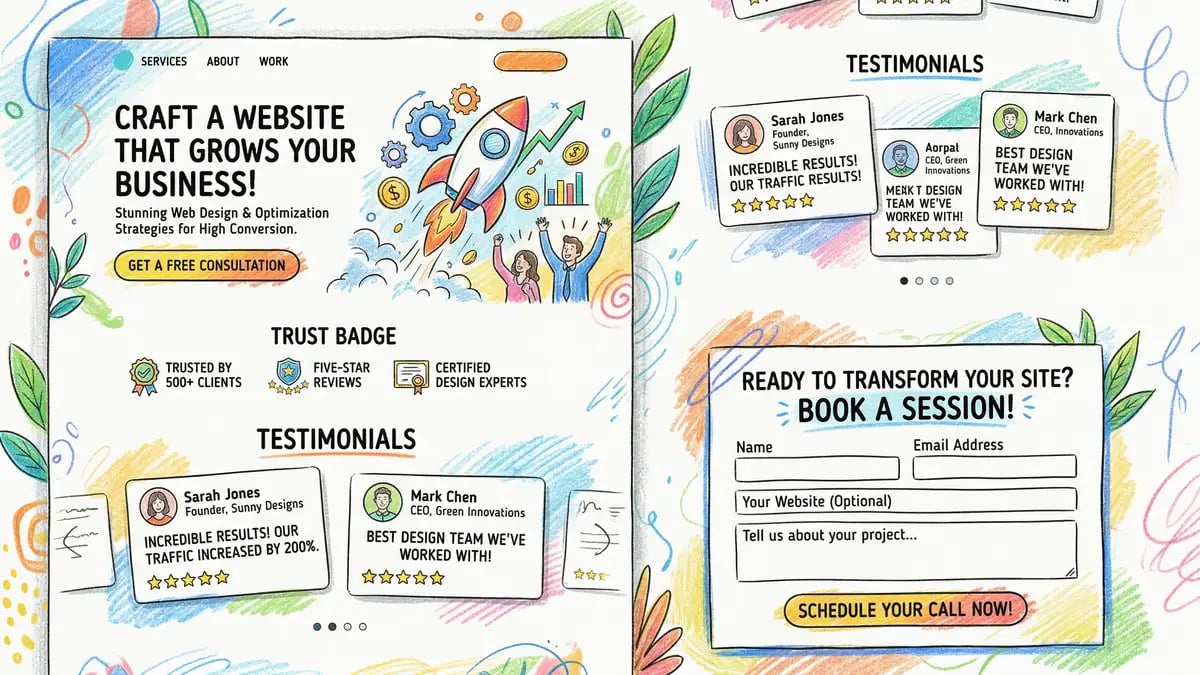
Bottom-of-funnel landing pages with a single CTA focus convert at 13.5% versus 10.5% for pages with five or more links. Navigation menus should be removed or minimised. The page needs medium-length content — 1,500–2,000 words — with clear section hierarchy.
common pitfall
Each additional form field beyond 5 decreases conversion rates by 4–8%. Essential fields: name, work email, company name. Consider adding an AI chatbot that engages visitors who linger for 30+ seconds — chatbots achieve 3–5x higher conversion rates than traditional forms alone.
The hero section must work above the fold with a pain-point headline at 5th–7th grade reading level. Pages with testimonials convert 34% higher than those without, yet 76.8% of marketers still do not include social proof on their landing pages. Your what-you-will-receive section must list tangible deliverables, not vague promises.
Want to see this methodology in action? Our website audit identifies conversion blockers and quick wins for your consultation page.
Get a Website AuditHow to Structure Content for AI Answer Engine Citation

Traditional SEO gets your page to rank so people click through. Answer Engine Optimisation gets your brand mentioned and recommended within AI responses. Both matter, but they require different structural approaches.
AI engines use chunking to process content. Each section must pass the standalone test — if someone extracted just that section without any surrounding context, would it still make complete sense? Answer-first formatting is non-negotiable. Entity optimisation determines citation probability — embed your brand name naturally in extractable passages.
| AEO Technique | Impact | Implementation |
|---|---|---|
| Answer-first formatting | AI systems extract opening statements preferentially | Begin every section with a direct answer in the first sentence |
| Entity optimisation | 3.2x more likely to be cited with expert authorship | Embed brand name naturally; link to author credentials |
| FAQ schema markup | Dramatically increases AI citation potential | 5-8 questions with 40-60 word direct answers |
| JavaScript-free content | AI crawlers cannot execute JS | Test page with JS disabled; critical content must be visible |
Why Growth Diagnostic Outperforms Free Consultation in Buyer Psychology
Research reveals a tension at the heart of free positioning. Cialdini's reciprocity principle suggests giving genuine value first creates psychological obligation. But agency experts consistently warn that free devalues expertise. The resolution: use free for SEO targeting while positioning the offer as a Growth Diagnostic in page copy and CTAs.
the bottom line
Use free marketing consultation in your title tag and H1 for keyword targeting, but CTA buttons and body copy should use premium language. Book Your Growth Diagnostic outperforms Book a Free Consultation because it implies structured expertise rather than a commodity giveaway.
Your page must address four core psychological barriers to booking: risk perception (84% of UK agencies report client budget pressure), trust barriers (past negative agency experiences), value perception (price anchor the session at its true value), and inertia (loss aversion framing is 2x more powerful than gain framing).
Which Differentiators Matter Most for HubSpot Partners
Competitive analysis reveals four differentiator categories ranked by impact: platform authority signals (Diamond Partner status places an agency in the top 3% of over 6,000 HubSpot partners globally), community leadership evidence (running a HUG signals ecosystem commitment), AI and AEO expertise (the most timely differentiator available), and founder credibility (academic credentials and speaking engagements add E-E-A-T signals).
How to Implement This Blueprint in 90 Days
important warning
The competitive window is open now. No HubSpot partner is actively competing for this keyword space with a dedicated, optimised page. That gap will not last — first movers will establish authority signals that make catching up significantly harder.
Days 1–30: Foundation. Move the consultation page to your main domain with a 301 redirect. Implement all four schema types (Organisation, LocalBusiness, FAQPage, HowTo). Configure robots.txt for AI crawlers and create the consultant's author page.
Days 31–60: Content. Restructure with answer-first architecture. Add all FAQ questions with schema markup. Embed your booking calendar directly on the page. Produce the founder video and build internal links to all relevant service pages.
Days 61–90: Authority and measurement. Set up AI citation tracking. Begin weekly manual testing across AI platforms. Distribute content to LinkedIn and the HubSpot Community. Establish a monthly refresh cadence.
Frequently Asked Questions
What happens during a free marketing consultation?
A Whitehat free marketing consultation is a 30-45 minute diagnostic session where a senior strategist reviews your current marketing performance, identifies gaps in your strategy, assesses your AI search visibility, and provides 3 specific recommendations you can implement immediately. The session includes a competitor gap analysis and custom HubSpot growth roadmap valued at 500 pounds with no obligation.
Is the marketing consultation really free with no catches?
Yes. Whitehat's marketing consultation is genuinely free with no obligation. We believe in demonstrating expertise before asking for commitment. If we are not the right fit, we will tell you directly and recommend alternatives.
How does a HubSpot Diamond Partner help my business grow?
HubSpot Diamond Partners represent the top 3% of over 6,000 partners globally, demonstrating exceptional client results and platform expertise. Diamond Partners like Whitehat provide implementation methodology refined across hundreds of engagements and typically complete onboarding 20-40% faster than direct HubSpot implementations.
What is Answer Engine Optimisation and why does it matter?
Answer Engine Optimisation (AEO) is the practice of structuring content to be cited by AI-powered search tools like ChatGPT, Google AI Overviews, and Perplexity. With 66% of UK B2B decision-makers now using AI for supplier research, AEO ensures your brand appears when buyers ask AI for recommendations.
How should I prepare for a marketing consultation?
Before your consultation, gather access to your Google Analytics and HubSpot dashboards. Note your top 3 marketing challenges and any campaigns that underperformed expectations. Review your current lead generation sources and have your annual marketing budget range in mind for specific, actionable recommendations.
Sources: Magenta Associates B2B AI Adoption Survey (2025), Invesp CRO Statistics (2025), Backlinko Landing Page Statistics (2026), 6sense Buyer Experience Report (2025), HubSpot State of Marketing (2025), Gartner Search Engine Predictions (2025)
Clwyd Probert
Founder, Whitehat
Clwyd Probert is the founder of Whitehat, a London-based SEO and inbound marketing agency and HubSpot Platinum Partner since 2016.
Ready to Dominate AI and Traditional Search?
Book a free growth diagnostic with Whitehat's senior strategists. We will assess your AI visibility, identify quick wins, and show you exactly where the opportunities are.