
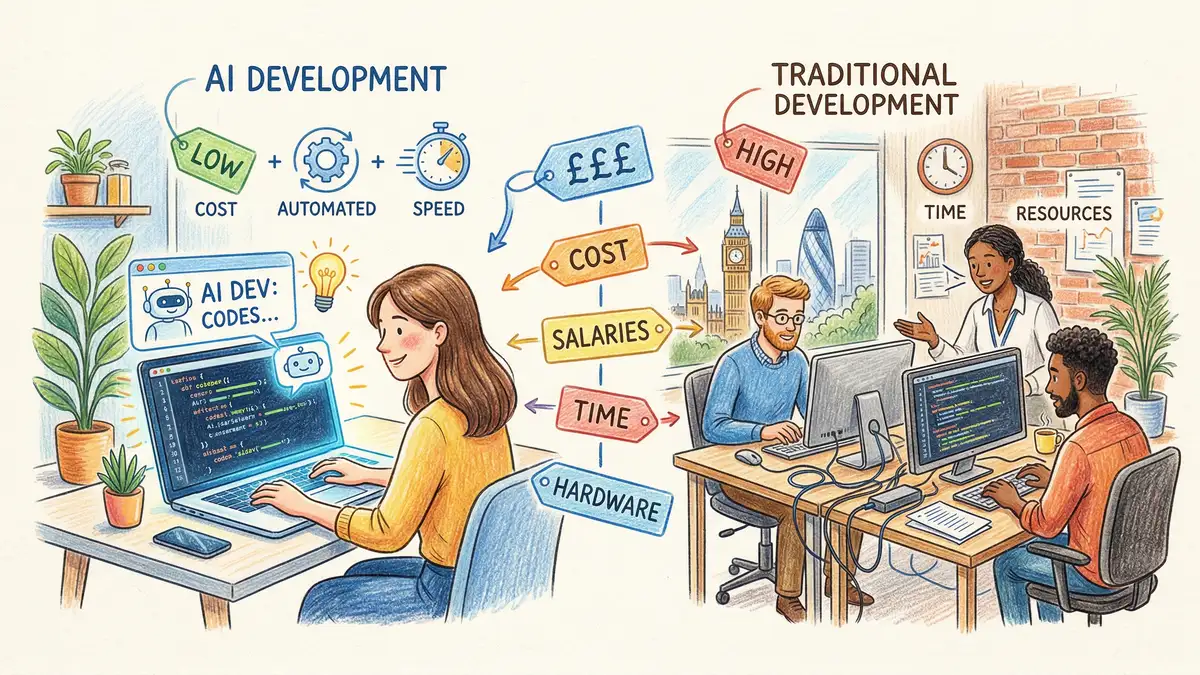
AI development costs in the UK range from £96 per year for AI coding tools to £30,000-80,000 for traditional agency projects. The real opportunity isn't hiring developers—it's equipping your marketing and operations teams with AI tools that let them build solutions themselves, bypassing the IT backlog entirely.
This guide breaks down what UK businesses actually pay for AI-assisted development in 2026, drawing on the UK Government's own trial data, real pricing from major tools, and honest assessments of what non-technical teams can realistically build. We'll cover tool costs, productivity benchmarks, security considerations, and when you still need professional developers.
£8-£40
Monthly per user
AI coding tools
56 mins
Saved daily
UK Gov. trial data
45%
Security flaws
AI-generated code
Sources: GitHub Copilot pricing (2026), UK Government AI Coding Assistant Trial (2025), Veracode 2025 GenAI Code Security Report
What Do AI Coding Tools Actually Cost?
AI coding assistants cost between £8 and £40 per user per month in the UK, with enterprise tiers reaching £50/month for enhanced security and compliance features. For a marketing team of five people, annual costs range from £480 to £2,400—a fraction of a single agency project.
The market has consolidated around several major players, each with different strengths. GitHub Copilot dominates enterprise adoption with its IDE integration, while Claude Code and Cursor offer more sophisticated "agentic" capabilities that can handle multi-step development tasks autonomously.
| Tool | Individual | Business | Best For |
|---|---|---|---|
| GitHub Copilot | £8-31/month | £15-31/user | Teams already using VS Code |
| Cursor | £16-32/month | £32/user | Beginners (familiar interface) |
| Claude Code | £16-158/month | £119/user | Complex multi-step tasks |
| Windsurf | £12/month | £24-47/user | Budget-conscious teams |
| Amazon Q Developer | Free tier | £15/user | AWS-centric organisations |
Sources: Pricing converted at $1 = £0.79. All figures current as of January 2026.
Whitehat SEO's AI consultancy team typically recommends starting with GitHub Copilot for teams new to AI-assisted development—it has the gentlest learning curve and widest enterprise adoption. For more ambitious automation projects, Claude Code's agentic capabilities justify the higher price point.
How Does This Compare to Traditional Development?
Traditional UK development costs dwarf AI tool subscriptions. A junior developer costs £34,000-40,000 annually including employer National Insurance and pension contributions. Senior developers command £60,000-110,000, according to Ravio's 2026 UK compensation data.
UK contractor day rates have stabilised at £500-525 median for mid-level developers, rising to £600-700 for senior specialists (IT Jobs Watch, December 2025). Agency blended rates typically run £525-700 per day.
Key Takeaway
A simple internal tool built by a UK agency costs £30,000-80,000. The same tool built by a marketing team using AI coding assistants might cost £2,400/year in subscriptions plus 40 hours of staff time.
The comparison isn't quite apples-to-apples. Agency projects include requirements gathering, design, testing, documentation, and ongoing support. AI-assisted internal builds often skip these steps—which works fine for throwaway prototypes but creates problems for anything that needs to last.
| Option | Annual Cost | Best For |
|---|---|---|
| AI tools (5-person team) | £480-2,400 | Internal tools, prototypes, automations |
| Junior developer (employed) | £34,000-40,000 | Continuous development needs |
| Agency project (internal tool) | £30,000-80,000 | Complex, documented, supported |
| Contractor (3-month project) | £33,000-46,000 | Specific expertise, defined scope |
What Productivity Gains Can You Expect?
The UK Government ran the largest public-sector trial of AI coding assistants in 2024-25, deploying 2,500 licences across 50+ central government organisations. The findings provide the most reliable UK-specific productivity data available.
Government developers using AI assistants saved an average of 56 minutes per working day—equivalent to 28 working days annually per user. User satisfaction scored 6.6/10, and 58% said they wouldn't return to working without AI assistance.
However, the headline numbers require context. Code suggestion acceptance rates averaged just 15.8%—meaning developers rejected over 84% of AI suggestions. The productivity gains came from the 16% that hit the mark, not from blindly accepting everything.
The Productivity Paradox
Self-reported gains don't match reality: A rigorous 2025 METR study found experienced developers were actually 19% slower with AI tools when working on familiar codebases—despite believing they were 20% faster. Self-reported productivity gains often exceed reality.
Vodafone UK reported their Copilot deployment saved employees 3 hours per week on average, with legal teams saving 4 hours per week. At enterprise scale (68,000 employees), even modest per-person gains compound into significant operational efficiency.
Microsoft Research found it takes approximately 11 weeks for teams to realise full productivity gains. Factor this ramp-up period into ROI calculations—the first quarter often shows minimal returns.
What Can Non-Technical Teams Actually Build?
Marketing and operations teams can realistically build internal tools, automations, and data utilities using AI coding assistants—but the scope has firm boundaries. Understanding what works and what doesn't prevents expensive failures.
High success rate (achievable without coding background)
- Simple forms and surveys (web-based data collection)
- Internal dashboards pulling from marketing/sales data
- CSV processing and data transformation scripts
- Workflow automations (Slack notifications, email triggers)
- Basic API integrations (connecting CRM to email tools)
- Spreadsheet-to-application conversions
Moderate success rate (requires learning basic concepts)
- Multi-step approval workflows with conditional logic
- Database-connected applications
- Browser extensions for internal use
- Simple CRUD web applications
Still requires professional developers
- Security-critical applications (payments, authentication)
- Customer-facing production systems
- Complex integrations with legacy systems
- Applications requiring regulatory compliance
- Systems that need long-term maintenance and support

Whitehat SEO's AI consultancy practice has helped clients build internal reporting dashboards, content workflow automations, and lead scoring utilities—all maintained by marketing teams rather than developers. The key is matching ambition to capability.
UK Organisations Already Doing This
Several UK organisations have documented their "citizen developer" programmes—where non-IT staff build applications using low-code platforms and AI tools. These case studies illustrate both the potential and the governance requirements.
Berkshire Healthcare NHS Trust
The Trust has trained 1,600+ citizen developers—clinical and administrative staff who build their own applications using Microsoft Power Platform. Staff complete mandatory "Becoming a Responsible Citizen Developer" training before building anything.
Their citizen developers have built employee onboarding tools, data collection apps, team dashboards, and workflow automations. Crucially, IT maintains oversight through restricted application types and governance controls—staff can't build anything that touches patient data without formal approval.
Balfour Beatty
The UK's largest construction contractor (26,000 employees) has deployed 6 Power Apps in production with 40+ more in development. Non-IT projects include a fire safety mobile application built by the Health & Safety team and bid management apps created by business units.
Community Fibre (London)
The London broadband provider documented 26,000+ hours saved across marketing, finance, and operations through citizen developer automations. Marketing teams automated lead reporting, finance automated billing processes, and operations streamlined core workflows—all without IT bottlenecks.
Security and Quality Risks You Need to Manage
AI-generated code carries real risks that require governance frameworks, not just enthusiasm. Veracode's 2025 GenAI Code Security Report found 45% of AI-generated code contains known security vulnerabilities. Cross-site scripting (XSS) failures appeared in 86% of tests.
Apiiro's 2024 research found AI-generated code showed 322% more privilege escalation paths than human-written code. These aren't theoretical concerns—they're systematic patterns across AI coding tools.
Governance Essentials
OWASP's Top 10 Risks for Citizen Development identifies "blind trust" (accepting AI outputs uncritically) and "sensitive data leakage" as the highest-severity risks. Every organisation needs code review processes, data classification policies, and IT oversight—even for "non-technical" builds.
Technical debt accumulates faster with AI assistance. GitClear documented an 8x increase in duplicated code blocks after AI coding tool adoption. Google's DORA 2024 research found a 25% increase in AI usage correlates with a 7.2% decrease in delivery stability.
The "orphaned application" problem compounds these risks. When the citizen developer who built a tool leaves the organisation, undocumented applications become maintenance nightmares. Require documentation, ownership transfer processes, and regular audits from day one.
When Do You Still Need Professional Developers?
AI tools augment development capacity—they don't eliminate the need for professional oversight. Certain projects require traditional development regardless of budget pressure or convenience.
| Use Case | AI-Assisted OK? | Professional Required? |
|---|---|---|
| Internal dashboard | ✅ Yes | For code review only |
| Customer-facing application | ⚠️ Prototyping only | ✅ Yes, for production |
| Payment processing | ❌ No | ✅ Yes, always |
| Workflow automation | ✅ Yes | For complex logic |
| Healthcare/regulated | ⚠️ Non-clinical only | ✅ Yes, for clinical systems |
The decision framework is straightforward: if the application handles sensitive data, faces customers, processes payments, or operates in a regulated environment, professional development and security review are non-negotiable. AI tools can accelerate these projects, but they can't replace architectural judgment and security expertise.
Frequently Asked Questions
How much do AI coding tools cost per month in the UK?
AI coding tools cost between £8 and £40 per user per month in the UK. GitHub Copilot starts at £8/month for individuals, Cursor charges £16-32/month, and Claude Code costs £16-119/month depending on tier. Enterprise plans with enhanced security typically run £31-50/user/month.
Can non-technical staff really build software with AI tools?
Yes, but with boundaries. Non-technical users successfully build internal dashboards, workflow automations, data processing scripts, and simple web forms using AI coding assistants. However, security-critical applications, complex integrations, and customer-facing systems still require professional development oversight.
What productivity gains can UK businesses expect from AI coding tools?
The UK Government trial found AI coding assistants saved developers 56 minutes per day—equivalent to 28 working days annually. However, a 2025 METR study found experienced developers were actually 19% slower on familiar codebases, suggesting gains depend heavily on context and task type.
Is it cheaper to use AI tools or hire a developer in the UK?
AI tools cost £96-480 per user annually versus £34,000-40,000 for a junior UK developer (including employer costs). However, AI tools augment existing staff rather than replace developers entirely. The comparison depends on project complexity, security requirements, and ongoing maintenance needs.
What are the security risks of AI-generated code?
Veracode's 2025 report found 45% of AI-generated code contains known security vulnerabilities. Cross-site scripting failures occur in 86% of cases, and AI code shows 322% more privilege escalation paths than human-written code. Governance frameworks and code review processes are essential.
How long does it take to see ROI from AI development tools?
Microsoft Research found it takes approximately 11 weeks for teams to realise full productivity gains from AI coding tools. Initial training takes 2-4 weeks for basic proficiency, with meaningful time savings typically appearing within 30-60 days of consistent use.
Need expert guidance on AI implementation? Whitehat SEO's AI consultancy helps UK businesses adopt AI tools with measurable ROI.
View AI Consultancy ServicesReady to Implement AI in Your Business?
Whitehat SEO helps UK B2B companies navigate AI adoption—from tool selection to full implementation—with transparent pricing and measurable outcomes.
Clwyd Probert
CEO & Founder, Whitehat SEO
Clwyd founded Whitehat SEO in 2011 and has grown it into a HubSpot Diamond Partner serving B2B companies across the UK. He runs the world's largest HubSpot User Group in London, guests lectures at UCL, and advises on AI implementation for marketing transformation.
References
- UK Government AI Coding Assistant Trial Report (2025) — Primary UK productivity data: 56 minutes/day saved across 2,500 users
- GOV.UK Technology Blog (2025) — UK public sector AI coding guidance
- IT Channel Oxygen (2024) — Vodafone UK Copilot savings: 3 hours/week per employee
- Berkshire Healthcare NHS Trust (2025) — UK citizen developer programme: 1,600+ trained staff
- GitHub Blog (2024) — Accenture enterprise Copilot study: 8.69-15% PR merge rate increase
- Index.dev (2025) — Developer productivity statistics compilation
- LinearB (2025) — ROI analysis of GitHub Copilot
- OWASP Top 10 Risks for Citizen Development (2025) — Security governance framework
- Augment Code (2025) — AI coding tool comparison and pricing
- UK Government AI Playbook (2025) — Official AI implementation guidance