
Direct Answer
UK B2B marketing managers should use Facebook advertising in 2026 as a full-funnel engine: run broad, creative-led prospecting to attract qualified accounts, capture intent with a single compelling offer, then retarget warm audiences to book meetings—measuring success by cost per qualified lead and pipeline created, not clicks or impressions. The platform's scale remains unmatched (billions of users), but success depends on better creative, first-party data, and clean CRM measurement—not micro-targeting tweaks.
Key Takeaways
- Facebook still works for UK B2B when treated as a full-funnel demand and retargeting channel, not a lead vending machine.
- Broad targeting + exceptional creative now beats narrow micro-targeting; privacy changes favour simple first-party audiences.
- The 3-layer funnel matters: prospecting (cold), offer capture (warm-ish), and retargeting (warm) create predictable pipeline.
- Measurement must happen in your CRM, not Facebook's dashboard; cost per qualified lead and pipeline created are the metrics that matter.
- Creative testing and refresh cycles are non-negotiable; assume every winning ad has an expiry date and build accordingly.
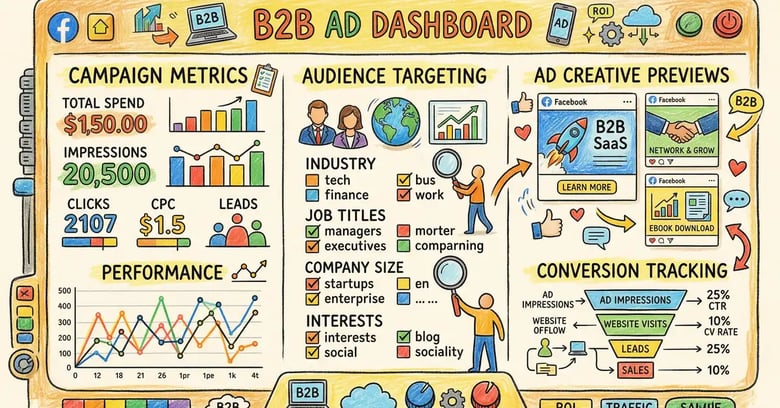
Why Facebook Still Works for UK B2B (When Done Right)
Facebook isn't "dead" for B2B marketing, but it is unforgiving if you treat it like a lead vending machine. The winning teams use it to create demand, educate the market, and convert warm intent—then measure outcomes in the CRM, not the Facebook dashboard. Here's why it belongs in a UK B2B marketing mix:
Three reasons Facebook belongs in your B2B budget
- Scale + reach: Facebook's global audience remains massive (in the billions). That matters because even niche B2B audiences are made of humans with personal accounts—decision makers who research solutions outside work hours.
- Full-funnel behaviour: Decision makers browse, watch, click, save, and come back later. Paid social excels at staying present during that "quiet research" phase before they're ready to talk to sales.
- Real ROI (when tracked properly): Multiple industry surveys still rank Facebook near the top for perceived marketing ROI—especially when you include the "assist value" of touchpoints that influence later conversions.
The shift from 2025 to 2026: stop trying to out-tweak the algorithm. Start feeding it better signals—clean first-party audiences, better creative, and clear measurement of what actually matters (qualified leads and pipeline, not clicks).
Build a Simple Full-Funnel Strategy You Can Actually Run
Most B2B Facebook accounts fail for one boring reason: they run a single campaign, ask for a demo immediately, then act surprised when cold audiences don't comply. The fix is structure.
The minimum viable 3-layer funnel
Layer 1: Prospecting (cold audience)
Broad UK targeting plus strong, educational creative. Goal: grab attention and drive qualified traffic (not necessarily leads on day one). Think webinar invites, valuable content, or founder perspective—not "book a demo" CTA yet.
Layer 2: Offer capture (warm-ish audience)
One compelling offer: webinar, benchmark report, calculator, or "how to" guide. Goal: capture a lead with clear intent signals. This is where you convert anonymous traffic into contacts you can nurture and measure in HubSpot.
Layer 3: Retargeting (warm audience)
Retarget site visitors, video viewers, and engaged leads with proof (case studies, testimonials) and a next step (demo, consultation, call). This is where pipeline actually forms.
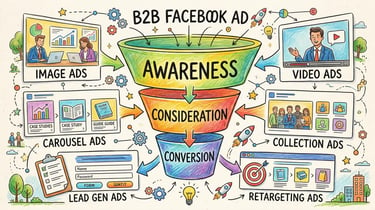
This structure prevents the "one ad, ask for everything" trap that kills most B2B Facebook campaigns. Each layer has a single purpose and a single call-to-action. The audience for each layer is different (cold → warm → warmer), so the message and offer change too.
Why it works: you're not fighting against audience intent. A cold prospector is not ready to book a demo; they're in discovery. A site visitor has shown interest; they might be. Someone who watched your case study video has shown strong intent; they're nearly ready. The funnel matches the message to the moment.
Targeting in 2026: Broad Plus First-Party Beats "Clever"
The old playbook was: stack interests, narrow job titles, build tiny audiences, then micro-optimise. The new reality is: privacy changes and automated delivery have shifted the advantage toward cleaner data and better creative.
Your targeting hierarchy (in priority order)
- First-party audiences: CRM lists, customer lists, MQLs, SQLs, plus strategic exclusions (existing customers, bounced prospects) so you don't waste spend.
- Warm behavioural audiences: Site visitors, video viewers, high-intent page visitors (pricing, integrations, comparison pages), lead magnet downloaders.
- Broad prospecting with guardrails: UK location + relevant industries + seniority (if applicable), then let creative do the qualification. This is where the 3-layer funnel shines—the message filters, not the audience settings.
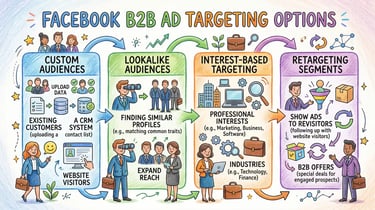
The logic is simple: warm audiences (first-party, behavioural) are scarce and expensive. Start with them. For scale, go broad with good creative. A well-crafted prospecting ad that speaks to a real pain point will outperform a narrowly targeted mediocre ad 9 times out of 10.
If you're unsure what "counts as warm intent", build your logic from your content strategy. A visitor who reads your pricing page behaves differently from someone who skims a top-of-funnel blog post. Map behaviours to intent, then audience. Facebook's algorithm is smart enough to optimise delivery if you give it honest signals.
Creative That Sells to Humans (Not Just Algorithms)
In 2026, Facebook ads performance is disproportionately driven by creative. That's not a "nice to have"—it's the job. Your targeting can be broad and still work if the message does the filtering for you.
Winning angles for UK B2B prospecting
- Cost of inaction: What you lose by staying manual, spreadsheet-driven, or process-light.
- Proof and specificity: Benchmarks, numbers, time saved, concrete outcomes—not vague claims.
- Process clarity: "Here's the exact framework we use" builds confidence and reduces friction.
- Risk reduction: Compliance, governance, predictable reporting—the operational anxiety your prospects have.
Formats that typically win
- Short video (15–30 seconds): One clear point, proof, and CTA. High view completion, high engagement.
- Carousel/document-style creative: Mini-guide slides that tell a story. Scrolling increases dwell time.
- Founder or expert POV: Human face, strong opinion, simple takeaway. Authenticity beats polish.
- Case study snapshots: One metric, one quote, one outcome. More credible than generic testimonials.
A practical creative testing plan
Don't launch one ad and pray. Launch a small system:
- 3 angles (e.g., cost of inaction, risk reduction, "how we do it")
- 2 formats per angle (short video + static, or carousel + video)
- 1 proof variant per angle (testimonial, case metric, award/partner badge)
- 1 contrarian hook ("Stop doing X, do Y instead") to test novelty
That's 6 live ads from day one. Run them for 7–14 days, learn which angles and formats win, then scale winners and pause losers. Refresh every 2–4 weeks or when CTR drops below your baseline.
Measurement, GDPR, and Proving Pipeline in HubSpot
Facebook reporting is fine for optimisation. It is not fine for board-level reporting. UK B2B marketing managers need CRM-level truth: which campaigns created qualified leads, meetings, pipeline, and revenue.
Minimum viable tracking stack
- UTMs (consistent, human-readable): campaign, content, audience—so you can slice results by strategy later.
- Meta Pixel (installed correctly): Key events verified, not just ViewContent and Lead.
- Conversions API (CAPI): Improves event quality and resilience, especially important post-iOS privacy changes.
- CRM integration: Lead capture into HubSpot, lifecycle stages defined (subscriber → MQL → SQL → customer).
- Consent management: GDPR-compliant, transparent consent with clear privacy messaging. No shortcuts here.
Reporting your CFO will respect
Stop reporting: impressions, clicks, CTR, CPC.
Start reporting: cost per qualified lead, meetings booked, pipeline created, win rate, payback period, CAC trend (even directional beats vanity metrics).
If you're on HubSpot, the fastest path is to connect the dots properly (not duct-tape spreadsheets). Clean UTMs + accurate lead capture + clear lifecycle stages = reportable pipeline from day one.
Optimisation and Scaling Without Burning Money
Optimisation in paid social is mostly disciplined boredom: test, learn, iterate, repeat. The trick is to avoid random "tweaks" that reset learning and make your results look like a heart monitor in an accident ward.
Rules of thumb that keep you sane
- Change one variable at a time: Creative or offer or audience or landing page. Not five things at once.
- Hold tests long enough to learn: 7–14 days depending on volume. More is better; less is gambling.
- Scale gradually: Increase budgets in controlled steps, not "double it because Tuesday felt good".
- Refresh creatives before fatigue: Assume every winner has an expiry date. Plan refresh cycles (every 2–4 weeks for always-on campaigns).
- Protect retargeting: Set frequency guardrails (don't retarget someone 30 times a day) and keep it always-on with proof-led assets.
The hardest part is patience. Resist the urge to "check and tweak" every 3 days. Let systems run, collect clean data, then adjust with intention.
Frequently Asked Questions
Is Facebook still worth it for UK B2B in 2026?
Yes—if you treat it as a full-funnel channel. Use it to create demand, capture intent with a single offer, and retarget warm audiences with proof. Measure in your CRM using cost per qualified lead, meetings booked, and pipeline created (not clicks).
What budget do I need to start?
You need enough to run a stable test for 7–14 days. In many UK B2B categories, that's often £30–£100/day for a single focused campaign, but audience size and lead goals shift this. If budget is tight, reduce scope: one offer, one audience, multiple creatives.
What targeting works best now that tracking is harder?
Start with first-party audiences (CRM lists and exclusions), then warm behavioural audiences (site visitors, video viewers), then broad prospecting with minimal constraints (UK + relevant industries). Let the algorithm optimise delivery while you control the offer and message.
Lead forms or landing pages—what's better?
Lead forms usually produce cheaper leads; landing pages often produce better quality. The only correct answer is: test both and decide using cost per qualified lead or meetings booked, not cost per lead.
How do I prove pipeline from Facebook ads in HubSpot?
Use consistent UTMs, ensure lead capture routes into HubSpot, define lifecycle stages for "qualified", and report on contacts created, qualified leads, meetings booked, and pipeline attribution. If your setup isn't clean, start with proper onboarding to fix the foundations first.
How long should I test before scaling?
Give each test 7–14 days (or enough conversions to be meaningful), then scale winners gradually and refresh creatives proactively. If performance swings, check creative fatigue, offer clarity, landing page fit, and tracking consistency before blaming the platform.
About the Author
Clwyd Probert is founder of Whitehat, a B2B marketing and growth agency specialising in paid social, SEO, and revenue operations for tech and scale-ups. He's spent 10+ years helping UK B2B teams build predictable pipeline from paid channels—not just reporting impressions.