
The major AI platforms have converged on similar pricing—around £16–20 per month for premium tiers—whilst differentiating on specialised capabilities. Understanding which tool fits your workflow is the first step toward effective AI-assisted content creation.
AI content as a Marketing Tool
AI writing tools have become essential productivity multipliers for content marketers, with 85% of marketers now using AI specifically for content creation. The critical insight for 2026: Google doesn't penalise AI content—it penalises low-quality content regardless of origin. Success requires treating AI as an augmentation layer that accelerates routine tasks while preserving space for human expertise, originality, and experience. The tools have never been more capable, but the strategic question remains unchanged: use AI to amplify your unique voice, not replace it.
The 2026 AI Writing Toolkit Has Reached Enterprise Maturity
ChatGPT-4o, released May 2024, offers multimodal processing across text, images, audio, and video with a 128,000-token context window. OpenAI's November 2024 "creative writing boost" specifically improved storytelling quality for content creators, making it a strong all-rounder for marketing teams.
Claude from Anthropic has emerged as the preferred tool for long-form content, offering up to 200,000 tokens of context on Pro plans. Its Constitutional AI approach produces notably natural, measured prose that requires less editing for brand voice consistency. Content strategists consistently report Claude excels at maintaining narrative coherence across extended pieces—essential for comprehensive blog posts and thought leadership content.
Google Gemini differentiates through deep integration with Google Workspace. Its Canvas feature transforms text into web pages, infographics, and audio overviews, whilst Deep Research mode generates comprehensive multi-page reports from a single prompt. The AI Pro tier includes a million-token context window, making it particularly powerful for research-heavy projects.
Specialised tools have carved distinct niches. Jasper (£40–100/month) leads in brand voice consistency with its Knowledge Base and multi-brand management. Writesonic has pioneered Generative Engine Optimisation (GEO), tracking how brands appear in AI search results from ChatGPT, Perplexity, and Gemini. Copy.ai remains the fastest option for short-form content like social posts and ad copy.
At Whitehat SEO, we help marketing teams select and implement the right AI tools for their specific content workflows, ensuring technology investment translates into measurable productivity gains.
Google Rewards Quality, Not Production Method
Google's position crystallised in February 2023 and was reinforced by the March 2024 Core Update: appropriate use of AI or automation is not against their guidelines when it's not used primarily to manipulate search rankings. The company evaluates content on E-E-A-T (Experience, Expertise, Authoritativeness, Trustworthiness) regardless of how it was produced.
The March 2024 update introduced three critical spam policies. Scaled Content Abuse now targets mass-produced low-value content whether created by AI, humans, or both—the behaviour matters, not the method. Site Reputation Abuse addresses third-party content produced primarily for rankings without proper oversight. Google's stated goal: reduce low-quality, unoriginal content by 45% in search results.
"Write for humans, not for ranking systems, whether those systems are traditional search or LLM-powered experiences."
— Danny Sullivan, Google Search Liaison
The data shows AI content can rank effectively. As of late 2024, research from Originality.ai found that 17.31% of top 20 search results contained AI-generated content. However, 100% of websites receiving manual actions (penalties) in study samples used AI content—confirming that low-quality AI abuse triggers consequences whilst quality AI-assisted content succeeds.
This aligns with Whitehat SEO's approach to ethical SEO services: focus on creating genuinely useful content that serves your audience, and the rankings will follow.
The Best Workflows Front-Load Human Expertise
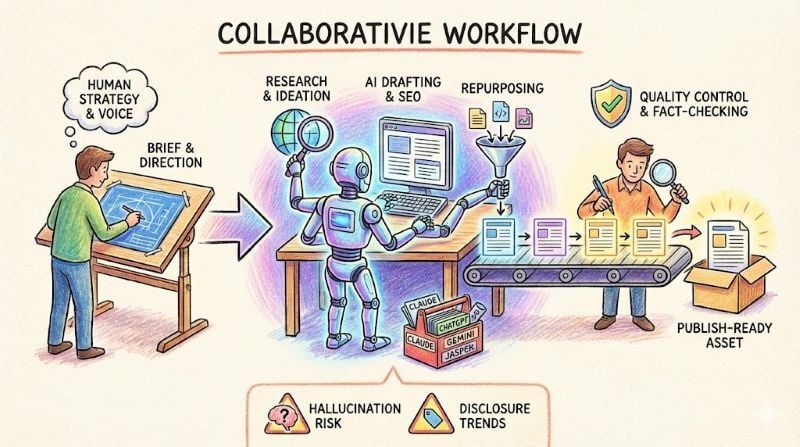
Ryan Law, Director of Content Marketing at Ahrefs, has documented the most detailed public workflow for AI-assisted content. His process emphasises that successful AI content requires the skill and guidance of a competent content marketer to work. The critical insight: front-load human input at the START of the process rather than hoping to fix AI drafts afterwards.
The workflow begins with documenting existing editorial processes, then uploading these to AI tools with specific brand voice instructions. Before AI drafts anything, create detailed content briefs containing target keywords, key talking points, subtopics from SERP analysis, and product mention requirements. Only then does AI generate outlines and drafts—with the human acting as editor throughout.
Content Marketing Institute research shows this hybrid approach delivers results: organisations implementing structured AI workflows have reduced content production time by 40% whilst improving engagement metrics by 28%. The pattern works because AI excels at "hygiene" tasks—research synthesis, structural organisation, SEO optimisation, internal linking—whilst humans provide the differentiation that builds audience loyalty.
When to Use AI vs. Human Authorship
Use AI For:
- Ideation and keyword research
- Outline generation
- First drafts of routine informational content
- SEO optimisation suggestions
- Content repurposing across formats
- Internal linking recommendations
Reserve Human Authorship For:
- Opinion pieces and thought leadership
- Original research and case studies
- Content requiring personal experience
- Rapidly changing or breaking topics
- Emotional brand storytelling
- Strategic messaging and positioning
NP Digital's testing revealed a striking finding: when identical content was labelled as "AI-generated" versus human-written, average read time dropped by half for the AI label—demonstrating that disclosure itself affects user engagement regardless of actual quality.
Practical Applications: Matching AI Strengths to Content Needs
The most effective use cases leverage AI's computational advantages whilst preserving human judgement for areas requiring experience and nuance. Here's how marketing teams are applying AI tools across the content lifecycle:
Ideation and Topic Research
AI content helpers can analyse SERPs to identify subtopics competitors cover and angles they've missed. Topic research tools reveal search potential and keyword difficulty. The consistent finding: AI dramatically accelerates the research phase that traditionally consumed hours of manual analysis. At Whitehat SEO, we use AI-assisted research to identify content gaps and opportunities for our clients' inbound marketing strategies.
Outline Creation
Outline generation becomes systematic rather than intuitive. The recommended workflow analyses top-ranking pages for heading structure, generates H2/H3 hierarchy with talking points and data requirements, then applies human judgement to identify unique angles. This structured approach ensures comprehensive coverage whilst preventing the formulaic outputs that characterise pure AI generation.
First Draft Generation
First draft generation works best with detailed content briefs provided upfront. Including key points, examples, unique angles, and specific requirements in the prompt produces drafts that require editing rather than wholesale rewriting. Using AI canvas features for inline commenting enables iterative refinement without losing context.
SEO Optimisation
Tools like Semrush's SEO Writing Assistant provide real-time keyword usage suggestions, readability scoring, and tone consistency checking. This is where AI truly shines—handling the technical optimisation that ensures content is discoverable whilst humans focus on making it compelling.
Content Repurposing
AI transforms single pieces into social posts, email newsletters, video scripts, and audience-specific variations—the use case where AI delivers perhaps its clearest time savings. A comprehensive blog post can spawn dozens of derivative assets with minimal additional effort.
Quality Control
Quality control requires dedicated verification. Teams using structured multi-stage review report 90% fewer mistakes, with only 1 in 50 posts needing rework compared to 1 in 5 for manual processes. The investment in verification infrastructure pays for itself in avoided reputation damage.
Hallucinations and Copyright Uncertainty Demand Vigilance
Factual accuracy remains AI's most significant limitation. A Journal of Medical Internet Research study found GPT-3.5 hallucinated 39.6% of academic citations whilst GPT-4 improved to 28.6%—better but still unacceptable for professional content. Even best-performing models maintain 1–2% hallucination rates on summarisation tasks.
Real-world consequences have materialised. Air Canada was ordered to pay damages in February 2024 after its chatbot invented a bereavement fare policy. Lawyers were fined £4,000 for submitting ChatGPT-fabricated court cases. Deloitte issued partial refunds on a substantial Australian government report containing hallucinated academic sources. These incidents demonstrate that AI confidence bears no relationship to accuracy.
⚠️ Key Risk Statistic
47% of AI users admitted making at least one major business decision based on hallucinated content in 2024. Knowledge workers now spend an average of 4.3 hours per week fact-checking AI outputs—partially offsetting the productivity gains that justified adoption.
Copyright law creates additional uncertainty. The U.S. Copyright Office ruled that AI-generated content cannot be copyrighted without sufficient human authorship. Mere prompting doesn't qualify—humans must provide "meaningful expressive elements" for protection. Human editing and creative modifications can make AI-assisted works copyrightable, but the boundary remains legally undefined.
This is why content audits and quality assurance processes remain essential. AI can accelerate production, but human oversight is non-negotiable for content that represents your brand.
AI Detection Tools Remain Unreliable Whilst Disclosure Requirements Grow
The AI detection industry's self-reported accuracy claims face significant challenges from independent research. GPTZero claims 99.3% accuracy with a 0.24% false positive rate, but a 2024 National Library of Medicine study found an 18% false positive rate—meaning nearly one in five human-written documents was incorrectly flagged.
For SEO purposes, detection scores appear irrelevant. There's no evidence Google uses AI detection in ranking algorithms. Google's focus remains on content quality signals rather than production method detection. The practical recommendation from SEO experts: invest in quality improvement rather than detection evasion.
However, disclosure requirements are expanding rapidly:
- EU AI Act (effective August 2026): Mandates that AI-generated content intended to inform the public on matters of public interest must include machine-readable disclosure markers.
- FTC (October 2024): Banned fake AI-generated reviews with penalties up to $51,744 (approximately £40,000) per violation.
- California AI Transparency Act (January 2026): Requires disclosure of AI involvement in content creation.
- YouTube (July 2025): Stricter monetisation rules for mass-produced AI content.
The C2PA standard (Coalition for Content Provenance and Authenticity) is emerging as the industry solution. Backed by 300+ organisations including Adobe, Microsoft, Google, and BBC, it embeds cryptographically signed metadata tracking content origin, editing history, and AI involvement.
The Numbers Confirm AI as Productivity Tool, Not Replacement
Adoption has reached mainstream levels: 69–88% of marketers now use AI tools depending on survey methodology, with 85% specifically using AI for content creation. The trajectory points toward near-universal adoption, with 90% of content marketers planning to use AI in 2025 according to industry surveys.
Productivity gains are measurable and consistent. Marketers report saving 5+ hours weekly on average, with CoSchedule finding 83% of users report increased productivity. Time savings per content piece average 3 hours according to Synthesia research. These efficiencies translate to business outcomes: organisations implementing AI marketing report 41% average revenue increase and 32% reduction in customer acquisition costs.
Key AI Content Statistics for 2025
| Marketers using AI for content | 85% |
| Average weekly time saved | 5+ hours |
| AI content performs better than non-AI | 56% agree |
| Bloggers using AI for entire articles | Only 6% |
| Marketers who edit AI content before publishing | 86% |
Quality perceptions split between producers and consumers. Among marketers, 56% say AI-assisted content performs better than non-AI content, and 85% believe AI has improved their content quality. However, consumer sentiment tells a different story: approximately 50% would not trust a brand they knew used AI-generated content. This perception gap suggests disclosure strategy requires careful consideration.
The expert consensus positions AI as augmentation rather than replacement. HubSpot finds 65% of marketers champion using AI as an assistive tool whilst warning against over-reliance. Only 6% of bloggers use AI to write entire articles according to Orbit Media—the majority use it for ideation, research, and editing.
Frequently Asked Questions
Does Google penalise AI-generated content?
No. Google penalises low-quality content regardless of how it's produced. AI-generated content that demonstrates E-E-A-T (Experience, Expertise, Authoritativeness, Trustworthiness) and serves user intent can rank well. The March 2024 Core Update specifically targets scaled content abuse—mass-produced low-value content—not AI assistance used responsibly.
Which AI writing tool is best for marketing content?
It depends on your use case. ChatGPT-4o offers the best all-round versatility. Claude excels at long-form content and maintaining brand voice. Google Gemini integrates deeply with Workspace. Jasper leads for teams managing multiple brands. Most marketers benefit from using 2–3 tools for different tasks rather than relying on a single platform.
How much time can AI save on content creation?
Research consistently shows marketers save 5+ hours weekly when using AI tools effectively. Time savings per content piece average 3 hours. However, factor in verification time—knowledge workers spend about 4.3 hours per week fact-checking AI outputs. Net productivity gains depend heavily on workflow design and quality assurance processes.
Should I disclose when content is AI-assisted?
Current UK regulations don't mandate disclosure for AI-assisted marketing content, but requirements are expanding globally. The EU AI Act (effective August 2026) will require machine-readable markers for certain public interest content. Google recommends disclosure "when it would be reasonably expected." Consider your audience expectations and brand positioning when deciding.
How accurate is AI-generated content?
AI models still hallucinate facts at concerning rates. Research shows GPT-4 fabricates approximately 28.6% of academic citations. Even best-performing models maintain 1–2% hallucination rates on summarisation tasks. Human fact-checking remains essential for any content representing your brand professionally.
Making AI Work for Your Content Strategy
The 2025 landscape rewards strategic integration rather than wholesale adoption or rejection. AI tools have matured into reliable productivity multipliers—Claude for long-form coherence, ChatGPT-4o for multimodal versatility, Gemini for Google Workspace integration, specialised tools for specific workflows. Google's policies explicitly permit AI-assisted content that demonstrates genuine expertise and serves user needs, whilst penalising mass-produced content created primarily for ranking manipulation.
The winning formula combines AI efficiency with human differentiation. Front-load expertise into detailed briefs before AI generates drafts. Build verification infrastructure that catches hallucinations before publication. Maintain clear brand voice documentation that AI can reference consistently. Reserve thought leadership, original research, and emotionally resonant content for human authorship where AI cannot replicate the required experience.
Detection tools remain unreliable for enforcement, but disclosure requirements are expanding—plan for transparency as the regulatory default rather than the exception. Copyright protection requires demonstrable human creative contribution, making documentation of your editorial process increasingly important.
The marketers achieving best results treat AI as a talented but junior team member: capable of excellent draft work under clear direction, but requiring supervision, fact-checking, and the strategic judgement that transforms competent content into audience-building assets.
Ready to Transform Your Content Strategy?
At Whitehat SEO, we help marketing teams integrate AI tools effectively whilst maintaining the human expertise that builds lasting audience relationships. From HubSpot implementation to Answer Engine Optimisation, we'll help you build a content engine that delivers results.
References & Further Reading
- Google Search Central: Google Search's Guidance About AI-Generated Content
- HubSpot: 2025 Marketing Statistics, Trends & Data
- Content Marketing Institute: Content Marketing Statistics
- CoSchedule: State of AI in Marketing Report 2025
- HubSpot: AI Trends for Marketers Report
- Google Search Central: Using Generative AI Content on Your Website