
12 Benefits of Blogging for Business in 2026 (With ROI Data)
Business blogging delivers an average 748% ROI over three years for B2B companies, with organic leads closing at 14.6% compared to just 1.7% for outbound. In 2026, blogging's value has evolved beyond traffic generation — it now builds mental availability with the 95% of buyers not currently in-market, earns citations from AI answer engines like ChatGPT and Google AI Overviews (where referred visitors convert at 4.4× higher rates), and creates the attribution clarity that CFOs demand.
key takeaway
Blogging in 2026 is not just about traffic — it builds mental availability with future buyers (95-5 rule), earns AI citations that convert at 4.4× higher rates, and creates the attribution trail CFOs demand. The average B2B company achieves 748% ROI over three years.
1. Exceptional ROI Across B2B Industries

Website, blog, and SEO is the number one ROI-generating channel for B2B brands, cited by 27% of marketers as their top ROI channel — ahead of paid social at 26%, according to HubSpot's 2026 State of Marketing report. Content marketing generates £3 for every £1 invested on average, compared to £1.80 for paid advertising — a 67% performance advantage.
| Industry | 3-Year SEO ROI | ROAS | Break-Even |
|---|---|---|---|
| B2B SaaS | 702% | 8.75× | 7 months |
| Financial Services | 1,031% | 11.1× | 9 months |
| Manufacturing | 813% | 9.8× | 7 months |
| Professional Services | 526% | 6.15× | 8 months |
| Average (All B2B) | 748% | 9.1× | 9 months |
2. Significant Lead Generation Advantage
Companies with active blogs generate 67% more leads per month than non-blogging peers. Small businesses with consistent blogging programmes see 126% more lead growth, whilst websites with blogs have 434% more indexed pages and 97% more inbound links — dramatically expanding their organic search footprint.
The quality of those leads matters too. SEO and organic leads close at 14.6% compared to just 1.7% for outbound leads — an 8.6× difference in conversion effectiveness. Someone actively searching for solutions to their problem is fundamentally more qualified than someone interrupted by a cold call.
67%
More leads from active blogs
vs non-blogging companies
14.6%
Organic lead close rate
vs 1.7% outbound
3.5x
More leads from 16+ posts/month
HubSpot benchmark
At Whitehat, we have seen this play out consistently across our SEO services clients: the companies that commit to consistent, quality content production build sustainable lead generation engines that outperform paid channels within 12–18 months.
3. AI Search Visibility (The Blogging Benefit Competitors Are Not Talking About)
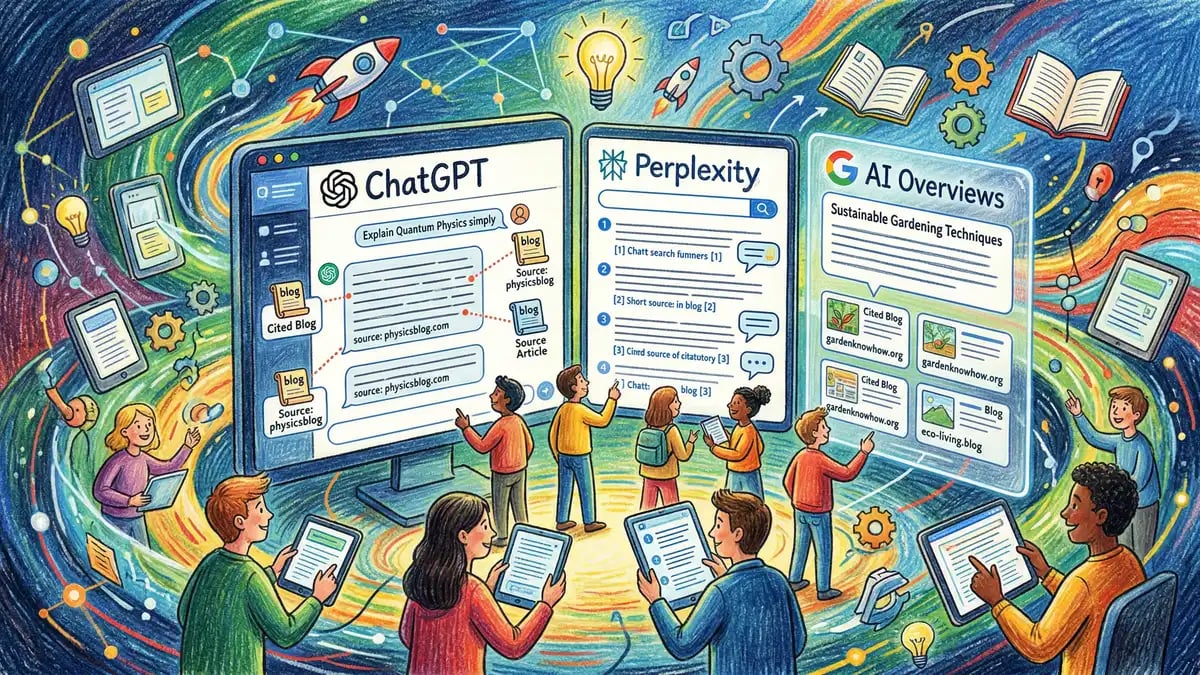
AI referral traffic currently accounts for approximately 1% of total website traffic — but visitors from AI search engines convert at 4.4× higher rates than traditional organic visitors. ChatGPT referrals grew 52% year-on-year between September and November 2025, whilst Gemini referral traffic exploded by 388% in the same period.
Platform-specific conversion rates show ChatGPT visitors converting at 15.9%, Perplexity at 10.5%, Claude at 5%, and Gemini at 3%. These visitors arrive pre-qualified — they have already read an AI's recommendation of your content.
watch out
Google AI Overviews reduce organic click-through rates for position-1 content by 58%. However, brands cited in AI Overviews earn 35% more organic clicks and 91% more paid clicks than those not cited. Being cited is the new being ranked.
Blog content optimised for AI citation — with clear answers in the first 40–60 words of each section, proper schema markup, and authoritative sourcing — earns 2.8× higher AI citation rates than poorly structured content. This is why Answer Engine Optimisation (AEO) has become an essential complement to traditional SEO.
4. Building Mental Availability With Future Buyers (The 95-5 Rule)

Only approximately 5% of B2B buyers are in-market at any given time — the remaining 95% are future buyers who will enter the market eventually. This insight, from Professor John Dawes at the Ehrenberg-Bass Institute, fundamentally reframes blogging's strategic purpose.
Corporations change service providers roughly once every five years on average, meaning only 20% are in-market over a full year, roughly 5% in any given quarter. Marketing's primary job is not generating leads from today's buyers — it is building memory structures (mental availability) with the 95% who will buy later.
Consistent blogging is the single most cost-effective way to build this mental availability. When someone encounters your brand repeatedly through valuable content — whilst they are not even thinking about buying — you are earning a place on their shortlist for when they eventually do enter the market.
5. Earning a Place on the Day One Shortlist
According to 6sense's 2025 Buyer Experience Report, 95% of the time the winning vendor is already on the buyer's Day One shortlist — before any evaluation even begins. Additionally, 94% of buying groups rank their shortlist in order of preference before initiating contact with sales, and the vendor ranked first wins approximately 80% of the time.
| Metric | Finding | Source |
|---|---|---|
| Winners on Day One shortlist | 95% of the time | 6sense 2025 |
| Shortlists ranked before contact | 94% of buying groups | 6sense 2025 |
| Win rate for #1 ranked vendor | 80% | 6sense 2025 |
| Buyers starting with a vendor in mind | 92% | Forrester 2024 |
| Buyers starting with single preferred vendor | 41% | Forrester 2024 |
Your blog content is how you earn a place on that Day One shortlist. Our SEO services help B2B companies build the content authority that gets them noticed before the buying process begins.
Explore SEO Services6. Reaching Hidden Buyers Who Never Talk to Sales
The 2025 Edelman-LinkedIn B2B Thought Leadership Impact Report introduced a critical concept: hidden buyers — decision-influencers who rarely interact with sales but powerfully shape vendor selection. These stakeholders consume thought leadership content, form opinions about vendors, and advocate during RFPs — all without ever appearing on your CRM.
The research found that 95% of hidden decision-makers say strong thought leadership makes them more receptive to sales outreach. Additionally, 71% say thought leadership is more effective than traditional marketing materials, and 79% are more likely to advocate for a vendor during RFPs if that vendor produces quality thought leadership.
Your blog posts get shared in Slack channels, forwarded in internal emails, and referenced in peer conversations you will never know about. Attribution may never capture it, but this is precisely how you build the preference that shows up as a direct conversion months later.
7. Building Trust in an Era Where Trust Equals Revenue
The 2025 Edelman Trust Barometer found that trust is now equal to price and quality as a purchase consideration — a seismic shift in B2B buying psychology. Meanwhile, 88% of B2B buyers agree they trust a brand more if they receive valuable content from that vendor.
Only 40% of B2B buyers trust that salespeople understand their needs. Content fills the trust gap that sales cannot. A well-researched blog post demonstrating genuine expertise builds credibility before a sales conversation even begins.
This is why Google's E-E-A-T framework (Experience, Expertise, Authoritativeness, Trustworthiness) has become so important for content ranking. Our SEO best practices guide covers how to demonstrate these signals through your content.
8. Compounding Returns That Build Over Time
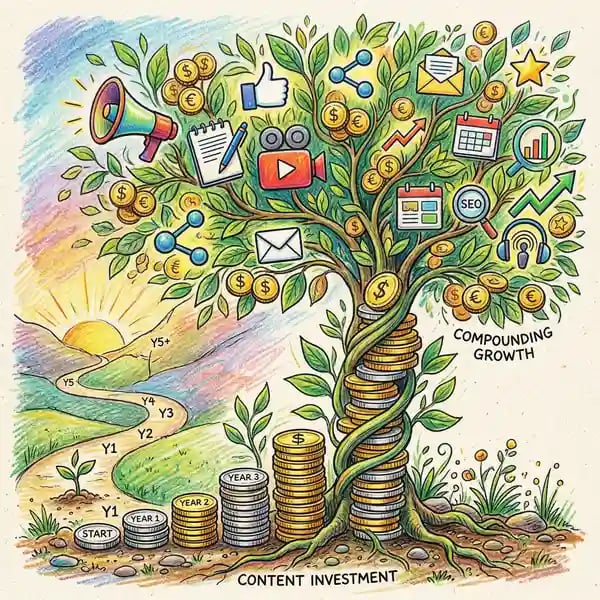
Only approximately 10% of blog posts are compounding posts where traffic increases over time rather than declining after publication. However, these compounding posts drive 38% of total website traffic. A single well-optimised evergreen article can generate leads for years.
Updating existing content is equally powerful. Refreshing old evergreen posts can increase traffic by 106%, and evergreen content typically holds top-10 rankings for two or more years before significant decline. This is why content maintenance — not just creation — is essential.
what this means
Despite organic traffic declining 12.7% in 2025 due to AI Overviews and zero-click search, revenue increased 10.9% and revenue per visitor rose approximately 27%. The visitors that do arrive are higher-intent and more valuable.
9. Dramatic Cost Efficiency vs Paid Channels
Content marketing costs 62% less than traditional outbound marketing whilst generating 3× more leads. B2B SaaS organic lead cost per lead averages £130 compared to £245 for paid channels — a 47% cost advantage that compounds as your content library grows.
Even more granular analysis shows content marketing CPL at approximately £73, PPC CPL at £143, and trade show CPL at £640. Whilst paid channels deliver faster results, the unit economics favour content investment over any meaningful time horizon.
The most effective B2B programmes do not choose between SEO and PPC — they use both strategically. Our guide to SEO costs in 2026 breaks down realistic budgets and the complementary relationship between organic and paid investment.
10. Fuel for Marketing Automation Systems
Blog content powers the entire marketing automation engine. Companies earn approximately £4.30 for every £1 invested in marketing automation over three years, with 76% seeing positive ROI within one year. But automation without content is an empty engine.
Automated nurturing produces a 451% increase in qualified leads, whilst automated emails generate 320% more revenue than non-automated communications. Nurtured leads make 47% larger purchases than non-nurtured leads, and companies excelling at nurturing generate 50% more sales-ready leads at 33% lower cost.
If you are using HubSpot (or evaluating it), our HubSpot onboarding services ensure your content strategy connects directly to automation workflows from day one.
11. Clear Attribution Your CFO Will Trust
HubSpot Marketing Hub users report an average 505% ROI over three years, with 129% more inbound leads after the first year of implementation. The real value is not in the leads themselves — it is in the attribution clarity.
Marketing Hub Enterprise provides multi-touch revenue attribution connecting blog posts, landing pages, emails, CTAs, and ads to closed-won deals. Three attribution types — contact create, deal create, and revenue attribution — with multiple models including first-touch, last-touch, W-shaped, and full-path ensure you can answer the question every CFO asks: what actually drove that revenue?
12. How to Get Started (Or Improve Your Results)
The data is clear on what works. Orbit Media's 12th Annual Blogger Survey found that the average blog post in 2025 was 1,333 words — but only 9% publish posts over 2,000 words, and 39% of those report strong results compared to the 21% benchmark. Length correlates with performance.
common pitfall
Bloggers who always conduct keyword research report strong results 32% of the time — nearly double those who skip it. Posts with seven or more images perform approximately 3× better than those with one image. And collaborative content featuring subject matter experts delivers strong results at 2× the rate of solo content.
If you are serious about building a content programme that delivers these results, start with a proper foundation. Our website audit service identifies the technical issues holding your content back, whilst our full-service approach ensures SEO, content, and marketing automation work together as a unified system.
Frequently Asked Questions
How often should a business blog for best results?
Companies posting 16 or more blog articles monthly see 3.5× more leads than those publishing fewer than four. However, quality matters more than quantity — the correlation between 2,000+ word posts and strong results is stronger than publishing frequency alone. Start with four quality posts monthly and scale from there.
What ROI can a B2B company expect from blogging?
The average B2B company achieves 748% ROI over three years from thought leadership-based SEO campaigns, with a 9-month break-even period. Industry-specific ROI ranges from 526% for professional services to 1,031% for financial services. Content marketing CPL averages £73 compared to £143 for PPC.
How long should a business blog post be?
Whilst the average blog post is 1,333 words, posts of 2,000+ words deliver significantly better results — 39% of long-form publishers report strong results versus the 21% baseline. For cornerstone content targeting competitive keywords, aim for 2,500–4,000 words with proper structure and visual elements.
How do I optimise blog content for AI search engines like ChatGPT?
Structure content with clear headings and provide direct 40–60 word answers immediately after each header. Implement Article, FAQ, and HowTo schema markup (81% of cited pages include schema). Include statistics with citations, update content every 90 days, and ensure AI crawlers (GPTBot, Google-Extended, Claude-Web, PerplexityBot) are allowed in your robots.txt.
Is blogging still worth it with AI Overviews reducing clicks?
Yes. Despite organic traffic declining 12.7% in 2025 due to AI Overviews, revenue per visitor increased 27% as remaining visitors are higher-intent. Additionally, brands cited in AI Overviews earn 35% more organic clicks. Blog content optimised for AI citation converts at 4.4× higher rates than traditional organic.
Sources: HubSpot 2026 State of Marketing, First Page Sage SEO ROI Statistics (2025), 6sense Buyer Experience Report (2025), Edelman Trust Barometer (2025), Edelman-LinkedIn B2B Thought Leadership Impact Report (2025), Orbit Media 12th Annual Blogger Survey (2025), Semrush AI Search Citation Study (2025)
Clwyd Probert
Founder, Whitehat
Clwyd Probert is the founder of Whitehat, a London-based SEO and inbound marketing agency and HubSpot Platinum Partner since 2016.
Ready to Build a Content Programme That Delivers?
Get a complimentary SEO audit that identifies your biggest content opportunities and technical blockers.