
AI Content Strategy: How to Build an AI-Powered Content Plan That Ranks (2026)
AI has fundamentally changed how content strategists work. Instead of spending weeks on research and planning, modern teams now use artificial intelligence to map keyword landscapes, identify content gaps, and generate optimised briefs in hours. This shift isn't about replacing human creativity—it's about eliminating busywork and freeing your team to focus on strategy, storytelling, and competitive differentiation.
In this guide, we'll walk you through a complete AI-powered content strategy workflow that hundreds of UK marketing teams are already using to reduce production time by 40–65%, improve topical authority, and maintain E-E-A-T across every piece of content.
Why AI-Powered Content Strategy Matters Now
The content landscape has changed dramatically. Search engines now reward content that answers entire topic clusters, not isolated keywords. Your competitors are using AI to move faster. And your audience increasingly sees AI-generated content—which means quality, authenticity, and expertise have become your only real differentiators.
A strategic content approach powered by AI gives you three immediate advantages:
Speed and scale. What used to take two weeks (keyword research, competitor analysis, brief writing) now takes two days. This means you can respond faster to market opportunities and publish more frequently without burning out your team.
Data-driven strategy. AI tools analyse hundreds of top-ranking pages in minutes, revealing exactly which subtopics, questions, and structural patterns Google rewards. You're no longer guessing—you're building strategy on what actually works.
Topical authority at scale. By mapping the full content landscape around your pillar topics and systematically filling gaps, you signal expertise to Google. Search engines notice when you cover a subject comprehensively—and reward you with better rankings and featured snippet opportunities.
The AI Content Strategy Workflow: 7 Steps
Building an AI-powered content strategy isn't chaotic. It follows a logical, repeatable workflow. Here's what it looks like:
1. AI-Powered Keyword Research and Semantic Clustering
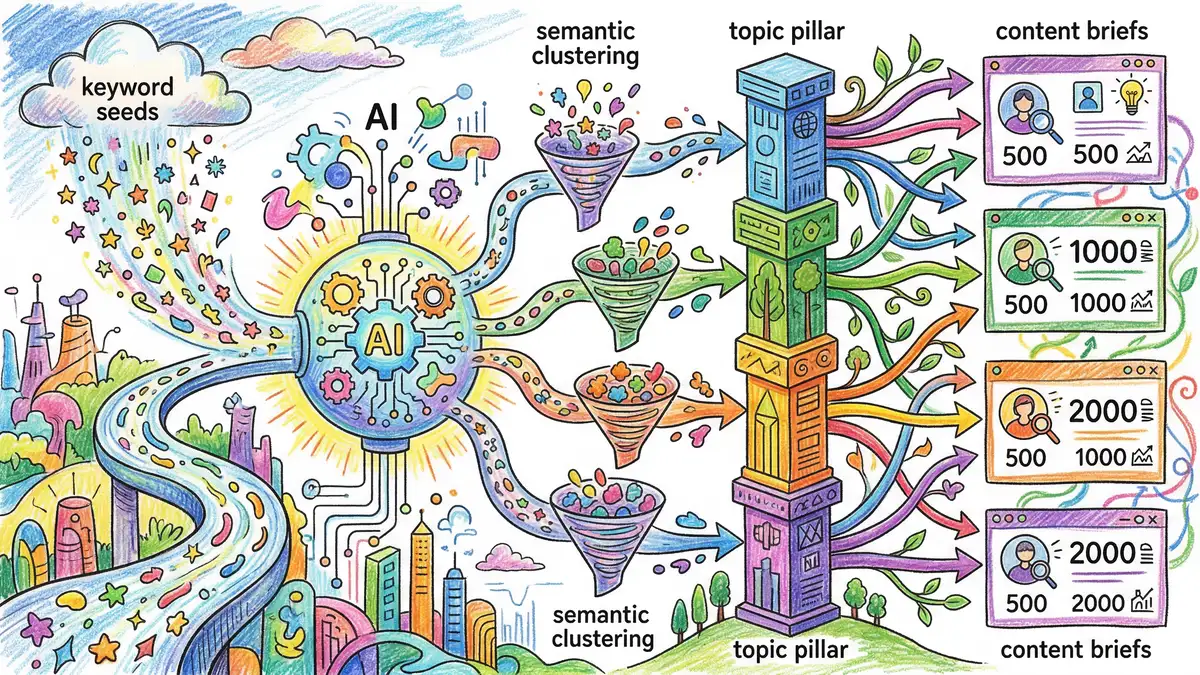
Start with your pillar topic. Use AI tools like Clearscope or MarketMuse to generate hundreds of related keywords and questions. The AI doesn't just list them—it automatically groups them into semantic clusters based on user intent and content overlap.
For example, if your pillar is "AI for SEO," the AI might cluster keywords into: "AI SEO tools," "AI keyword research," "AI content optimisation," "AI link building," and "AI analytics." Each cluster becomes a potential sub-pillar or cluster article.
This automated clustering saves weeks of manual work and reveals patterns your team might have missed. More importantly, it ensures your content roadmap is actually aligned with how your audience searches.
2. Gap Analysis and Opportunity Scoring
Next, run a content gap analysis. Tools like Surfer SEO and MarketMuse analyse your website and identify which clusters and keywords you've covered—and which ones are missing entirely. The AI scores each opportunity using three metrics:
Search volume: How many people search for this topic each month?
Keyword difficulty: How hard will it be to rank for this cluster?
Business value: Will ranking for this topic drive qualified leads or revenue?
3. AI-Generated Content Briefs
This is where the real speed-up happens. Tools like Frase and MarketMuse now generate complete content briefs automatically. The AI:
• Analyses the top 10 ranking pages for your target keyword
• Extracts common sections, subheadings, and structural patterns
• Identifies all "People Also Ask" questions your content should answer
• Recommends target word count, keyword density, and content depth
A brief that would take a human strategist 4–6 hours is now ready in 10 minutes. Your writers have a clear roadmap instead of guessing what Google wants.
4. Content Calendar Prioritisation Using AI
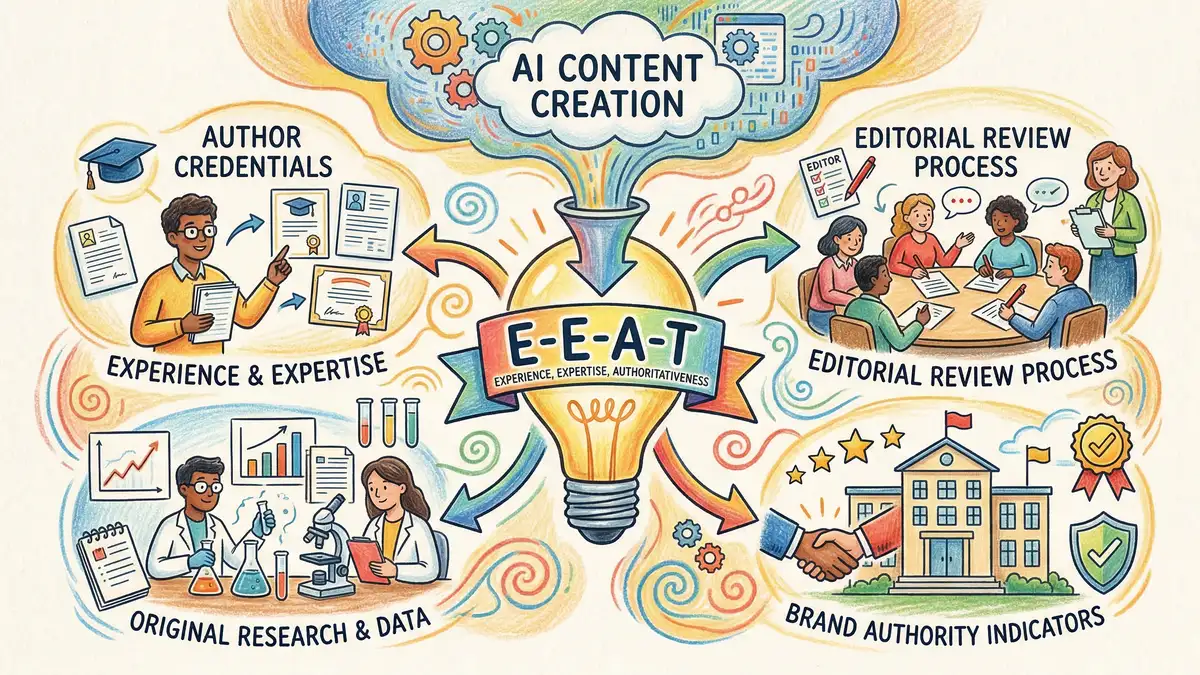
You now have 100 content opportunities ranked. Which ones should your team tackle first? AI scoring systems multiply search volume × urgency × business value to create a priority rank.
For UK marketing teams, this often means prioritising topics that align with current customer acquisition challenges and highest-value customer segments. An AI system learns your business context and adjusts recommendations accordingly.
The result: a content calendar that's driven by data, not politics or gut feeling.
5. AI-Assisted Writing and Drafting
Tools like ChatGPT and Claude can generate first drafts based on your brief. Some teams feed the AI the research, the brief, and the keyword targets—and the AI produces a 1000-word draft in seconds.
The critical insight: writers who edit AI drafts produce better content faster than writers who start from a blank page. The AI does the heavy lifting (structure, first pass, fact assembly). Your writers focus on voice, uniqueness, and expertise—the things AI can't replicate.
At Whitehat, we've found that this "human-in-the-loop" approach maintains E-E-A-T while cutting production time by 40–65%.
Key insight: AI doesn't write better than humans. But AI + humans produce better content faster than either can alone. The workflow works because it divides labour: AI handles research, structure, and drafting. Humans handle strategy, editing, and expertise.
6. On-Page Optimisation with AI
Once your draft is written, tools like Surfer SEO and Clearscope analyse it in real time. The AI checks your content against top-ranking pages and tells you exactly what's missing:
• Do you have all the subheadings that Google-ranking pages include?
• Is your word count in the optimal range?
• Have you answered all the "People Also Ask" questions?
• Are you using semantic variations of your primary keyword?
The AI gives you a score. You hit publish when you're confident it's optimised.
7. Performance Measurement and Iterative Improvement
After publishing, AI analytics platforms now track performance in real time. They tell you which sections of your content are driving clicks, which aren't, and why. This data feeds back into your content strategy:
• Did this article reach the rankings you expected?
• Which cluster articles are underperforming?
• Should you revisit this content, or double down on what's working?
Over time, your AI system learns your vertical, your audience, and your competition. Future recommendations get smarter and more accurate.
Essential AI Tools for Content Strategy (2026)
No single tool does everything. A modern content stack layers specialised tools for different workflow stages:
Research and Clustering
Clearscope generates keyword clusters and AI briefs. For UK teams, pricing starts from £449/month. MarketMuse does similar work with stronger data visualisation. Both are industry standards.
Gap Analysis and Competitive Intelligence
MarketMuse is built for content strategy. It maps your content against competitors, scores opportunities, and generates briefs. Pricing is around £599/month for smaller teams.
On-Page Optimisation
Surfer SEO and Frase both analyse your draft and tell you how to improve rankings. Surfer is stronger for technical optimisation. Frase is better for research and brief generation. Both cost £99–£199/month.
Drafting and Writing
ChatGPT (£20/month) and Claude are fast and reliable for drafting. For content teams, ChatGPT's code interpreter mode helps with data analysis. Claude excels at complex writing tasks and maintains consistency across long documents.
A typical UK content team budgets £1,500–£2,500/month across this stack. The ROI is immediate: if AI saves your team 20 hours per week, you're paying for the tools in reduced labour costs alone.
Building Topical Authority with AI-Driven Pillar-and-Cluster Architecture
Google doesn't rank individual keywords anymore. It ranks comprehensive topics. A pillar-and-cluster content architecture signals to Google that you're the authoritative source on an entire subject area.
Here's how AI accelerates this:
1. AI topic modelling. Feed your pillar topic into MarketMuse or Clearscope. The AI maps every subtopic, question, and content angle that experts and searchers associate with your pillar. You see the full landscape before you plan anything.
2. Cluster priority scoring. Not all clusters are equal. AI scores them by: search volume, competition, relevance to your business, and synergy with other clusters. You prioritise high-impact clusters first.
3. Semantic linking recommendations. When you publish a cluster article, AI tools automatically suggest which pillar articles it should link to—and which internal links would strengthen your topical authority. This creates a web of connections that Google recognises as expertise.
4. Authority measurement. Over time, AI analytics tell you: "You're 78% complete on this pillar topic. The missing 22% are these clusters." You know exactly what to build next to solidify your authority.
Ready to Build Your AI-Powered Content Strategy?
Whitehat's content strategists work with UK marketing teams to build pillar-and-cluster architectures that dominate Google. We handle research, architecture, and strategy—so your team can focus on writing and performance.
Explore Our AI Content Strategy ServicesMaintaining E-E-A-T in an AI-Driven Content Strategy
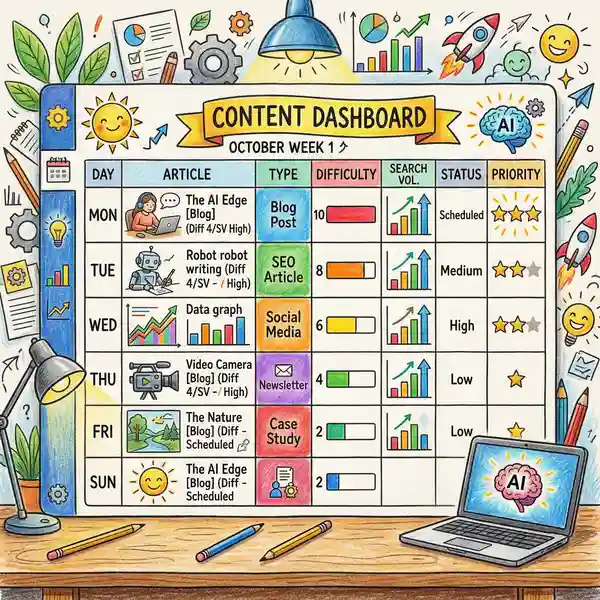
The biggest risk with AI content tools: your content becomes indistinguishable from competitors' AI content. Google can't (and shouldn't) penalise AI-written content. But it will reward content that demonstrates genuine expertise, real-world experience, and unique perspective.
Here's how to maintain E-E-A-T when using AI:
Expertise: AI as Accelerator, Humans as Differentiators
Use AI to speed up research and drafting. But ensure every article includes:
• Original data, case studies, or proprietary research
• Real-world examples from your industry or experience
• Author bylines with credentials and professional background
• A distinct voice and perspective that only your team can provide
Experience: Show Your Track Record
Link to your case studies, client testimonials, and published results. If you're writing about "AI for SEO," link to your own AI SEO projects and results. This proves you've actually implemented the advice you're giving.
Authoritativeness: Build Your Brand as the Expert
Quote industry experts (with attribution). Link to academic research. Cite original sources, not derivative content. Build your About page with author credentials. Make it obvious that your team knows what they're talking about.
Trustworthiness: Be Transparent About AI Use
You don't need to disclose that you used ChatGPT. But you should make it clear that your content is fact-checked, sourced, and verified. Include citations. Link to original research. Show your sources. Trustworthiness isn't about hiding AI—it's about proving your content is accurate and well-researched, regardless of your tools.
AI Content Strategy and AEO: Preparing for AI-Generated Search Results
Google's AI Overviews (formerly SGE) summarise search results directly in the SERP. Your content may appear in that AI-generated summary without any click-through.
So what does this mean for your AI content strategy? Structure matters more than ever.
Use semantic HTML. Use proper H2, H3, and list tags. Use <blockquote> for key quotes. Use <table> for data. Google's AI extracts from well-structured content more accurately.
Answer immediately. Front-load your most important insight. Don't bury the answer in paragraph 3. AI Overviews extract the highest-quality, clearest answers—so make your first paragraph do the heavy lifting.
Include original data. AI Overviews can't cite content it can't understand. When you include original statistics, proprietary research, or unique analysis, Google's AI has to link to your page for full context.
Optimise for featured snippets. Content that ranks in featured snippets ranks better in AI Overviews. So follow featured snippet best practices: clear definitions, tables, numbered lists, and concise answers.
At Whitehat, we've seen that AI content strategies built with AEO in mind outperform those that don't. It's not complicated—it's just discipline about structure and clarity.
Measuring Content Strategy Success with AI Analytics
Traditional content metrics (pageviews, time on page) don't tell you whether your content strategy is actually working. AI-powered analytics go deeper.
Track Topical Authority Growth
Tools like Semrush and Ahrefs now show your "topical authority score" for each pillar. You can measure: "3 months ago, we were 40% complete on the 'AI SEO' pillar. Today, we're 78% complete." This metric directly correlates with ranking improvements and organic traffic growth.
Monitor AI Overview Mentions
Set up alerts for when your content appears in Google's AI Overviews. Track which articles are cited (and how often). This tells you which content Google's AI finds most authoritative.
Analyse Content Performance by Cluster
Don't just look at which articles rank. Look at: "How many keywords in the 'AI Tools' cluster are ranking?" "What's the average ranking position?" "Is our topical authority in this cluster improving?" This data tells you where to invest next.
Measure Content ROI by Business Value
Not all traffic is equal. Content that drives qualified leads is more valuable than content that drives curious browsers. Use your CRM and analytics to measure: "Which content clusters are driving the most high-value leads?" Over time, you optimise your content strategy to prioritise clusters that deliver business results, not just traffic.
AI-Powered Content Strategy Delivers Real Results
Common Mistakes When Building AI-Powered Content Strategies
1. Using AI Without a Strategy
The biggest mistake: firing up ChatGPT and asking it to write 50 articles without any keyword research, gap analysis, or prioritisation. The result: 50 mediocre pieces that rank nowhere and drive no business value.
The fix: Start with strategy (keyword research, gap analysis, clustering). Then use AI to execute. Strategy first, AI second.
2. Not Editing AI Output
Publishing AI drafts without human review is a recipe for factual errors, inconsistent voice, and low E-E-A-T signals. AI drafts are starting points, not finished products.
The fix: Always assign a senior writer to review, fact-check, and refine AI drafts. Budget 2–3 hours of editing per 2,000-word article.
3. Ignoring Internal Links and Topical Authority
Publishing articles in isolation defeats the purpose. Your pillar-and-cluster architecture only works if you link strategically.
The fix: Use AI tools to recommend internal links. Map your linking strategy before you publish. Make sure every cluster article links back to the pillar. Make sure the pillar links to every cluster.
4. Over-Relying on AI Scoring Without Business Context
AI tools rank opportunities by search volume × difficulty. But that doesn't mean they're right for your business. Maybe a lower-volume, high-intent keyword drives more qualified leads.
The fix: Use AI scores as a starting point, not the final word. Always apply business logic. Prioritise content that aligns with your sales funnel, customer problems, and revenue goals.
FAQ: AI Content Strategy Questions
Can AI write SEO content that actually ranks?
Yes, but only if the AI is guided by proper strategy. AI writing tools produce content faster, but they don't replace strategic thinking. If you feed an AI tool a good brief (backed by keyword research and competitive analysis), the output is usually solid. If you ask AI to write random articles with no strategy, you'll get mediocre content that doesn't rank. Strategy drives results. AI accelerates execution.
Is AI-generated content bad for SEO?
Google doesn't penalise AI-written content. It penalises low-quality content, regardless of how it was written. An AI-written article that's well-researched, accurate, and useful will rank better than a human-written piece that's thin and unhelpful. The tool doesn't matter. Quality and usefulness matter.
Should I disclose that my content was written by AI?
Not necessarily. You're not required to. But you should be transparent about your sources and fact-checking process. If you cite research, link to it. If you reference data, show where it came from. Trustworthiness comes from transparency about sourcing, not disclosure of tools. That said, many publishers now include author bios that mention AI assistance. It's becoming standard practice, and it doesn't hurt rankings.
What's the fastest way to build a pillar-and-cluster content structure with AI?
Use MarketMuse or Clearscope to map your pillar topic (1–2 days). This gives you 30–50 cluster opportunities. Score them by search volume, difficulty, and business value (1 day). Generate briefs for your top 10 clusters (1 day). Publish your pillar article + 5 cluster articles month 1 (3–4 weeks with an experienced writer). Then add 2–3 clusters per month until you're complete. A typical pillar-and-cluster build takes 4–6 months for a broad topic with 40–50 pieces. But you're publishing content the entire time, so you're ranking and driving traffic while you build.
How do I know if my AI content strategy is working?
Track three metrics: (1) Topical authority score (% complete on your pillar). This should improve by 5–10% per month. (2) Organic traffic to cluster pages. This should show consistent month-over-month growth. (3) Rankings for target keywords. You should see positions improve from outside the top 100 to top 50 within 3 months, and top 10 within 6 months. If you're not seeing movement after 3 months, the issue is usually strategy (wrong keywords, poor briefs) rather than execution.
Can I run an AI content strategy solo, or do I need a team?
You can start alone, but scale requires a team. One person can manage research, strategy, and output. But AI still needs editing, fact-checking, and human quality control. A single strategist can publish 4–6 AI-assisted articles per month with solid quality. A team of 2–3 (strategist + 2 writers) can publish 15–20 per month. For fast scaling, you need people: ideally a strategist for planning and a writer or two for production.
Build Your AI-Powered Content Strategy Today
Whitehat has helped UK brands build topical authority using AI-driven strategies. We research your landscape, architect your pillar-and-cluster structure, and help your team execute with speed and quality.
Sources: MarketMuse 2025 Content Strategy Benchmark Report; Clearscope Research on Content Production Efficiency; Google Search Central guidance on topical authority and E-E-A-T; HubSpot Research on AI Adoption in Content Marketing Teams (2025–2026).