
Video now dominates B2B marketing with 91% of businesses using it as a core tool and 93% of marketers reporting the strongest ROI ever recorded. For B2B organisations, video has become non-negotiable: 95% of buyers say video is important in purchase decisions, whilst companies using video grow revenue 49% faster than those that don't.
Key Takeaway
93% of marketers report positive ROI from video marketing—the highest figure ever recorded
82% of consumer internet traffic is now video content
41% of video marketers now use AI tools (up from 18% in 2023)
Landing pages with video convert up to 86% better than those without
75% of all video viewing happens on mobile devices
Whitehat's analysis of the latest research reveals how AI-generated video adoption has jumped from 18% to 41% in just two years, why vertical-first formats have become the default, and what this means for your marketing strategy.
Video Consumption Has Reached Unprecedented Levels
82%
Internet Traffic Is Video
Average person watches 17 hours of online video per week
34h 56m
Monthly TikTok Usage
YouTube users average 27 hours 10 minutes monthly
70B
Daily YouTube Shorts Views
5.91% engagement rate—highest among short-form platforms
The shift towards short-form is decisive: 78% of consumers prefer watching short videos when learning about products, compared to just 9% who prefer text articles. Meanwhile, 96% of people have watched an explainer video to learn about a product or service, and 85% have been convinced to buy after watching a video.
The data confirms that video isn't optional—it's where your audience spends their time and makes purchasing decisions. If you're not integrating video into your inbound marketing strategy, you're missing the primary channel for B2B engagement.
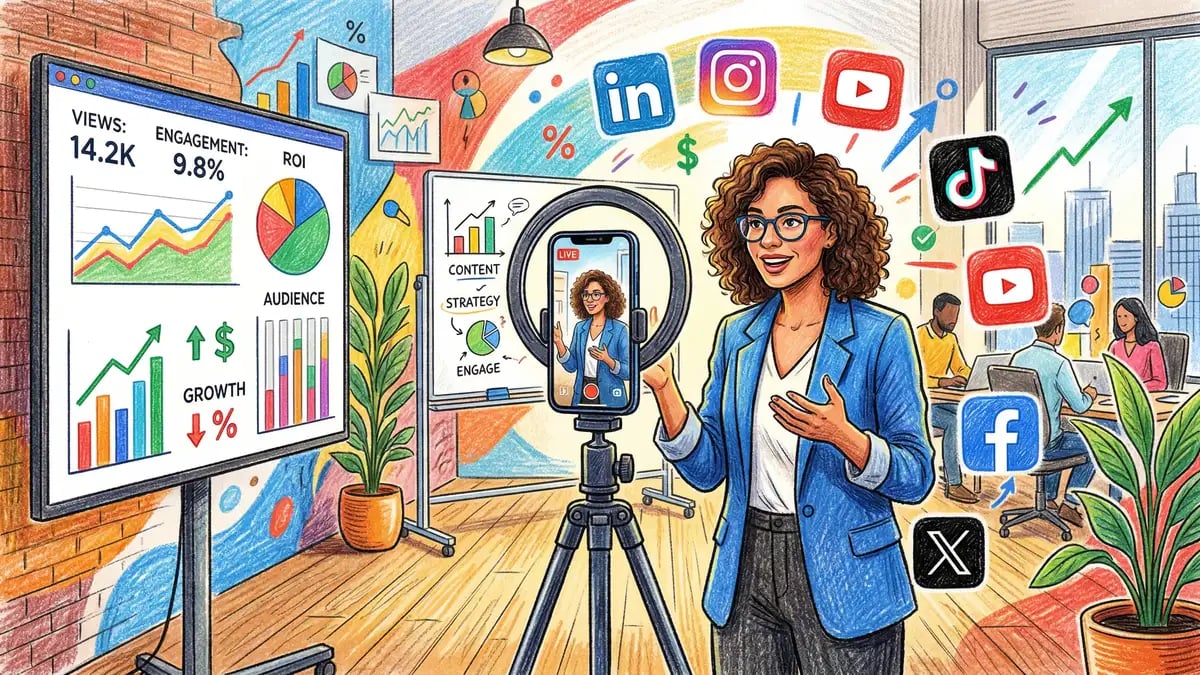
B2B Video Marketing Delivers Exceptional Results
B2B buyers have fundamentally changed how they research and purchase. According to Wyzowl's research, 70% of B2B buyers watch video content during their purchase journey, with 50% preferring video over text formats like whitepapers. B2B video content achieves 1,200% higher engagement than text and images combined.
The business impact is measurable and significant — for a comprehensive breakdown of the latest data, see our video marketing benchmarks for 2026. Wistia's 2024 State of Video Report found that 87% of B2B marketers actively use video in their strategies, with 74% reporting that videos convert better than other content types. LinkedIn has emerged as a critical channel, with 97% of B2B marketers using it for content marketing and 65% of B2B companies having gained customers directly through LinkedIn video.
| Metric | Statistic | Source |
|---|---|---|
| B2B buyers watching video | 70% | Wyzowl |
| Video vs text/image engagement | 1,200% higher | Industry research |
| LinkedIn video sharing | 20x more likely | |
| Video testimonial conversion lift | 80–86% | Wistia |
| Video-equipped sales email opens | +16% open rate | HubSpot |
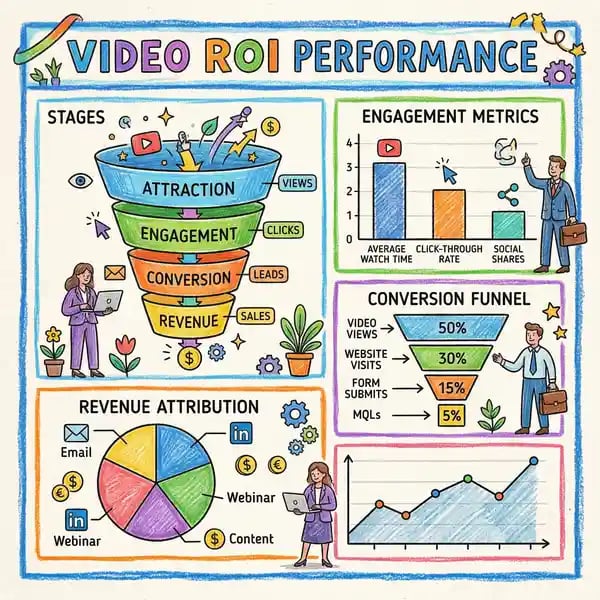
Video Dramatically Boosts Email and Landing Page Performance
Adding video to email campaigns produces some of the most dramatic performance improvements in digital marketing. Including 'video' in email subject lines increases open rates by 7%, whilst embedding video in emails boosts click-through rates by 200–300%. Yet only 23% of marketers currently use video in emails—representing a significant competitive opportunity.
Landing pages with video convert up to 86% better than those without. Interactive product videos specifically boost conversion by up to 70%. Pages with video keep visitors engaged significantly longer, and video testimonials outperform text equivalents by 80–86% in conversion impact. For HubSpot users, the native video capabilities through the Vidyard partnership enable direct tracking of these metrics in contact records and workflow automation.
Want to integrate video into your HubSpot marketing engine?
Discuss Your Video StrategySocial Media Video Benchmarks by Platform
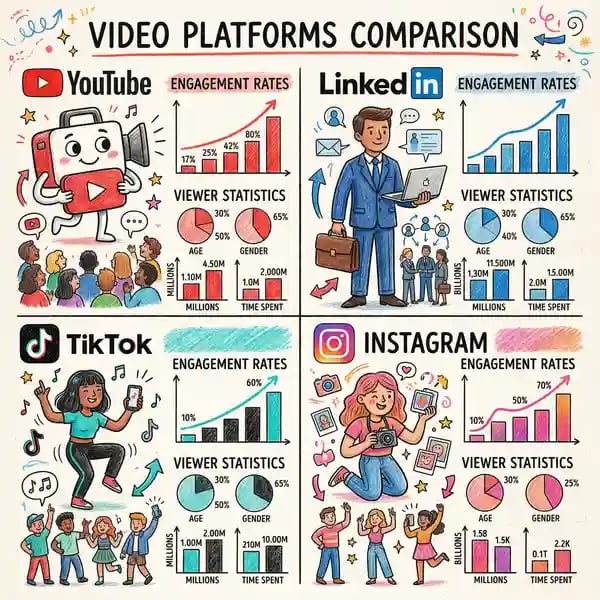
YouTube remains the dominant platform for video marketers, with 82% actively using it and 69% reporting effectiveness — our YouTube marketing guide for B2B covers channel setup and strategy in depth. YouTube Shorts engagement has risen from 3.95% in January 2024 to 4.71% in January 2025, signalling growing momentum for short-form content.
LinkedIn video is experiencing rapid growth with a 34% year-on-year increase in video uploads in Q4 2024 and 36% growth in video viewership in 2025. Notably, 97% of LinkedIn videos are now vertical, and 78% are shot on smartphones. LinkedIn users are 20x more likely to share video than other post types.
| Platform | Marketer Usage | Effectiveness | Key Engagement Stat |
|---|---|---|---|
| YouTube | 82% | 69% | 5.91% Shorts engagement |
| 70% | 50% | 20x more likely to share | |
| 69% | 56% | 1/3 of usage is Reels | |
| 66% | 55% | 6x engagement for Live | |
| TikTok | 40% | 29% | 4.64–4.9% avg engagement |
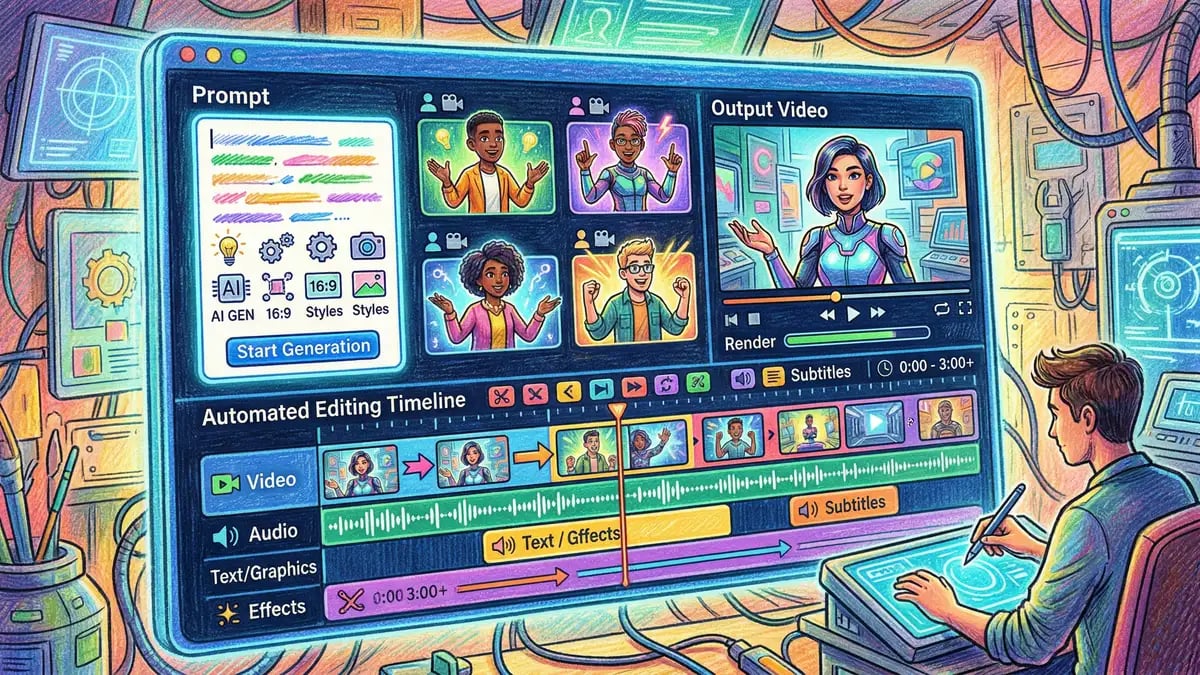
AI Video Creation Has Reached an Inflection Point
AI adoption for video has accelerated dramatically, with 63% of video marketers now using AI tools to create or edit videos—up from 51% in 2024 and just 18% in 2023. By 2026, 75% of marketing videos are projected to be AI-generated or AI-assisted, fundamentally changing production economics and speed.
Wistia's 2025 State of Video Report confirms this shift: 41% of video marketers now use AI tools, with 19% planning to start soon. Auto-generating captions has become the most common AI use case at 59% adoption, followed by translation into multiple languages at over 30%. The cost implications are substantial: AI video tools can reduce production costs by 97–99% for simple projects.
Watch Out
AI video tools can reduce production costs by 97–99% for simple projects, but auto-generated captions alone are insufficient per WCAG standards and require human review. The European Accessibility Act takes effect 28 June 2025, requiring WCAG 2.1 compliance. Captions must achieve 99%+ accuracy for pre-recorded content.
Short-Form Dominates Engagement, Long-Form Converts
Short-form video has become the number one content format used by marketers, with 30% of both B2B and B2C marketers leveraging it as their primary format. Videos under 60 seconds maintain 82% engagement rates compared to just 61% for videos over two minutes. 71% of marketers believe videos between 30–60 seconds deliver the best ROI.
However, the conversion story is more nuanced. Wistia's analysis of 90+ million videos reveals that 30–60 minute videos actually have the highest conversion rates, with lead generation forms at the end of 60+ minute videos achieving a remarkable 65% conversion rate. For shorter content, forms placed in the third quarter of 1–3 minute videos convert at 58%.
The strategic implication: use short-form video for awareness, engagement, and social reach. Deploy long-form content—webinars, detailed tutorials, original series—when conversion is the primary goal. Our video marketing funnel guide maps the right format to each stage of the B2B buyer journey. Remember that 67% of mobile viewers swipe away if a video doesn't engage them within the first three seconds.
Vertical Video and Mobile-First Formats Are Now Mandatory
Vertical-first video formats have become the default for 67% of mobile campaigns. Vertical videos generate 58% higher engagement on mobile than horizontal formats, and viewers watch 76% of vertical videos to completion compared to just 49% for horizontal.
A striking 85% of mobile videos are viewed without sound, making captions essential rather than optional. Content designed for silent viewing is 70% more likely to be watched completely on LinkedIn. For more actionable production and post-production advice, see our video marketing tips playbook. Wistia reports that vertical HD uploads (1080×1920) saw 51% more uploads than the previous year.
Video SEO Requires Schema Markup and Platform Optimisation
Video schema markup has become essential for search visibility, yet only 18% of organisations implement it despite 72.8% of first-page results including structured data. YouTube SEO fundamentals remain critical: titles under 60 characters with front-loaded keywords, descriptions of 200–300 words with natural keyword inclusion, and chapters with timestamps.
Short-form videos have tripled in visibility in mobile search results, growing from 5% to 15% according to Semrush. Video transcripts make content crawlable by search engines. Caption usage has increased 572% since 2021 per Wistia data—beneficial for both accessibility and SEO.
Measuring Video ROI Requires Attribution Integration
The primary video KPIs tracked by marketers include engagement rate (60%), conversion rate, play rate, view count, and total watch time. Wistia's analysis shows video viewers are approximately 70% more likely to convert than non-viewers.
For HubSpot users, the Vidyard integration enables contact-level video tracking with percentage watched (25%, 50%, 75%, 100%), workflow enrolment triggers, and lead scoring. Companies implementing closed-loop attribution see 15–18% lift in revenue.
The Bottom Line
Adopt AI video tools now—the 63% adoption rate and 97–99% cost reduction make AI-assisted production a competitive necessity
Optimise for mobile-first vertical formats—with 75% of viewing on mobile and 58% higher engagement, horizontal-first thinking is obsolete
Implement attribution infrastructure—the Vidyard-HubSpot integration enables contact-level tracking that connects video views to closed revenue. Read our full B2B video marketing pillar guide for the complete strategy framework
Frequently Asked Questions
What is the ROI of video marketing in 2025?
93% of video marketers report positive ROI—the highest figure ever recorded. Companies using video grow revenue 49% faster, and adding video to landing pages can boost conversion rates by up to 86%.
How long should B2B marketing videos be?
For LinkedIn, 30–90 seconds works best with under 60 seconds achieving 200% better completion. For webinars, 30–60 minutes have the highest conversion rates. YouTube long-form content performs best at 7–15 minutes.
How are AI tools changing video marketing?
AI adoption has jumped from 18% in 2023 to 41% in 2025. Common uses include auto-generating captions (59%), translations (30%+), and script generation. AI tools can reduce production costs by 97–99% for simple projects.
Why is vertical video important for B2B marketing?
With 75% of video viewing on mobile and users holding phones vertically 94% of the time, vertical videos generate 58% higher engagement and 76% completion rates versus 49% for horizontal.
How can HubSpot users track video marketing performance?
HubSpot's Vidyard integration enables contact-level tracking with engagement percentages, workflow triggers, and lead scoring. Video events sync to contact timelines for revenue attribution reports.
Sources: Wistia State of Video 2025 · HubSpot Video Marketing Statistics · Wyzowl Video Marketing Statistics 2025 · HubSpot State of Video 2024 · HubSpot Marketing Statistics 2025
Clwyd Probert
Founder, Whitehat SEO
Clwyd Probert is the founder of Whitehat, a London-based SEO and inbound marketing agency and HubSpot Platinum Partner since 2016. He is a guest lecturer at UCL and runs the world's largest HubSpot User Group.
Ready to Transform Your Video Marketing Strategy?
Whitehat helps B2B companies integrate video into their HubSpot-powered marketing engines. From strategy to attribution, we ensure every video drives measurable pipeline.