
Key Takeaways
- The first 5 seconds determine whether your video gets watched — lead with the problem or outcome, not your logo or company introduction.
- Custom thumbnails increase click-through rates by 20–30%, and 89% of top-performing YouTube videos use them rather than auto-generated frames.
- Authenticity outperforms production polish in 2026 — UGC-style videos, team Q&As, and behind-the-scenes content generate stronger engagement than corporate productions.
- Every video needs captions: 92% of viewers watch with sound off, and captions boost retention even when sound is on.
- Repurpose every long-form video into 3–5 short-form clips — short-form content delivers 19% higher lead generation at the awareness stage.
The most effective B2B video marketing tips for 2026 focus on three fundamentals: hook viewers in the first five seconds, prioritise authenticity over production polish, and optimise every video for silent viewing with captions and strong visuals. These aren't theoretical recommendations — they are backed by data showing that 97% of marketers report video helps increase sales (Wyzowl, 2025), and that video retains 95% of messaging compared to just 10% for text. When Whitehat implements video strategies for B2B clients, these practical tips consistently separate videos that generate pipeline from those that collect dust.
This guide provides a practical playbook — not theory, but the specific actions that improve video performance at every stage from planning through distribution. Whether you are producing your first B2B video or optimising an existing library, these tips apply immediately.
5 sec
Hook Window
Time to capture or lose your viewer
20–30%
Thumbnail CTR Boost
Custom vs auto-generated thumbnails
92%
Watch Without Sound
Captions are mandatory, not optional
95%
Message Retention
Video vs 10% for text-only content
Pre-Production: Planning Tips That Save Time and Budget
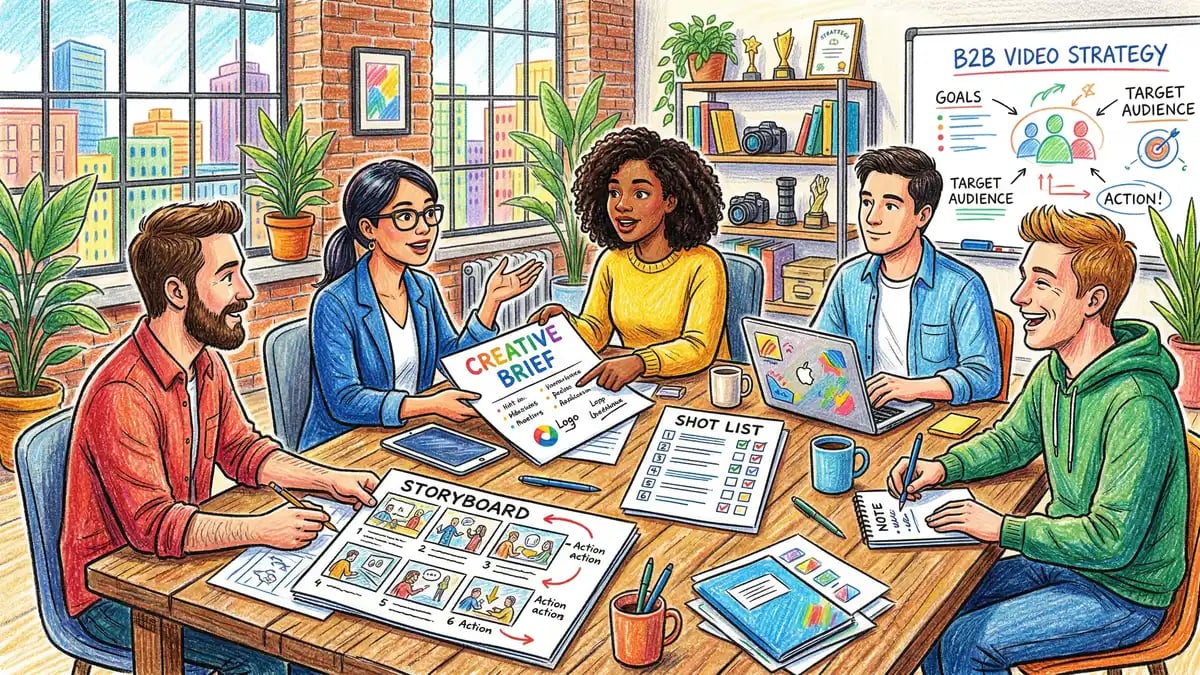
Pre-production is where most B2B video projects succeed or fail. Rushing into filming without proper planning leads to expensive reshoots, unfocused messaging, and videos that sit unwatched. The best B2B video marketing tip is deceptively simple: define your single objective before anything else. Every video should answer one question for one audience with one clear next step.
Write Scripts With a 5-Second Hook
The first five seconds of your video determine whether it gets watched. Lead with the problem or the outcome — never with your company logo, a generic introduction, or ambient footage. A strong hook pattern for B2B: "If [audience pain point], here's what most companies get wrong..." This immediately signals relevance and creates curiosity.
Script every video, even informal ones. A script does not mean reading from a teleprompter — it means having clear talking points, a defined structure, and a planned CTA. For a 60-second awareness video, your script should be approximately 150 words. For a 3-minute consideration video, target 450 words. The tighter your script, the more confident and natural the delivery.
Match Length to Purpose
| Video Purpose | Target Length | Script Length | Planning Tip |
|---|---|---|---|
| Social awareness clip | 15–30 seconds | 40–75 words | One statistic, one insight, one CTA. Film vertically. |
| Thought leadership | 60–90 seconds | 150–225 words | Share a contrarian view. Authenticity over polish. |
| Product walkthrough | 3–8 minutes | 450–1,200 words | Use screen recordings with voiceover. Plan chapters. |
| Webinar / deep-dive | 20–45 minutes | Outline + slides | Plan for repurposing: mark 3–5 clip-worthy moments. |
Source: Vidyard Video Benchmarks 2025, Wyzowl 2025
Production: Filming Tips for B2B Video
The most important B2B video production tip for 2026 is counterintuitive: authenticity outperforms production polish. UGC-style videos, team Q&As, and behind-the-scenes content now generate stronger engagement than highly polished corporate productions. Buyers want to see real people with genuine expertise, not actors reading scripts in front of green screens.
This does not mean production quality is irrelevant. Clear audio and stable video are non-negotiable — poor sound quality is the number one reason viewers stop watching. The distinction is between necessary quality (good audio, adequate lighting, steady camera) and unnecessary polish (cinematic transitions, drone shots, motion graphics for every statistic).

Essential Production Checklist
- Audio first: Invest in a quality lapel microphone (£30–100) before investing in camera upgrades. Record in a quiet space with soft surfaces to reduce echo. Test audio playback before starting any session.
- Lighting basics: Face the window for natural light, or use a simple ring light. Avoid overhead fluorescent lighting, which creates unflattering shadows. Two-point lighting (key light + fill) is sufficient for 90% of B2B video.
- Stable footage: Use a tripod or phone mount. Handheld footage is acceptable for behind-the-scenes content but distracting for talking-head videos. A £20 smartphone tripod eliminates most stability issues.
- Background matters: A tidy, branded background with one or two interesting objects creates a professional look without requiring a studio. Blurred backgrounds (available on most video conferencing tools) work for remote recordings.
- Film vertically for social, horizontally for everything else: If you know the primary distribution channel, film in the correct orientation from the start. Cropping horizontal to vertical always loses quality and framing.
For screen recordings and product walkthroughs, use dedicated tools like Loom, Vidyard, or OBS Studio. Record at 1080p minimum. Plan your screen layout before recording — close unnecessary tabs, increase font sizes, and use a clean desktop background. These small details project professionalism without expensive equipment.
Need help integrating video into your broader B2B marketing strategy? Whitehat builds inbound marketing systems that connect video content to pipeline through HubSpot — from planning to attribution.
Explore B2B Marketing ServicesPost-Production: Editing and Optimisation Tips
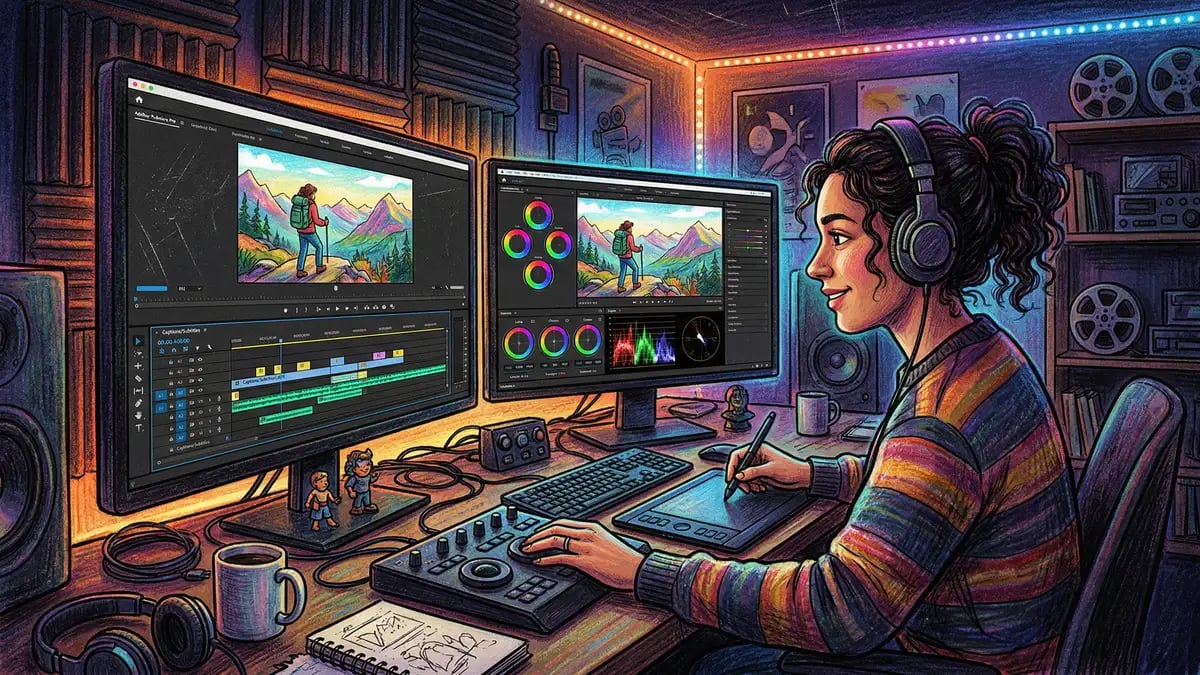
Post-production is where good footage becomes a high-performing asset. The editing process is not just about cutting footage — it is about optimising every element for engagement, discoverability, and conversion. Three post-production actions consistently move performance metrics: captions, thumbnails, and SEO metadata.
Add Captions to Every Video
92% of video viewers watch with sound off. This single statistic makes captions the highest-impact post-production action you can take. But captions serve a dual purpose — even when viewers have sound enabled, 50% still use captions for improved comprehension. Burn captions directly into the video file rather than relying on platform auto-captions, which remain unreliable for technical B2B terminology. AI captioning tools like Descript, CapCut, or Subtitle Edit can generate initial captions, but always review for accuracy on industry-specific terms.
Design Custom Thumbnails
Custom thumbnails increase click-through rates by 20–30% compared to auto-generated frames. Research from YouTube Creator Academy shows that 89% of top-performing videos use custom thumbnails, and thumbnails featuring real human faces generate an average of 921,000 more views than alternatives. Design thumbnails at 1280×720 pixels (16:9 ratio), keep any text under 12 characters, and use high-contrast colours that stand out against platform backgrounds.
Optimise for Search and AI Discovery
Video SEO extends beyond YouTube. Every video published on your website should include a full transcript (for crawlability), descriptive file names, and VideoObject schema markup. For YouTube specifically, optimise your title with your target keyword in the first 60 characters, write descriptions of 200+ words with relevant keywords, and add chapters with timestamps. These practices improve both traditional search visibility and AI answer engine citation — for a deeper dive on video SEO, see our video marketing and SEO guide.
Source: YouTube Creator Academy 2025, HubSpot Marketing Statistics 2025
Distribution: Getting Your Videos Seen
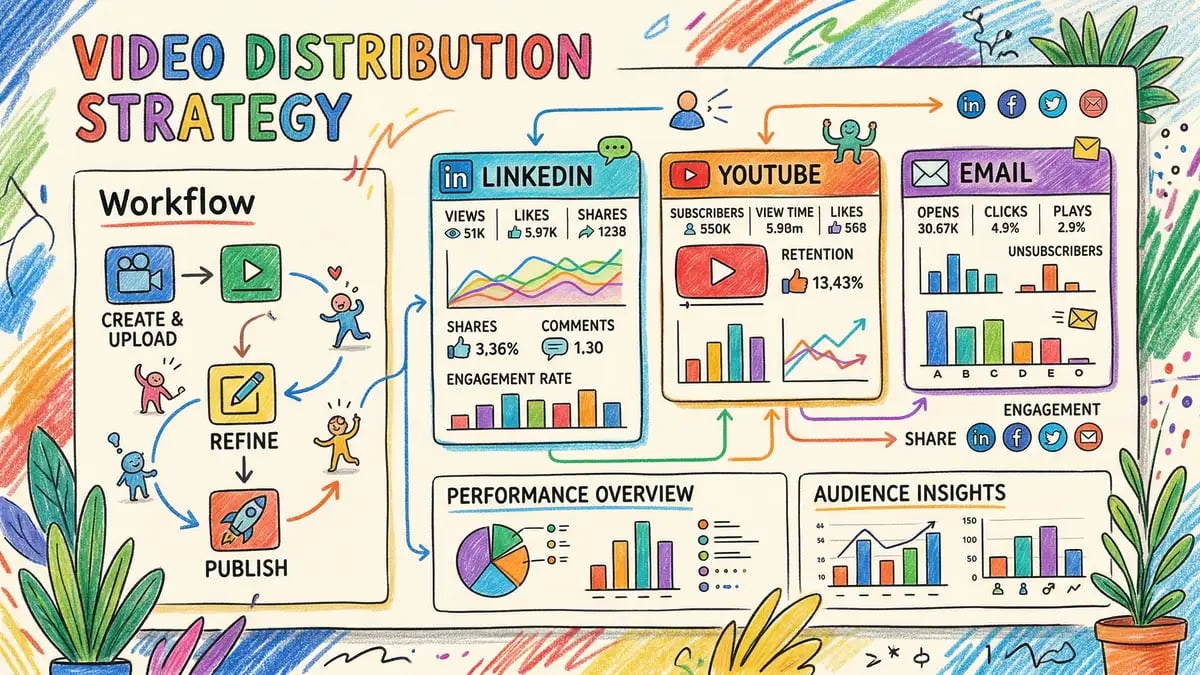
Producing a great video is half the work. Distribution is the other half — and where most B2B video strategies underperform. The core distribution principle for 2026: never publish once and hope. Every video should be distributed across at least three channels in format-appropriate versions.
Repurpose Every Long-Form Video
Every webinar, product demo, or long-form video should generate 3–5 short-form clips for social distribution. Short-form content delivers 19% higher lead generation at the awareness stage than long-form, and AI editing tools now make repurposing fast and cost-effective — reducing content production costs by approximately 27%. The repurposing workflow: identify the 3–5 most insight-dense moments during planning (mark timestamps), extract clips at the correct orientation, add captions, and distribute with unique copy for each platform.
Platform-Specific Distribution Tips
- Upload native video — never share YouTube links
- Post Tuesday–Thursday, 08:00–10:00 UK time
- Keep to 30–90 seconds for feed videos
- Start with text hook before the video plays
YouTube
- Optimise titles with target keyword first
- Add chapters with timestamps to all videos
- Write 200+ word descriptions with links
- Use custom thumbnails with faces
Your Website
- Embed with HubSpot video or Vidyard for tracking
- Add full transcript below video for SEO
- Include VideoObject schema markup
- Place contextual CTA within and below video
Email Distribution
Video in email campaigns boosts engagement significantly — pages with video see 82–88% more time spent on page. However, most email clients do not support embedded video playback. The best practice: include a custom thumbnail image linked to the video landing page, with the word "Video" in the subject line. According to HubSpot research, including "video" in email subject lines can increase open rates by 6%.
Performance: Tips for Measuring and Improving Results
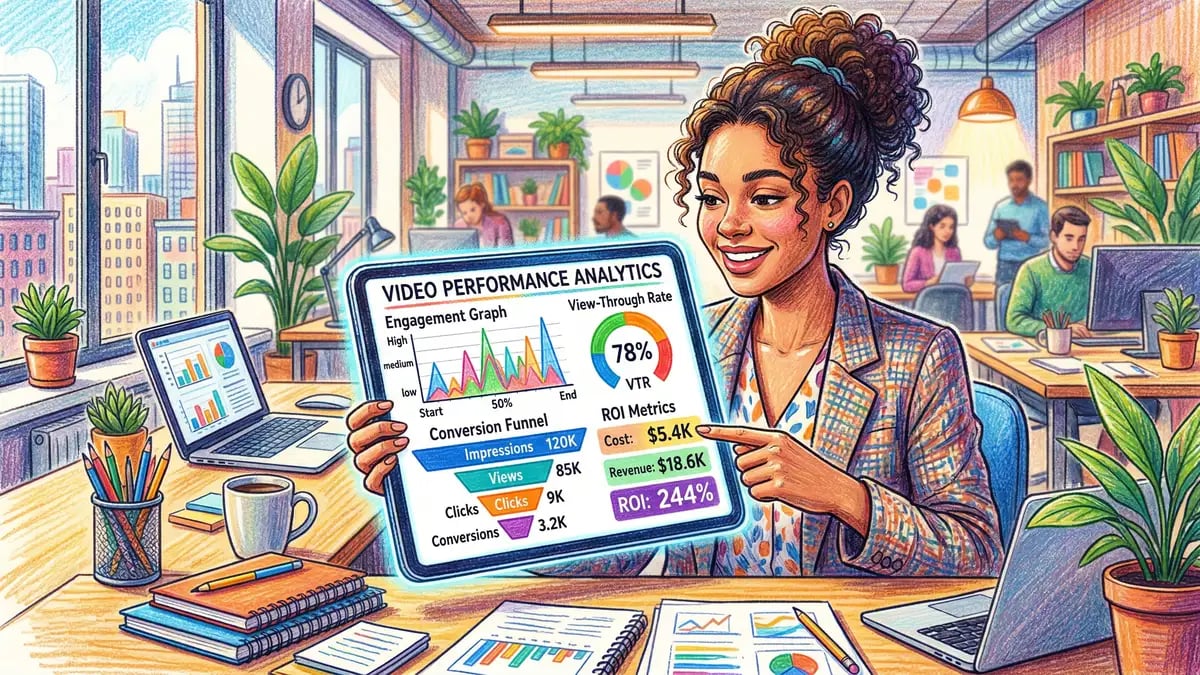
The final category of video marketing tips addresses the feedback loop — how to measure what is working, identify what is not, and systematically improve over time. Without measurement, you are guessing. With the right metrics, you can double down on winners and cut underperformers quickly.
Track the Right Metrics by Video Type
| Video Type | Primary Metric | Secondary Metric | What "Good" Looks Like |
|---|---|---|---|
| Social awareness clips | View count + shares | Profile visits | 1%+ engagement rate |
| Thought leadership | Watch time + completion | Comments + saves | 40%+ completion rate |
| Product walkthroughs | Demo requests | Watch % + drop-off points | 2–5% viewer-to-demo conversion |
| Testimonials | Influenced pipeline | CTA clicks | Appears in 30%+ of won deals |
A/B Test Systematically
61% of marketers plan to increase investment in their top-performing video formats — but identifying those top performers requires systematic testing. Start with thumbnails and titles, which have the largest impact on initial click-through. Then test hooks (first 5 seconds), CTAs (placement and wording), and video length. Change one variable at a time, run each test for at least two weeks, and track the impact on your primary metric for that video type.
AI-driven personalisation is emerging as a powerful optimisation lever. Early data suggests 72% higher engagement with personalised video content — where viewer name, company, or industry is dynamically inserted. Tools like Vidyard and HippoVideo enable this at scale, but even simple personalisation (mentioning the viewer's industry in the opening) makes a measurable difference.
For a comprehensive view of video marketing performance data and ROI benchmarks, our B2B video marketing statistics and benchmarks guide provides the numbers you need to set realistic targets and measure progress. And for a strategic framework on which videos to create first, see our video marketing funnel guide.
Source: Wyzowl 2025, Vidyard 2025
Frequently Asked Questions
What is the most important video marketing tip for B2B?
The single most impactful tip is to nail the first five seconds of every video. Lead with the problem or outcome — never with your logo or a generic introduction. This five-second hook determines whether the rest of your video gets watched, regardless of how good the content that follows is.
How much should a B2B company spend on video marketing?
Budget depends on format. AI-assisted and in-house production (thought leadership, screen recordings, social clips) costs £500–£2,000 per video. Professional production (case studies, product demos) ranges £5,000–£15,000. Start with lower-cost formats, measure ROI, then invest in higher production where data justifies it.
Should B2B videos be polished or authentic?
In 2026, authenticity outperforms polish for most B2B contexts. UGC-style videos, team Q&As, and behind-the-scenes content generate stronger engagement than corporate productions. The non-negotiables are clear audio and stable video — beyond that, authenticity builds more trust than cinematic production.
Do captions really matter for B2B video?
Yes — 92% of viewers watch video with sound off, making captions essential for basic viewability. Additionally, 50% of viewers use captions even with sound enabled. Burn captions into the video file rather than relying on platform auto-captions, which frequently mishandle technical B2B terminology.
How do you optimise video thumbnails for better click-through rates?
Custom thumbnails boost CTR by 20–30%. Use real human faces (which generate 921K more views on average), keep text under 12 characters, design at 1280×720 pixels in 16:9 ratio, and use high-contrast colours. Avoid stock images and auto-generated frames — 89% of top-performing videos use custom thumbnails.
Clwyd Probert
CEO & Founder, Whitehat SEO
Clwyd founded Whitehat in 2011 and has been a HubSpot Solution Partner since 2016. He helps B2B companies build inbound marketing systems that connect content to pipeline — replacing random acts of marketing with revenue-accountable strategy. He hosts the largest London HubSpot User Group and speaks regularly on AI optimisation and B2B content strategy.
Turn Video Tips Into a Revenue-Generating System
Whitehat helps B2B companies move from ad-hoc video to a measurable content strategy integrated with HubSpot CRM. Start with a free consultation to see where your biggest opportunities are.
Book a Free Consultation