
Zapier vs n8n vs Make: Which Automation Platform Is Right for Your B2B Pipeline?
23 min read · Last updated 30 January 2026
For most B2B demand generation teams, Zapier offers the fastest adoption with 8,000+ integrations, Make provides the best value at scale with operations-based pricing, and n8n delivers maximum control for technical teams willing to self-host. The right choice depends on your technical capability, monthly workflow volume, and data compliance requirements—particularly relevant for UK businesses navigating GDPR obligations.
If you're a Head of Demand Generation evaluating automation platforms to streamline lead routing, CRM enrichment, or sales-marketing handoffs, this comparison cuts through vendor marketing to deliver transparent pricing, real-world use cases, and UK-specific compliance guidance. At Whitehat, we implement all three platforms as part of our AI consultancy and implementation services—so this guide reflects hands-on experience rather than feature-list comparisons.
Quick Comparison: Zapier vs n8n vs Make at a Glance
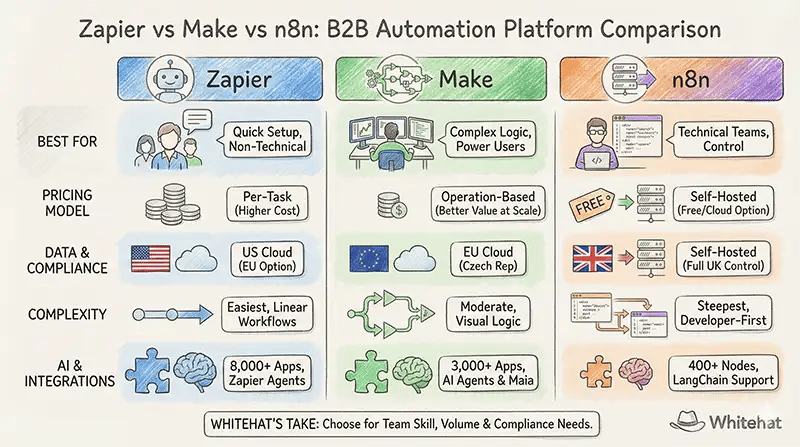
Before diving into detail, here's the executive summary. Zapier dominates for ease of use and breadth of integrations. Make (formerly Integromat) wins on cost efficiency for complex workflows. n8n appeals to technical teams prioritising control and data sovereignty.
| Criteria | Zapier | Make | n8n |
|---|---|---|---|
| Best For | Non-technical teams, quick setup | Complex workflows, cost-conscious | Technical teams, data sovereignty |
| Starting Price | £16/month (750 tasks) | £7/month (10,000 ops) | Free (self-hosted) / €20/month |
| Integrations | 8,000+ | 3,000+ apps (30,000 actions) | 400-500 native nodes |
| Learning Curve | Easiest | Moderate | Steepest |
| Self-Hosting | No | No | Yes (fair-code licence) |
| UK Data Residency | EU option available | Czech Republic (EU) | Your choice (self-hosted) |
What Are Zapier, n8n, and Make? Understanding Your Options
All three platforms solve the same fundamental problem: connecting applications that don't natively talk to each other and automating workflows between them. However, their approaches, pricing models, and target users differ significantly. Understanding these differences is essential before comparing features or costs.
Zapier: The Market Leader
Zapier pioneered the no-code automation category and remains the dominant player with over 3 million users worldwide. Founded in 2011, the platform now offers 8,000+ app integrations and processes billions of automated tasks monthly. Zapier's strength lies in accessibility—marketing teams can build automations without developer involvement, making it the default choice for non-technical business users.
Recent developments include Zapier Agents (autonomous AI assistants launched in November 2025), Zapier Copilot for natural language workflow creation, and bundled tools including Tables, Forms, and Chatbots on all paid plans. The company reached a $5 billion valuation and $310 million in revenue during 2024.
Make: The Power User's Choice
Make (formerly Integromat until 2022) targets users who need more sophisticated workflow logic than Zapier provides. The platform's visual canvas allows non-linear workflows with branching, iteration, and complex data transformation—capabilities that require multiple workarounds in Zapier. Make offers 3,000+ app integrations with over 30,000 available actions.
Owned by Celonis (German process mining company) since 2020, Make has introduced Make AI Agents in April 2025 and Maia, an AI co-pilot for scenario building. The company processes from Czech Republic-based EU data centres, offering GDPR-compliant processing for European businesses.
n8n: The Developer's Platform
n8n (pronounced "n-eight-n") represents a fundamentally different approach: fair-code licensing that allows self-hosting with full source code access. This appeals to technical teams requiring complete control over their automation infrastructure and data. The platform raised $60 million in March 2025, followed by $180 million in October 2025, reaching a $2.5 billion valuation—reflecting explosive growth in the developer community.
With 169,631 GitHub stars (placing it among the top 50 open-source projects globally) and $40 million ARR representing 10x year-over-year growth, n8n has proven that developer-first automation platforms have massive market appeal. Notable enterprise customers include Vodafone, Delivery Hero, Microsoft, Wayfair, and Zendesk.
Pricing Comparison: What Will Each Platform Actually Cost?
Pricing transparency is where most comparison articles fail. Vendors use different counting methods—tasks, operations, executions—that make direct comparison difficult. This section translates marketing pricing into real monthly costs at different scale levels.
Understanding the Counting Methods
Zapier counts tasks: Every trigger, action, or filter step in a workflow counts as one task. A simple "new lead in HubSpot → create contact in Salesforce → send Slack notification" workflow consumes three tasks per execution.
Make counts operations: Similar to Zapier, each module action consumes one operation. However, Make's polling triggers consume operations even when no data is found—a hidden cost that adds up with frequent polling intervals.
n8n counts executions: An entire workflow run counts as one execution, regardless of how many nodes (steps) it contains. This makes n8n dramatically cheaper for complex, multi-step workflows at scale.
Real-World Cost Comparison
| Monthly Volume | Zapier | Make | n8n Cloud | n8n Self-Hosted |
|---|---|---|---|---|
| 10,000 tasks/ops | ~£130/month | ~£7/month | ~£40/month | ~£50-80 infrastructure |
| 50,000 tasks/ops | ~£400/month | ~£30/month | ~£50/month | ~£50-80 infrastructure |
| 100,000 tasks/ops | ~£650/month | ~£80/month | Custom pricing | ~£100-200 infrastructure |
| Enterprise | ~£12,000-15,000/year | Custom pricing | Custom (~£5,500/month) | Licence + infrastructure |
The verdict on pricing: Make is significantly cheaper than Zapier at every scale level except the very simplest use cases. n8n self-hosted is cheapest for high-volume users with technical resources to maintain infrastructure. Zapier's premium reflects its ease of use and integration breadth—a reasonable trade-off for non-technical teams where staff time costs more than subscription fees.
Hidden Costs to Consider
Zapier: Premium app connectors (Salesforce, certain enterprise tools) require higher-tier plans. The 30-second hard timeout on API requests cannot be extended, potentially requiring workflow redesigns for slow external APIs.
Make: Polling triggers consume operations even when returning no data. A workflow checking every 5 minutes consumes 8,640+ operations monthly just for empty polls. Webhook-triggered workflows avoid this entirely.
n8n Self-Hosted: True cost includes server hosting (£50-200/month), database management, security patching, and DevOps time. Enterprise estimates suggest total cost of ownership can reach £200,000-300,000 annually when including dedicated DevOps resources.
Feature Comparison: Capabilities That Matter for B2B Teams
Feature lists favour platforms with more checkboxes, not necessarily the best fit for your workflows. This section focuses on capabilities that specifically matter for B2B demand generation: workflow complexity, error handling, AI capabilities, and team collaboration.
Workflow Complexity and Logic
Zapier uses a linear workflow model. Paths (conditional branching) are available but limited in sophistication. For demand gen teams needing simple "if lead score > X, add to sequence" logic, this works perfectly. Complex multi-branch scenarios require multiple separate Zaps or creative workarounds.
Make excels at visual complexity. The non-linear canvas supports routers (unlimited conditional branches), iterators (loop through arrays), aggregators (combine data), and sophisticated error handlers with custom retry logic. For workflows like "route leads to different sales reps based on territory, company size, AND deal stage," Make handles this natively.
n8n offers the most powerful logic capabilities: IF/Switch nodes, Split in Batches, Merge nodes for parallel processing, and the ability to write custom JavaScript or Python within workflows. This makes n8n behave more like a backend automation service than a simple integration tool.
Error Handling and Reliability
When a lead sync fails at 2am, what happens? This is where platforms diverge significantly.
Zapier offers automatic retries and error notifications but limited customisation. You can replay failed tasks manually, but automated error recovery requires Zapier-to-Zapier triggers (adding complexity and task consumption).
Make provides sophisticated error handling: custom retry intervals, fallback routes when primary actions fail, and the ability to continue workflows despite partial failures. For production-critical workflows, this prevents cascading failures from single-point issues.
n8n includes similar error handling to Make, plus detailed execution logs for debugging. Self-hosted deployments can integrate with external monitoring tools (Datadog, Prometheus) for enterprise-grade observability.
AI Capabilities (2025-2026)
All three platforms have invested heavily in AI features during 2025, reflecting market demand for intelligent automation.
Zapier launched Zapier Agents in November 2025—autonomous AI assistants that can perform multi-step tasks based on natural language instructions. Zapier Copilot uses AI to suggest workflow improvements and troubleshoot issues. Over 450 AI apps are available in the integration library.
Make introduced Make AI Agents in April 2025 and Maia (AI co-pilot) for scenario building. The MCP (Model Context Protocol) Server enables connections to external AI tools. Make's approach focuses on AI-assisted creation rather than autonomous execution.
n8n offers the deepest AI integration capabilities through LangChain support, enabling custom AI agent workflows. For teams building sophisticated AI pipelines—RAG systems, multi-model orchestration, or custom LLM applications—n8n provides the most flexibility.
Enterprise Features: Security, Compliance, and Governance
For UK businesses handling customer data, compliance isn't optional. GDPR requires data processing agreements, appropriate security measures, and often data residency within the EEA. This section covers what each platform offers for enterprise governance requirements.
Security Certifications and Compliance
| Certification | Zapier | Make | n8n Cloud |
|---|---|---|---|
| SOC 2 Type II | ✅ | ✅ | ✅ |
| ISO 27001 | ❌ | ✅ | ❌ |
| GDPR Compliant | ✅ | ✅ | ✅ |
| HIPAA | ❌ | BAA available | Self-hosted only |
| EU Data Residency | Available | Default (Czech Republic) | Frankfurt (Azure) |
UK-Specific Compliance Considerations
For UK businesses, the key consideration is whether data needs to remain within UK jurisdiction or whether EU processing suffices. Under the UK GDPR (post-Brexit), EU-based processing generally meets adequacy requirements, making Make and n8n Cloud viable options.
Zapier is US-headquartered with primary data processing in the United States. EU data residency is available on Enterprise plans, but requires explicit configuration. The platform relies on the EU-US Data Privacy Framework with UK Extension for compliance.
Make processes all data through Czech Republic servers by default, providing EU-based processing without additional configuration. For UK businesses, this offers practical GDPR compliance with minimal friction.
n8n offers the strongest data sovereignty position. Cloud deployments run from Frankfurt (Azure), while self-hosted deployments can run on UK-based infrastructure (AWS London, Azure UK South, or GCP London) for complete UK data residency.
Governance and Access Control
Zapier offers SAML 2.0 SSO and SCIM provisioning on Enterprise plans. Audit logs are available for 6 months on Team plans, 12 months on Enterprise. A common concern: "Zaps owned by individuals who leave the company cause serious risk"—Zapier's admin controls help but require Enterprise tier.
Make provides SSO only on Enterprise tier. Team roles and permissions are available on Teams plan (£24/month), offering better mid-market governance than Zapier's equivalent tier.
n8n Business tier (€550/month) includes SSO/SAML, Git-based version control, separate environments (dev/staging/production), and credential sharing across team members. Enterprise adds dedicated SLA support.
Integration Depth: Beyond the Numbers
Integration counts are marketing metrics—8,000 integrations means nothing if the three tools you need work poorly. For B2B demand generation, what matters is depth of integration with your sales and marketing stack: CRM platforms, sales engagement tools, and marketing automation systems.
CRM Integrations (Salesforce, HubSpot)
Salesforce: Zapier offers the most comprehensive native Salesforce integration with support for standard and custom objects, bulk operations, and real-time triggers. Make provides deep customisation for complex field mapping but requires more configuration. n8n supports full CRUD operations but needs developer setup for advanced scenarios.
HubSpot: All three platforms offer strong HubSpot integration capabilities. Zapier's HubSpot connector is particularly robust with deep support across CRM, Marketing Hub, and Service Hub. Make and n8n provide full CRUD operations with good trigger coverage.
Sales Engagement Tools
Outreach and Salesloft: Zapier leads with native integrations for both platforms—essential for demand gen teams running outbound sequences. Make offers good Salesloft support natively; Outreach requires HTTP modules for full functionality. n8n lacks native nodes for either, requiring webhook or HTTP configuration.
LinkedIn: All three platforms face the same limitation—LinkedIn's API restrictions limit automation to posting and basic profile actions. Lead generation automation (connection requests, message sequences) isn't possible through official integrations on any platform.
Data Enrichment and Intent Tools
For tools like Clearbit, ZoomInfo, Bombora, or G2 intent data, integration availability varies significantly:
Zapier offers direct integrations for Clearbit, ZoomInfo, and Apollo. Intent data platforms typically require webhook configurations but work reliably once set up.
Make and n8n generally require HTTP modules or webhooks for enrichment and intent data tools. The trade-off is more setup complexity for more customisation flexibility.
Real-World Use Cases: Which Platform for Which Workflow?
Rather than abstract feature comparisons, let's examine specific demand generation workflows and which platform handles each best.
Lead Routing and Territory Assignment
Scenario: Route inbound leads to the correct sales rep based on company size, industry vertical, and geographic territory—with round-robin distribution within each territory.
Best platform: n8n or Make. Both handle multi-condition routing elegantly through visual branching. n8n's Switch nodes and Make's Routers excel at complex conditional logic. Zapier can achieve this through nested Paths but becomes unwieldy beyond 3-4 conditions.
CRM Data Enrichment Pipeline
Scenario: When a new contact enters HubSpot, enrich with Clearbit data, check against ZoomInfo for additional firmographics, then update the contact record with combined data.
Best platform: Zapier. Direct integrations with Clearbit and ZoomInfo make this workflow straightforward. Multi-step Zaps handle the sequential enrichment without complex configuration.
Sales-Marketing Handoff Automation
Scenario: When a lead hits MQL threshold, create tasks in Salesforce, notify the assigned rep in Slack with context, add to appropriate Outreach sequence, and update marketing attribution.
Best platform: Make. The visual canvas makes multi-destination workflows clear and maintainable. Error handling ensures partial failures don't break the entire handoff process.
Multi-Touch Attribution Workflows
Scenario: Track touchpoints across web analytics, email engagement, event attendance, and content downloads—then attribute pipeline value across channels.
Best platform: n8n. Complex data transformation and aggregation benefits from n8n's ability to write custom code within workflows. For teams building sophisticated attribution models, n8n's flexibility is essential.
| Use Case | Best Platform | Why |
|---|---|---|
| Lead routing (complex logic) | n8n / Make | Visual branching handles multi-condition scenarios |
| CRM enrichment | Zapier | Direct integrations with enrichment tools |
| Sales-marketing handoff | Make | Multi-destination with error handling |
| Attribution workflows | n8n | Complex data transformation with custom code |
| Simple notifications | Zapier | Fastest setup, no overkill |
| AI agent workflows | n8n | LangChain support, deepest AI integration |
Learning Curve and Team Adoption Reality
The best automation platform is the one your team will actually use. Enterprise features and cost savings mean nothing if adoption stalls due to complexity.
Time to Productivity
Zapier: Non-technical users can build basic automations within hours. The guided workflow builder, extensive template library, and minimal configuration requirements make Zapier the fastest path to a working automation.
Make: Power users typically become productive within 1-2 days. The visual canvas requires understanding Make's module/scenario terminology, but once grasped, building complex workflows becomes intuitive.
n8n: Requires technical expertise for productive use. Marketing teams without developer support will struggle. However, for technical users, n8n's interface is logical and well-documented.
Support and Training Resources
Zapier offers the most comprehensive learning resources: Zapier University, extensive documentation, active community, and responsive support across all paid tiers.
Make provides good documentation and an academy with certification courses. Community support is active, though smaller than Zapier's ecosystem.
n8n has strong developer documentation and an engaged community forum. However, support below Enterprise tier is forum-only—even the £550/month Business plan doesn't include direct support, which surprises many buyers.
Our Recommendation: Choosing the Right Platform
After implementing all three platforms across dozens of B2B clients, here's our decision framework based on real-world outcomes.
Choose Zapier If:
- Your marketing team needs to build and maintain automations without developer involvement
- You need the broadest integration coverage (particularly for niche tools)
- Speed of implementation matters more than long-term cost optimisation
- Your workflow volume is under 10,000 tasks monthly
- You want AI capabilities (Zapier Agents) with minimal setup
Choose Make If:
- You have power users comfortable with visual logic builders
- Complex, multi-branch workflows are your primary use case
- Cost efficiency at scale (20,000+ operations monthly) is important
- EU data residency without configuration hassle is required
- You need sophisticated error handling for production workflows
Choose n8n If:
- You have technical resources to deploy and maintain the platform
- UK data residency with complete control is non-negotiable
- You're building AI agent workflows with LangChain or custom LLM integrations
- Very high workflow volumes make self-hosting economically attractive
- Open-source ethos and community contribution matter to your organisation
Not Sure Which Platform Fits Your Workflows?
We implement Zapier, Make, and n8n as part of our AI consultancy and implementation services. Book a 30-minute automation strategy call, and we'll assess your workflows, team capabilities, and compliance requirements to recommend the right platform.
Book Your Automation Strategy CallFrequently Asked Questions
Is n8n really free?
Yes, the n8n Community Edition is genuinely free for self-hosting with unlimited workflows and executions. Real costs include server hosting (typically £50-80/month for production use), database management, and technical expertise to maintain the deployment. n8n Cloud starts at €20/month for 2,500 executions.
Which is cheaper at scale: Zapier or Make?
Make is significantly cheaper at scale. At 100,000 monthly operations, Make costs approximately £80/month compared to Zapier's £650+. The difference becomes more pronounced with complex, multi-step workflows where Zapier's task-based counting multiplies costs.
Can n8n replace Zapier for enterprise?
Yes, for organisations with technical resources. n8n Enterprise offers SSO, SAML, version control, and dedicated support. Notable enterprise customers include Vodafone, Microsoft, and Zendesk. The trade-off is fewer native integrations (400-500 vs 8,000) and higher technical requirements.
What's the learning curve for Make vs Zapier?
Zapier is easiest—non-technical users become productive within hours. Make requires 1-2 days for power users to grasp the visual canvas and terminology. n8n requires technical expertise and is unsuitable for teams without developer support.
Which automation tool has the best Salesforce integration?
Zapier leads for Salesforce with the most comprehensive native integration—supporting standard and custom objects, bulk operations, and real-time triggers. Make offers deep customisation but requires more configuration. n8n supports full CRUD operations but needs developer setup.
Is self-hosted n8n worth the overhead?
Self-hosting is worth it if you have strict UK data residency requirements, very high workflow volumes (making cloud pricing expensive), available DevOps resources, or need to customise the platform. Otherwise, n8n Cloud or Make typically offer better value.
How do Zapier task limits work?
Every trigger, action, and filter step consumes one task. A 5-step workflow processing 1,000 records uses 5,000 tasks. Tasks reset monthly. Exceeding limits pauses workflows until the next billing cycle or you upgrade. This model makes complex workflows expensive compared to Make's operations or n8n's executions.
Which platform is best for GDPR compliance?
For UK businesses, n8n self-hosted on UK infrastructure offers the strongest compliance position with complete data sovereignty. Make's EU-based processing (Czech Republic) provides practical GDPR compliance by default. Zapier requires Enterprise tier and explicit EU data residency configuration.
Key Takeaways
- Zapier wins on accessibility: The best choice for non-technical teams prioritising speed and integration breadth over cost optimisation
- Make wins on value: Significantly cheaper at scale with superior visual logic for complex workflows
- n8n wins on control: Best for technical teams needing UK data sovereignty and AI agent capabilities
- Pricing models matter: A 10-step workflow costs 10x more in Zapier tasks than n8n executions
- Team capability determines success: The "best" platform is the one your team will actually adopt and maintain
Need help implementing workflow automation for your demand generation processes? Explore our marketing automation services or book a consultation to discuss your requirements.
References
- Zapier Security & Compliance (2025) — Enterprise security certifications and GDPR compliance documentation
- n8n Security Documentation (2025) — SOC 2 certification and data processing information
- Make GDPR Compliance (2025) — EU data processing and privacy documentation
- TechCrunch (March 2025) — n8n Series B funding announcement
- n8n Blog (October 2025) — Series C funding and $2.5B valuation announcement
- Eurostat (January 2025) — EU enterprise AI adoption statistics
- Digidop (January 2026) — Comprehensive platform comparison analysis
- Information Commissioner's Office — UK data protection regulatory guidance