
By Clwyd Probert · Published: 22 March 2026 · Last Updated: 31 March 2026
YouTube Video Marketing for B2B: 2026 Strategy Guide
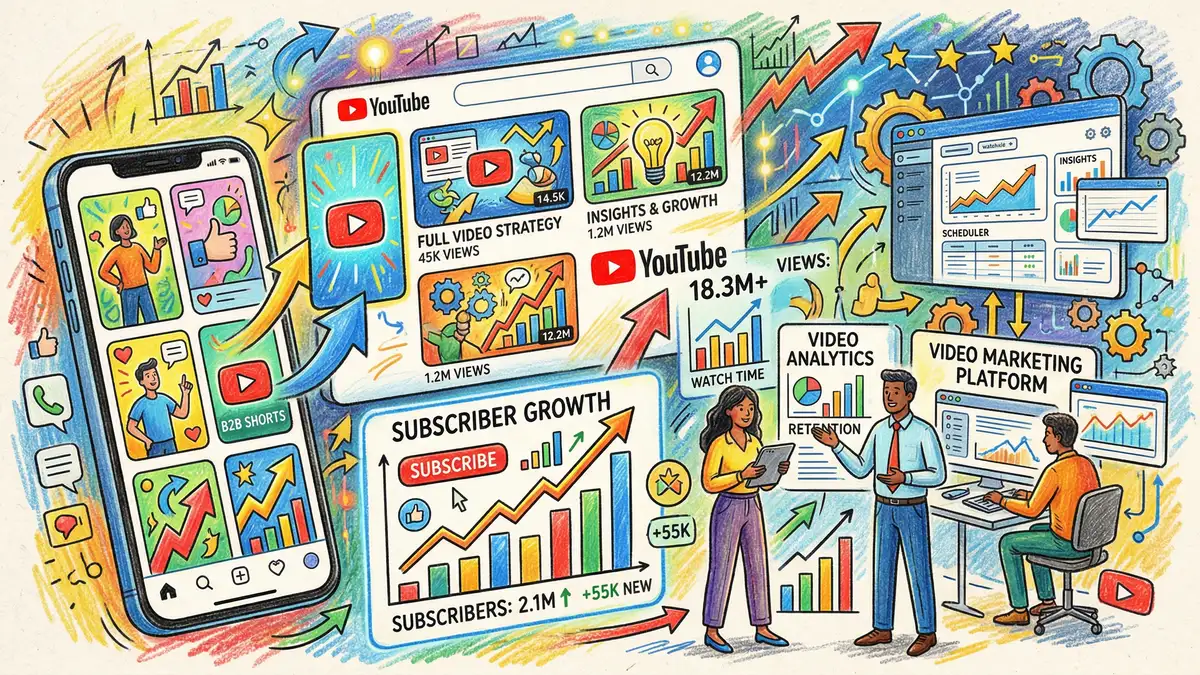
YouTube video marketing for B2B in 2026 requires a Shorts-first discovery strategy combined with long-form content for consideration-stage buyers. With 54.8 million UK users and 70% of B2B buyers now using video in purchase decisions, YouTube has become the second most-watched media service in the UK. B2B video content achieves 1200% higher engagement than text and images combined, making video strategy essential for any company targeting growth.
The platform has fundamentally transformed. December 2025's algorithm overhaul reduced long-form video slots on home feeds by up to 80%, whilst YouTube Shorts now drive 200 billion daily views globally. For UK marketing directors facing pressure to prove ROI, YouTube now offers both unprecedented reach and sophisticated attribution capabilities—but only with the right approach.
This guide covers what's actually working for B2B companies on YouTube in 2026, drawing on current platform data, algorithm mechanics, and practical strategies for connecting video engagement to measurable pipeline outcomes.
Why YouTube Matters for B2B Marketing in 2026
YouTube's position as the UK's second most-watched media service (behind only the BBC, according to Ofcom's Media Nations 2025 report) makes it impossible to ignore for B2B marketers. UK adults now spend an average of 51 minutes daily watching YouTube content, with viewing on television sets jumping from 34% to 41% between 2023-2024.
The B2B buying behaviour shift is equally significant. Research shows:
- 70% of B2B buyers incorporate video in their purchase decisions
- 59% of senior executives prefer video over text when researching solutions
- 93% of B2B buyers see video building trust in purchase decisions
- 58% of B2B marketers rank video as their top-performing content type
- 52% of B2B marketers report video delivers the highest ROI
- 49% of UK B2B technology buyers report that short-form social video helps inform purchasing decisions
These statistics represent a fundamental change in how prospects research and evaluate solutions. For B2B SaaS companies, video is now a primary touchpoint in the buying journey. Without a strategic video presence on YouTube, you're effectively invisible during the awareness and consideration stages when buyers are most receptive to discovering new solutions. For the complete B2B video strategy framework beyond YouTube, see our B2B video marketing pillar guide.
2026 B2B Video Marketing Statistics
| Metric | 2026 Performance | Impact |
|---|---|---|
| B2B Video Engagement vs Text | 1200% higher | Video dominates all other content formats |
| Conversion Rate Lift | 4.8% vs 2.9% without video | 65% higher conversion on pages with video |
| YouTube Shorts Engagement | 5.91% average rate | Highest among all short-form platforms |
| YouTube Shorts Daily Views | 200 billion globally | Primary discovery mechanism for B2B buyers |
| B2B Marketers Using Video | 71% of B2B firms | Video is mainstream, not emerging |
| Video ROI Satisfaction | 87% of marketers satisfied (2025) | Video delivers measurable business results |
| Short-Form Video ROI vs Static | 1.6x higher ROI | Shorts deliver superior returns on investment |
| Message Retention: Video vs Text | 95% video retention vs 10% text | Video messaging sticks with buyers |
| Revenue Growth with Video | 49% faster for video users | Video directly impacts business growth |
| B2B Marketers Planning Video Growth | 61% planning increased investment | Video strategy is essential for competitiveness |
These statistics illustrate a clear pattern: B2B video marketing is no longer a nice-to-have. It's a competitive requirement. Companies that fail to invest in YouTube video strategy are ceding market share to competitors who understand the channel's impact on buyer behaviour and pipeline growth.
How the YouTube Algorithm Works in 2026
YouTube's algorithm has undergone its most significant transformation since launch. In January 2025, YouTube's Senior Director of Growth & Discovery confirmed that Large Language Models now power the recommendation system, enabling semantic understanding of video content, context, and emotional tone.
The algorithm now "pulls" content for individual viewers rather than "pushing" videos universally. This fundamental shift means YouTube no longer privileges volume. Instead, it optimises for individual viewer satisfaction. If a long-form business explainer video engages a specific viewer longer than a trending music video, YouTube will recommend the explainer—regardless of channel size or historical performance.
Three discovery surfaces operate differently:
- Home Page: Shows personalised content based on broad interests and viewing history. LLMs analyse what types of videos keep you watching longest.
- Suggested Videos: Combine current viewing with personal history to predict next view. Context matters more than broad keywords.
- YouTube Search: Prioritises relevance first, then satisfaction metrics like retention and engagement. Small channels can outrank large ones if their video better satisfies the search query.
This represents a fundamental shift from channel authority to content relevance—critical for B2B companies entering competitive niches. A well-optimised video from a 500-subscriber channel can rank above a mediocre video from a 100,000-subscriber channel if it better answers the search query and keeps viewers engaged.

| Ranking Factor | Impact Level | What It Means |
|---|---|---|
| Audience Retention | Very High | Top videos achieve 50-60%; platform average is 23.7% |
| Watch Time | Highest | Total minutes watched remains primary ranking signal |
| Engagement Rate | High | Top videos average 2.65% vs 0.09% platform average |
| Click-Through Rate | High | 4-10% good; 7%+ excellent for B2B content |
| Comments Quality | High | Thoughtful discussions signal viewer satisfaction |
| Tags/Hashtags | Minimal | Only 37% of top videos use hashtags effectively |
The December 2025 Algorithm Shift: YouTube's home feed UI overhaul reduced long-form video recommendations from six per row to approximately two, with up to 80% reduction in total long-form content slots. Simultaneously, Shorts slots increased substantially. This makes YouTube Shorts integration essential for discovery—a strategic shift that impacts all B2B channels regardless of size or niche.
YouTube Shorts: The New Discovery Engine for B2B
YouTube Shorts has evolved from a TikTok competitor into the platform's primary discovery mechanism. With 200 billion daily views globally and engagement rates of 5.91%, Shorts now represent the funnel top for B2B buyer journeys.
Understanding Shorts performance requires context. 90% of all new uploads to YouTube are Shorts. Yet the top 1% of videos (by views) still capture 91% of total watch time. This paradox means Shorts are essential for getting discovered, but quality matters enormously—you're competing against exponential upload volume with LLM-powered curation.
Why Shorts matter for B2B: 53% of B2B buyers watch short-form video before filling contact forms or requesting demos. This statistic is critical because it means Shorts function as your primary lead generation top-of-funnel on YouTube — our video marketing funnel guide shows how to map content to each buyer stage. If you're not running a Shorts strategy, you're missing half of your potential buyers at the awareness stage.
- 5.91% engagement rate—highest among all short-form platforms (TikTok: 5.75%, Instagram Reels: 5.53%)
- Companies integrating Shorts with long-form see 41% faster channel growth
- Shorts linking to longer videos drive 74% higher subscriber conversion
- 77% of marketers report short-form video yields highest ROI vs long-form (22%)
YouTube Shorts Performance Metrics
High-performing B2B Shorts content types: 15-second product feature highlights (extracted from demos), quick tutorials addressing common problems, thought leadership clips featuring founders answering questions, behind-the-scenes company culture moments that build trust, customer success moments showing real results, FAQ responses to frequent buyer questions, and industry trend breakdowns that position your company as knowledgeable.
Production quality matters less than authenticity for Shorts. Hook viewers within the first 1-3 seconds—this is critical because YouTube's algorithm measures whether viewers watched to the end. Use 9:16 vertical format (native to mobile). Include captions (83% watch with sound off). Favour lo-fi authenticity over polished production—audiences now prefer genuine over produced.
The October 2024 extension of maximum Shorts duration to 3 minutes expands B2B storytelling considerably. You're no longer limited to 60-second soundbites. You can now tell more complete product stories, customer case studies, or thought leadership narratives within the Shorts format, which increases retention and conversion.
YouTube SEO Best Practices for 2026
A comprehensive February 2025 study by Search Engine Journal analysing 1.6 million YouTube videos reveals that traditional SEO tactics have diminished in importance whilst viewer satisfaction signals dominate.
Key findings: Only 6% of top-ranking videos use exact keyword matches in titles. YouTube's AI now understands video content from audio and visual analysis, not just metadata. This shift means content relevance matters more than keyword stuffing. Your video's actual content matters more than how you've labelled it.
Chapters and timestamps significantly impact SEO performance. 63% of top-ranking videos include timestamps, which appear as "Key Moments" in Google Search results. Implementation requires the first timestamp starting at 00:00, a minimum of three timestamps, and keyword-rich chapter titles under 50 characters. This structural approach helps both YouTube and Google understand your content's structure and improves discoverability across both platforms.
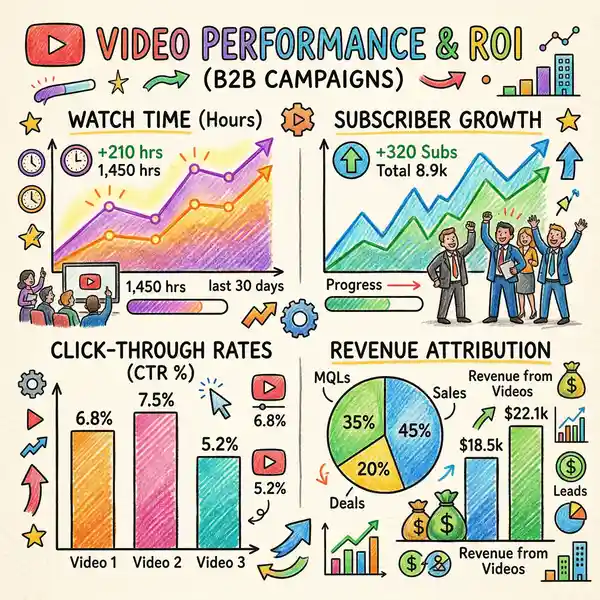
Thumbnail optimisation delivers measurable impact. 89% of top-ranking videos use custom thumbnails. Thumbnails featuring expressive faces can increase click-through rates by 20-30%, and videos with human faces receive 921,000 more views on average than those without. Keep text under 12 characters and use 1280×720 pixel resolution at 16:9 aspect ratio. For B2B content, show real people—not stock photography—in thumbnails when possible.
For titles, stay under 70 characters to avoid truncation and place primary keywords in the first 40 characters. Descriptions should be 200-300 words with the primary keyword in the first 25 words. The first 125 characters appear in search results—include your value proposition there. 78% of top-ranking videos include external links in descriptions, which suggests that YouTube rewards videos that drive traffic to other relevant properties.
Optimise Your B2B Content Strategy
Learn how to integrate YouTube video marketing with your overall B2B content strategy and connect engagement directly to pipeline outcomes.
Explore Our ApproachBuilding B2B YouTube Strategy: Three-Tier Funnel
Successful B2B YouTube marketing requires a three-tier content strategy aligned with the buyer journey:
Awareness (Shorts): 15-60 second vertical content featuring quick tips, thought leadership clips, and product highlights. Optimise for discovery through Shorts feed and Search. Goal: Get found by prospects who don't yet know your company exists.
Consideration (Mid-Form): 2-5 minute product demonstrations, case study highlights, and educational content. Focus on engagement and subscriber retention. Goal: Build credibility and help prospects understand how your solution addresses their specific problems.
Decision (Long-Form): 8-15 minute in-depth tutorials, webinars, and comprehensive guides. Optimise for watch time and conversion metrics. Goal: Provide the detailed information prospects need to feel confident making a purchase decision.
This three-tier approach ensures you're visible at every stage of the B2B buying journey. Many B2B companies create only long-form content, missing 80% of discovery opportunities (since long-form visibility dropped 80% in December 2025). Smart companies now use Shorts as the funnel top, mid-form for engagement, and long-form for deeper conversion-focused content.
AI Tools Transforming B2B Video Production
AI has fundamentally changed video production economics. According to Wistia's 2025 State of Video report, 41% of marketers now use AI for video creation (up from 18% in 2024), with caption usage via AI increasing 572% since 2021. This democratisation means B2B companies without large production budgets can now compete effectively with enterprises that have in-house video teams. For building brand authority through video beyond YouTube, see our guide to video marketing for brand engagement.
Enterprise-focused AI video platforms: Synthesia creates AI avatar-based training and explainer content (used by 90% of Fortune 100 companies, SOC 2 Type II and GDPR compliant). Descript enables text-based video editing where you edit transcript text and the video edits accordingly. HeyGen provides marketing-focused avatar content with ChatGPT integration for script generation.
YouTube's native AI features (2025-2026): Aloud auto-dubbing now supports 20+ languages with lip-sync technology. Dream Screen generates AI backgrounds for Shorts, saving production time. Veo 3 Fast enables text-to-video generation with free unlimited use in the UK, making animation and visual effects accessible to companies without animation expertise.
Video Marketing ROI and Attribution
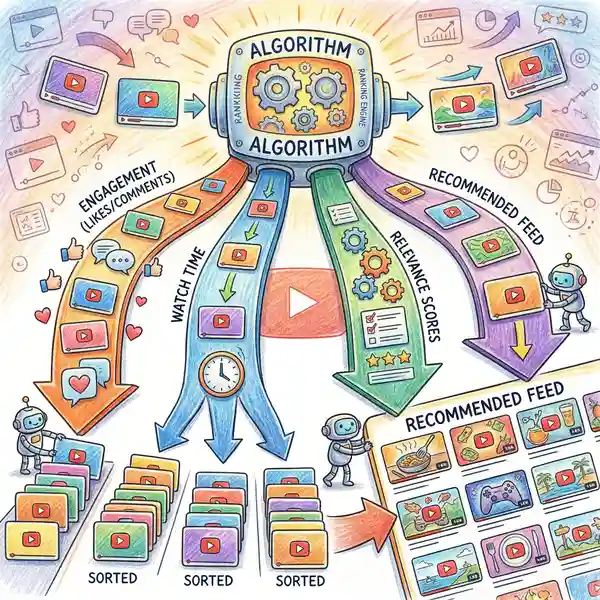
The business case for video marketing is now established. According to recent research: 82-93% of marketers report positive ROI from video — see our video marketing benchmarks for the full UK data set. Companies using video grow revenue 49% faster than non-users. B2B video achieves 4.8% conversion rate vs 2.9% for sites without video—a 65% improvement. Message retention reaches 95% for video vs 10% for text. Testimonial videos deliver 44% higher conversion rates. Personalised video follow-ups increase response rates by 36%.
Measuring YouTube ROI in HubSpot: HubSpot Marketing Hub Professional and Enterprise offer direct YouTube publishing with analytics including channel subscribers, total views, and engagement metrics. For granular tracking, Vidyard integration provides individual viewer engagement data on CRM records, workflow triggers based on percentage watched, and lead scoring based on video engagement patterns. This level of integration is essential for proving video ROI to leadership.
Key Takeaway: YouTube ROI Measurement
B2B video marketing delivers measurable results: 49% faster revenue growth, 65% higher conversion rates, and 95% message retention. HubSpot and Vidyard integration allows you to track individual viewer engagement and attribute video performance directly to pipeline outcomes. Start measuring today—95% of top performers use attribution tracking.
YouTube Advertising for B2B: Cost-Effective Demand Generation
YouTube advertising offers broader reach at lower cost than LinkedIn. UK B2B cost benchmarks for 2025-2026: Cost Per View (CPV) £0.04-£0.25 (average £0.10), CPM £3.20-£12.00, CPC for companion banners £0.80-£2.40, Shorts CPV £0.08-£0.24.
B2B targeting options include Customer Match (upload CRM lists), remarketing (target website visitors), In-Market Audiences (people researching B2B solutions), Custom Intent (target by recent searches), and company-based targeting (used by 62% of B2B marketers). Google's Demand Gen campaigns serve across YouTube, Google Discover, Gmail, and Display Network with 20%+ average conversion increase.
UK B2B YouTube Advertising Benchmarks (2025-2026)
Frequently Asked Questions
Implementation Roadmap
Month 1: Foundation
Audit existing YouTube presence, establish content calendar aligned with buyer journey, optimise channel metadata and branding, set baseline metrics for watch time and engagement.
Month 2: Launch Shorts Program
Create 1-2 Shorts weekly, extract clips from existing long-form content, test different content types, monitor engagement metrics, build subscriber base.
Month 3: Scaling Long-Form
Produce 2-4 mid-form videos (2-5 min), establish timestamp and chapter best practices, implement Vidyard tracking for lead attribution, start YouTube advertising campaigns.
Months 4-6: Optimisation
A/B test thumbnails and titles, analyse retention curves, double down on highest-performing content types, integrate YouTube with demand generation campaigns, scale successful ad campaigns.
Important Caveat: Algorithm Changes & Adapt
YouTube's algorithm evolved significantly in December 2025, and further updates are certain. Treat this guide as current for Q1 2026, but regularly review YouTube Creator Central and Google Marketing Updates for algorithm changes. The core principle remains constant: focus on retention rate and viewer satisfaction above all else. Algorithm shifts change the discovery surfaces but not the fundamental metrics YouTube rewards.
Key Takeaway: Three-Tier Funnel Strategy
Success in B2B YouTube marketing requires aligned content across awareness (Shorts), consideration (mid-form), and decision (long-form) stages. Shorts drive discovery with 5.91% engagement and reach 53% of B2B buyers before they request demos. Mid-form builds credibility. Long-form drives conversion. This integrated funnel approach is what separates successful YouTube channels from those getting lost in algorithm changes.
Key Takeaways:
YouTube video marketing in 2026 is driven by three forces: Algorithm shift toward Shorts-first discovery and LLM-powered recommendations. B2B buyer behaviour shift toward video-based research (70% use video in decisions). Technology democratisation through AI video creation and HubSpot attribution.
Success requires moving beyond "create video content" to "build integrated video funnels." Shorts drive discovery, mid-form builds consideration, long-form drives conversion. Measurement through HubSpot attribution connects each stage to pipeline outcomes.
Start with Shorts. They're the fastest route to discovery and lowest production barrier. Link them strategically to longer content. Measure everything. Scale what works.
Transform Your B2B Video Marketing with Expert Strategy
Whitehat helps B2B companies connect YouTube video marketing to measurable pipeline outcomes through HubSpot integration and data-driven strategy. Let us audit your current approach, identify Shorts opportunities aligned with your buyer journey, and build attribution tracking that connects engagement to revenue.
Discover Our Services Learn More →Explore Our Services
Content Marketing Services
Strategic video content development aligned with your B2B buyer journey, optimised for YouTube discovery and conversion.
Marketing Services
Comprehensive digital marketing including YouTube strategy, demand generation, and attribution through HubSpot integration.
Video Strategy Consulting
Expert guidance on YouTube Shorts integration, three-tier funnel development, and ROI measurement for B2B video.
Related Resources
- A Complete Guide to Video Marketing
- The Power of Video Marketing: Boosting Your Digital Strategy
- Video Marketing Tips: Running Video Across the Funnel
- Unlocking the Power of Video in Marketing & Sales
About Clwyd Probert
Clwyd Probert is a B2B content strategist at Whitehat with 8+ years of experience in video marketing, demand generation, and HubSpot integration. He specialises in helping B2B companies build video funnels that connect audience engagement to measurable pipeline outcomes. When not analysing YouTube algorithms, he's exploring the intersection of AI and content strategy.
Learn more: View Clwyd's profile