
Key Takeaways
- A video marketing funnel maps specific video types to each B2B buyer stage — awareness, consideration, and decision — with a distinct CTA and KPI per stage.
- Sites with video convert at 4.8% versus 2.9% without — a 66% improvement that compounds across the entire funnel.
- Short-form awareness videos (30–90 seconds) generate 31% more leads than blog content alone, while personalised decision-stage videos lift follow-up response rates by 36%.
- Attribution requires CRM integration: capture video engagement events on contact records, tag with UTMs, and tie to lifecycle stages for true revenue reporting.
- LinkedIn is now the dominant B2B video distribution channel (70% of video marketers use it), but owned pages remain critical for conversion-stage content.
A B2B video marketing funnel matches specific video content types to each stage of the buyer journey — awareness, consideration, and decision — so that every video has a defined purpose, a clear next-step CTA, and a measurable contribution to pipeline. Companies using video across the funnel see 4.8% conversion rates compared to 2.9% without video, according to EyeView Digital research. When Whitehat builds video strategies for B2B clients, we map every asset to a funnel stage with CRM-tracked attribution — because views without pipeline data are just entertainment.
This guide breaks down what video content works at each funnel stage, the benchmarks you should target, how to distribute effectively, and how to connect video engagement to revenue using HubSpot. Whether you're building a video strategy from scratch or trying to turn an existing library into a pipeline-generating system, this is the practical framework.
4.8%
Conversion Rate With Video
vs 2.9% without (66% uplift)
23%
Shorter Sales Cycles
With video at consideration stage
93%
Positive Video ROI
When measured via CRM attribution
70%
Use LinkedIn for Video
Top B2B distribution channel (Wyzowl 2025)
What Is a Video Marketing Funnel?
A video marketing funnel is a strategic framework that assigns specific video content types to each stage of the B2B buyer journey. Rather than producing videos randomly and hoping they contribute to sales, a funnel approach ensures every video has a defined audience, a measurable objective, and a clear path to the next stage.
The B2B video funnel typically follows three stages that mirror the buyer's decision process. Awareness (top of funnel) captures attention and frames the problem. Consideration (middle of funnel) educates on solutions and builds credibility. Decision (bottom of funnel) removes final objections and drives conversion. Each stage requires different video formats, lengths, distribution channels, and calls to action.
The critical difference between a video library and a video funnel is attribution. A library is a collection of assets. A funnel is a system where every video engagement event — view, completion, CTA click — is captured in your CRM and connected to pipeline stages. When Whitehat builds B2B video marketing strategies, we start with attribution architecture before producing a single frame of content.
Source: Wyzowl State of Video Marketing 2025, HubSpot Video Marketing Report 2025
Awareness Stage: Video Content That Captures Attention

The awareness stage is where potential buyers first encounter your brand. At this point, they may not know your company exists — they are researching a problem, exploring a trend, or looking for educational content. Your video's job is to earn attention, demonstrate expertise, and create enough interest for the viewer to take a small next step.
Awareness-stage video content generates 31% more leads than text-based blog content alone, according to HubSpot's 2025 marketing research. The key is keeping videos short and focused — 30 to 90 seconds is optimal for awareness content, matching the browsing behaviour of B2B professionals who are scanning rather than studying. Average watch time for awareness videos is approximately 3 minutes 45 seconds, meaning you have a narrow window to deliver value.
Best Video Types for Awareness
- Problem-framing videos (30–60 seconds): Name the challenge your audience faces and quantify the cost of inaction. These perform exceptionally well on LinkedIn, where 39% more shares occur for consideration-relevant content.
- Thought leadership clips (60–90 seconds): Feature your subject-matter experts sharing a contrarian or forward-looking perspective. Authenticity outperforms production quality at this stage.
- Educational explainers (60–120 seconds): Teach something genuinely useful without a hard sell. Explainer videos were created by 73% of video marketers in 2025 — the most popular format by volume.
- Data-led short-form clips (15–30 seconds): Pull one striking statistic and build a visual around it. Short-form content yields 19% higher lead generation than long-form at this stage.
Awareness-stage CTA: Subscribe, follow, download a guide, or read a related article. Do not ask for a demo or sales call at this stage — the buyer is not ready, and a premature ask damages trust. The goal is to move them into your ecosystem so consideration-stage content can do its work.
Source: Wyzowl 2025, HubSpot Marketing Statistics 2025
Consideration Stage: Video That Builds Credibility and Shortens Sales Cycles
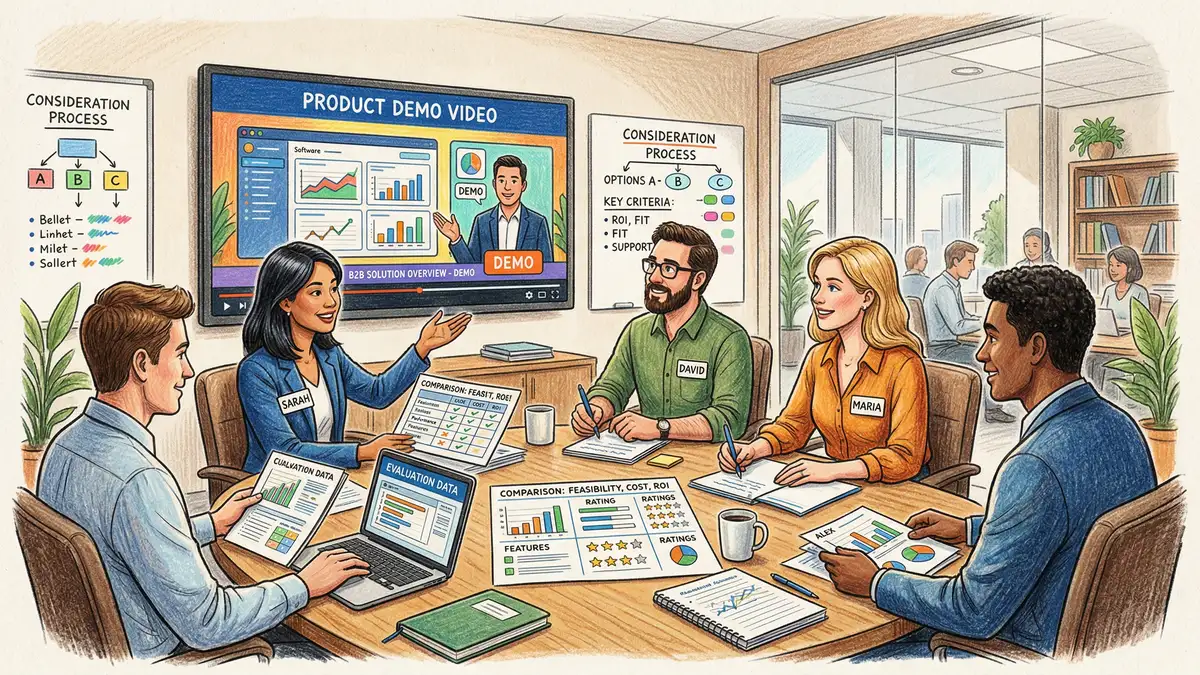
Once a buyer knows they have a problem and begins evaluating solutions, they enter the consideration stage. This is where video has the most dramatic impact on sales velocity. Consideration-stage video shortens B2B sales cycles by an average of 23%, because it pre-answers the questions buyers would otherwise ask across multiple sales calls, demos, and email threads.
At this stage, buyers consume longer, more detailed content. They are comparing options, evaluating capabilities, and building an internal case for their preferred solution. Landing pages with consideration-stage video see 34% higher conversion rates than pages without, according to research compiled by Vidyard.
Best Video Types for Consideration
- Product walkthroughs (3–8 minutes): Show how your solution works in practice, not just what it does. 57% of B2B buyers watch product demos during the consideration stage, making this format essential for any B2B video funnel.
- Webinars (30–45 minutes): The highest-performing consideration-stage format for complex B2B sales. Webinar attendees convert to qualified leads at rates of 20–40%, and 53% of B2B buyers cite webinars as influential during evaluation.
- Case study videos (2–4 minutes): Feature real clients describing the problem, the solution, and the measurable outcome. Case study videos with specific ROI numbers are 44% more likely to influence purchase decisions than generic testimonials.
- Comparison and "how to choose" videos (3–6 minutes): Address the evaluation criteria buyers use when comparing options. These videos intercept high-intent search queries and perform well as both organic content and sales enablement tools.
Consideration-stage CTA: Book a consultation, request a tailored demo, attend a webinar, or download a detailed guide. The buyer is now invested enough to exchange information for deeper engagement. This is where HubSpot's lead scoring and workflow automation becomes critical — capturing video engagement events and routing high-intent viewers to sales immediately.
| Funnel Stage | Best Video Types | Optimal Length | Primary CTA | Key Benchmark | Distribution |
|---|---|---|---|---|---|
| Awareness | Problem-framing, thought leadership, explainers | 30–90 seconds | Subscribe / follow | 31% more leads vs blog | LinkedIn, YouTube, social |
| Consideration | Product demos, webinars, case studies | 3–45 minutes | Book demo / attend webinar | 23% shorter sales cycles | Website, email, webinar platforms |
| Decision | Personalised proposals, testimonials, pricing | 1–5 minutes | Sign up / purchase | 36% higher response rates | Email, sales outreach, deal rooms |
Source: Vidyard Video Marketing Statistics 2025, Wyzowl 2025
Building a video funnel requires the right CRM foundation. Whitehat's HubSpot onboarding sets up the tracking, workflows, and attribution you need to connect video engagement to pipeline — typically within 90 days.
Explore HubSpot OnboardingDecision Stage: Video That Closes Deals

The decision stage is where video has its highest per-view value. Buyers at this point have shortlisted their options and are looking for final validation. They need confidence that your solution works, that your team is competent, and that the risk of choosing you is lower than the risk of the alternative. Personalised decision-stage videos increase follow-up response rates by 36% and boost overall engagement by 39%.
Testimonial videos are particularly powerful at the decision stage. Video testimonials with specific outcome data drive 44% higher conversion than written testimonials or generic endorsements. The reason is psychological — seeing a real person from a comparable company describe measurable results creates trust that text cannot replicate. For B2B buyers navigating 6–18 month purchase cycles with multiple stakeholders, testimonial videos become shareable internal assets that help your champion sell to their own colleagues.
Best Video Types for Decision
- Personalised proposal videos (2–5 minutes): Record a Loom or Vidyard video walking through a tailored proposal. These feel more personal than a PDF and dramatically increase open and response rates in competitive deals.
- Customer testimonials (1–3 minutes): Feature specific clients with named results. "We increased qualified leads by 34% in 90 days" is infinitely more persuasive than "great service, would recommend."
- Objection-handling videos (45–120 seconds): Address the three to five most common objections directly — pricing, implementation timeline, integration concerns, security. Making these proactively signals confidence.
- Pricing and ROI walkthrough videos (2–4 minutes): Transparently explain your pricing model and expected returns. In an industry where pricing opacity loses 20% of leads, a clear pricing video becomes a competitive advantage.
Decision-stage CTA: Start a free trial, book an implementation call, sign the proposal, or schedule onboarding. At this stage, the CTA should remove friction — make the next step as easy as a single click. Video combined with a frictionless CTA is how you convert intent into revenue.
Video Distribution Strategy by Funnel Stage
Distribution is where most B2B video strategies fail. Producing great video content and then uploading it to YouTube with no promotion plan is the equivalent of writing a brilliant report and filing it in a drawer. Effective distribution means placing the right video in the right channel at the right funnel stage.
LinkedIn has become the dominant B2B video platform — 70% of video marketers now use LinkedIn for distribution (Wyzowl, 2025), up from 55% in 2023. For awareness-stage content, LinkedIn's native video format significantly outperforms shared links. However, LinkedIn is primarily an awareness and early-consideration channel. Conversion-stage content belongs on your own website and in direct outreach.
LinkedIn (Awareness + Consideration)
Native video posts receive 39% more shares than external links. Best for thought leadership, problem-framing, and event promotion. Upload directly — never share YouTube links.
Optimal length: 30–90 seconds | Post Tue–Thu 08:00–10:00 UK
YouTube (Awareness + Consideration)
The second-largest search engine globally with 54.8 million UK users. Ideal for longer educational content, product tutorials, and webinar recordings that drive ongoing organic discovery.
Optimal length: 5–10 minutes | Focus on SEO (titles, descriptions, chapters)
Website + Email (Consideration + Decision)
Your owned channels are where conversion happens. Video on landing pages lifts conversions by 80%+. Email with embedded video thumbnails increases click-through by 82–88%.
Optimal length: 1–5 minutes | Embed with tracking pixels + HubSpot CTAs
The most effective B2B video distribution follows a three-lane model: Owned channels (website, landing pages, email nurture) for conversion, Rented channels (LinkedIn, YouTube, partner newsletters) for reach, and Sales-led distribution (personalised Loom/Vidyard, sequences, deal rooms) for closing. Each lane maps to a different funnel stage, and the proportion of investment shifts as your funnel matures.
Source: Wyzowl 2025, IAB UK Digital Ad Spend 2025
Connecting Video to Revenue: CRM Attribution in HubSpot
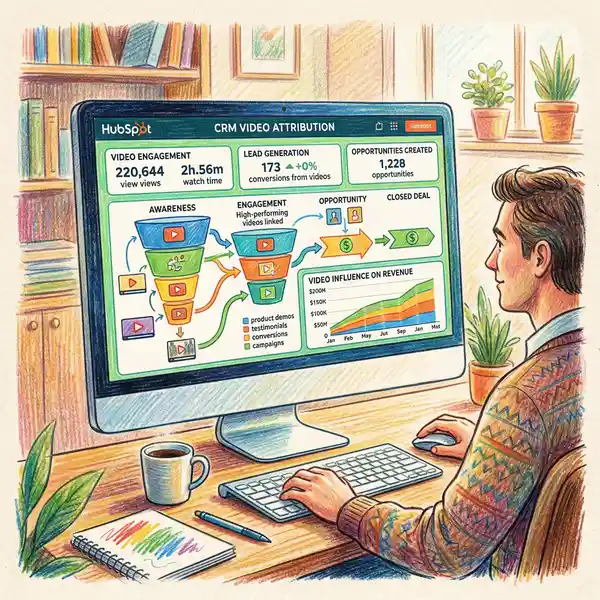
The fundamental shift from "video library" to "video funnel" is measurement. Without CRM attribution, video remains a cost centre justified by vanity metrics — views, watch time, likes. With proper attribution, video becomes a provable revenue channel with clear ROI. 93% of marketers who measure video through CRM-connected attribution report positive ROI (Wyzowl, 2025).
HubSpot provides the infrastructure for video-to-revenue attribution when configured correctly. The system works by capturing video engagement events — viewed, percentage watched, CTA clicked — on individual contact records, then tying those events to lifecycle stage changes, deals created, and revenue won. This transforms video from a branding exercise into a trackable pipeline contributor.
Five Steps to Video Revenue Attribution
Enforce UTM Parameters
Tag every video link with consistent UTM parameters (source, medium, campaign, content). This ensures HubSpot attributes the original traffic source correctly.
Capture Video Events on Contacts
Use HubSpot integrations with Vidyard, Wistia, or YouTube to push video engagement events (views, completion rates, CTA clicks) onto individual contact records.
Map Videos to Lifecycle Stages
Create HubSpot workflows that advance contacts through lifecycle stages based on video engagement. A viewer who watches 75%+ of a product demo is a stronger MQL signal than a blog reader.
Build Attribution Reports
Use HubSpot's multi-touch attribution reporting to see which videos contributed to deals. Report on influenced pipeline, not just first-touch or last-touch conversions.
Automate High-Intent Routing
Set up instant notifications and task creation when high-value video engagement occurs — a prospect watches your pricing video or completes a product demo. Speed-to-lead matters most at this point.
The most common attribution mistake is measuring video success by views alone. Views indicate reach, not revenue. The metrics that matter for a video funnel are: video-influenced pipeline (total deal value where video was a touchpoint), MQL contribution (percentage of MQLs with video engagement), and sales cycle impact (days-to-close for video-engaged contacts versus non-engaged). These are the numbers that justify ongoing investment and scaling.
Source: Wyzowl 2025, HubSpot CRM Documentation
Video Funnel Conversion Benchmarks for B2B
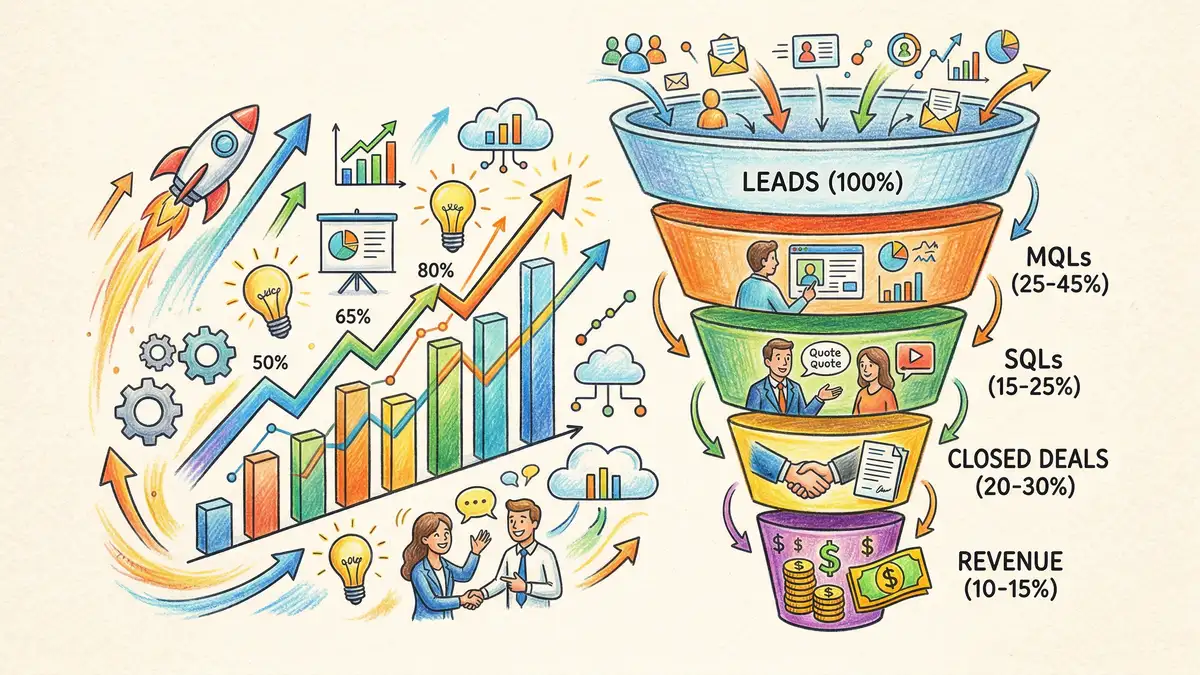
Understanding what "good" looks like at each funnel stage prevents you from either abandoning a working strategy too early or persisting with an underperforming one. These benchmarks are drawn from aggregate B2B data and should be calibrated to your specific industry and average contract value.
| Funnel Metric | Average Benchmark | Top Performer | What Moves the Needle |
|---|---|---|---|
| Visitor-to-Lead (with video) | 2.5–4.8% | 5%+ | Contextual CTAs within video, gated content offers |
| Lead-to-MQL | 20–40% | 35–45% | Video-based lead scoring, engagement thresholds |
| MQL-to-SQL | 20–35% | 35%+ | Sales using video intel, personalised follow-up |
| SQL-to-Opportunity | 30–50% | 50%+ | Case study videos, ROI calculators with video |
| Opportunity-to-Won | 20–35% | 35%+ | Personalised proposal videos, testimonial sharing |
Industry context matters significantly. SaaS companies typically see 1.1% visitor-to-lead rates at baseline, while professional services can reach 7.4%. The benchmarks above represent the lift you should expect when adding video to an existing funnel — not absolute conversion rates across all B2B. For a more detailed breakdown of video ROI data, see our B2B video marketing statistics and benchmarks analysis.
Frequently Asked Questions
What is a B2B video marketing funnel?
A B2B video marketing funnel is a strategic framework that maps specific video content types to each stage of the buyer journey — awareness, consideration, and decision. Each stage uses different video formats, lengths, distribution channels, and CTAs to move buyers toward a purchase decision while tracking engagement through CRM attribution.
How long should B2B videos be at each funnel stage?
Awareness videos perform best at 30–90 seconds. Consideration content ranges from 3–45 minutes depending on format (product demos are shorter, webinars are longer). Decision-stage videos typically work best at 1–5 minutes. The key principle is matching length to the viewer's commitment level at each stage.
Which video types generate the most B2B leads?
Webinars are the highest-converting format, with 20–40% of attendees becoming qualified leads. Explainer videos (used by 73% of marketers) are the most widely produced. Product walkthroughs drive the strongest consideration-stage engagement, with 57% of B2B buyers watching demos during evaluation.
How do you measure video ROI in B2B marketing?
Measure video ROI by connecting engagement to commercial outcomes through your CRM. Track video-influenced pipeline (total deal value where video was a touchpoint), MQL contribution (percentage of MQLs with video engagement), and sales cycle impact (days-to-close for video-engaged versus non-engaged contacts). Views alone are not an ROI metric.
What is the best platform for B2B video distribution?
LinkedIn is the dominant B2B video platform, used by 70% of video marketers and delivering 39% more shares than other channels for business content. However, a full funnel requires multiple channels: LinkedIn for awareness, YouTube for educational discovery, your website for conversion, and direct outreach for decision-stage engagement.
Can HubSpot track video engagement and attribute revenue?
Yes. HubSpot integrates with video platforms like Vidyard and Wistia to capture engagement events on contact records. When paired with UTM tracking, lifecycle stage workflows, and multi-touch attribution reporting, HubSpot can show which videos influenced specific deals and revenue. This requires proper configuration — Whitehat's HubSpot onboarding sets this up as part of the standard implementation.
Clwyd Probert
CEO & Founder, Whitehat SEO
Clwyd founded Whitehat in 2011 and has been a HubSpot Solution Partner since 2016. He helps B2B companies build inbound marketing systems that connect content to pipeline — replacing random acts of marketing with revenue-accountable strategy. He hosts the largest London HubSpot User Group and speaks regularly on AI optimisation and B2B content strategy.
Ready to Build a Video Funnel That Drives Pipeline?
Whitehat builds B2B video strategies connected to HubSpot CRM — so every view, click, and conversion is tracked and attributed to revenue. Start with a free consultation.
Book a Free Consultation