

The Ultimate Guide to Digital Marketing Agencies (2026): How to Choose the Right Partner
By Clwyd Probert · Whitehat SEO Ltd · London, UK
In 2025, the “right” digital marketing agency is the one that builds revenue infrastructure—measurement, automation, and buyer trust—not just campaigns. This matters because search is increasingly zero-click and B2B buyers self-educate for most of the journey. This guide shows what to demand, what to ignore, and how to vet partners who can prove impact in pipeline and revenue.
If your reporting is a mess (or HubSpot feels like a Ferrari you’re driving in first gear), start here: HubSpot onboarding and revenue tracking setup. You’ll get faster clarity than buying another month of “traffic”.
1) The 2025 reality: traffic isn’t the goal anymore
A digital marketing agency in 2026 must optimise for visibility in answer engines (AI Overviews, ChatGPT-style tools, featured snippets) as well as classic search. According to SparkToro’s 2024 zero-click study, only a minority of Google searches result in an “open web” click—meaning you can’t build a plan that assumes every query turns into a website visit.
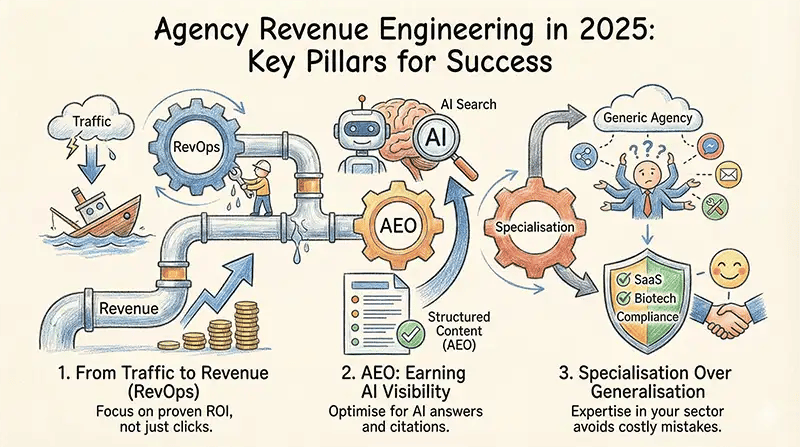
That’s why modern SEO is increasingly paired with Answer Engine Optimisation: content structured so it can be extracted, cited, and trusted. If you want this done properly (and not as a buzzword), see Answer Engine Optimisation services and make sure your partner can explain, in plain English, how you will be cited—not just ranked.
Quick stat you can use in the boardroom:
B2B buyers typically complete around 70% of their buying journey before they engage sellers, based on 6sense research—so your content and proof of expertise must do more of the selling before your sales team even gets a chance.
2) In-house vs agency: the UK cost equation has changed
The “just hire one marketing manager” plan collapses in 2026 because the skill stack is wider: technical SEO/AEO, conversion, paid media, CRM automation, reporting, and content that doesn’t sound like a robot wrote it. You don’t need more activity; you need an operating system for revenue.
A practical benchmark: if you can’t confidently show where ROI comes from, you’re not alone. In a Carney & Quill marketing trends report, 40% of marketers said proving ROI is their biggest challenge. That’s exactly the gap a capable agency should close—ideally with clean attribution, dashboards, and CRM integration (not a monthly PDF of vanity metrics).
If “measurement” currently means spreadsheets and crossed fingers, a good starting point is a proper website audit plus CRM reporting clean-up—so you can tie marketing to pipeline, not vibes.
3) The services that actually matter (and the ones to ignore)
A modern agency should prioritise what drives compounding results: technical SEO + AEO, conversion optimisation, HubSpot automation, and paid media that connects to revenue. The goal is to reduce “random acts of marketing” and increase predictable, measurable demand.
- Must-have: Technical SEO that improves crawlability, speed, and structured data. See SEO services.
- Must-have: CRM + RevOps support so you can trace marketing activity to pipeline. Start with HubSpot onboarding.
- Must-have: Integrated programmes that align channels to a single revenue story. See B2B marketing services.
- Ignore: “Guaranteed #1 rankings”, secret sauce link packages, and reporting that won’t show you costs, conversion rates, and pipeline impact.
4) Why specialisation matters in B2B (SaaS and Life Sciences)
Generalists struggle in complex B2B categories because the buyer journey is longer, stakeholders are more risk-averse, and proof requirements are higher. If your agency can’t talk fluently about pipeline stages, lifecycle definitions, and compliance constraints, you’ll pay for activity but not outcomes.
This matters even more in an AI-saturated content world: dull, generic output becomes invisible. Research connected to “The Extraordinary Cost of Dull” highlights that dull communications can require significantly more media spend to achieve comparable impact. Translation: distinctiveness is not a “nice to have” — it’s budget efficiency.
5) How to vet an agency (the selection framework)
A confident agency should welcome scrutiny. Your goal is to find a partner that’s transparent, technically competent, and built around measurable outcomes—not pitch theatre.
The 6 questions to ask in every pitch
- “How do you measure success?” (You want pipeline, CAC, and revenue—not just clicks.)
- “Show me a live dashboard.” (If it’s always a PDF, you’ll never get clarity.)
- “Who do I work with weekly?” (Avoid the ‘A-team sells, interns deliver’ problem.)
- “How do you handle attribution?” (UTMs, lifecycle stages, CRM reporting, closed-loop.)
- “What is your AI policy?” (AI can help, but humans must own accuracy and brand voice.)
- “What will you deliver in the first 30 days?” (A real plan, not hand-waving.)
If you want a reality check quickly, use a structured discovery call and get clarity on fit before you commit: contact Whitehat.
6) What a good first 90 days looks like (so you don’t get rinsed)
A strong onboarding period prevents scope creep, confusion, and “busy work”. You should see a clear plan that sequences strategy, technical foundations, and launch—plus training so your team isn’t dependent forever.
- Weeks 1–2: discovery, goal alignment, KPI definitions, tracking decisions.
- Weeks 3–6: technical fixes, CRM automation, reporting, content structure for AEO.
- Weeks 7–8: launch, conversion improvements, role-based training.
- Weeks 9–12: optimisation, pipeline analysis, and a board-ready narrative.
If HubSpot is part of your stack, make sure onboarding includes lifecycle stages, lead routing, and closed-loop reporting. That’s exactly what HubSpot onboarding should deliver.
Conclusion: choose a partner who can prove revenue impact
In 2025, the risk isn’t just hiring the wrong agency—it’s paying for activity that never becomes revenue. Search behaviour is changing, buyers self-educate longer, and AI tools increasingly influence which brands get trusted. Your partner must combine technical competence with measurement discipline and clear communication.
Want the fastest path to clarity? Start with a plan that connects marketing to money: integrated B2B marketing services, or book time directly: speak to a strategist.
Frequently Asked Questions
What does a digital marketing agency do in 2026?
In 2026, a strong digital marketing agency builds revenue infrastructure, not just campaigns. That means connecting SEO/AEO, paid media, content, and CRM automation so marketing results can be traced to pipeline and revenue, with dashboards your leadership team can trust.
How much does a digital marketing agency cost in the UK?
UK agency costs vary widely based on scope, specialism, and whether delivery includes strategy, content, paid media, and CRM work. The best way to compare is by outcomes: pipeline created, CAC reduced, and clarity of attribution—not just a monthly retainer number.
Should I hire an agency or build an in-house team?
If you need multiple specialist skills quickly, an agency often delivers faster time-to-impact than hiring. Many teams go hybrid: keep strategic ownership in-house and outsource specialist execution like technical SEO/AEO, HubSpot architecture, and paid media optimisation.
What questions should I ask a marketing agency before hiring?
Ask how they measure success, what dashboards you’ll get, who you’ll work with weekly, and how they handle attribution. You should also ask about their AI policy, account transparency, and what the first 30–90 days will look like in practical deliverables.
How long does it take to see results from a marketing agency?
Paid media and conversion work can show impact in weeks, while SEO and authority building typically take longer. A professional plan defines early leading indicators (tracking and conversion rate) and ties them to lagging indicators (pipeline and closed-won revenue).
What are the biggest red flags when choosing an agency?
Guaranteed rankings, hidden ad accounts, vague reporting, unclear onboarding, and AI-only content production are major red flags. If a partner can’t show transparency, measurement discipline, and a clear delivery process, you’ll likely end up paying for motion instead of progress. view our pricing
References
- SparkToro — 2024 Zero-Click Search Study: https://sparktoro.com/blog/2024-zero-click-search-study-for-every-1000-us-google-searches-only-374-clicks-go-to-the-open-web-in-the-eu-its-360/
- 6sense — Buyers spend ~70% of the journey researching before contacting sellers (research summary article): https://6sense.com/blog/dont-call-us-well-call-you-what-research-says-about-when-b2b-buyers-reach-out-to-sellers/
- Carney & Quill — 2024 Marketing Trends Report (PDF): https://assets-global.website-files.com/5dafa392fcdc196abf1f613a/65cd51ebba06d364e63c9609_240214-quill-carney-marketing-report.pdf
- Ahrefs — AI search traffic conversion analysis: https://ahrefs.com/blog/ai-search-traffic-conversions-ahrefs/
- The Extraordinary Cost of Dull — source overview and supporting materials: https://system1group.com/the-extraordinary-cost-of-dull
- Whitehat — Contact details: https://whitehat-seo.co.uk/contact
- Whitehat — Answer Engine Optimisation: https://whitehat-seo.co.uk/answer-engine-optimisation