
AI & Technology
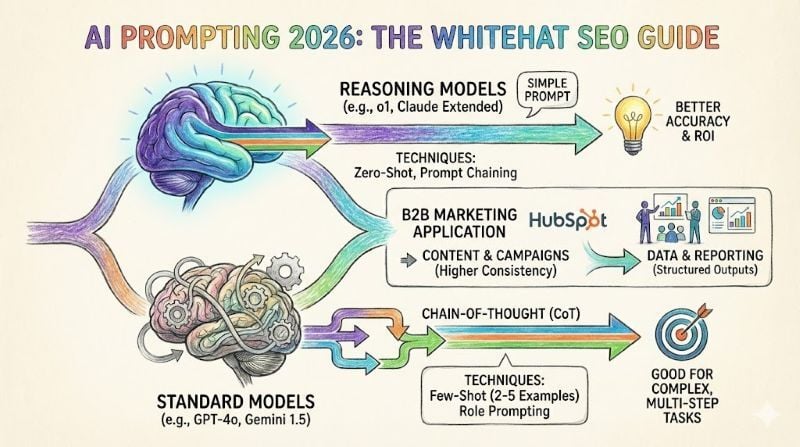
The most effective AI prompting approach in 2026 depends entirely on which model you're using. For reasoning models like OpenAI's o1/o3 and Claude's extended thinking, simpler prompts now outperform complex chain-of-thought instructions—the model handles reasoning internally. According to the Wharton Prompting Science Report (June 2025), chain-of-thought prompting delivers only 2.9-3.1% improvement on reasoning models whilst requiring 20-80% more processing time. Whitehat SEO's work with B2B clients across HubSpot, marketing automation, and AI implementation projects confirms this shift: the marketers getting results have fundamentally changed their approach.
AI Prompting Techniques for B2B Marketers: The 2026 Guide
Why reasoning models have changed everything—and what actually works now
How Reasoning Models Changed Everything
The arrival of reasoning models represents the most significant development in AI prompting since GPT-4's launch. OpenAI's o1 and o3, Anthropic's Claude with extended thinking (launched February 2025), and Google's Gemini 3 all incorporate internal deliberation that fundamentally changes how marketers should structure their prompts.
Where SmartGPT-era techniques prescribed elaborate multi-step reasoning instructions, today's best practice for reasoning models is simplicity and clarity. OpenAI's official guidance now states that these models perform best with straightforward prompts—you should trust the model's inherent reasoning abilities rather than micromanaging the thinking process.
Anthropic's guidance: "When using extended thinking, start by removing all chain-of-thought guidance from your prompts."
This represents a paradigm inversion. Whitehat SEO's AI marketing work with mid-market B2B companies shows that teams still using 2023-era prompting techniques are wasting tokens and often getting worse results. The models have evolved faster than most prompting practices.
The Five Most Effective Prompting Techniques for B2B Marketing
Zero-Shot Prompting: The New Default
Zero-shot prompting—asking AI to perform a task without providing examples—has gained significant ground as models improve. For reasoning models, this is now the recommended starting point. The key is being exceptionally clear about what you want rather than showing the model how to think.
When to use zero-shot: Content ideation, first-draft creation, data analysis, strategic recommendations. Essentially, any task where the model's training covers the domain well.
Few-Shot Prompting: Precision Through Examples
Few-shot prompting—providing 2-5 examples of desired output—remains powerful for precision tasks where consistent formatting matters. According to Sander Schulhoff, founder of Learn Prompting and co-author of the most comprehensive prompting study (analysing 1,500+ papers with OpenAI, Microsoft, Google, Princeton, and Stanford), few-shot can improve accuracy from 0% to 90% in specific scenarios.
Whitehat SEO's Few-Shot Guidelines:
- Optimal range: 2-5 examples (diminishing returns after 4-5)
- Example order matters: Optimal sequences achieve near state-of-the-art results; poor ordering drops to chance levels
- Surprising finding: Even random labels in proper format outperform no examples at all
When to use few-shot: Email sequences requiring specific tone, HubSpot workflow descriptions, case study formatting, social media posts following brand guidelines.
Chain-of-Thought: Use Selectively
For non-reasoning models (GPT-4o, Claude 3.5, Gemini 1.5), chain-of-thought prompting remains valuable—but with caveats. Wharton's research found that whilst CoT improves average performance slightly, it can introduce more variability in answers and occasionally trigger errors.
The field has expanded into multiple "Chain-of-X" paradigms documented in a 2025 ACL survey: Chain-of-Utterances, Chain-of-Logic, Visual CoT, and Think-on-Graph. Multimodal CoT from Meta and AWS combines language and visual data in two stages: rationale generation and answer inference.
When to use chain-of-thought: Complex multi-step problems with non-reasoning models, mathematical calculations, debugging code, analysing competitor positioning.
Prompt Chaining: Breaking Complexity into Steps
Rather than cramming everything into one massive prompt, prompt chaining breaks complex tasks into sequential, linked prompts. Each step's output becomes the next step's input. This approach works across all model types and produces more reliable results for multi-stage marketing workflows.
When to use prompt chaining: Content calendar development, campaign planning, persona creation, competitive analysis reports. For HubSpot implementations, Whitehat SEO uses prompt chaining to develop buyer personas, then map content to journey stages, then create specific assets.
Role Prompting: Tone Over Accuracy
Assigning AI a specific role ("You are an experienced B2B content strategist...") is useful for setting tone and perspective, but research confirms it's largely ineffective for improving factual accuracy. Use role prompting to influence voice and framing, not to make the model smarter about a subject.
When to use role prompting: Brand voice consistency, perspective-taking exercises, creating content that sounds like it comes from a specific department or persona.
Model-Specific Optimisation for B2B Marketing
Each major AI platform has distinct characteristics that affect prompting strategy. Enterprise LLM spend has shifted dramatically: according to Menlo Ventures' 2025 research, Anthropic (Claude) now commands 40% of enterprise spend (up from 24% in 2024), whilst OpenAI dropped from 50% to 27%. Claude also holds 54% market share for enterprise coding versus OpenAI's 21%.
| Model | Best For | Prompting Approach |
|---|---|---|
| GPT-4o / GPT-5 | Creative content, multimodal tasks | Pin to specific model snapshots for production |
| OpenAI o1/o3 | Complex reasoning, analysis | Simple prompts; avoid CoT instructions |
| Claude 3.7 / 4 | Long-form content, nuanced analysis | Use XML tags for structure; clear system prompts |
| Claude Extended Thinking | Complex strategy, multi-step problems | Remove all CoT guidance; let model reason |
| Gemini 3 | Google ecosystem integration | Keep temperature at default 1.0 |
Anthropic's Official Best Practices (Ranked by Impact)
- Be clear and direct: Strip out fluff, use plain language
- Use examples (multishot prompting): Show, don't just tell
- Let Claude think: Encourage step-by-step reasoning (for non-extended-thinking)
- Use XML tags: Structure prompts with <thinking> and <answer> tags
- Give Claude a role: Define persona and context in system prompt
- Prefill responses: Start the output to guide format
Temperature and Parameter Settings That Work
Temperature controls randomness in AI outputs. For B2B marketing, getting this right means the difference between reliable, professional content and unpredictable results that require heavy editing.
| Marketing Task | Temperature | Top-P |
|---|---|---|
| Data extraction, reporting | 0.0-0.2 | 0.1 |
| Technical documentation, specs | 0.2-0.4 | 0.3 |
| Customer communications, emails | 0.5-0.7 | 0.7 |
| Creative campaigns, brainstorming | 0.8-1.0 | 0.9 |
⚠️ Critical Rule
Adjust temperature OR top-p, not both simultaneously. Changing both creates unpredictable interactions. For Gemini 3 specifically, Google strongly recommends keeping temperature at the default 1.0—the model's reasoning capabilities are optimised for this setting.
Structured Outputs: The Enterprise Standard
All three major providers now offer structured output capabilities that guarantee JSON Schema compliance—a critical advancement for marketing automation and HubSpot workflow integrations. This means AI outputs can flow directly into CRM fields, marketing automation sequences, and reporting dashboards without manual reformatting.
OpenAI introduced structured outputs in August 2024 with guaranteed schema compliance. Use response_format.type: "json_schema" or set strict: true on function calls.
Anthropic released structured outputs in November 2025 (public beta). Requires a specific header and output_format parameter.
Google Gemini uses response_mime_type: "application/json" with a response_schema parameter, supporting streaming structured outputs.
Implementation Best Practices for Marketing Teams
- Use Pydantic (Python) or Zod (TypeScript) for type-safe schema definitions
- Mark all fields as required and set
additionalProperties: false - Use lower temperature (0.1-0.3) when consistency matters
- Set adequate
max_tokensto avoid truncation
Enterprise Prompt Governance: What Most Guides Miss
A broader discipline called context engineering has emerged that encompasses prompt engineering. Anthropic's engineering blog explains that given LLMs are constrained by a finite attention budget, good context engineering means finding the smallest possible set of high-signal tokens that maximise the likelihood of the desired outcome.
Context engineering includes managing system prompts, retrieved documents (RAG), session state, and tool definitions—not just the user prompt itself. For B2B marketing teams, this means thinking about the entire information architecture around your AI workflows.
Building a Prompt Library
Whitehat SEO recommends that marketing teams maintain a version-controlled prompt library with:
- Standardised templates for common tasks (email sequences, blog outlines, social posts)
- Version history tracking what changed and why
- Performance notes documenting which prompts work well for which models
- Brand voice guidelines embedded in reusable system prompts
- Compliance checkpoints especially for regulated industries like healthcare and financial services
Enterprise Prompt Management Platforms
| Platform | Best For | Pricing |
|---|---|---|
| PromptLayer | Non-technical teams, A/B testing | Free tier; Pro ~£40/user/mo |
| LangSmith | LangChain ecosystem | Free tier; Plus £31/user/mo |
| Langfuse | Self-hosting requirements | Open source; Enterprise custom |
| Promptfoo | CI/CD integration, red teaming | Free (open source) |
The Business Case: Prompt Engineering ROI
The productivity gains from AI are well-documented, but prompt engineering specifically delivers measurable advantages:
340%
Higher ROI for companies mastering prompt engineering vs. basic prompting
76%
Cost reduction for API calls with engineered prompts
67%
Average productivity improvement from structured frameworks
30-70%
Improvement in output quality and consistency
The prompt engineering market itself is projected to grow from £0.68 billion (2024) to £2.74 billion (2029) at a 32.1% CAGR—a clear signal that businesses recognise this as a critical capability, not a passing skill.
Enterprise AI Investment Context
According to the Stanford AI Index 2025 and McKinsey's research:
- 78% of organisations now use AI in at least one function
- 71% regularly use generative AI (up from 33% in 2023)
- £37 billion enterprise GenAI spending in 2025 (3.2x year-over-year growth)
- £10.30 returns per pound invested for top AI performers (IDC 2024)
Common B2B Marketing Prompting Mistakes
Using 2023 techniques with 2026 models
Chain-of-thought prompting on reasoning models wastes tokens and time. Match your technique to the model.
Over-relying on role prompting for accuracy
Role prompting helps with tone, not correctness. Use it for voice consistency, not subject matter expertise.
Ignoring example order in few-shot prompts
Example sequence dramatically affects performance. Test different orderings, don't assume.
Adjusting temperature AND top-p simultaneously
These parameters interact unpredictably. Change one, leave the other at default.
Underestimating security risks with AI agents
As Schulhoff notes, prompt injection remains unsolvable and AI agents are far more vulnerable than chatbots.
Getting Started: A 30-Day Implementation Roadmap
Week 1: Audit and Assessment
- Document current AI usage across your marketing team
- Identify which models team members are using and for what tasks
- Collect existing prompts and assess which techniques are being applied
- Establish baseline productivity and quality metrics
Week 2: Technique Matching
- Map your key marketing tasks to optimal prompting techniques
- Update any legacy chain-of-thought prompts being used with reasoning models
- Create few-shot examples for tasks requiring consistent formatting
- Document temperature settings by task type
Week 3: Infrastructure
- Set up a shared prompt library (even a simple shared doc works to start)
- Create standardised templates for your top 5 recurring tasks
- Establish version control and change documentation practices
- If using structured outputs, set up schema definitions
Week 4: Measurement and Iteration
- Compare outputs using updated techniques vs. baseline
- Document time savings and quality improvements
- Identify prompts that aren't performing and iterate
- Schedule monthly prompt library reviews
Frequently Asked Questions
Should I still use chain-of-thought prompting?
It depends on the model. For reasoning models like OpenAI's o1/o3 and Claude's extended thinking, avoid chain-of-thought—these models handle reasoning internally. For standard models like GPT-4o and Claude 3.5, chain-of-thought remains useful for complex multi-step problems but can introduce variability.
How many examples should I include in few-shot prompts?
Research shows 2-5 examples is optimal, with diminishing returns after 4-5. Focus on quality over quantity—well-chosen examples in the right order outperform more examples in random order. Test different sequences to find what works for your specific task.
What temperature should I use for marketing content?
For customer communications and emails, 0.5-0.7 provides a good balance of consistency and natural variation. For creative campaigns and brainstorming, increase to 0.8-1.0. For data extraction and technical documentation, keep it low at 0.0-0.4. Never adjust both temperature and top-p simultaneously.
Is prompt engineering worth investing time in given how fast models improve?
Yes. Companies mastering prompt engineering see 340% higher ROI on AI investments versus basic prompting. The techniques evolve (as this guide shows), but the discipline of understanding how to communicate effectively with AI systems becomes more valuable as AI becomes more central to marketing operations.
Which AI model should B2B marketers prioritise?
Enterprise adoption has shifted significantly toward Claude, which now commands 40% of enterprise LLM spend (up from 24% in 2024). However, the best approach is model-matching: use different models for different tasks based on their strengths, and ensure your team understands each model's optimal prompting approach.
Ready to Transform Your Marketing Team's AI Capability?
Whitehat SEO's AI consultancy services help B2B marketing teams build systematic AI capabilities that deliver measurable ROI. From prompt library development to HubSpot AI integration, we focus on practical implementation—not theoretical frameworks.
References and Further Reading
- Wharton Prompting Science Report 2 (June 2025) — papers.ssrn.com
- Stanford AI Index Report 2025 — aiindex.stanford.edu/report
- OpenAI Prompt Engineering Guide — platform.openai.com/docs/guides/prompt-engineering
- Anthropic Prompt Engineering Overview — docs.anthropic.com
- Menlo Ventures State of Generative AI in Enterprise (2025) — menlovc.com
- McKinsey State of AI Report — mckinsey.com
- Google Gemini Prompting Strategies — ai.google.dev
- DAIR.AI Prompting Guide — promptingguide.ai