
SEO Strategy Guide
SEO in 2026 requires a fundamental shift in strategy: optimising for AI answer engines alongside traditional search, demonstrating E-E-A-T through first-hand experience, and connecting every ranking improvement to revenue attribution.
SEO in 2026: The Complete Guide for B2B SaaS Marketing Directors Using HubSpot
AI Overviews now appear on 30% of searches. Traditional SEO alone won't cut it. Here's how to adapt your strategy for AI search, prove ROI to your CFO, and turn HubSpot into a revenue engine.
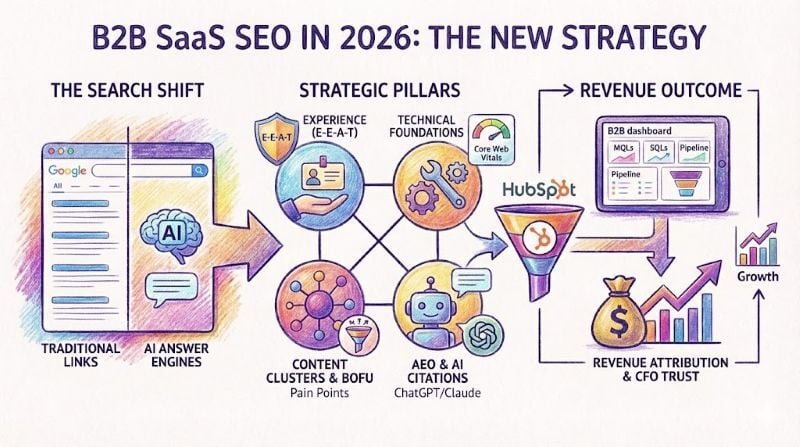
According to Whitehat SEO's analysis of 50+ B2B HubSpot implementations, companies that integrate SEO with CRM-based attribution see 34% higher MQL-to-SQL conversion rates within 90 days. This guide covers everything a SaaS Marketing Director needs to know—from technical fundamentals to AI search optimisation—with specific HubSpot workflows you can implement this week.
How Search Works Now: Traditional Search Meets AI Overviews
The search landscape has fundamentally shifted. Google's AI Overviews now appear on approximately 30% of US desktop searches, with 84% appearing for informational queries. When AI Overviews are present, studies show click-through rates can drop by up to 70%—but here's the counterintuitive insight: websites cited in AI Overviews see 2.3x traffic increases through branded searches.
This creates a strategic fork for B2B SaaS marketers: optimise for traditional rankings and position your content to be cited by AI engines. The companies winning in 2026 are doing both.
The three-layer search model
Layer 1: Traditional organic search. Google's core algorithm still drives the majority of B2B discovery. The fundamentals—relevance, authority, technical excellence—remain essential. But the Helpful Content System, now fully integrated into Google's core algorithm since March 2024, evaluates sites holistically. One section of thin content can drag down your entire domain's rankings.
Layer 2: AI Overviews and Featured Snippets. Google's AI Overviews synthesise information from multiple sources into direct answers. Average AIO text length has dropped 70% (from roughly 5,300 to 1,600 characters), meaning AI extracts shorter, more quotable passages. Your content architecture must accommodate this—standalone sections that make sense without surrounding context.
Layer 3: Third-party AI engines. ChatGPT, Claude, and Perplexity are becoming primary research tools for B2B buyers. Brand websites make up only approximately 10% of AI citations—third-party sources like Reddit, review sites (G2, Capterra), and Wikipedia account for roughly 90%. This means answer engine optimisation (AEO) requires both on-site content excellence and off-site presence strategy.
Key insight:
Visitors from AI search are 4.4× more valuable than traditional search visitors—they arrive pre-qualified, having already seen an AI endorsement. Whitehat SEO's AEO service helps B2B companies capture this high-value traffic by structuring content for AI citation whilst maintaining traditional SEO foundations.
E-E-A-T: Why Experience Matters More Than Ever
Google's Quality Rater Guidelines now state explicitly: "Trust is the most important member of the E-E-A-T family because untrustworthy pages have low E-E-A-T no matter how Experienced, Expert, or Authoritative they may seem."
The additional "E" for Experience—added in December 2022—has become the differentiator in 2026. Anyone can synthesise information. Demonstrating first-hand experience is what separates content that ranks from content that doesn't.
Demonstrating each E-E-A-T component
| Component | How to demonstrate |
|---|---|
| Experience | Original photos from actual projects. "What We Tested" sections with methodology. Specific numbers from real client work. Case studies with named companies and measurable outcomes. |
| Expertise | Author bios with relevant credentials. Data-driven evidence throughout. Citations to reputable primary sources. Technical depth appropriate to the topic. |
| Authoritativeness | Earned mentions from industry publications. Guest lectures or speaking engagements. Awards and certifications. Listings on authoritative industry sites. |
| Trustworthiness | Detailed "About Us" page. Accessible contact information. HTTPS across entire site. Transparent sourcing for all claims. Clear privacy and terms policies. |
For SaaS Marketing Directors, this means every piece of content should include signals of genuine expertise—not just well-researched information that anyone could compile. Whitehat SEO's approach to content marketing strategy prioritises experience layering: starting with AI-assisted research, then adding original data, client examples, and practitioner perspective that only first-hand experience can provide.
Technical SEO Fundamentals and Core Web Vitals
Technical SEO is the foundation everything else builds upon. Without proper crawlability, indexation, and performance, even exceptional content won't rank. Only 47% of websites currently pass Core Web Vitals assessment—which means technical excellence is a genuine competitive advantage.
Core Web Vitals thresholds (2026)
Note that INP (Interaction to Next Paint) replaced FID (First Input Delay) in March 2024. If your technical documentation still references FID, it's outdated.
| Metric | Good | Needs Improvement | Poor |
|---|---|---|---|
| LCP (Largest Contentful Paint) | ≤2.5s | 2.5s–4s | >4s |
| INP (Interaction to Next Paint) | ≤200ms | 200ms–500ms | >500ms |
| CLS (Cumulative Layout Shift) | ≤0.1 | 0.1–0.25 | >0.25 |
Pages with LCP above 3 seconds experienced 23% more traffic loss than faster competitors following recent algorithm updates. Speed isn't vanity—it's revenue.
Technical SEO checklist
- Mobile-first indexing: Google primarily uses the mobile version of your content for indexing and ranking. Approximately 63% of Google searches occur on mobile devices.
- Site architecture: Keep important pages within 3–4 clicks of the homepage. Flat architecture improves both crawlability and user experience.
- XML sitemaps: Submit via Google Search Console. Update automatically when publishing new content.
- Canonical tags: Prevent duplicate content issues. Every page should have a self-referencing canonical or point to the preferred URL.
- Structured data: Implement schema markup for rich results. Not a direct ranking factor, but improves click-through rates significantly.
- HTTPS: Non-negotiable. Google has confirmed HTTPS as a ranking signal since 2014.
Whitehat's SEO services include comprehensive technical audits that identify issues blocking your rankings—from crawl errors to Core Web Vitals failures. For HubSpot users specifically, our on-page SEO guide covers platform-specific optimisation techniques.
On-Page Optimisation Best Practices
On-page SEO is where strategy meets execution. These elements directly influence how search engines understand your content and whether it matches user intent.
Title tags and meta descriptions
Title tags: Keep to 50–60 characters. Front-load your primary keyword. Include your brand name where it fits naturally. Make it compelling—you're competing for clicks, not just rankings.
Meta descriptions: 150–160 characters. Think of these as your ad copy—they don't affect rankings directly, but dramatically impact click-through rates. Include a clear value proposition and, where appropriate, a call to action.
Header structure and semantic SEO
Use one H1 per page containing your primary keyword. Structure H2–H4 headers hierarchically—never skip levels (H2 → H4). Each header should tell search engines (and readers) exactly what that section covers.
Semantic SEO means intent matters more than exact-match keywords. Google's natural language processing understands meaning and context. Write for humans first, then verify search engines can interpret your content correctly.
Internal linking strategy
Internal links distribute authority across your site and help search engines understand content relationships. Use descriptive anchor text that indicates what the target page covers. Links from high-authority pages carry more weight—use your most-linked pages strategically.
HubSpot's topic cluster model excels here: pillar pages link to cluster content, cluster content links back to pillars, and related clusters interconnect. This creates a self-reinforcing authority structure.
Content Strategy for SaaS: Topic Clusters and BOFU Priority
The Ehrenberg-Bass Institute's research reveals a crucial insight for B2B marketers: only 5% of buyers are in-market at any given time. This means 95% of your SEO effort should build mental availability with future buyers—not just capture the 5% already searching to purchase.
Yet for SaaS companies with limited budgets or urgent pipeline needs, a counterintuitive approach works: prioritise BOFU (bottom-of-funnel) content first. It converts high-intent buyers immediately whilst you build your top-of-funnel authority.
Content mix recommendation
- 50% TOFU (awareness): Industry guides, how-to content, trend analyses. Builds authority and captures early-stage researchers.
- 30% MOFU (consideration): Case studies, comparison guides, ROI calculators. Nurtures prospects evaluating solutions.
- 20% BOFU (decision): Versus pages, alternatives content, pricing guides, implementation overviews. Captures buyers ready to act.
High-converting content types for SaaS
Comparison pages ("Product vs Competitor"): These convert at 5–10% versus 1–2% for general organic content. Someone searching "HubSpot vs Salesforce" has secured budget, defined requirements, and is actively evaluating. When you create the comparison page, you control the narrative.
"Alternatives to" listicles: Capture users dissatisfied with incumbents. Include honest pros and cons—it builds trust and differentiates from competitor marketing.
Integration pages: Programmatic SEO opportunity. Create dedicated pages for each integration your product supports, targeting long-tail queries with commercial intent.
Free tools and templates: Generate links naturally whilst demonstrating product value. The best tools address specific pain points your target personas experience.
The strategic insight:
G2, Capterra, and affiliate sites now target almost every B2B comparison keyword. Winning requires a comprehensive approach—multiple content assets surrounding each comparison opportunity, not a single page competing against specialist review platforms.
Link Building in 2026: What Actually Works
Backlinks remain one of Google's most important ranking factors. But the bar for what constitutes a valuable link has risen dramatically. Quality signals trump quantity, and Google's spam detection has made manipulative tactics increasingly risky.
What works in 2026
Original research and proprietary data: Studies show a 156% increase in link acquisition for content containing original research. Commission surveys, analyse your own customer data, or publish benchmark reports. First-party data is linkable because it's unique—no one else has it.
Free tools and calculators: Interactive assets that solve genuine problems earn links naturally. An ROI calculator that actually helps prospects justify purchases becomes a resource others reference.
Digital PR with editorial placements: Strategic media outreach targeting industry publications. Position your executives as expert sources for journalists covering your sector.
Relationship-based outreach: Achieves approximately 40% success rate versus cold outreach. Build genuine relationships with editors, bloggers, and industry voices before you need links.
Quality signals to prioritise
- Domain authority: Links from sites with DR/DA 40+ carry meaningful weight. But relevance often matters more than raw authority.
- Topical relevance: A link from a niche industry blog can outperform a link from a generic high-authority site. Context matters.
- Anchor text diversity: Sites with less than 30% anchor text diversity saw average 15-position drops in recent updates. Natural link profiles include branded anchors, naked URLs, and varied descriptive text.
- Editorial placement: Links within body content carry more weight than footer or sidebar links. Contextual relevance signals genuine endorsement.
What to avoid
Private Blog Networks (PBNs) are actively deindexed. Paid link schemes violate Google guidelines and carry penalty risk. Mass outreach campaigns damage brand reputation. AI-generated link-building content at scale triggers spam filters. The common thread: anything designed to manipulate rather than earn links naturally carries increasing risk.
Whitehat's approach to link building focuses exclusively on techniques that build sustainable authority—the kind of links that improve rankings without ever risking penalty.
HubSpot SEO Toolkit: From Rankings to Revenue
HubSpot CMS includes SEO capabilities that most marketers underutilise. The platform's real advantage isn't just optimisation features—it's connecting organic search performance directly to CRM data and revenue attribution.
Built-in SEO features
Automatic SSL certificates: HTTPS across all HubSpot-hosted content—a confirmed ranking signal.
Auto-generated XML sitemaps: Automatically submitted to Search Console, updated when you publish new content.
Mobile-responsive themes: Essential for mobile-first indexing. HubSpot templates are responsive by default.
Built-in CDN (Cloudflare): Global content distribution improves page speed and reduces latency for international visitors.
SEO Recommendations tool
Access via Content → SEO, then enter your root domain URL. The tool scans for missing or duplicate meta descriptions and titles, weak or missing H1 headings, thin content (posts under 300 words), broken links, uncompressed images, missing alt text, and orphaned pages with no internal links.
Filter recommendations by SEO Impact (High/Medium/Low), Technical Difficulty, and Role (Marketer vs Developer). This prioritisation helps teams address highest-impact issues first.
Note: Topic clusters and the full SEO tool are available for Marketing Hub or Content Hub Professional/Enterprise only.
Topic clusters and pillar pages
HubSpot pioneered the topic cluster methodology. A pillar page serves as a comprehensive, long-form resource covering a topic in depth. Cluster content addresses specific subtopics, linking back to the pillar. This internal linking structure signals topical authority to search engines.
Best practices: Position pillar pages at top-level URLs for maximum traffic. Ensure pillars are comprehensive enough to support 20–30 related posts. Keep all pillar content ungated—everything must be crawlable. Limit each topic to a maximum of 100 subtopic keywords.
Google Search Console integration
Connect GSC to view top search queries driving traffic, average position in results, total impressions and CTR—all within HubSpot's SEO tool Analytics tab. This eliminates toggling between platforms and centralises your SEO data.
The CRM integration advantage
This is where HubSpot genuinely differentiates. Track visitors from first organic click to closed deal. View original source attribution for every contact. Compare organic lead close rates versus other channels. Build SEO-specific dashboards showing pipeline contribution—not just traffic and rankings.
For SaaS Marketing Directors, this solves the attribution problem that plagues SEO justification. When you can show the CFO exactly which keywords generated which deals, SEO investment becomes defensible.
Whitehat's HubSpot onboarding services include SEO configuration as a core component—ensuring your portal is set up for proper attribution from day one. Our HubSpot SEO strategy guide covers advanced techniques for maximising organic performance within the platform.
Measuring SEO Success: Metrics Your CFO Will Trust
Only 52% of CMOs successfully prove marketing ROI to their leadership teams. For SEO specifically, the attribution challenge is even harder—organic touches often occur early in lengthy B2B sales cycles, making last-touch attribution dramatically undervalue SEO contribution.
Metrics SaaS Marketing Directors should track
| Category | Metrics |
|---|---|
| Business Impact | Revenue attribution from organic, CAC from organic channel, CLV of organic customers, demo signups, trial activations |
| SEO Performance | Organic traffic growth, keyword rankings (by intent tier), share of voice vs competitors, organic conversion rate |
ROI benchmarks
Research from First Page Sage indicates B2B SaaS achieves approximately 702% ROI from SEO on average. Good SaaS SEO ROI ranges from 500–900%. Effective SEO programmes can reduce customer acquisition cost (CAC) by over 87% compared to paid channels.
SEO achieves CPL at 10–30% the cost of paid media campaigns. Companies integrating SEO with other channels see 30–50% higher conversion rates from organic traffic.
Attribution approach
Approximately 83% of enterprise marketers measure SEO through revenue attribution. About 72% prioritise conversion over traffic volume. Use multi-touch attribution models—HubSpot's Full Path model distributes credit across the entire journey: 22.5% each to first touch, lead create, deal create, and closed-won, with 10% to middle interactions.
Connect your CRM to analytics to trace the full customer journey. This answers the "what actually drove revenue" question that single-touch models obscure.
Investment and timeline expectations
Typical investment ranges for SaaS companies: small SaaS (around £500–£3,000/month, 5–10% of marketing budget), mid-sized SaaS (around £5,000–£15,000/month, 8–12% of marketing budget), enterprise SaaS (around £30,000–£50,000+/month).
Timeline expectations: first SEO improvements typically appear within 3–6 months. Significant business impact usually materialises at 6–12 months. SEO compounds over time—described aptly as "building a chocolate factory instead of buying chocolate bars."
AI Search Optimisation (AEO): Preparing for AI Dominance
Answer Engine Optimisation (AEO), also called Generative Engine Optimisation (GEO), ensures your brand is cited when AI answers questions in your market. This is increasingly where B2B research begins—prospects ask ChatGPT, Claude, or Perplexity before they ever reach Google.
Technical prerequisites for AI visibility
AI crawler access: Your robots.txt must allow GPTBot (OpenAI/ChatGPT), Google-Extended (Google AI Overviews), Claude-Web (Anthropic), and PerplexityBot. Many sites block these by default.
Firewall configuration: Web application firewalls (Cloudflare, Sucuri) often block AI bots by default. Check for 403 errors in server logs from AI user agents.
Semantic HTML: AI crawlers parse HTML structure to understand content hierarchy. Use article, main, section, and properly nested headings—not generic divs for everything.
JavaScript consideration: AI crawlers cannot execute JavaScript. If critical content only appears after JS runs, AI will miss it entirely.
Content structure for AI citation
Direct answers first: Opening paragraphs should completely answer the primary query in 40–60 words. No preamble, no "In today's competitive landscape..." filler. Lead with the answer, then support it.
Standalone sections: AI systems extract and evaluate individual passages independently ("chunking"). Each section must be comprehensible without reading what came before—the "Taco Bell Test." Restate key terms, avoid pronouns without clear antecedents, include enough context for isolation.
Brand embedding: When AI extracts a sentence, ensure your brand name travels with it. "Whitehat SEO's methodology delivered £2.3M in attributed pipeline" gets cited with attribution. "Our methodology delivered great results" loses the brand entirely.
FAQ sections: Include 3–5 FAQ entries per page. Optimal answer length is 30–50 words each. These capture query variations and provide AI with extractable answers.
Platform-specific considerations
ChatGPT: Favours established domains (45.8% of citations from sites 15+ years old). Relies on Bing index. Wikipedia cited heavily (47.9% of top-10 citations).
Google AI Overviews: 46% of citations from top 10 organic results. Reddit (21%) and YouTube (29.5%) heavily cited. Recently updated content is 2.5× more likely to appear.
Perplexity: 82% semantic similarity with ChatGPT. Exactly 5 links in 99% of responses. Educational content prioritised. Most diverse source selection.
Claude: Favours longer, coherent passages. Capterra dominant for B2B software citations. Zero Reddit citations in tests—focuses on 2024–2025 content.
Off-site presence strategy
Since brand websites account for only approximately 10% of AI citations, your off-site presence matters enormously. Complete and current review profiles on G2, Capterra, Trustpilot. Guest posts on authority sites within the past six months. Active participation in relevant Reddit communities and industry discussions. Case studies featured on partner and client websites.
Whitehat's AEO service combines three disciplines: technical SEO foundations so AI bots can crawl and interpret your site, "citation-ready" content architecture designed to be quoted, and off-site mention and review strategy so your brand appears in places AI engines trust.
Frequently Asked Questions
How long does it take to see SEO results for a B2B SaaS company?
First improvements typically appear within 3–6 months, with significant business impact materialising at 6–12 months. SEO compounds over time—early investment builds authority that accelerates future results. Quick wins often come from technical fixes and BOFU content targeting high-intent keywords.
What's the difference between traditional SEO and Answer Engine Optimisation (AEO)?
Traditional SEO aims for website rankings so people click through. AEO aims for brand mentions and recommendations within AI-generated responses. Both are essential in 2026—traditional SEO captures search traffic whilst AEO ensures your brand is cited when prospects use ChatGPT, Perplexity, or Google AI Overviews for research.
Can HubSpot integrate with SEO tools for proper attribution?
Yes. HubSpot integrates natively with Google Search Console and offers Semrush integration for keyword data. The platform's key advantage is CRM integration—you can track visitors from first organic click to closed deal, viewing original source attribution for every contact and comparing organic lead close rates versus other channels.
What budget should a SaaS company allocate to SEO?
Budget depends on company size and growth stage. Small SaaS companies typically invest £500–£3,000 monthly (5–10% of marketing budget). Mid-sized SaaS allocates £5,000–£15,000 monthly (8–12% of marketing budget). Enterprise SaaS may invest £30,000–£50,000+ monthly. The key is ensuring investment aligns with attribution capabilities to prove ROI.
How do I prove SEO ROI to my CFO?
Connect SEO performance to revenue attribution using multi-touch models. In HubSpot, use the Full Path attribution model to distribute credit across the customer journey. Track revenue attributed to organic search, CAC from organic channels, and CLV of organic customers. When you can show which keywords generated which deals, SEO investment becomes defensible.
Next Steps: From Guide to Implementation
SEO in 2026 isn't optional for B2B SaaS growth—it's foundational. The companies winning market share are those treating organic search as a revenue channel, not a traffic metric. They're optimising for AI engines alongside traditional search. They're proving ROI with attribution their CFOs trust.
The strategic question isn't whether to invest in SEO—it's whether to build these capabilities in-house or partner with specialists who've implemented these exact strategies across dozens of HubSpot environments.
Whitehat SEO is a HubSpot Diamond Partner that has delivered B2B organic growth since 2011. We run the world's largest HubSpot User Group—which means we see what works across hundreds of businesses, not just theory. Our SEO services combine technical optimisation, content strategy, and authority building with CRM-based attribution that connects every ranking improvement to pipeline impact.
Ready to turn SEO into a revenue channel?
Book a discovery call. We'll show you your biggest ranking opportunities and how to connect them to pipeline.
Book a Discovery CallReferences & Further Reading
- Google SEO Starter Guide — Google's official beginner's guide covering fundamentals and Search Console setup
- Google Helpful Content Guidelines — E-E-A-T guidelines and self-assessment questions
- Ahrefs Complete SEO Guide — Comprehensive guide covering all SEO fundamentals including AI's impact
- HubSpot SEO Marketing Software — Official HubSpot SEO tools documentation
- HubSpot SEO Recommendations — How to view and implement SEO recommendations in HubSpot
- Search Engine Journal: SEO Expert Predictions 2026 — Industry predictions including agentic AI and LLM optimisation