
HubSpot & Marketing Automation
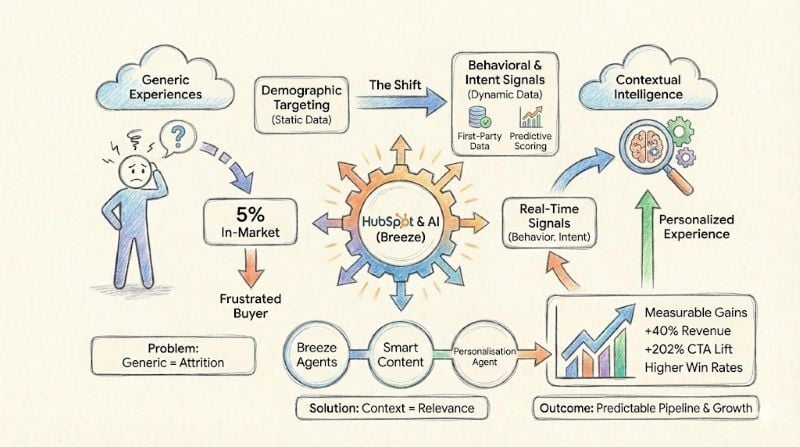
The stakes are clear. Companies excelling at personalisation generate 40% more revenue than average performers, whilst those delivering generic experiences face buyer attrition—71% of B2B buyers become frustrated when personalisation fails to materialise. Whitehat's experience implementing HubSpot across 100+ B2B organisations confirms this: clients who activate Smart Content and behavioural segmentation consistently outperform those using static list-based approaches.
Personalisation for B2B Marketing: 2026 Research Update
B2B personalisation has shifted from demographic targeting to real-time, AI-powered contextual intelligence. In 2025, contextual segmentation means targeting prospects based on what they're doing right now—their behaviour, intent signals and situational context—rather than just who they are. Organisations using this approach see conversion improvements of 200% or more, according to McKinsey research. The practical implication: if your marketing still relies primarily on firmographic data like industry, company size and job title, you're leaving significant pipeline on the table.
The ROI Case: What the Research Shows
The research community has converged on remarkably consistent findings about personalisation's business impact. McKinsey's analysis shows personalisation drives a 5–15% revenue increase and 10–30% improvement in marketing ROI, whilst reducing customer acquisition costs by up to 50%. Companies with faster growth rates derive 40% more of their revenue from personalisation than slower-growing counterparts.
| Metric | Impact | Source |
|---|---|---|
| Personalised CTA conversion lift | +202% vs. basic CTAs | HubSpot Research |
| Revenue increase from personalisation | 5–15% | McKinsey |
| Marketing ROI improvement | 10–30% | McKinsey |
| B2B buyers expecting tailored experiences | 82% | Forrester, Dec 2024 |
| Companies using AI-driven personalisation | 92% | Twilio Segment 2024 |
| B2B marketers using GenAI weekly | 71% | G2 Research |
HubSpot's analysis of over 330,000 CTAs found personalised versions convert 202% better than generic alternatives—a benchmark that applies directly to B2B contexts. Segmented email campaigns show equally compelling results: 14.3% higher open rates, double the click-through rates, and 4.6% lower bounce rates compared to non-segmented sends.
Forrester's December 2024 "State of B2B Personalization" report found that over half of B2B buyers consider vendor content useless—creating an opportunity for marketers who personalise around buying group roles and lifecycle stages. The same research notes that 75% of B2B buyers expect immediate responses to questions, making real-time contextual triggers essential rather than optional.
HubSpot's 2024–2025 Capabilities: What's Changed
Breeze AI, launched at INBOUND 2024, represents HubSpot's most significant platform evolution in years. The unified AI layer now powers the entire customer platform with three core components: Breeze Assistant (the renamed Copilot) for real-time insights and content creation, Breeze Agents for specialised tasks, and Breeze Intelligence for data enrichment across 200+ million buyer and company profiles.
The Personalisation Agent, announced at INBOUND 2025 and currently in beta, functions as an AI-powered targeting specialist. It analyses which audience segments respond best to personalised web content, then instantly generates tailored CTAs, landing pages, and email variations without manual configuration. Whitehat's early implementation work with beta clients shows this addresses a long-standing B2B challenge: speaking differently to different buying committee members without building dozens of manual variations.
HubSpot's Eight Smart Content Targeting Criteria
- Ad source via UTM parameters
- Country (IP-based geolocation)
- Device type (desktop, mobile, tablet)
- Referral source
- Preferred language
- Contact list membership
- Lifecycle stage
- Query parameters
HubSpot's segmentation architecture received a major rebrand in late 2025: "Lists" are now "Segments" with enhanced AI capabilities. Marketers can generate segment filters using natural language descriptions—describing the audience they want in plain English—whilst AI-powered segment suggestions recommend targeting strategies based on business goals. New capabilities include Visitor Segments (based on anonymous web visitor data enriched by Breeze Intelligence), Lookalike Segments for expanding high-value audiences, and Split Segments for A/B testing.
For organisations running HubSpot onboarding with Whitehat, we configure Predictive Lead Scoring from day one. HubSpot Enterprise uses machine learning to analyse closed-won versus closed-lost patterns, automatically scoring leads based on conversion likelihood. The system now supports up to 25 different scoring systems per account—allowing separate models for different product lines, regions, or buyer personas.
Signals Over Static Segments: The 2025 Approach
The definition of contextual segmentation has evolved fundamentally. Experian's 2025 analysis captures the shift: "Identity tells us who someone is. Context tells us when it matters. The next wave of AI-driven marketing will unite privacy-first identity with contextual intelligence to deliver real-time relevance, responsibly."
In practice, this means moving from demographic groupings to signal-based segmentation that tracks first, second, and third-party buying signals to build dynamic audiences. Real-time context analysis examines environmental, temporal, and situational signals revealing intent—when a prospect downloads a pricing guide after viewing case studies, the contextual signal matters more than their job title.
Traditional (Reactive)
Analyses past performance to adapt tactics over days or weeks. Segments built on static attributes like job title, industry, and company size.
Contextual (Predictive)
Uses machine learning to forecast future behaviours and adjust in real time. Segments built on behavioural signals, intent data, and situational context.
"First and foremost, guessing is bad," notes Katie Robbert, CEO of Trust Insights. "Predictive forecasting tells you where to spend your money: when to step up, when to step down."
Gartner's B2B Buying Journey framework identifies six stages requiring distinct contextual approaches: Problem Identification, Solution Exploration, Requirements Building, Supplier Selection, Validation, and Consensus Creation. The average B2B journey now spans 102 days from initial contact to close, with buyers spending only 17% of that time talking to sales—making lifecycle stage segmentation for marketing touchpoints critical. For teams already using HubSpot, creating Smart Content is the practical starting point for implementing this at scale.
Case Studies: Measurable Conversion and Revenue Gains
The following results demonstrate what's achievable when organisations move from demographic segmentation to contextual intelligence.
Sandler — Global Sales Training
Implemented HubSpot Breeze AI for personalised marketing-to-sales handoff.
60% increase in SQLs successfully converting to pipeline
Aerotech — Manufacturing
Deployed AI-powered deal prioritisation with Breeze assistant and AI-guided actions.
66%
higher win rates
17.5 hrs
saved weekly
50%
reduction in manager meeting time
Dermalogica Canada — B2B Wholesale
Transformed wholesale B2B experience with personalised segmentation.
74% → 92%
conversion rate improvement
47 → 11 days
purchase gap reduction (76% faster)
Dynamic Yield — B2B SaaS (Own Platform)
Used their Experience OS platform for B2B segmentation and personalisation.
275%
increase in newsletter signups
800%
uplift in demo requests from personalised ads
Adobe's partnership with Demandbase for real-time website personalisation and intent-based advertising generated a 3× increase in visitor-to-lead conversion rates. Ceros used 6sense's AI-powered ABM platform to achieve a 72%+ meeting-to-SQL conversion rate. These results aren't outliers—they represent what's achievable when contextual intelligence replaces demographic guesswork.
First-Party Data: The Foundation for Everything Else
Google's July 2024 reversal on complete cookie deprecation didn't eliminate the urgency around first-party data—it merely shifted the timeline. Chrome now offers users privacy controls rather than automatic blocking, but Safari and Firefox maintain third-party cookie restrictions that result in 60% lower CPMs for cookied Safari users compared to Chrome.
In Q1 2025, 71% of publishers recognised first-party data as a key source of positive advertising results, up from 64% in 2024. The business case is compelling: first-party behavioural data can improve customer acquisition costs by 83% and boost ROI by 72%.
The Privacy-First Personalisation Framework
Zero-Party Data
Voluntarily shared via quizzes, preference centres, surveys, and explicit form submissions.
First-Party Data
Collected from owned properties—website behaviour, CRM interactions, email engagement.
Contextual Data
Based on content environment analysis rather than individual user tracking.
Research shows 83% of consumers refuse to do business with brands they don't trust, making transparent data practices a revenue protection strategy. For HubSpot users, the platform's Smart CRM functions as an integrated CDP, providing a single source of truth that powers Breeze AI's personalisation capabilities.
Collection methods gaining traction include interactive content like quizzes and assessments, gated content exchanges, loyalty programmes with value exchanges, preference centres allowing explicit customisation, and CRM-integrated forms capturing progressive profile data. Nielsen's 2025 research found that 59% of global marketers identify AI for campaign personalisation as the most impactful industry trend—but implementation requires the first-party data foundation to fuel AI algorithms. Segmenting with context starts with getting your data house in order.
Implementation Priorities for 2026
Based on Whitehat's implementation experience across B2B organisations using HubSpot, here are the priorities that deliver measurable results.
Predictive segmentation over reactive approaches
For organisations with sufficient historical data, HubSpot's AI-powered scoring and segment suggestions make predictive targeting accessible without data science teams. Start with lead scoring based on closed-won patterns, then expand to predictive content recommendations.
Lifecycle stage personalisation
Forrester notes that personalising around buying group roles remains "still underused" despite its effectiveness. Configure Smart Content rules for each lifecycle stage—subscribers, leads, MQLs, SQLs, opportunities, and customers should see different CTAs, content recommendations, and messaging.
First-party data infrastructure first
Advanced personalisation requires clean, complete data. Before activating Breeze AI features, ensure your HubSpot CRM has proper lifecycle stages defined, lead sources tracked consistently, and progressive profiling capturing additional data over time.
Smart CTAs for immediate impact
The 202% conversion improvement from personalised CTAs represents one of marketing's highest-ROI tactics. This is the quickest win—configure Smart CTAs that change based on lifecycle stage, showing "Download Guide" to new visitors and "Book Consultation" to qualified leads.
AI agents for scale
HubSpot's Personalisation Agent enables hyper-personalisation at scale that previously required enterprise-level resources. When it exits beta, early adopters with clean data foundations will see the fastest results.
The Growing Gap Between Leaders and Laggards
The gap between personalisation leaders and laggards is widening. Organisations achieving results like Sandler's 60% SQL increase or Aerotech's 66% higher win rates share a common characteristic: they've moved from demographic segmentation to real-time contextual intelligence, powered by AI that identifies not just who prospects are, but when and why engagement matters most.
The technology is now accessible. HubSpot's Breeze AI, Smart Content, and the forthcoming Personalisation Agent mean mid-market B2B organisations can implement sophisticated contextual segmentation without enterprise budgets or dedicated data science teams. The question is no longer "can we afford to personalise?" but "can we afford not to?" With 82% of buyers expecting tailored experiences and competitors already delivering them, the answer is increasingly clear.
Frequently Asked Questions
What is contextual segmentation in B2B marketing?
Contextual segmentation groups prospects based on real-time behavioural signals and intent data rather than static demographic attributes. Instead of targeting "Marketing Directors at SaaS companies," you target "visitors who viewed pricing pages twice and downloaded a case study this week"—capturing actual buying intent rather than assumed interest based on job title.
How long does it take to implement personalised segmentation in HubSpot?
Basic Smart Content and lifecycle-based personalisation can be configured within 2–4 weeks. Comprehensive implementation—including predictive lead scoring, Breeze AI configuration, workflow automation, and multi-channel personalisation—typically requires 6–12 weeks through a structured HubSpot onboarding process.
Do I need HubSpot Enterprise for contextual personalisation?
Smart Content and basic Smart CTAs are available in HubSpot Professional. Enterprise adds Predictive Lead Scoring with machine learning, additional scoring models (up to 25 per account), and more advanced Breeze AI capabilities. Most mid-market B2B organisations see significant results starting with Professional.
What's the difference between HubSpot's Personalisation Agent and Smart Content?
Smart Content requires manual configuration of rules and content variations for each segment. The Personalisation Agent (currently in beta) uses AI to automatically identify which segments respond to which content, then generates tailored variations without manual setup—representing a shift from rules-based to AI-driven personalisation.
How does first-party data relate to contextual segmentation?
First-party data—collected from your website, CRM, and email engagement—provides the behavioural signals that power contextual segmentation. Without clean, complete first-party data, you can't identify intent signals or track prospect behaviour across touchpoints. It's the foundation: AI-driven personalisation is only as good as the data it runs on.
Ready to Implement Contextual Segmentation?
Whitehat helps B2B organisations configure HubSpot's personalisation capabilities for measurable pipeline impact. From Smart Content setup to Breeze AI configuration, we'll help you move from demographic guesswork to contextual intelligence.
Book a HubSpot ConsultationReferences
- Forrester: The State of B2B Personalization, 2024 (December 2024)
- McKinsey: What is Personalization? (2024)
- HubSpot: Personalized CTAs Convert 202% Better (Updated 2024)
- Twilio Segment: State of Personalization Report 2024 (June 2024)
- HubSpot: Breeze AI Product Overview and Case Studies
- Gartner: The B2B Buying Journey (2024)
- Experian: Context is Key to Making AI Successful in Marketing 2025
- G2: AI in B2B Marketing – How Teams Are Using AI in 2025
- Nielsen: AI Redefining Marketing Today and Tomorrow (2025)
- Dynamic Yield: We Drink Our Own Brew (2024)
Related Resources view our pricing