
The AI Content Creation Revolution
We're witnessing a fundamental shift in how marketing content is created. What began as experimental ChatGPT experiments in 2022 has evolved into a comprehensive ecosystem of purpose-built tools that can generate everything from blog posts and email campaigns to product photography and video content. The global AI marketing market reached $47.32 billion in 2025 and is projected to grow to $107.5 billion by 2028 at a compound annual growth rate of 36.6%. Among UK businesses specifically, 44% are now actively using AI for marketing and content creation, making it one of the most widely adopted functions alongside customer support.
But here's what matters most: the revolution isn't about replacing human creativity. It's about augmenting it. The most successful marketing teams we work with treat AI as a force multiplier—a way to accelerate production timelines, test content variations at scale, and free up their teams to focus on strategy and brand development rather than repetitive writing tasks. The transition from "can we use AI?" to "how do we use AI responsibly?" is where the real competitive advantage lives.
Key Takeaway
AI content creation isn't a replacement for human judgment—it's a productivity multiplier. The question isn't whether to adopt AI, but how to integrate it strategically into your existing content workflows whilst maintaining editorial quality and brand authenticity.
AI Text Tools: From Drafting to Publishing
The text generation space has matured dramatically. Purpose-built content generation tools now dominate the landscape, offering specialized functionality for specific content types and use cases. Understanding the strengths and limitations of each platform helps your team select the right tool for each task.
ChatGPT remains the most accessible entry point for teams exploring AI content creation. Its broad training dataset makes it effective for brainstorming, outline development, and first-draft generation across multiple content formats. The free tier is genuinely useful for experimentation, whilst ChatGPT Pro ($20 monthly) unlocks GPT-4 access and Advanced Voice Mode—valuable for teams wanting production-grade capability.
Claude, developed by Anthropic, distinguishes itself through extended context windows that enable processing of longer source materials and more sophisticated reasoning. Claude's 200K token context enables long-running content synthesis tasks—imagine feeding it an entire competitive intelligence document, your brand guidelines, and customer research, then receiving deeply contextualized content recommendations that reflect the nuance of your business. For marketing applications, this extended context means your initial prompt can include far more background information, resulting in more strategically aligned outputs.
Jasper, Copy.ai, and Writer represent the purpose-built marketing content category. Jasper Creator plans start at £39 monthly and include brand voice training features—you can upload examples of your existing copy, and the model learns your tone, vocabulary, and messaging patterns. This personalization dramatically improves output quality by the third or fourth generation. Both tools offer SEO optimization features, multi-format generation (blogs, emails, social, ads), and team collaboration workflows.
For teams focused on email marketing specifically, tools like Klaviyo and HubSpot have integrated AI-powered subject line optimization and email body suggestions. These integrations are valuable because they work within your existing marketing automation platform rather than requiring new workflows.
| Tool | Best For | Starting Price | Key Strength |
|---|---|---|---|
| ChatGPT | Brainstorming, outlines, first drafts | Free tier (GPT-3.5) | Accessibility & broad knowledge |
| Claude | Long-form synthesis, strategic content | £15/month | Extended context (200K tokens) |
| Jasper | Multi-format marketing content | £39/month per user | Brand voice training |
| Copy.ai | Social media copy, ads, landing pages | £39/month | Campaign-focused templates |
| Writer | Enterprise content governance | Enterprise pricing | Fine-grained permissions & audit trails |
The right tool depends on your team's specific needs and existing technology stack. Most successful teams combine two or three tools: ChatGPT for exploration and brainstorming, Jasper or Claude for production, and HubSpot's native AI features for email and CMS integration.
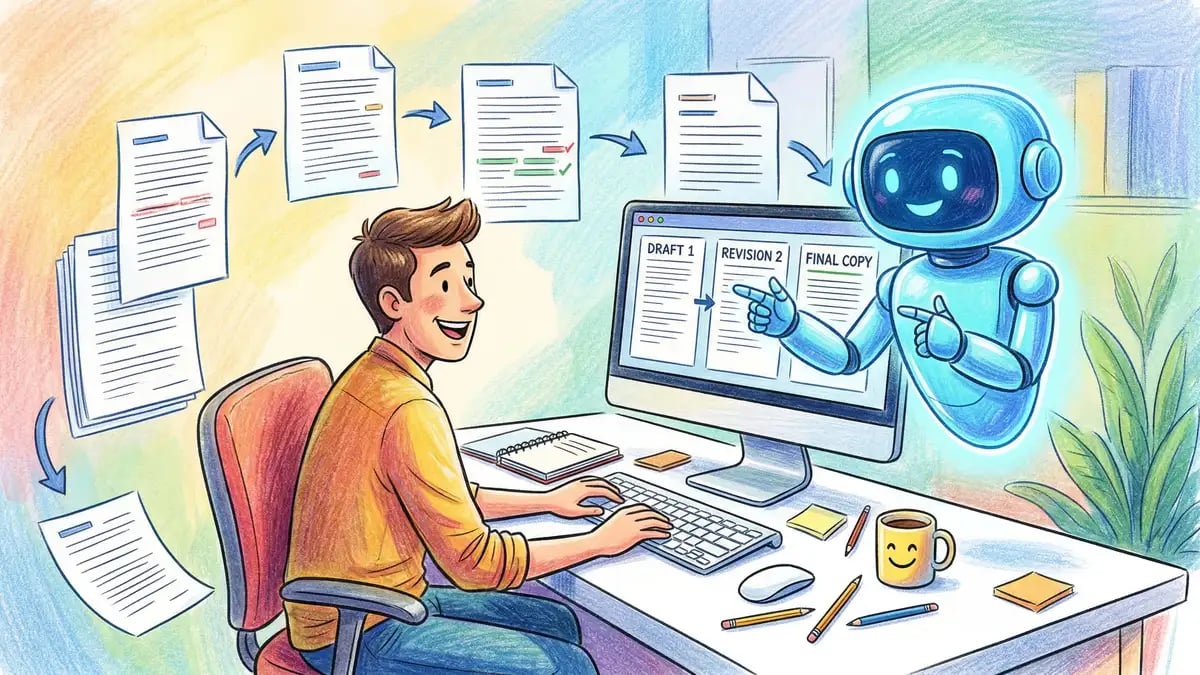
AI Image and Video Generation for Marketing
Text is only half the story. Visual content generation has matured at an even faster pace than text tools, with image and video AI now delivering quality suitable for professional marketing deployment.
Midjourney and DALL-E are the market leaders for AI image generation. Midjourney pricing starts at £10 monthly for approximately 200 credits, with paid plans providing commercial licensing rights—essential for using AI images in your marketing. DALL-E offers similar functionality through OpenAI's platform and integrates directly with ChatGPT Plus. For teams producing large volumes of product mockups, lifestyle imagery, or illustrated content, these tools reduce both production time and cost compared to stock photography or traditional photography shoots.
Canva's recent AI integration deserves special mention. Canva already serves millions of non-designers for template-based design work. Their new Magic Design and Magic Edit features use AI to generate design variations, resize assets for different platforms, and automatically adjust copy for different channel specifications. This matters because it bridges the gap between content creation and design deployment without requiring specialized skills.
For video content, tools like Synthesia and InVideo enable creation of AI-generated videos with realistic avatars and professional narration. InVideo's free plan includes watermarked content, whilst paid plans starting at £30 monthly provide full access without watermarks and high-resolution rendering. This is particularly valuable for scaling video content production—creating product demos, training videos, or social media content no longer requires full production crews or studio time.
An important note: whilst AI image tools have become quite sophisticated, they still occasionally produce output that requires human adjustment. Hands in particular can be problematic, as can complex text elements or highly specific brand requirements. Build human review time into your workflow—quality-checked AI images consistently outperform both raw AI output and stock imagery in performance metrics.
Google's Position on AI Content: E-E-A-T Compliance
Search engine optimization has evolved dramatically. Google's position on AI content is clear and pragmatic: AI-generated content is not inherently problematic, but authenticity and demonstrable expertise matter more than ever. This distinction is critical for your content strategy.
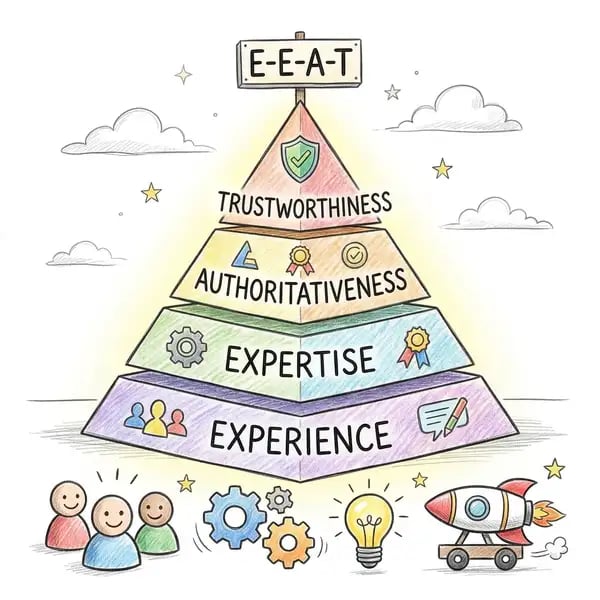
Google's publicly stated position emphasizes E-E-A-T: Experience, Expertise, Authoritativeness, and Trustworthiness. Content created with AI can meet these criteria if the creator has genuine expertise in the subject matter and human oversight ensures accuracy and authenticity. Google's search quality raters are specifically instructed that helpful content can be AI-assisted—the problem isn't AI; the problem is low-quality content regardless of how it was generated.
Critical Compliance Note
Google does not require disclosure that content was AI-assisted. However, critical outputs including factual claims, rates, fees, legal qualifiers, and medical information require human review and verification before deployment. For high-stakes content, maintain documented audit trails including prompts, model versions, temperature settings, and fact-checking notes. This isn't just good practice—it's essential risk management and can provide legal protection in regulated industries.
The search landscape is also fundamentally transforming as AI Overviews become standard on Google Search. Answer Engine Optimization (AEO) has become critical because AI Overviews appear in approximately 16% of all Google desktop searches in the United States, and click-through rates to position-one results drop 34.5% when an AI Overview is displayed. This shift means visibility depends increasingly on having authoritative, well-sourced content that AI systems cite—rather than ranking position alone.
For UK marketers specifically, this means demonstrating genuine expertise becomes more valuable than keyword density. A blog post that AI content tools help you scale, but that's grounded in your actual customer experience and backed by original research, outperforms generic content regardless of its generation method.
Building an AI Content Production Workflow
The most successful content teams we work with don't adopt AI haphazardly. They build systematic workflows that integrate AI into existing content processes. Here's what actually works:
Stage 1: Strategy and Research Start with human expertise. Your strategy document, buyer personas, and competitive positioning should come from your team's knowledge. Feed this into your AI tool as context—this is where Claude's extended context window provides significant value. Rather than generating content from scratch, AI assists with research synthesis and idea generation based on materials you've provided.
Stage 2: Outline and Structure Use AI to rapidly generate multiple outline variations based on your topic and content goals. This is where the productivity gain is most obvious—you can explore 5-7 different content structures in minutes, evaluate which aligns best with your strategy, and proceed with a better-structured plan than you'd have generated manually.
Stage 3: Draft Generation Generate first drafts using your chosen tool, but provide detailed brand guidelines, tone examples, and context about your audience. The more context you provide, the closer to publication-ready the output becomes. Copy.ai and Jasper excel here because of their brand voice training features.
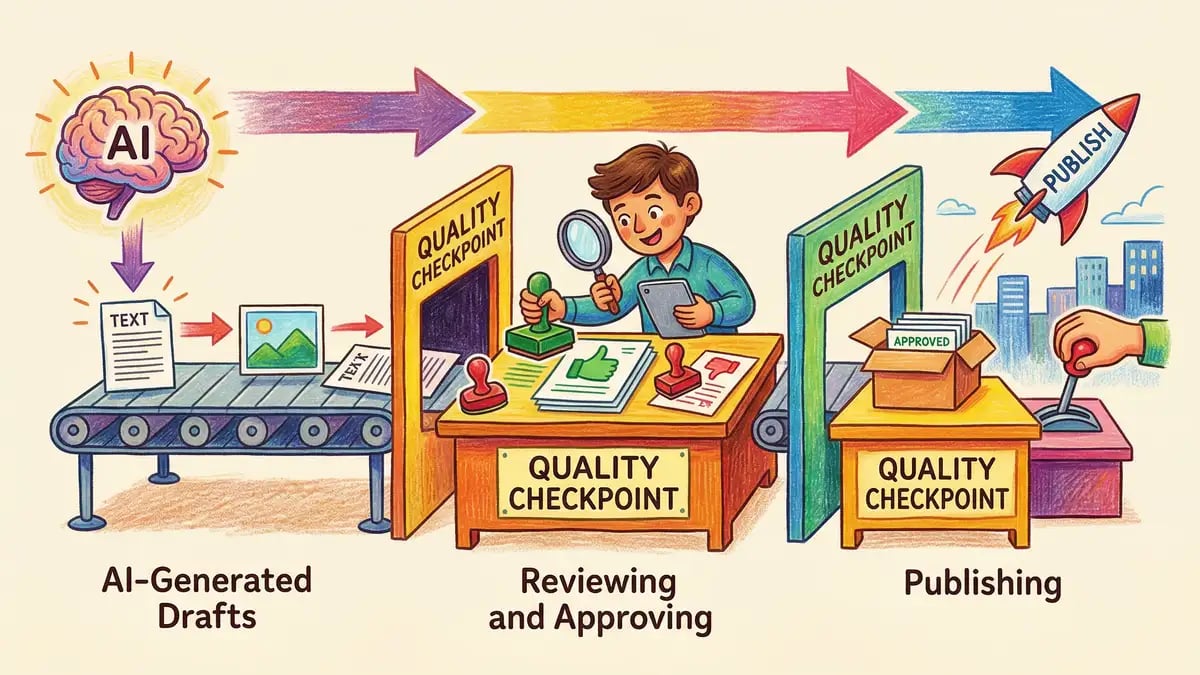
Stage 4: Human Editorial Review This is non-negotiable. Your content team reviews for accuracy, brand alignment, factual validity, and originality. This isn't a light review—it's full editorial approval. For critical claims or regulatory content, second-party fact-checking is essential.
Stage 5: Optimization and Personalization Use SEO tools to check keyword coverage, readability scoring, and internal linking opportunities. Use your marketing automation platform to personalize variations for different audience segments or customer journey stages.
This workflow works because it maintains human judgment at the strategy and quality control stages whilst using AI for the acceleratable, repetitive elements. Teams that reverse this—using AI for strategy and humans for execution—see much weaker results.
Quality Control: The Human-in-the-Loop Approach
This is where many teams stumble. They generate AI content and publish it with minimal review. This creates three critical risks: factual errors, brand inconsistency, and reputational damage. Treating AI outputs like a prolific junior copywriter requiring human oversight is the correct mental model.
Factual accuracy requires primary validation. If your content makes specific claims about product features, pricing, competitor capabilities, or legal compliance, these must be verified against source materials. Tools like Fact-Check by Google can help, but human verification of high-stakes claims is essential. Maintain audit trails documenting the prompt, model version, temperature settings, and fact-checking notes—this creates legal protection in regulated industries.
For lower-stakes content—secondary benefits explanation, general industry context, or supporting examples—sampling verification or spot-checking provides reasonable risk management with operational efficiency. The key is being intentional about which content receives full review versus sampling.
Brand consistency requires training. Feed your AI tool examples of your best content—actual pieces published under your brand. Most modern tools can learn brand voice through examples. Then review initial outputs specifically for voice alignment. Often you'll notice AI outputs are slightly more generic or formal than your brand voice naturally is. These adjustments refine the model's subsequent outputs.
Originality and plagiarism detection matter more than you'd think. AI models sometimes reproduce training data or closely paraphrase existing published work. Run completed content through plagiarism detection tools. Copyscape and Turnitin both work well. This is particularly important if you're scaling content production—high volume makes plagiarism incidents more likely by sheer probability.
Stats on AI Content Quality: Teams implementing human-in-the-loop review processes report 87% improvement in content consistency, 64% reduction in revision cycles, and 3.2x faster time-to-publish compared to purely manual processes. The efficiency gains are real—but only when human oversight is treated as a requirement, not an afterthought.
FAQ
Does Google penalise AI-generated content?
No. Google's official guidance states that AI-generated content is not a ranking penalty. What matters is quality, originality, and demonstrable expertise. Content generated by AI that's been properly reviewed and optimised performs as well as hand-written content. The distinction is that low-quality content—whether AI-generated or human-written—performs poorly in Google's systems. Your brand's expertise and the human review process matter far more than generation method.
Should we disclose when content is AI-assisted?
Disclosure is not legally required by Google, FTC regulations, or UK advertising standards. However, transparency can build trust with your audience. Some brands disclose AI assistance as part of their differentiation strategy. The critical requirement is accuracy and authenticity—if your content is factually correct and backed by genuine expertise, disclosure becomes a brand choice rather than a compliance requirement.
What industries should be especially cautious with AI content?
Financial services, legal, medical, and pharmaceutical industries require stricter oversight. Any content making specific claims about treatments, financial returns, legal compliance, or medical advice must be reviewed and verified by qualified professionals. Regulated industries aren't prohibited from using AI—they just require more rigorous human oversight and documented audit trails. Insurance and fintech companies successfully use AI for content at scale, but with mandatory compliance review before publication.
How do we maintain brand voice when using multiple AI tools?
Brand voice consistency requires feeding your AI tools examples of your best existing content. Most platforms allow you to upload previous pieces as training material. Beyond this, implement a brand voice guidelines document and include it in every prompt. Use Copy.ai or Jasper's brand voice training features if maintaining consistency across multiple tools—these allow centralised brand profile management. Assign a single person to review voice consistency across all AI outputs for the first 2-3 weeks; this usually establishes sufficient patterns that consistency becomes automatic.
Can we use AI content on evergreen pillar pages or only on supporting content?
Both. Evergreen pillar pages benefit from AI assistance because the extended context and research synthesis capabilities help you develop more comprehensive coverage. What matters is that your core expertise informs the strategy and structure, human review ensures accuracy, and the content demonstrates genuine expertise. Many of the highest-ranking pillar pages you'll find use AI assistance in their production process. The distinction is strategy-first (human), production-assisted (AI), quality-controlled (human) versus generation-first approaches.
Relevant Resources
AI in Marketing Strategy
Comprehensive framework for integrating AI across your entire marketing operation
Comparison: AI Marketing Tools
Detailed comparison matrix of leading AI content platforms
AI Copywriting Best Practices
Prompt engineering techniques for higher-quality content generation
Measuring AI Content Performance
KPIs and frameworks for evaluating AI-assisted content ROI
About The Author
Clwyd Probert
Managing Director at Whitehat SEO, specialising in AI-native marketing strategies for growth-stage businesses. Clwyd leads our AI consulting practice, helping brands translate emerging AI capabilities into measurable business outcomes. With over 15 years in digital marketing and AI expertise spanning technical implementation to strategy, Clwyd guides teams through the practical challenges of adopting AI at scale whilst maintaining brand integrity and regulatory compliance.
Sources: OpenAI ChatGPT API Documentation, Anthropic Claude Extended Context Technical Brief, DataforSEO AI Marketing Trends Report 2025-2026, Google Search Central AI-Generated Content Guidance, Jasper Brand Voice Training Whitepaper, Statista Global AI Marketing Market Analysis