
Maximise Authority
in 2026
To maximise authority in 2026, distribute answers natively across the platforms buyers actually use, structure every asset for AI citation (AEO/GEO + Schema 2.0), and operationalise repurposing with HubSpot Breeze Content Remix so you can be present everywhere without multiplying workload.
The uncomfortable truth
In the “traffic era”, distribution meant pushing links back to your site. In the “citation era”, the platforms and AI systems are the destination. The goal shifts from clicks to being the source that gets referenced.
Zero-click is not a trend. It’s the default. SparkToro’s 2024 zero-click study found that only 374 out of every 1,000 EU Google searches (and 360 out of every 1,000 US searches) result in a click to the open web.[5] Similarweb reporting suggests “no-click” grew from 56% to 69% in the year after Google AI Overviews launched.[7]
If you’d like the original version of this topic, here it is: Maximise Authority: Multi-channel Distribution.
Updated: · Author: Clwyd Probert (CEO & Founder, Whitehat SEO Ltd)
The traffic era ended and authority became “being cited”
Authority in 2026 is not about ranking #1 and waiting for clicks—it’s about being the brand AI engines and humans repeatedly reference when they need an answer. In practice, that means prioritising entity clarity (who you are and what you do) and verification (proof others can cross-check).
Search behaviour has shifted from “query → click” to “query → synthesis”. When the result is consumed inside an AI answer (or a platform feed), the brand that gets cited becomes the default source—whether or not the user ever visits a website.[5][7]
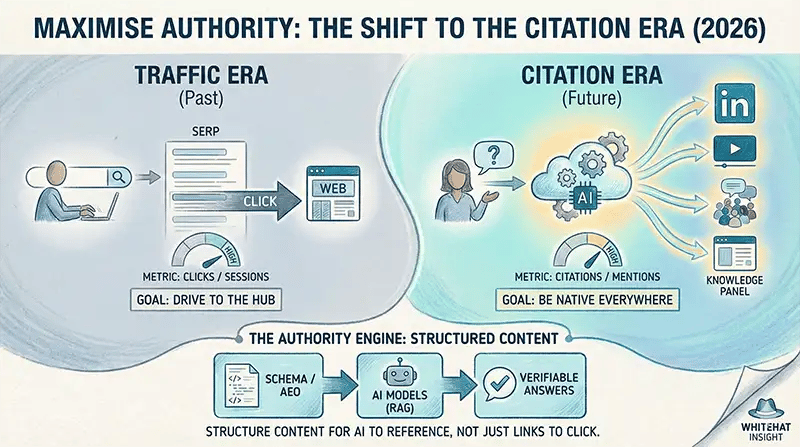
The “Citation Era” changes what distribution is for
Multi-channel distribution used to be amplification. Now it’s infrastructure. You’re injecting verifiable, format-native expertise into the places buyers search and AI models retrieve from.
| Feature | Traffic Era | Citation Era |
|---|---|---|
| Primary interaction | Query → SERP → click | Query → AI synthesis |
| Success metric | CTR / sessions | Mentions / citations |
| Content format | Long-form guides | Answer blocks + data |
| Distribution goal | Drive to the hub | Be native everywhere |
This “Traffic Era” vs “Citation Era” model is a practical way to describe the shift documented in recent zero-click research.[5][6][7]
Trust is the moat and generic AI content is the liability
The fastest way to lose authority is to publish “perfectly average” AI copy at scale. When everyone can generate plausible content, buyers default to what feels experienced, specific, and verifiable. That’s why Whitehat’s “Help First” positioning matters more now than it did in the link-building era.
As generative AI content floods feeds, buyers lean harder on signals they can verify: specificity, quotes from real experts, and data points that can be checked. Studies on ChatGPT citations show that expert quotes and statistical data points correlate with higher citation frequency.[8]
AEO and GEO are the mechanics behind being referenced by AI
AEO (Answer Engine Optimisation) wins the “direct answer” slot by structuring each section so an engine can safely extract it. GEO (Generative Engine Optimisation) increases the odds your content is retrieved and kept during the generation phase of Retrieval Augmented Generation (RAG) workflows.
AEO (Answer Engine Optimisation) is about making answers extractable. GEO (Generative Engine Optimisation) is about improving visibility inside generative responses.[4] In practice, structure matters: one large study of ChatGPT citations found that section lengths of ~120–180 words between headings performed best, and pages with more statistical data points and expert quotes were cited more often.[8]
Schema 2.0 and llms.txt make your site “machine readable”
Schema in 2026 isn’t a “nice to have”; it’s your site’s native language for AI discovery. Beyond Article markup, you should explicitly define your organisation, authors, FAQs, and key entities so answer engines can connect the dots with high confidence.
| Schema type | Why it matters | AI impact |
|---|---|---|
| Organization | Defines your brand entity | Improves entity salience |
| Person | Proves expertise and authorship | Strengthens E‑E‑A‑T |
| FAQPage | Feeds Q&A pairs to engines | Covers query fan-out |
| Speakable | Marks extractable sections | Improves voice responses |
Schema and machine-readable entity signals are repeatedly cited as practical inputs for AI visibility, alongside broader authority signals.[8]
Consider adding llms.txt as a curated “syllabus” that points AI systems to your highest-signal pages.[9][10] Evidence on impact is mixed—one citation study reported negligible correlation—so treat it as a navigation aid, not a magic lever.[8]
“Search everywhere” replaces hub-and-spoke distribution
In a zero-click world, you can’t rely on people to leave the platform and come back to your site. The modern model is native atomisation: one pillar asset becomes multiple, platform-native pieces that deliver value where the buyer is already consuming.
In a zero-click world, your website is the canonical source—but distribution needs to be native. Citation research also shows strong correlation between AI visibility and brand presence across discussion platforms (e.g., Reddit/Quora), which is one reason “in-feed authority” and community participation matter.[8]
Persona-led distribution stops multi-channel from becoming “more work”
Multi-channel fails when it’s “post everywhere”. It works when it’s “say the right thing in the right place for the right buyer”. Whitehat’s Phase 1 personas make the trade-offs obvious: not every channel matters equally for every market.
The biotech/medtech persona relies on dark social and peer validation, so distribution means shareable data artefacts and compliance-accurate answers. The SaaS marketing director needs speed and “snackable ROI”, so fixed-price clarity (like the HubSpot Launchpad) and native LinkedIn formats matter most.
LinkedIn becomes your reputation engine (and your new homepage)
For B2B, LinkedIn is where buyers verify you. If your expertise isn’t visible in-feed, you’re asking prospects to take a leap of faith. The goal is to publish content that performs without a link click: carousels, text posts, and short clips with one clear insight.
A practical tactic: turn your blog headers into a five-slide PDF carousel (problem → insights → “so what” CTA) and produce the first draft with HubSpot’s Content Remix, then edit hard for proof and voice. Keep the CTA frictionless: “reply ‘audit’ and I’ll send the checklist”, not “book a call”.[3]
YouTube transcripts are an underpriced source of AI visibility
Video isn’t just “top-of-funnel brand”. In AI retrieval systems, transcripts are clean, conversational text that can be indexed, retrieved, and cited. Every pillar page should have a short video summary, with the transcript published (or embedded) alongside the page.
Short, specific videos (especially pricing/timeline explainers) work because they mirror how people ask questions—and transcripts give engines clean text to retrieve. Pair that with tight sectioning, quotes, and data points, which citation research associates with higher visibility.[8]
Communities and dark social are the trust layer you can’t track
The most influential distribution often happens where you can’t measure it: Slack groups, WhatsApp threads, internal company chats, and niche communities. That “dark social” layer is where recommendations form, especially in high-consideration B2B categories.
Treat community touchpoints (including your London HubSpot User Group) as distribution nodes by shipping “share-ready” assets (templates, charts, checklists) that people can drop into private conversations.
Reddit, Quora, and reviews provide “human validation” signals
Buyers don’t trust brands talking about themselves. They trust peers. That’s why review platforms, forums, and Q&A sites have outsized influence in AI answers: they contain real language, real objections, and real comparisons.
Forums and Q&A sites (notably Reddit and Quora) can act as “human validation” layers. A large ChatGPT citation study found strong correlation between brand mentions on these platforms and citation frequency.[8]
HubSpot Breeze Content Remix is the execution lever
Multi-channel is only feasible if you can produce high-quality variations fast. HubSpot’s Content Remix (powered by Breeze) is designed for exactly this: repurposing one asset into multiple outputs across social, email, and scripts so teams can publish natively without rewriting from scratch.[3]
Here’s the operational workflow you can copy/paste into your team SOP (and yes—still review everything; AI is the drafter, not the editor):[3]
- Prep: Ensure Content Hub Professional or Enterprise is active; enable generative AI and connected data inputs; connect social/ad accounts.
- Select: Choose one pillar asset with measurable outcomes (or start from a URL / Google Drive draft).
- Generate: Create up to six formats (LinkedIn carousel + post, email teaser, 60s script, audio summary, retargeting ad copy).
- Channel-fit: Set objective and tone per channel; use brand-safe visuals and keep claims verifiable.
- Authority check: Add proof (numbers, examples), remove generic fluff, and fix brand voice drift.
- Publish + measure: Publish natively and track engagement density + citation/mention lift + pipeline influence.
Whitehat tip: If you’re doing this inside HubSpot already, pair it with a structured onboarding so the portal, analytics, attribution, and governance are configured from day one. See: HubSpot onboarding services and our HubSpot Onboarding Guide (2026 edition).
Human-in-the-loop governance prevents brand drift (and legal drift)
AI speed is addictive. It’s also how brands end up publishing confident nonsense—or content that sounds like it was generated by the same factory as everyone else’s. Governance isn’t bureaucracy; it’s how you protect differentiation.
Citation research consistently favours depth, expert quotes, and freshness—and none of that happens reliably without governance. Lock in brand voice guardrails and mandatory human review. Rule of thumb: if a claim can’t be cross-checked, it doesn’t go out.[8]
Measure authority with SOM, pipeline influence, and engagement density
If you only track sessions, you’ll miss the point. In a zero-click landscape, you need metrics that reflect visibility and persuasion even when the user doesn’t land on your site.
- Share of Model (SOM): how often you’re cited for the prompts that matter (across ChatGPT, Perplexity, Gemini experiences).
- Pipeline attribution: marketing-sourced and marketing-influenced revenue, using full-path or time-decay models in HubSpot.
- Engagement density: saves, shares, watch time, and community comments as the new proxy for “traffic”.
90-day roadmap to shift from traffic KPIs to citation KPIs
You don’t need a “massive rebrand”. You need a deliberate 90-day sprint that hardens your technical foundations, operationalises repurposing, and builds verifiable presence across the channels that shape buying decisions.
Days 1–30: Foundation
- Run an AI visibility audit (prompt set + citation check)
- Implement Organization, Person, and FAQPage schema on key pages
- Create llms.txt and ensure your content is crawlable
Days 31–60: Atomise
- Remix your top 5 posts into social/email/video suites
- Train the team on answer-first writing (40–60 word blocks)
- Ship 1 community-ready asset per month (template/checklist)
Days 61–90: Scale trust
- Digital PR for niche publications to earn citations, not just links
- Review SOM trends and double down on formats that win
- Lock in governance: brand voice + human review steps
If you want Whitehat to run the audit + implementation, start here: HubSpot onboarding services or explore our Content Hub guidance: HubSpot Content Hub guide.
Frequently Asked Questions
What does “authority” mean in the citation economy?
Authority is your likelihood of being referenced in AI answers and trusted platform feeds, not just your ranking position. It’s built through entity clarity, verifiable claims, and repeat exposure across the places buyers research and validate vendors.
Do I still need SEO if clicks are falling?
Yes—retrieval still depends on crawlable pages, strong internal linking, and clear topical coverage. The upgrade is structuring content so it survives the “generation” layer of RAG: answer-first sections, clean definitions, and schema that makes relationships explicit.
What is Share of Model (SOM)?
Share of Model measures how often your brand is cited or mentioned in AI responses for a set of category prompts. Run a consistent prompt audit across major engines monthly, track mention frequency and sentiment, and align improvements to pipeline impact.
What is llms.txt and should I implement it?
llms.txt is a proposed standard file that points AI systems at your most important pages and context, acting like a curated index. It won’t replace SEO, but it can reduce ambiguity and help models find the “best” version of your content on complex sites.
How does HubSpot Content Remix help multi-channel distribution?
Content Remix (powered by Breeze) turns one pillar asset into multiple outputs—social posts, emails, scripts, and more—so you can publish natively across platforms without rewriting from scratch. It’s most effective when you add first‑party proof and do a strict human review before publishing.
How do I stop AI tools from making everything sound generic?
Use AI to draft and humans to validate. Set brand voice guardrails, edit for specificity, add numbers and real examples, and remove anything that could be pasted onto a competitor’s website unchanged. If the content can’t be verified, don’t publish it.
References
Sources used for definitions, platform capabilities, and supporting statistics. (Always verify current figures before quoting in board decks—these markets move fast.)
- Whitehat SEO: “How to maximise your content authority with Multi-Channel Distribution”. Whitehat SEO Ltd. (16 Jun 2020). URL: https://whitehat-seo.co.uk/blog/maximise-authority-multi-channel-distribution
- Whitehat SEO: “HubSpot Onboarding Guide (2026 edition)”. Whitehat SEO Ltd. (Accessed 17 Jan 2026). URL: https://whitehat-seo.co.uk/blog/hubspot-onboarding-how-to-get-started-with-hubspot
- HubSpot Knowledge Base: “Repurpose content using AI with content remix”. HubSpot. (Accessed 17 Jan 2026). URL: https://knowledge.hubspot.com/blog/repurpose-content-using-ai-with-content-remix
- Aggarwal, P. et al.: “GEO: Generative Engine Optimization”. arXiv (HTML version). (16 Nov 2023). URL: https://arxiv.org/html/2311.09735v3
- Fishkin, R.: “2024 Zero-Click Search Study…”. SparkToro. (1 Jul 2024). URL: https://sparktoro.com/blog/2024-zero-click-search-study-for-every-1000-us-google-searches-only-374-clicks-go-to-the-open-web-in-the-eu-its-360/
- Similarweb: “Zero-Click Searches And How They Impact Traffic”. Similarweb Blog. (Accessed 17 Jan 2026). URL: https://www.similarweb.com/blog/marketing/seo/zero-click-searches/
- Schwartz, B.: “Similarweb: No Clicks From Google Grew From 56% to 69% Since AI Overviews”. Search Engine Roundtable. (3 Jul 2025). URL: https://www.seroundtable.com/similarweb-google-zero-click-search-growth-39706.html
- Southern, M. G.: “New Data Reveals The Top 20 Factors Influencing ChatGPT Citations” (SE Ranking analysis summary). Search Engine Journal. (26 Nov 2025). URL: https://www.searchenginejournal.com/new-data-top-factors-influencing-chatgpt-citations/561954/
- Howard, J.: “The /llms.txt file” (proposal). llmstxt.org. (3 Sep 2024). URL: https://llmstxt.org/
- Semrush: “What Is LLMs.txt & Should You Use It?”. Semrush Blog. (Accessed 17 Jan 2026). URL: https://www.semrush.com/blog/llms-txt/
Internal note for editors: This article was structured for answer engines using answer-first blocks, standalone sections, and FAQ schema, and it applies section-length guidance and citation-oriented structure from recent ChatGPT citation research.[8]
Want this implemented, not just read?
If you’re serious about winning the citation economy, we’ll help you set the foundations (schema + governance), build a remixable content system in HubSpot, and measure what actually matters: citations, influence, and pipeline.
Book a call