
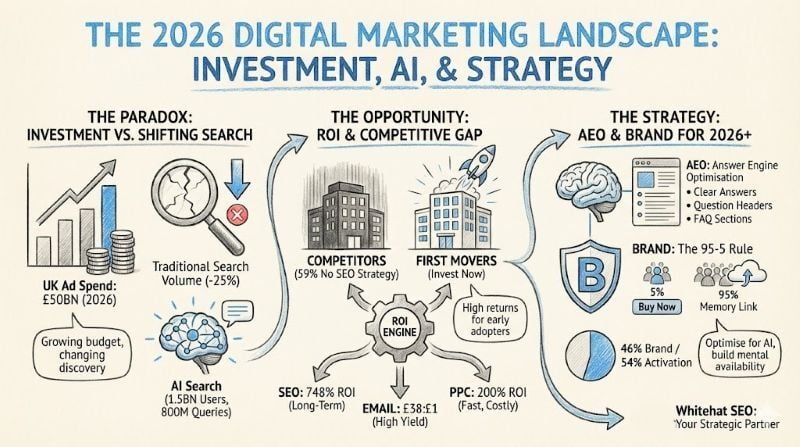
The digital marketing landscape in 2026 presents a paradox. Investment is growing, with the Gartner 2025 CMO Spend Survey reporting that 79.2% of CMOs expect budget increases this year. Yet the fundamentals of how people search are shifting dramatically. Google's AI Overviews now serve 1.5 billion monthly users, ChatGPT processes 800 million weekly active queries, and Gartner predicts traditional search volume will drop 25% by the end of 2026. explore our digital marketing FAQs
Why Invest in Digital Marketing in 2026?
UK digital ad spend is projected to reach £50 billion in 2026, yet 59% of UK businesses still lack an SEO strategy, according to LOCALiQ's 2026 research. This gap creates significant competitive opportunity: businesses investing in digital marketing now—particularly in SEO and AI search optimisation—position themselves ahead of competitors who haven't adapted to the new search landscape.
For UK B2B decision-makers weighing whether to invest in digital marketing, the question isn't if—it's where and how. This guide provides the authoritative UK statistics, ROI benchmarks by channel, and practical guidance you need to make informed investment decisions for 2026 and beyond.
The UK Digital Marketing Investment Landscape in 2026
UK businesses invested £35.53 billion in digital advertising in 2024, representing 13% year-on-year growth according to IAB UK. The trajectory continues upward, with AA/WARC forecasting total UK ad spend to reach £49-50 billion in 2026, growing 6.6% from 2025 levels.
Search and online display now account for 81% of total UK ad spend, demonstrating the dominance of digital channels. Mobile commands 71% of digital investment, reflecting how UK consumers research and purchase products.
| Metric | Value | Source |
|---|---|---|
| UK Digital Ad Spend 2024 | £35.53 billion | IAB UK |
| UK Ad Spend Forecast 2026 | £49-50 billion | AA/WARC |
| Digital Share of Marketing Budgets | 61.1% | Gartner 2025 |
| Average Marketing Budget | 7.7% of revenue | Gartner 2025 |
| UK Businesses Without SEO Strategy | 59% | LOCALiQ UK 2026 |
The IPA Bellwether Report for Q4 2025 shows UK marketing budgets flatlined, with 57.4% of companies leaving spend unchanged amid economic uncertainty. However, looking ahead, a net balance of 18.4% of UK marketers expect budget increases for 2025/26, signalling cautious optimism. For businesses willing to invest while competitors pause, this creates a window of opportunity.
How Much Should UK Businesses Invest in Digital Marketing?
Budget benchmarks vary significantly by company size and sector. The Gartner 2025 CMO Spend Survey, which surveyed 402 CMOs across North America, UK and Europe, found the average marketing budget sits at 7.7% of company revenue—unchanged from 2024 after several years of decline.
However, this average masks significant variation. Small companies with under £5 million revenue typically invest 14% of revenue in marketing, while B2B enterprises with revenue exceeding £250 million average just 3.7%. Technology and software companies benchmark higher at 11-15%, reflecting the competitive intensity of their markets.
Budget Allocation by Industry
- Consumer packaged goods: 18.09% of revenue (highest)
- Technology and software: 11-15% of revenue
- Manufacturing: 5-7% of revenue
- IT and business services: 5.8% of revenue (down from 9% in 2024)
- Professional services: 7-10% of revenue
Within digital budgets, Gartner's research shows paid search leads at 13.9% of digital spend, followed by digital display (12.5%), social advertising (12.2%), and email marketing (7.4%). The shift toward paid digital is pronounced: 69% of all digital spend now goes to paid channels.
Digital Marketing ROI Benchmarks: Which Channels Deliver?
Not all digital channels deliver equal returns. Whitehat SEO's analysis of industry data reveals significant variation in ROI across channels—understanding these benchmarks helps allocate budget to highest-yield opportunities.
SEO: The Highest Long-Term ROI Channel
According to First Page Sage's analysis of SEO campaigns from 2021-2025, the median SEO ROI across industries is 748% over a three-year period. This means for every £1 invested in SEO, businesses can expect £7.48 in return—though the figure varies significantly by sector. Real estate leads with 1,389% ROI, followed by financial services at 1,031% and medical devices at 1,183%.
For B2B SaaS companies, First Page Sage reports 702% average SEO ROI, with positive returns typically appearing within 6-12 months and peak performance in years two and three. SEO also reduces customer acquisition costs by 60% compared to paid channels, according to industry research.
Email Marketing: The Hidden Champion
UK email marketing delivers exceptional returns. The DMA UK reports £38 return for every £1 spent on email marketing—making it one of the highest-ROI channels available. UK average open rates sit at 35.9%, with click rates of 2.3%. Automated email sequences generate 4x more revenue than batch campaigns, according to Omnisend research.
PPC: Immediate Results with Higher Costs
PPC delivers faster results than SEO but at higher cost. WordStream benchmarks show average PPC ROI of 200% (£2 return per £1 spent), with average Google Ads cost-per-lead around £55. B2B PPC typically breaks even within 4 months. However, costs are rising: CPCs increased 12.88% year-on-year in 2025, putting pressure on paid media budgets.
| Channel | Avg ROI | Time to Positive ROI |
|---|---|---|
| SEO | 748% | 6-12 months |
| Email Marketing | 3,600-4,200% | Immediate |
| Content Marketing | 300-765% | 3-6 months |
| PPC/Paid Search | 200% | Immediate |
| LinkedIn B2B | 113% ROAS | Variable |
The AI Search Transformation: Why 2026 Is Different
This is where digital marketing in 2026 diverges from previous years. AI-powered search is no longer emerging—it's here, and it's fundamentally changing how B2B buyers research and select vendors.
According to the G2 Buyer Behavior Report, GenAI chatbots are now the #1 source influencing B2B vendor shortlists, cited by 17.1% of buyers—ahead of software review sites (15.1%). Forrester reports that B2B buyers are adopting AI search at 3x the rate of consumers, with 90% of organisations now using generative AI tools during their purchasing process.
The Numbers That Matter
- Google AI Overviews: 1.5 billion monthly users across 200 countries
- ChatGPT: 800-900 million weekly active users
- Perplexity: 780 million monthly queries
- CTR reduction when AI Overview present: 47% drop compared to traditional results
- Traditional search volume decline: 25% predicted by end of 2026 (Gartner)
For businesses investing in digital marketing, these statistics demand a strategic response. Traditional SEO remains essential—but it's no longer sufficient. Smart marketers are now investing in Answer Engine Optimisation (AEO), structuring content to be cited and recommended by AI search tools like ChatGPT, Perplexity, Google AI Overviews, and Claude.
Whitehat SEO's analysis of early AEO adopters shows they receive 3.4x more traffic from answer engines than competitors, with 31% higher engagement and 27% higher conversion rates. The opportunity is significant for businesses that move now—before competitors catch up.
The 95-5 Rule: Why Brand Investment Matters
Research from the Ehrenberg-Bass Institute reveals a critical insight for B2B marketers: only 5% of B2B buyers are in-market at any given time. The remaining 95% aren't ready to buy—yet. This has profound implications for digital marketing investment.
The data shows that B2B companies change banks, law firms, and service providers roughly every 5 years on average. This means your advertising mostly reaches buyers who won't purchase soon—but it works by building memory links that influence future decisions. LinkedIn's B2B Institute found that 82% of searchers choose a brand they were already familiar with when making their first click.
This explains why Binet and Field's seminal research recommends a 46% brand / 54% activation split for B2B marketing. It also explains why branded search delivers 19x higher ROAS than generic search, according to LinkedIn and Magic Numbers research published in late 2025.
Key insight: The IPA Effectiveness Conference in October 2025 revealed that budget is 8x more important than ROI in driving marketing effectiveness. Net profit generated is actually down 11% since COVID despite ROI increasing 4%. The message: tight budgets and narrow targeting create a "death spiral" that reduces overall returns.
What UK Businesses Are Actually Doing
LOCALiQ's 2026 State of Digital Marketing report surveyed over 500 UK businesses in January 2026, revealing the current state of digital marketing adoption:
- 84% use organic social media (highest adoption)
- 66% have a website or app
- 62% use content marketing
- 61% use email marketing
- 48% invest in SEO
- 50% are currently using AI in marketing
Perhaps most striking: 76% of UK marketers find marketing more challenging than 12 months ago, and 56% feel overwhelmed by the pace of change. Yet only 64% of those with SEO strategies have adapted them for AI search changes—leaving significant room for competitive differentiation.
The British Chambers of Commerce reports AI adoption among UK SMEs has grown from 25% in 2024 to 35% in 2025, with B2B service firms leading at 46% adoption. The trajectory is clear: AI tools are becoming standard for marketing operations.
Making the Business Case for Digital Marketing Investment
If you're building a case for digital marketing investment, here's how Whitehat SEO recommends structuring your argument:
1. Benchmark Against Industry Standards
If your marketing budget sits below 7.7% of revenue, you're investing less than the average company. For technology companies, this should be 11-15%. Use Gartner's benchmarks to contextualise your current spend.
2. Lead with ROI, Not Costs
Frame investment in terms of expected returns. SEO's 748% average ROI means a £50,000 investment should generate £374,000 in value over three years. Email marketing's 38:1 return in the UK makes it essentially self-funding from early results.
3. Highlight the Competitive Window
With 59% of UK businesses lacking an SEO strategy and only 36% of those with strategies having adapted to AI search, there's a significant first-mover advantage available. This window won't remain open indefinitely.
4. Address the AI Search Shift
With 17% of B2B vendor shortlists now influenced by AI chatbots—and that figure growing rapidly—businesses need to be visible where buyers are looking. Traditional search optimisation alone will become increasingly insufficient.
Practical Next Steps for 2026
Based on the data and Whitehat SEO's experience with UK B2B companies, here's a practical framework for digital marketing investment in 2026:
- Audit your current position: Understand where you rank in traditional search and whether AI tools mentio how to rank in AI search resultsn or recommend your business. If they don't, that's a gap to close.
- Prioritise SEO foundations: Despite AI changes, organic search still drives the majority of B2B website traffic. Ensure your technical SEO is sound and your content addresses buyer questions directly.
- Invest in AEO alongside SEO: Structure content for AI extraction. This means clear answers, question-based headers, FAQ sections, and content that can stand alone when quoted.
- Build attribution infrastructure: Use HubSpot or similar platforms to track marketing's contribution to pipeline. With 52% of CMOs struggling to prove ROI, clear attribution becomes a competitive advantage.
- Balance brand and performance: Follow the 46/54 split. Resist the temptation to over-invest in bottom-funnel performance at the expense of reaching the 95% who aren't buying yet.
Frequently Asked Questions
How much should a UK B2B company spend on digital marketing in 2026?
The Gartner 2025 CMO Spend Survey found that average marketing budgets sit at 7.7% of company revenue. For technology and software companies, this rises to 11-15% of revenue. UK SMBs with revenue under £5 million typically invest 12-14% of revenue in marketing.
What is the average ROI of SEO in 2026?
According to First Page Sage's analysis of SEO campaigns from 2021-2025, the median SEO ROI is 748% over three years. B2B SaaS companies see average ROI of 702%, with positive returns typically appearing within 6-12 months.
How is AI search changing digital marketing investment?
Gartner predicts traditional search volume will drop 25% by end of 2026 due to AI chatbots. AI chatbots are now the #1 source influencing B2B vendor shortlists at 17.1%. Businesses need to invest in Answer Engine Optimisation (AEO) alongside traditional SEO to remain visible.
What percentage of UK businesses have an SEO strategy?
Only 41% of UK businesses have an SEO strategy, according to LOCALiQ's 2026 State of Digital Marketing report. This means 59% lack any formal SEO approach, creating significant competitive opportunity for businesses that invest in search optimisation.
What is the recommended split between brand and performance marketing?
Research from Binet and Field, adapted for B2B contexts, recommends a 46% brand / 54% activation split. The LinkedIn B2B Institute suggests 50/50 as a practical starting point. Cutting brand investment creates a "death spiral" of diminishing returns over time.
The Bottom Line
Digital marketing investment in 2026 isn't optional—it's essential for businesses that want to remain visible to buyers researching solutions. The data is clear: SEO delivers exceptional ROI, UK businesses are under-investing relative to global benchmarks, and AI search is creating a competitive divide between early movers and laggards.
With 59% of UK businesses lacking an SEO strategy and traditional search volumes declining, the window for competitive differentiation is open. Businesses that invest now in both traditional SEO and emerging AEO capabilities will build the visibility and mental availability that drives future growth.
At Whitehat SEO, we've been helping UK B2B companies build search visibility since 2011. As a HubSpot Diamond Partner, we track every ranking improvement through to revenue—so you know exactly which keywords drive business, not just clicks. Ready to discuss your digital marketing investment strategy? Explore our SEO services or learn about our AEO capabilities.
References
- Gartner 2025 CMO Spend Survey – Marketing budgets at 7.7% of revenue
- IPA Bellwether Report Q4 2025 – UK marketing budget trends
- IAB UK Digital Adspend Report – UK digital advertising spend data
- First Page Sage SEO ROI Statistics – SEO return on investment benchmarks
- LOCALiQ UK State of Digital Marketing 2026 – UK business adoption data
- G2 Buyer Behavior Report 2025 – B2B buyer research patterns
- LinkedIn B2B Institute – Brand vs performance research
- IPA Effectiveness Conference 2025 – Budget importance vs ROI
About Whitehat SEO
Whitehat SEO is a London-based HubSpot Diamond Partner and full-service inbound marketing agency. Founded in 2011 by CEO Clwyd Probert, we run the world's largest HubSpot User Group and provide SEO, AEO, and AI advisory services to B2B companies across the UK. Learn more at whitehat-seo.co.uk. marketing services view our pricing