
Inbound Marketing Strategy
The shift isn't subtle. When 94% of B2B buyers are using large language models for research, and 95% of purchases come from vendors already on the buyer's "Day One shortlist," the game has fundamentally changed. This guide explains what's different, what still works, and what you need to do about it.
Inbound Marketing in 2026: From Flywheel to AI-Powered Loop
HubSpot's methodology has evolved. B2B buyers have transformed. Here's what it means for your marketing strategy—and what to do about it.
The Short Answer
HubSpot's inbound methodology has fundamentally transformed since 2018, evolving from the customer-centric flywheel to an AI-era playbook called "The Loop" introduced in September 2025. This shift reflects a new reality where 60% of searches end without a click, buyers complete most research through AI tools before visiting websites, and traditional SEO-driven inbound strategies no longer suffice. The data supports this evolution: inbound leads still cost 61% less than outbound and convert at nearly double the rate—but the tactics to capture them have changed dramatically.
If you've built your marketing strategy around inbound marketing principles, you're not wrong—you're just working with an outdated playbook. The fundamentals remain sound: attract with valuable content, engage authentically, delight customers into advocates. What's changed is how buyers discover and evaluate solutions.
HubSpot's Methodology Journey: Funnel to Flywheel to Loop
The inbound marketing methodology has undergone two major transformations since its inception. At INBOUND 2018, CEO Brian Halligan announced the transition from the traditional sales funnel to the flywheel model, placing customers at the centre rather than treating them as an afterthought. The three-phase approach—Attract, Engage, Delight—emphasised momentum from happy customers driving referrals and repeat business.
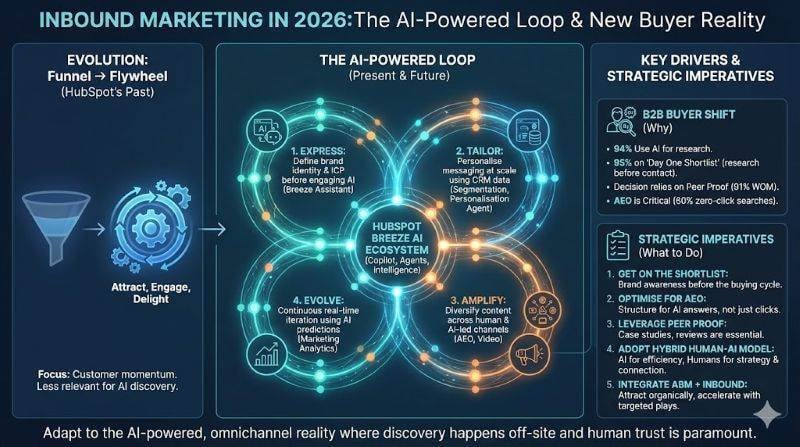
For seven years, the flywheel served as HubSpot's primary strategic framework, with refinements focused on reducing friction and maximising customer force. However, at INBOUND 2025 (September 3-5), CMO Kipp Bodnar and CEO Yamini Rangan introduced "The Loop"—a four-stage AI-era playbook designed for a fundamentally different buying landscape.
| Stage | Purpose | Key Tools |
|---|---|---|
| Express | Define brand identity, tone, and ICP before engaging AI | Breeze Assistant, Brand Identity (Beta) |
| Tailor | Personalise messaging at scale using unified CRM data | AI-Powered Segmentation, Personalisation Agent |
| Amplify | Diversify content across human and AI-led channels | Marketing Studio, AEO Grader |
| Evolve | Continuous real-time iteration using AI predictions | Marketing Analytics, Email Optimisation |
According to HubSpot's official positioning: "The core components of inbound marketing are still essential, but they aren't enough anymore." The Loop builds on inbound's foundation—educating customers, creating value, building relationships—whilst adapting for a world where buyers discover brands through AI answer engines, social platforms, and creator ecosystems rather than traditional search.
The 2024-2025 Statistics That Define Modern Inbound
Current data reveals that inbound marketing remains dramatically more cost-effective than outbound approaches, though the execution has evolved. The numbers tell a compelling story for marketing leaders.
Cost and Conversion Advantages Persist
Inbound marketing generates leads at an average cost of £135 compared to £364 for outbound—a 61% saving. SEO delivers a 14.6% conversion rate versus just 1.7% for traditional outbound methods like cold-calling and direct mail. Companies using marketing automation see £5.44 return for every £1 invested within three years, whilst email marketing generates £36-40 for every £1 spent.
Content Marketing Effectiveness Has Increased
According to the Content Marketing Institute's 2024 report, 87% of marketers report content marketing generates demand and leads—up 11 points since 2023. Content marketing generates three times more leads per pound spent than traditional advertising whilst costing 62% less. Companies that blog receive 55% more website visitors than those that don't.
Marketing Automation Has Reached Maturity
- 76% of businesses now use marketing automation as part of their strategy
- HubSpot commands approximately 35-38% of the global marketing automation market
- Automated emails generate 320% more revenue than non-automated emails
- 37% of all email-generated sales come from automated sequences despite representing only 2% of volume
Email benchmarks for 2024 show strong performance across industries, with average open rates of 39.64% and click-through rates of 3.25%. Welcome emails dramatically outperform, achieving 83.63% open rates and 16.6% click-through rates.
HubSpot's Breeze AI Ecosystem Powers the New Methodology
HubSpot launched Breeze AI at INBOUND 2024 (September 18, 2024) as its comprehensive AI solution embedded across the entire customer platform. The ecosystem includes three main components that enable the Loop methodology.
Breeze Copilot (now Breeze Assistant) serves as an AI-powered companion that works across marketing, sales, and service teams. It provides personalised insights about leads and customers, creates content, researches companies, and summarises tickets—all using business context from the Smart CRM.
Breeze Agents automate end-to-end workflows. The four core agents launched include the Content Agent (generating landing pages, blogs, case studies, and podcasts in brand voice), Social Media Agent (creating platform-optimised posts), Prospecting Agent (researching and sending personalised outreach), and Customer Agent (providing 24/7 automated support).
Breeze Intelligence pulls from a database of over 200 million buyer and company profiles for data enrichment, buyer intent identification, and form shortening to increase conversions. At INBOUND 2025, these features were rebranded to HubSpot Enrichment, HubSpot Buyer Intent, and HubSpot Form Shortening.
HubSpot Platform Structure (2025)
The platform now comprises six core hubs: Marketing Hub, Sales Hub, Service Hub, Content Hub (formerly CMS Hub), Data Hub (formerly Operations Hub), and Commerce Hub. HubSpot transitioned to seat-based pricing in March 2024, with Starter tiers beginning at £15/month per seat and Professional Marketing Hub starting around £800-890/month.
For businesses already using HubSpot, the AI capabilities represent a significant operational advantage. Teams can now personalise at scale, automate repetitive tasks, and maintain consistent brand voice across all channels—all whilst keeping human judgment at the centre of strategic decisions.
B2B Buyers Have Fundamentally Changed How They Research and Purchase
The 6sense B2B Buyer Experience Report 2025 reveals seismic shifts in buyer behaviour that directly impact inbound strategy. 95% of purchases now come from a "Day One shortlist"—buyers already know who they want before actively engaging sellers. The vendor contacted first wins 80% of deals.
Buying cycles have shortened from 11.3 months in 2024 to 10.1 months in 2025, whilst buyers evaluate an average of 5.1 vendors (up from 4.5). Notably, 77% of the time the vendor identified as favourite during selection wins the deal, and nearly 80% of seller conversations are now buyer-initiated.
AI Has Become Central to B2B Research
The 6sense report found 94% of buyers use LLMs for research, whilst HubSpot's 2025 B2B Buyer Survey shows 48% of B2B buyers use AI tools like ChatGPT to research software—with 98% saying these tools are impactful. Interestingly, 58% of buyers said the need to evaluate how vendors implement AI caused them to engage sellers 6-7 weeks earlier than previously.
Self-service preferences dominate: 75% of B2B buyers prefer a rep-free sales experience according to Gartner. However, this comes with risk—customers who purchase via self-service digital commerce are 1.65x more likely to experience purchase regret.
Trust and Word-of-Mouth Remain Decisive
An overwhelming 91% of B2B purchasing decisions are influenced by word-of-mouth, with 86% of B2B buyers citing peer recommendations as the most influential factor. 84% of B2B decision-makers start the buying process with a referral, and word-of-mouth drives 5x more sales than paid advertising.
Content consumption patterns favour brevity and proof: 90%+ prefer short articles, 76% use videos, and 75% prefer case studies. Critically, 69% of B2B marketers report case studies as their most effective content type.
Answer Engine Optimisation Emerges as the Critical New Discipline
The rise of AI-powered search has created a new optimisation discipline called Answer Engine Optimisation (AEO)—the practice of structuring content so AI platforms like ChatGPT, Perplexity, and Google AI Overviews can directly provide it as answers to user queries.
This matters because 60% of searches now end without a click (SparkToro's 2024 Zero Click Search Study), and Gartner predicts 25% of organic search traffic will migrate to AI chatbots and virtual agents by 2026. Stack Overflow experienced an 18% traffic decline after ChatGPT became widely adopted—a canary in the coal mine for content-dependent businesses.
HubSpot has responded by launching an AEO Strategy Tool to help marketers optimise for LLM visibility in ChatGPT, Claude, and Perplexity. Understanding the key differences between traditional SEO and AEO is now essential:
Traditional SEO Goal
Rankings, clicks, website traffic
AEO Goal
Citations, mentions, and inclusion in AI-generated answers
Success Metric
Zero-click visibility, AI summaries, brand mentions—even without website visits
Best practices for AEO include structuring content for extraction with clear answer-first sections, using schema markup for AI interpretation, building authority through consistent messaging across multiple independent sources, and targeting question-based queries. The good news? Most of what works for SEO already works for AEO—the differences are narrower than the hype suggests.
Video and Conversational Marketing Have Reached Mainstream Adoption
Video marketing has achieved near-universal adoption: 91% of businesses use video as a marketing tool in 2025 according to Wyzowl—an all-time high. 93% of video marketers see video as important to strategy, with 82% reporting good ROI. Notably, 63% of video marketers now use AI tools to create and edit videos, up from 51% in 2024.
The impact metrics are compelling: 93% say video increased brand awareness, 85% say it helped generate leads, and 83% say video directly increased sales. For B2B specifically, video content achieves 1,200% higher engagement than text and images combined.
Short-Form Video Dominates
HubSpot's 2025 State of Marketing Report identifies short-form video (29.18%) as the most popular content format, with 21% of marketers saying it delivers the highest ROI. 71% believe videos between 30 seconds and 2 minutes are most effective.
Conversational marketing has scaled through chatbot adoption. The chatbot market reached £8.7 billion in 2024 and is projected to grow to £28.95 billion by 2029. 58% of B2B enterprises actively use chatbots, with 80% of sales and marketing teams having integrated chatbot systems. Site visitors with high-intent chat messages are 5x more likely to convert, and well-designed chatbots achieve 80-90% response rates.
AI Adoption in Marketing Is Now Table Stakes—With Significant Caveats
AI has moved from emerging trend to operational necessity. The Salesforce State of Marketing Report (9th Edition) found 32% of marketing organisations have fully implemented AI whilst 43% are experimenting. HubSpot reports 72% of marketers agree AI tools help personalise customer experiences, with 85% reporting improvements in content quality.
Semrush's research shows 67% of small business owners already use AI for content marketing or SEO. Among content marketers specifically, 54% use AI to generate ideas whilst only 6% use it to write entire articles (Orbit Media). The efficiency gains are real: 36% of marketers using AI spend less than one hour writing long-form blog posts.
However, Significant Concerns Persist
- 60% of marketers who use generative AI worry it could harm brand reputation due to bias, plagiarism, or values misalignment
- 86% of marketers spend time manually editing AI-generated content
- 52% of consumers report reduced engagement with content they believe is AI-generated
Gartner predicts 1 in 5 brands will position themselves as "AI-free" by 2027—a counter-movement emphasising human authenticity as a differentiator. The smart approach? Use AI for efficiency (content drafting, data analysis, personalisation at scale) whilst preserving human judgment for strategy, creativity, and authentic relationship-building.
Account-Based Marketing and Inbound Have Merged Into a Unified Approach
The artificial separation between ABM and inbound marketing has dissolved. The ABM market reached £9 billion+ in 2024 and is growing to £14.7 billion by 2033. 87% of marketers say ABM delivers higher ROI than other marketing efforts, with ABM delivering 3x higher ROI than traditional marketing approaches.
The integration creates a powerful combination: inbound content attracts target accounts organically, whilst ABM accelerates engagement with high-value prospects. Content serves dual purposes—building broad awareness whilst supporting targeted account plays. This approach keeps marketing and sales aligned throughout increasingly complex buying journeys involving 10+ buying group members for mid-market purchases.
A key opportunity exists: only 21% of organisations currently use intent data for ABM, creating significant competitive advantage for early adopters.
What Marketers Must Do Differently in 2026
The research reveals five strategic imperatives for modern inbound marketing:
Get on the Day One Shortlist
With 95% of purchases coming from buyers' initial consideration set, brand awareness and thought leadership must occur before active buying begins—not during it.
Optimise for AI Discovery
Structure content for AEO extraction, ensure consistent brand presence across sources AI platforms trust, and accept that visibility in AI-generated answers may matter more than website clicks.
Invest in Peer-Generated Proof
With 91% of B2B decisions influenced by word-of-mouth and 86% relying on peer reviews, customer testimonials, case studies, and review site presence have become essential infrastructure.
Adopt the Hybrid Human-AI Model
Use AI for efficiency (content drafting, data analysis, personalisation at scale) whilst preserving human judgment for strategy, creativity, and authentic relationship-building.
Integrate ABM with Inbound
Use inbound to attract target accounts and ABM to accelerate conversion, recognising that the methodologies are complementary rather than competing.
The flywheel's physics remain valid—customer delight still generates momentum—but the mechanics of capturing and channelling that momentum have fundamentally changed. Marketers who adapt to The Loop's AI-powered, omnichannel reality will thrive; those waiting for the old playbook to return will find their competitors have already moved on.
Frequently Asked Questions
What is The Loop in HubSpot's 2025 methodology?
The Loop is HubSpot's AI-era marketing playbook introduced at INBOUND 2025, replacing the flywheel as the primary strategic framework. It comprises four stages: Express (define brand identity and ICP), Tailor (personalise messaging at scale using CRM data), Amplify (diversify content across human and AI channels), and Evolve (continuous real-time iteration using AI predictions). Unlike the flywheel's focus on customer momentum, The Loop addresses how buyers now discover brands through AI answer engines and social platforms.
Is inbound marketing still effective in 2025?
Yes, inbound marketing remains highly effective. Inbound leads cost 61% less than outbound (averaging £135 versus £364) and convert at nearly double the rate. SEO delivers a 14.6% conversion rate compared to 1.7% for traditional outbound methods. Content marketing generates three times more leads per pound spent than traditional advertising. However, the tactics have evolved—marketers now need to optimise for AI answer engines alongside traditional search.
What is Answer Engine Optimisation (AEO)?
Answer Engine Optimisation (AEO) is the practice of structuring content so AI platforms like ChatGPT, Perplexity, and Google AI Overviews can directly cite it when answering user queries. Unlike traditional SEO which targets rankings and clicks, AEO focuses on getting your brand cited and mentioned in AI-generated answers. With 60% of searches now ending without a click, AEO has become essential for maintaining visibility as buyers increasingly research through AI tools.
How have B2B buying behaviours changed in 2025?
B2B buying behaviour has shifted dramatically. According to the 6sense B2B Buyer Experience Report 2025, 95% of purchases now come from a "Day One shortlist"—buyers know their preferred vendors before actively engaging sales. The vendor contacted first wins 80% of deals, and 94% of buyers use AI tools like ChatGPT for research. Buying cycles have shortened from 11.3 to 10.1 months, with nearly 80% of seller conversations now buyer-initiated. This means brands must build awareness before the buying journey begins.
What is HubSpot Breeze AI and how does it support The Loop?
HubSpot Breeze AI is a comprehensive AI ecosystem launched at INBOUND 2024 and expanded in 2025. It includes three main components: Breeze Assistant (an AI companion for marketing, sales, and service teams), Breeze Agents (automated specialists for content, prospecting, customer service, and social media), and Breeze Intelligence (data enrichment from over 200 million buyer profiles). These tools enable the four stages of The Loop by automating personalisation, content creation, and real-time optimisation at scale.
References & Further Reading
HubSpot Official Sources:
- Breeze AI Platform – HubSpot's comprehensive AI solution
- INBOUND 2025 Fall Spotlight – The Loop methodology announcement
- Breeze Documentation – HubSpot Knowledge Base
Industry Research Reports:
- 6sense B2B Buyer Experience Report 2025 – Comprehensive B2B buyer behaviour study
- Content Marketing Institute B2B Research – Annual content marketing benchmarks
- Wyzowl Video Marketing Statistics 2025 – State of video marketing
- GetResponse Email Benchmarks – Email marketing performance data
Related Articles from Whitehat:
- What Is Inbound Marketing? – Foundational guide to inbound principles
- AEO: How to Show Up in ChatGPT Search – Practical AEO implementation guide
- AI for Marketers – How AI is transforming marketing operations
- SEO & AEO Strategy – Building an integrated search strategy
Need Help Adapting Your Inbound Strategy?
As a HubSpot Diamond Partner, we help B2B companies navigate the shift from flywheel to Loop—optimising for both traditional search and AI discovery. marketing services SEO services view our pricing
Book a Strategy Call