
The Self-Starter's Inbound Marketing Diagnostic
Being a "self-starter" in marketing used to mean you were willing to roll up your sleeves and write a few blog posts. In 2026, it means something fundamentally different. It means you are the architect of a revenue engine, often operating under intense scrutiny from a board or stakeholders that demands more pipeline with less budget. If you're managing inbound marketing for a B2B company—whether in-house or as an agency partner—you need a diagnostic framework to determine if your current activity is generating genuine pipeline or just noise.

Quick Answer: What Questions Do Successful Inbound Marketers Ask?
The most effective inbound strategies start with seven critical questions: (1) Do you understand who you're not selling to? (2) Is your value proposition clear in 5 seconds? (3) Are you using your martech stack as a revenue engine or a database? (4) Do you have a single source of truth for marketing and sales data? (5) Is your content designed for AI query decomposition? (6) Are you building trust or chasing vanity metrics? (7) Can you afford the learning curve of in-house growth, or is an agency partnership more economical? This diagnostic helps B2B marketers align their tactics with revenue outcomes rather than activity metrics.
With marketing budgets flatlining at roughly 7.7% of company revenue across the UK and North America, you cannot afford "random acts of marketing." You need a diagnostic framework to determine if your current activity is truly generating revenue impact. This guide walks through the seven questions every self-starting marketer must answer.
1. Strategic Alignment: Are You Solving the Right Problem?
The first failure point for self-starters isn't a lack of effort; it's a lack of precision. In the AI-driven era, traffic is vanity. Trust is sanity. Pipeline is reality.
Do You Know Who You Aren't Selling To?
According to the Ehrenberg-Bass Institute's foundational research on buyer behaviour, 95% of B2B buyers are not actively in-market at any given time. This is a critical insight that most self-starters overlook. If your strategy relies solely on "Buy Now" calls-to-action and bottom-funnel content, you are systematically ignoring the vast majority of your future revenue.
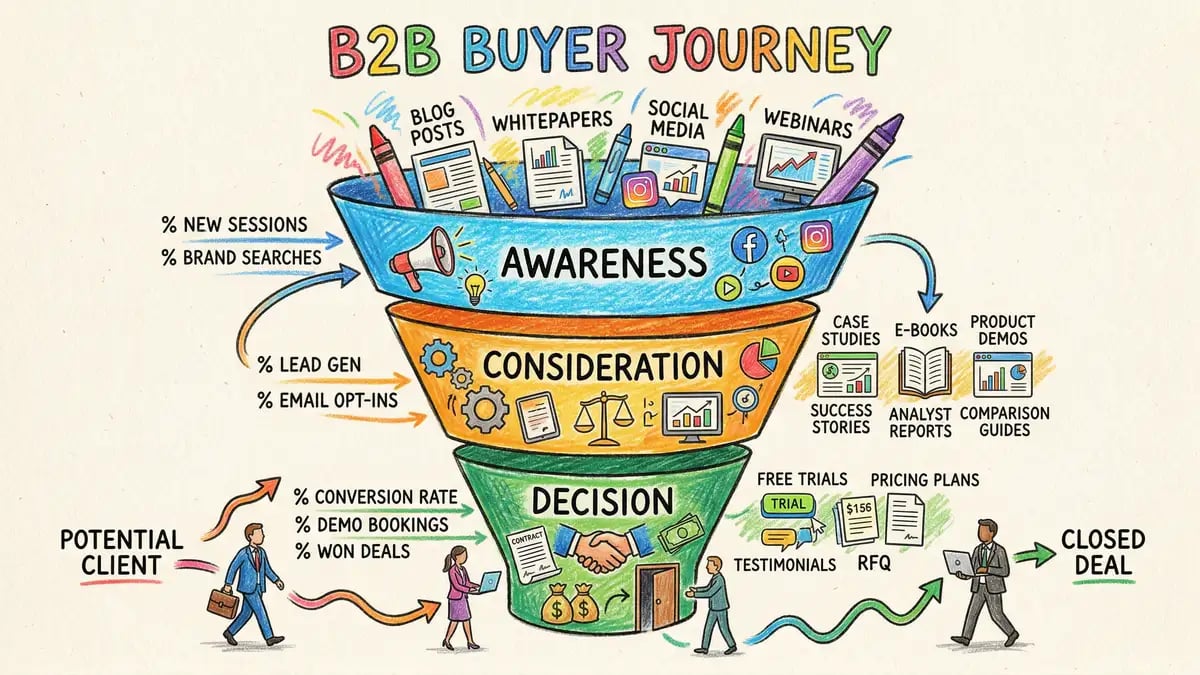
Your primary job is to build mental availability with the 95% of out-of-market buyers so that when they do enter the market—whether in 3 months or 18 months—you are the only logical choice. This requires a content strategy that spans awareness and consideration, not just conversion. Think about the last significant software purchase your company made. You likely spent weeks in evaluation before you ever reached out to a sales team. Your buyers do the same.
Is Your Value Proposition Clear in the First 5 Seconds?
Research from 6sense shows that B2B buyers complete roughly 70% of their buyer journey before they ever contact a sales representative. By the time someone lands on your website or reads your content, they've already formed initial impressions about whether you're worth their time. If your website speaks in vague corporate jargon—"We deliver best-in-class solutions" or "We're the industry leader"—you lose potential customers before the conversation starts.
Instead, your value proposition must address a specific pain point clearly. Not "we help companies scale" but "we reduce customer churn by 30% in the first 90 days by implementing predictive analytics." Specificity wins in 2026.
2. The Technology Audit: Is Your Martech Stack a Revenue Engine or a Paperweight?
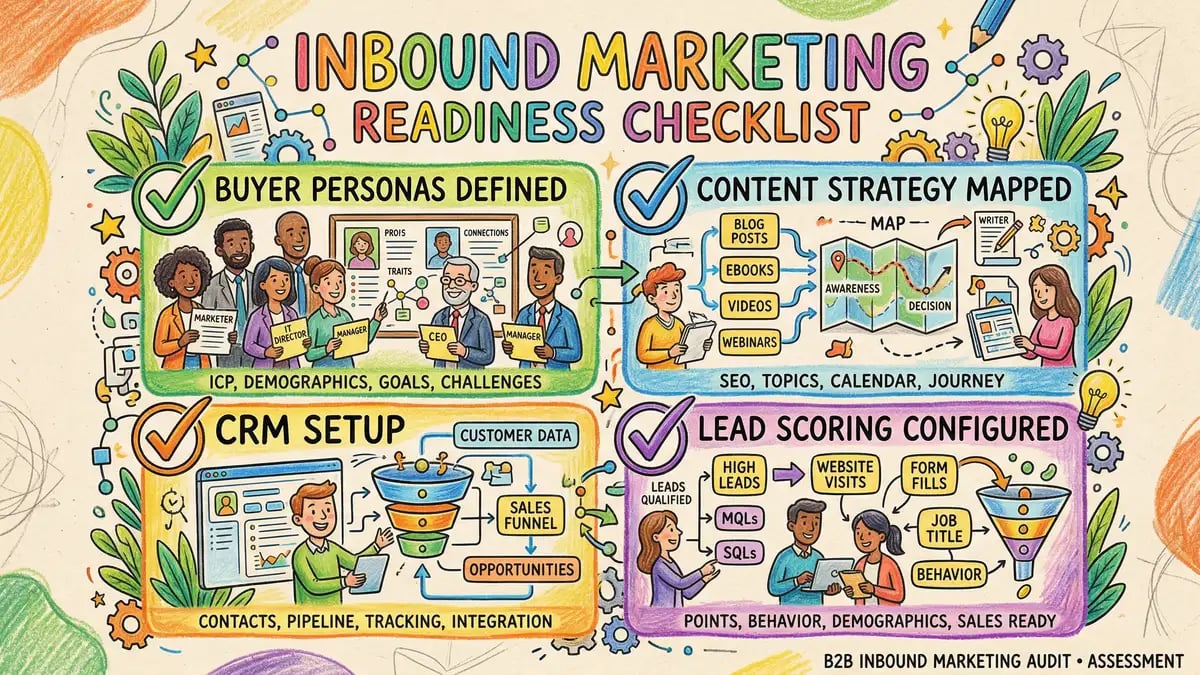
Many organisations pay for powerful platforms like HubSpot, Salesforce, or Marketo but barely scratch the surface of their capabilities. For UK-based B2B companies, this represents a missed opportunity. HubSpot alone sits on thousands of workflow automations, custom properties, and integration capabilities that most users never implement.
Are You Using Your Platform as a Rolodex or a Revenue Engine?
If you're manually moving leads between columns in your CRM, exporting CSVs to Excel for reporting, or sending batch emails instead of trigger-based sequences, you're leaving money on the table. HubSpot customers who optimise their platform see 129% more leads after one year, according to HubSpot's own ROI research—but only if the automation workflows are correctly configured and maintained.
This means setting up lead scoring that reflects your actual sales criteria, building nurture sequences that adapt based on buyer behaviour, and creating automated alerts so sales only contacts prospects when they show genuine intent signals. The difference between a fully utilised platform and a minimally used one is often the difference between a predictable revenue engine and a marketing department that struggles to justify its budget.
Do You Have a Single Source of Truth?
Attribution is the holy grail of 2026. If your marketing data sits in one silo—tracked in your marketing automation platform—and your sales data sits in another—tracked in your CRM—you cannot calculate Customer Acquisition Cost (CAC), Lifetime Value (LTV), or demonstrate marketing's true contribution to pipeline. This is a board-level conversation that increasingly shapes marketing budget allocation.
A "single source of truth" means your marketing and sales data are integrated, historical touchpoints are tracked, and revenue is attributed back to the campaigns and content that influenced the deal. This requires proper implementation of your martech stack, which is why professional onboarding and optimisation services have become essential for ambitious marketing leaders.
3. Content in the AI Era: Optimising for Both Machines and Humans
The "Inbound is Dead" narrative that circulates every few years is simply false. But "lazy inbound"—high-volume, low-quality content created without strategic intent—certainly is dead. With 60% of searches now ending without a click (zero-click searches according to SparkToro research), and with AI models increasingly providing answers directly, your content strategy must evolve beyond driving clicks.
Is Your Content Designed for Query Decomposition?
AI engines like ChatGPT, Claude, and other emerging systems break user questions down into sub-queries—a process called "query decomposition." To rank in AI-generated answers and maintain visibility, your content must be comprehensive enough to answer not just the primary question but also the anticipated follow-up questions a user might ask. This is the core of Answer Engine Optimisation (AEO).
For example, if someone asks "How do I implement HubSpot workflows?" an AI-optimised answer would cover not just the steps but also common pitfalls, performance monitoring, troubleshooting, and integration with other systems. This requires deeper, more thoughtful content—and it rewards the self-starter who takes time to be genuinely helpful rather than just optimised.
Are You Chasing Clicks or Building Trust?
As Yamini Rangan, CEO of HubSpot, has noted: "We do not chase clicks, we build trust." High-volume, low-quality content generated by AI tools will increasingly be ignored, deprioritised by search engines, and distrusted by buyers. Human insight, original research, expert perspectives, and data-backed claims are the new premium currency in content marketing.
If you're a self-starter operating with limited budget, focus on creating content that reflects your genuine expertise. A single comprehensive guide to solving a specific customer problem—backed by case studies or proprietary research—will outperform 50 generic blog posts created to satisfy SEO checklists.
4. The Financial Reality: In-House vs. Agency Economics
For the self-starter facing the most critical decision: Should you build an in-house team or partner with an agency? The answer requires honest number-crunching. Building a robust, modern inbound engine typically requires five specialist roles: a strategist, a writer, a designer, a developer, and a martech specialist (whether HubSpot, Marketo, or similar).
| Cost Centre | In-House Team (Annual) | Agency Partner (Annual) |
|---|---|---|
| Salaries & Benefits | £150k–£200k (3 roles minimum) | £0 |
| Recruitment & Training | £15k–£25k | £0 |
| Software, Tools & Subscriptions | £12k–£18k | Included |
| Management Overhead & Contingency | £15k–£30k | £0 |
| Retainer Investment | £0 | £42k–£72k |
| TOTAL | ~£192,000–£298,000 | ~£42,000–£72,000 |
The economics are stark. But before you assume an agency is the obvious choice, factor in the intangible benefits of building in-house capability: institutional knowledge, direct control over execution, alignment with company culture, and the ability to respond quickly to market changes. The decision depends on your company's growth stage, risk tolerance, and how quickly you need to hit revenue targets.
Can You Afford the "Time to Competence"?
It takes 8–12 months for a new marketing hire to reach full productivity in your specific context. They need time to understand your product, your market, your buyers, your sales process, and your technical stack. An agency partner, by contrast, hits the ground running on Day 1 because they bring proven frameworks and experience from working with dozens of similar companies.
The hybrid approach—starting with agency support to establish strategy and processes, then transitioning to in-house execution—is increasingly popular with self-starters who want fast results without overcommitting payroll.
Key Takeaways
The Seven Questions Every Self-Starter Must Answer:
- Do you understand who you're not selling to? (Focus on the 95% out-of-market.)
- Is your value proposition clear in 5 seconds? (Specificity beats vague corporate language.)
- Are you using your martech platform as a revenue engine or just a database? (Automation and workflow matter.)
- Do you have a single source of truth for marketing and sales data? (Attribution is non-negotiable.)
- Is your content designed for AI query decomposition? (Cover primary and secondary questions.)
- Are you building trust or chasing vanity metrics? (Focus on genuine expertise and outcomes.)
- Can you afford the in-house learning curve, or is an agency partner more economical? (Do the maths honestly.)
Frequently Asked Questions
Is inbound marketing still effective in 2026?
Absolutely. But the definition has shifted. It's no longer primarily about "traffic" but about building "mental availability" and "trust architecture." Inbound leads still cost 61% less than outbound leads to acquire, and the content you create compounds over time. The key is moving from vanity metrics (page views, clicks) to revenue metrics (pipeline contribution, customer acquisition cost).
How much does a proper HubSpot implementation cost?
DIY HubSpot setups are possible but often lead to underutilisation of the platform's capabilities. Professional onboarding typically ranges from £5,000 to £20,000 depending on complexity, integrations, and customisation. The ROI comes from preventing data silos, accelerating pipeline velocity, and enabling sales-marketing alignment that reduces deal cycle length.
What's the difference between SEO and AEO?
SEO (Search Engine Optimisation) gets you clicked. AEO (Answer Engine Optimisation) gets you cited. AEO ensures your brand and content are the "answer" provided by AI models like ChatGPT, Google's AI Overview, and other generative systems. This requires structured data, high-authority content, and answers that address the full query context rather than just keyword-matching.
How long does it take to see ROI from inbound?
Inbound is a compound asset. Expect to see leading indicators—traffic growth, engagement metrics, lead volume—in 3–6 months. Revenue impact typically matures around months 6–9 as leads progress through longer B2B sales cycles. However, with proper attribution and closed-loop reporting, you should be able to demonstrate contribution to pipeline within the first quarter.
Conclusion: From Self-Starter to Scale
The journey of the self-starter eventually hits a ceiling. You can't do everything, and in 2026, you shouldn't try. The goal is to reach that ceiling fast—demonstrating value and building momentum—then partner for scale. Whether you scale with in-house hires or an agency partnership depends on your answers to the seven diagnostic questions in this guide.
The companies that win in 2026 won't be those that chase every new tactic. They'll be the ones that build systematic, trust-based inbound engines aligned with revenue outcomes. Start by asking the right diagnostic questions. The answers will guide your next move.
About the Author
Clwyd Probert is the founder of Whitehat, a London-based SEO and inbound marketing agency and HubSpot Diamond Partner. With over 15 years of experience in digital marketing strategy, he helps B2B companies across the UK build sustainable organic growth through data-driven approaches. He regularly speaks at marketing conferences on inbound strategy, revenue alignment, and HubSpot optimisation.