
B2B Marketing Strategy
The B2B Effectiveness Code analysis of 435 case studies from WARC and Cannes Lions databases reveals an uncomfortable truth: B2B creative is concentrated at the least effective end of the marketing effectiveness spectrum. Creative commitment in B2B—a composite of media budget, duration, and channel breadth—has actively declined over the past decade, precisely when evidence shows longer, broader, better-funded campaigns deliver superior results.
B2B Brand Marketing in 2026: Why the Long Game Finally Wins
The evidence is now overwhelming—B2B companies that invest in brand building dramatically outperform those focused solely on short-term activation. Here's what the research tells us and how to act on it.
B2B brand marketing has fundamentally shifted. Research from the LinkedIn B2B Institute, Ehrenberg-Bass Institute, and the work of Les Binet and Peter Field confirms that the optimal B2B marketing split is approximately 46–50% brand building to 54–50% activation—yet most B2B marketers currently allocate just 30% to brand. Whitehat SEO's analysis of B2B marketing effectiveness reveals that companies correcting this imbalance consistently outperform competitors trapped in the lead generation treadmill.
This matters because 95% of B2B buyers are out-of-market at any given time, and 90% of purchases come from vendors already on buyers' mental shortlists before research begins. For B2B SaaS companies, professional services firms, and enterprise technology providers, these dynamics mean brand building isn't a luxury—it's the primary mechanism for future revenue generation.
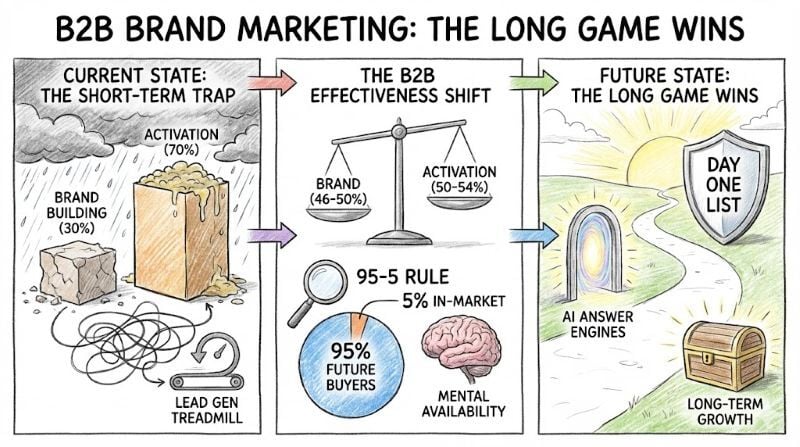
Add to this the AI disruption: Gartner predicts traditional search volume will drop 25% by 2026 as buyers shift to AI answer engines. The brands that win will be those already embedded in buyers' memories when they ask ChatGPT or Perplexity for recommendations.
The 95-5 Rule Has Fundamentally Reframed B2B Marketing Strategy
Professor John Dawes of the Ehrenberg-Bass Institute articulated what has become the most influential framework in modern B2B marketing: at any given time, roughly 95% of business buyers are not in-market for your product. This isn't a precise rule but a powerful heuristic derived from B2B repurchase cycles—companies typically change banking services every five years, buy computers every four years, and switch professional service providers on similarly extended timelines.
The implications for B2B marketers are profound. If only 5% of your potential customers are actively buying right now, then 95% of your advertising reaches people who won't purchase anytime soon. This reality demands a fundamental shift in thinking: rather than optimising for immediate lead capture, effective B2B marketing must focus on building memory structures that activate when buyers eventually enter the market.
Research from Bain & Company and Google confirms this with striking data on the "Day One List" phenomenon. When surveying 1,208 B2B buyers across software, cloud hosting, hardware, and professional services, they found that 80–90% of buyers already have a shortlist of vendors before beginning formal research—and 90% ultimately purchase from that original list. The average buyer includes just three vendors on their Day One list.
What this means for your business: If you're not already in mind when the buying journey begins, you have only an 8% chance of winning the deal. Whitehat SEO's inbound marketing services are designed specifically to build the mental availability that gets you onto buyers' Day One lists—combining SEO services with brand-building content that resonates with out-of-market buyers.
The LinkedIn B2B Institute has codified this insight into practical strategy: "Flip the funnel on its side." Rather than thinking in terms of top, middle, and bottom funnel stages, marketers should segment their approach between in-market buyers (5%) who need rational, product-focused activation messaging, and out-of-market buyers (95%) who need emotional brand building that creates lasting memories.
Brand and Activation Budgets Require Careful Rebalancing for B2B
Les Binet and Peter Field's landmark analysis of IPA Databank B2B case studies revealed that the optimal budget split for B2B companies differs from their famous 60:40 B2C rule. For B2B specifically, their research indicates 46% brand building to 54% activation delivers maximum effectiveness—what Binet describes as "a bit more rational, a bit more activation-heavy" than consumer marketing. The LinkedIn B2B Institute simplifies this to a practical recommendation of 50:50 as a starting point.
Current reality falls far short of this recommendation. According to LinkedIn's B2B Marketing Benchmark, the typical allocation is 30% brand building, 36% lead generation, and 20% demand generation—meaning most B2B organisations significantly under-invest in brand. Technology marketers are particularly guilty, spending just 33% on brand building versus 67% on activation.
| Metric | Recommended | Current Average |
|---|---|---|
| Brand building allocation | 46–50% | 30% |
| Activation allocation | 50–54% | 56% |
| Marketing as % of revenue | 7–9% | 7.7% |
The Gartner CMO Spend Survey 2025 shows marketing budgets have stabilised at 7.7% of company revenue after years of decline from the pre-pandemic peak of 11%. B2B SaaS companies specifically invest a median of 8% of ARR on marketing, with high-growth companies spending approximately 40% more than their slower-growing peers. The pressure on these constrained budgets makes allocation decisions more consequential than ever.
Within these budgets, paid media now commands 30.6% of spend—up 11% year-over-year—with digital channels taking 61.1% of channel budgets. However, the channel delivering the best results for B2B brand building remains LinkedIn, where 84% of B2B marketers report the platform delivers best value. LinkedIn's own research shows audiences exposed to both brand and acquisition messages are 6x more likely to convert, validating the integrated approach over siloed campaign thinking.
AI Answer Engines Are Creating an Urgent Visibility Crisis
The most significant disruption to B2B brand marketing in 2025–2026 is the rise of AI answer engines. Gartner's stark prediction that traditional search engine volume will drop 25% by 2026 is already manifesting in buyer behaviour: according to research from Responsive, 25% of B2B buyers now use generative AI more than traditional search when researching vendors, with nearly two-thirds using AI at least as much as search.
The traffic impact is severe and measurable. Seer Interactive's analysis found that organic click-through rates plummeted 61% on queries where Google displays AI Overviews—from 1.76% to just 0.61%. Paid search fared even worse, with CTR crashing 68%. The G2 2025 Buyer Behavior Report reveals that GenAI chatbots have become the number one source influencing vendor shortlists at 17.1%, surpassing vendor websites (12.8%) and salespeople (8.8%).
This shift demands new optimisation strategies. Answer Engine Optimisation (AEO) or Generative Engine Optimisation (GEO) focuses on getting brands cited in AI-generated responses rather than traditional search rankings. Whitehat SEO's AEO services address this emerging channel specifically, ensuring your brand appears when buyers ask AI tools for recommendations.
The platforms have distinct source preferences:
- ChatGPT draws heavily from Wikipedia (47.9% of citations), Reddit (11.3%), and Forbes (6.8%)
- Google AI Overviews favour Reddit (21%), YouTube (18.8%), and Quora (14.3%)
- Perplexity relies most heavily on Reddit (46.7%) and YouTube (13.9%)
For B2B brands, practical adaptation requires several shifts. Content must appear in raw HTML rather than JavaScript-dependent formats, as AI crawlers cannot reliably execute scripts. Key messages should be optimised within 160 characters—the text blocks AI most commonly extracts. Original research, surveys, and first-party data become essential for earning citations across the web.
The silver lining: AI search traffic converts better. Research from Amsive shows LLM-referred traffic converts at 14.2% compared to Google's 2.8%, likely because AI users are further along in their decision-making process and have received more context before arriving at a website.
Thought Leadership and Video Now Drive Measurable Brand Outcomes
The 2024–2025 Edelman-LinkedIn B2B Thought Leadership Impact Study provides compelling evidence for content investment. 75% of decision-makers and C-suite executives report that thought leadership has led them to research a product or service they weren't previously considering, while 70% of C-suite executives say it led them to reconsider their current vendor.
Perhaps most striking: 54% of C-suite executives spend more than one hour per week consuming thought leadership content. This represents significant attention from exactly the stakeholders B2B marketers most want to reach. The question isn't whether to invest in thought leadership—it's whether your thought leadership is distinctive enough to capture attention in a crowded market.
Video has emerged as the dominant format. According to Wyzowl's State of Video Marketing 2025, 93% of marketers say video is an important part of their marketing strategy, with 91% of businesses now using video as a marketing tool—an all-time high. LinkedIn research shows video content achieves 5x more engagement than text-only posts, while native video receives 24x more engagement than static posts.
The optimal format has shifted decisively toward short-form content. Average B2B video length decreased from 6 minutes in 2022 to 4 minutes 15 seconds in 2025, with the sweet spot for most content being 30 seconds to 2 minutes. Short-form video now delivers the highest ROI, with 104% more marketers naming it most valuable in 2025 versus the previous year.
Employee advocacy amplifies all content efforts. Messages shared by employees achieve 561% greater reach than those shared through brand channels, with 800% more engagement on employee-shared posts. Leads generated through employee advocacy are 7x more likely to convert. Companies with formal advocacy programmes report that 64% of participating employees credit the programme with attracting new business.
LinkedIn's Algorithm Now Rewards Depth Over Volume
LinkedIn's algorithm underwent significant changes in 2024–2025 that B2B marketers must understand. Richard Van Der Blom's analysis of over 1.5 million posts reveals sobering trends: organic views down 50% year-over-year, engagement dropped 25%, and follower growth down 59%. However, this contraction reflects a deliberate shift toward quality over quantity.
The algorithm now prioritises "dwell time"—how long someone views a post—over simple engagement metrics. Meaningful comments are weighted far more heavily than generic responses, while engagement bait tactics like "Comment YES if you agree" are actively detected and suppressed. Posts containing external links now reach 25–35% fewer people, encouraging native content creation.
Content formats that perform best include:
- Carousels (PDF documents) achieving a 6.60% average engagement rate
- Native video with 24x more engagement than static posts
- Educational frameworks that demonstrate genuine expertise
LinkedIn explicitly uses LLM understanding to identify and reward authentic authority in specific niches, making consistency and depth more valuable than breadth. Strategic recommendations from the research include posting 2–5 times per week (achieving 120% more visibility versus sporadic posting), engaging strategically through comments 5–10 times daily (increasing profile views by 55% and content reach by 20%), and leading with brand-building content before conversion messages, which performs 2.3x better than immediate activation approaches.
Measurement Failures Perpetuate the Short-Termism Trap
The most persistent barrier to appropriate brand investment is measurement dysfunction. The LinkedIn B2B Institute found that 96% of APAC marketers measure ROI within three months—yet average B2B sales cycles exceed six months and can extend beyond a year for enterprise purchases. This temporal mismatch guarantees that brand building appears to fail when measured against inappropriate timescales.
SaaS sales cycles have lengthened significantly, now averaging 84 days at the median, with enterprise deals extending to 90–180+ days. The causes compound: average B2B deals now involve 6.8–11 stakeholders (up from 5.4 in 2020), CFO involvement in software purchases increased 40%, and security questionnaires routinely add 2–4 weeks. Measuring brand campaign effectiveness against quarterly lead targets ignores these realities.
The measurement gap extends beyond timing. Research shows 82% of companies have ABM practices but only 33% measure account-centric metrics—they're executing one strategy while measuring against another framework entirely. Under 25% of marketers rate their measurement practices as "fair," and Gartner identifies "proving ROI with analytics" as a top-three challenge hindering marketers' ability to demonstrate success.
Whitehat SEO's approach integrates HubSpot implementation with attribution modelling that accounts for B2B buying cycles. Our HubSpot CRM setup includes dashboards your CFO will trust—connecting marketing activity to pipeline and revenue over realistic timeframes, not arbitrary quarterly targets.
Recommended approaches include multi-touch attribution modelling (used by 73% of companies over £200M in revenue), marketing mix modelling for macro-level analysis that can capture brand advertising effects, and acceptance that brand campaigns genuinely need 18+ months to demonstrate full impact. Metrics should evolve to include mental market share, share of voice in AI responses, citation frequency across platforms, and brand health tracking beyond simple awareness.
The Path Forward Requires Strategic Patience and Bold Creativity
The LinkedIn B2B Institute identifies three essential actions for B2B marketers: extend the duration of advertising commitment, maximise the number of media channels, and maintain rather than reduce investment. These recommendations run counter to prevailing practice but align with the fundamental insight that brand effects compound over time while activation effects decay rapidly.
81% of B2B video ads fail to even register in viewers' memories according to LinkedIn B2B Institute and Media Science research—a stark reminder that distinctiveness matters as much as presence. Most B2B advertising uses similar blue and white colour palettes, leading to 25% misattribution where buyers remember seeing an ad but credit the wrong brand. Bold creative that builds distinctive memory structures is not optional for brand building; it's the mechanism through which brand building works.
The prize for getting this right is substantial. IPA Effectiveness Awards winners demonstrate that sustained brand building delivers extraordinary results. The principle applies equally to B2B: brands that resist the pressure for short-term metrics and invest consistently in mental availability will compound advantages over competitors trapped in the lead generation treadmill.
What This Means for Your Marketing Strategy
The research consensus is clear: B2B brand marketing has entered a pivotal transition where long-held assumptions about the primacy of lead generation are being overturned by evidence. The 95-5 rule demonstrates that most marketing reaches future rather than current buyers, making memory building the primary mechanism for revenue generation. The Day One List research shows that brand consideration is largely determined before formal buying processes begin, meaning sales activation can only capture demand that brand building has already created.
Three strategic imperatives emerge from this synthesis:
- Rebalance budgets toward a genuine 50:50 split between brand and activation, accepting that most B2B organisations are currently under-investing in brand by significant margins.
- Prepare urgently for AI-mediated discovery by optimising content for answer engines, building presence on high-citation platforms, and tracking visibility in AI responses alongside traditional metrics.
- Commit to measurement frameworks that accommodate B2B timescales, resisting pressure to judge brand campaigns by quarterly activation metrics.
The most successful B2B brands in 2026 will be those that resist the seductive certainty of short-term performance metrics in favour of building the mental availability that determines whether they make it onto buyers' Day One lists. In a world where AI increasingly mediates discovery and consideration happens before vendors know they're being evaluated, brand has become the ultimate competitive moat.
Ready to Future-Proof Your B2B Marketing?
Whitehat SEO helps B2B companies build the brand equity and search visibility that gets them onto buyers' Day One lists. As a HubSpot Diamond Partner and the organisers of the world's largest HubSpot User Group, we combine deep platform expertise with evidence-based marketing strategy.
Frequently Asked Questions
What is the 95-5 rule in B2B marketing?
The 95-5 rule, developed by Professor John Dawes of the Ehrenberg-Bass Institute, states that approximately 95% of B2B buyers are out-of-market at any given time. Only 5% are actively looking to purchase. This means most B2B marketing reaches future buyers, not current ones, making brand building the primary mechanism for future revenue generation rather than immediate lead capture.
What is the optimal budget split between brand and activation for B2B?
Research from Les Binet, Peter Field, and the LinkedIn B2B Institute recommends a 46–50% brand building to 50–54% activation split for B2B companies. This differs from the famous 60:40 B2C rule. However, most B2B companies currently allocate only 30% to brand building, significantly under-investing in the activity that drives long-term growth.
How do AI answer engines affect B2B brand marketing?
AI answer engines like ChatGPT, Google AI Overviews, and Perplexity are becoming the first stop for B2B buyers researching vendors. Gartner predicts traditional search volume will drop 25% by 2026. Brands now need Answer Engine Optimisation (AEO) strategies to appear in AI-generated recommendations, alongside traditional SEO. The good news: AI-referred traffic converts at 14.2% versus 2.8% from Google.
What is the Day One List and why does it matter?
Bain & Company research found that 80–90% of B2B buyers already have a shortlist of vendors (the "Day One List") before beginning formal research—and 90% ultimately purchase from that original list. If your brand isn't already in buyers' minds when their buying journey begins, you have only an 8% chance of winning the deal, regardless of how good your sales activation is.
How long does B2B brand building take to show results?
Brand campaigns genuinely need 18+ months to demonstrate full impact. This conflicts with typical measurement practices—96% of marketers measure ROI within three months, yet average B2B sales cycles exceed six months. Companies using marketing mix modelling and multi-touch attribution over longer timeframes consistently find that brand investment delivers higher ROI than short-term activation alone.
References and Further Reading
- LinkedIn B2B Institute & Ehrenberg-Bass Institute. How B2B Brands Grow.
- Dawes, J. (2021). The 95:5 Rule: Advertising Effectiveness and B2B Buyers. Ehrenberg-Bass Institute.
- Bain & Company. How Zero-Click Search Affects B2B Marketers.
- Gartner. (2024). Gartner Predicts Search Engine Volume Will Drop 25% by 2026.
- Binet, L. & Field, P. The Long and the Short of It: Balancing Short and Long-Term Marketing Strategies. IPA.
- Edelman & LinkedIn. 2024-2025 B2B Thought Leadership Impact Study.