Skip to content

Life Science Inbound Marketing: 3,558% ROI + Compliance [2026]

How Life Science Companies Generate Qualified Inbound Leads in 2026

Life science companies generate high-quality inbound leads through educational content addressing scientific queries, regulatory-compliant HubSpot workflows with auditable approval trails, and multi-touch attribution systems that prove marketing ROI across complex 8-month sales cycles involving 6-10 decision-makers from clinical, regulatory, and executive teams.

The life science sector faces a unique marketing challenge in 2026. Marketing directors at biotech, pharmaceutical, and medical device companies must generate qualified leads whilst navigating stringent regulatory requirements, educating highly specialised audiences, and proving ROI to sceptical C-suite executives. Traditional outbound methods—cold calling researchers, purchasing contact lists, attending trade shows—deliver diminishing returns as decision-makers increasingly begin their buying journey through online research.

life-science-inbound-engine

According to HubSpot's 2024 State of Marketing report, inbound marketing generates leads at 61% lower cost than traditional outbound approaches whilst delivering 10x higher conversion rates in B2B sectors. For life science companies specifically, PM360's 2024 Life Science Marketing Benchmark Study found that organisations with mature inbound strategies achieve 54% higher marketing-qualified lead (MQL) volumes and 3.5x better lead-to-opportunity conversion rates compared to outbound-focused competitors.

This comprehensive guide examines how forward-thinking life science marketers build sustainable inbound lead generation systems in 2025. Drawing on current industry data, expert perspectives, and quantifiable case studies, we'll explore the strategies, technologies, and compliance frameworks that transform marketing from a cost centre into a predictable revenue engine. Whether you're implementing HubSpot for the first time or optimising an existing inbound marketing programme, these evidence-based approaches will help you attract, engage, and convert the specialised audiences your business needs to grow.

Why Traditional Outbound Methods Fail Life Science Companies

The pharmaceutical, biotech, and medical device sectors have historically relied on field sales representatives, trade show exhibitions, and direct mail campaigns. These approaches worked when purchasing decisions were made primarily through personal relationships and when digital information was scarce. That landscape has fundamentally changed.

Salesforce's 2024 State of Marketing report reveals that 87% of B2B buyers now begin their purchasing journey with online research before ever speaking to a sales representative. For life science buyers—who must evaluate complex technical specifications, regulatory compliance, and long-term vendor stability—this figure rises to 92% according to BioSpace's 2024 Purchasing Behaviour Study.

The economics are equally compelling. Content Marketing Institute's 2024 B2B Benchmarks found that life science companies allocating budget to inbound marketing achieve:

  • Cost per lead (CPL): $255 for biotech, $187 for medical devices, and $131 for pharmaceutical companies—compared to $890+ for outbound-generated leads
  • Lead quality: 3.2x higher lead-to-opportunity conversion rates for inbound-sourced prospects
  • Sales cycle efficiency: 26% shorter time-to-close when buyers engage with educational content before sales contact
  • Customer lifetime value: 41% higher LTV for customers acquired through inbound channels

Christine Slocumb, CEO of Supreme Optimization and recognised life science marketing strategist, explains: "The old pharmaceutical rep model assumed you could educate buyers through personal relationships. Today's procurement committees do extensive research independently. If your educational content doesn't appear in their research phase, you're simply not considered. It's not about brand awareness anymore—it's about being the trusted source when they're actively evaluating solutions."

This shift is particularly acute for companies targeting research institutions, hospital systems, and large pharmaceutical organisations where purchasing decisions now involve 6-10 stakeholders across clinical, regulatory, procurement, and executive functions. Traditional single-threaded sales approaches cannot effectively engage this diverse buying committee. Inbound marketing, by contrast, delivers targeted educational content that serves each stakeholder's specific concerns whilst maintaining consistent brand messaging. Platforms like HubSpot enable life science marketers to track engagement across all committee members, providing sales teams with the intelligence needed to navigate complex, consensus-driven purchasing processes.

What Constitutes High-Quality Inbound Leads in Life Sciences

Not all leads carry equal value. Life science companies face extended sales cycles—averaging 8 months for medical devices and 14 months for laboratory equipment according to IQVIA's 2024 Sales Cycle Analysis—making lead quality far more critical than lead volume. Marketing directors must implement qualification frameworks that identify prospects with genuine purchasing intent, budget authority, and timeline alignment.

Dr. Paul Avery, Senior Marketing Consultant at BioStrata, defines high-quality life science leads through five criteria:

  1. Organisational fit: Company size, research focus, and funding stage align with your ideal customer profile (ICP)
  2. Role relevance: Contact holds decision-making authority or significant influence within the purchasing committee
  3. Problem awareness: Prospect demonstrates understanding of the specific challenge your solution addresses
  4. Engagement depth: Multiple content interactions indicating serious research rather than casual browsing
  5. Timeline signals: Behavioural indicators suggesting active evaluation (pricing page visits, comparison downloads, demo requests)

HubSpot's platform enables life science marketers to operationalise these criteria through progressive lead scoring that automatically adjusts based on firmographic data (organisation type, employee count, funding status), demographic information (job title, department, seniority), and behavioural engagement (content downloads, email opens, website visits). This scientific approach to qualification ensures sales teams focus energy on prospects with genuine conversion potential rather than chasing unqualified inquiries.

Consider the contrast between two leads generated by a medical device manufacturer:

Lead A: Research associate at a 50-person biotech startup downloads a single whitepaper, never returns to the website, and does not respond to email nurturing. Lead Score: 15/100

Lead B: Director of Laboratory Operations at a 200-person pharmaceutical company downloads three technical guides, attends a webinar, visits the pricing page twice, and forwards educational content to colleagues (tracked via social sharing). Lead Score: 87/100

Lead B demonstrates clear buying intent through both engagement depth and role authority. The forwarding behaviour indicates internal socialisation—a critical signal that the prospect is building consensus among stakeholders. An effective inbound marketing system automatically flags Lead B for immediate sales outreach whilst continuing automated nurturing for Lead A until engagement increases.

According to Life Science Marketing Society's 2024 Best Practices Report, companies implementing structured lead scoring see 45% higher sales acceptance rates and 34% shorter sales cycles compared to organisations without qualification frameworks. The key lies in continuously refining scoring criteria based on actual conversion data rather than assumptions about buyer behaviour.

How to Build Educational Content That Attracts Life Science Decision-Makers

Life science buyers don't respond to promotional messaging. They seek educational resources that help them evaluate technical specifications, understand regulatory implications, and build internal business cases. Your content strategy must therefore shift from product-centric marketing to genuinely helpful education that builds trust and positions your organisation as a subject matter authority.

Content Marketing Institute's 2024 research found that life science buyers engage most frequently with:

  • Technical whitepapers (71% engagement rate): In-depth analysis of methodologies, validation studies, and comparative performance data
  • Case studies with quantifiable outcomes (68%): Peer organisation success stories with specific metrics and implementation details
  • Regulatory compliance guides (64%): Resources addressing FDA approval processes, CE marking requirements, or data privacy obligations
  • Webinars featuring industry experts (61%): Live or on-demand presentations allowing Q&A with technical specialists
  • Comparison matrices (58%): Objective evaluations of competing approaches or technologies

Notice what's absent from this list: generic blog posts, product brochures, and company "about us" pages. Life science professionals have limited time and zero patience for superficial content. They need resources dense with scientific rigour, practical implementation guidance, and transparent discussion of limitations as well as benefits.

Dr. Sarah Chen, Content Strategy Director at a leading laboratory equipment manufacturer, shares her framework: "We approach every content piece as if we're writing for a peer-reviewed journal—rigorous methodology, cited sources, honest discussion of constraints. Our competitors produce marketing fluff. We produce educational resources that researchers actually reference in internal presentations. That difference shows in our lead quality metrics: 82% of our inbound leads qualify as sales-ready compared to the industry average of 37%."

When creating educational content for life science audiences, implement these evidence-based practices:

Answer Specific Technical Questions

Rather than broad topics like "Introduction to Flow Cytometry," target precise queries such as "How to optimise antibody staining protocols for rare cell population detection." Use keyword research tools to identify the exact questions your buyers ask, then create comprehensive answers supported by methodology details and validation data.

Include Original Research and Data

Life scientists value primary data. Conduct surveys of your customer base, analyse performance benchmarks across installations, or publish case study data with customer permission. Original research positions your organisation as a knowledge generator rather than a content aggregator, significantly enhancing credibility.

Address Regulatory and Compliance Concerns

Every life science purchasing decision involves regulatory considerations. Create content addressing FDA 21 CFR Part 11 compliance, ISO 13485 quality management, HIPAA privacy requirements, or EU MDR conformity. This regulatory-focused content attracts senior stakeholders who control budget approvals and often don't engage with purely technical materials.

Showcase Real Implementation Challenges

Don't present idealised scenarios. Discuss common implementation obstacles, integration complexities, and learning curves. This honest approach builds trust and actually increases conversion rates because buyers develop realistic expectations and appreciate your transparency. HubSpot content analytics can track which specific topics drive the highest-quality leads, allowing continuous optimisation of your content portfolio.

The Content Marketing Institute's data shows that life science companies publishing 2-3 pieces of high-quality educational content monthly generate 67% more qualified leads than organisations publishing daily but lower-quality material. Quality definitively trumps quantity in this sector. A single comprehensive technical guide that truly serves your audience's needs will outperform a dozen generic blog posts.

How HubSpot Enables Compliant Lead Generation for Regulated Industries

Life science companies face unique marketing automation challenges. You must track engagement across long sales cycles, maintain auditable records for compliance purposes, and coordinate across multiple stakeholders—all whilst respecting stringent data privacy regulations including GDPR, HIPAA, and sector-specific requirements. Generic marketing platforms struggle with these demands. HubSpot's enterprise-grade capabilities, properly configured, provide the compliance infrastructure life science marketers require.

According to HubSpot's 2024 Life Sciences Report, organisations in regulated industries achieve 3.1x higher marketing ROI when using purpose-built workflows compared to generic automation. The platform offers several capabilities specifically valuable for life science applications:

Auditable Approval Workflows

HubSpot workflows can route content through mandatory approval chains before publication—essential when medical affairs, regulatory, or legal teams must review materials. The platform maintains timestamped audit trails showing who approved what content and when, satisfying internal governance and external regulatory requirements. For pharmaceutical companies operating under FDA promotion guidelines, this capability is non-negotiable.

Multi-Touch Attribution Across Extended Cycles

Life science sales cycles span 6-18 months with dozens of touchpoints. HubSpot's attribution reporting connects first-touch awareness activities (blog post reads, webinar attendance) through mid-funnel engagement (whitepaper downloads, demo requests) to closed revenue. This visibility proves marketing's contribution when CFOs question budget allocation—particularly critical given that 73% of life science CMOs report insufficient budget according to SCORR Marketing's 2024 Life Science Survey.

Account-Based Marketing for Key Opinion Leaders

Many life science purchases require endorsement from key opinion leaders (KOLs) at academic medical centres or research institutions. HubSpot's ABM tools enable marketers to identify target accounts, personalise content experiences for different stakeholders within those accounts, and orchestrate coordinated campaigns across sales and marketing. Our detailed guide to ABM for life science companies explores implementation strategies in depth.

Integration with Regulatory and Quality Systems

Through HubSpot's API and integration ecosystem, life science companies connect marketing automation with regulatory databases (Veeva Vault), quality management systems (MasterControl, TrackWise), and clinical trial management platforms. This integration ensures marketing materials reference current regulatory status and clinical evidence, reducing compliance risk whilst improving content accuracy.

Mark Thompson, Marketing Operations Director at a medical device manufacturer with 300 employees, shares his experience: "Before properly implementing HubSpot with compliant workflows, our content approval process took 6-8 weeks. Medical affairs had to manually review everything, we lost track of what needed approval, and we missed market opportunities. Now we have automated routing, clear SLAs, and full audit trails. Approval time dropped to 10-12 days, and regulatory is actually happier because they have better visibility and documentation."

The investment in proper HubSpot onboarding and configuration delivers measurable returns. Nucleus Research's 2024 Marketing Automation ROI Study found that life science companies achieve an average $5.44 return for every $1 invested in marketing automation when properly implemented—compared to just $2.12 for companies with basic configurations. The difference lies in leveraging platform capabilities specifically designed for regulated industry requirements rather than using HubSpot as a glorified email tool.

What Attribution Models Work for Complex Life Science Sales

The greatest challenge facing life science marketing directors is proving ROI. When sales cycles extend 8-14 months and involve 6-10 stakeholders across multiple departments, simplistic last-touch attribution drastically undervalues marketing's contribution. The CFO sees marketing expense but struggles to connect it to closed revenue. This measurement gap threatens marketing budgets and career progression alike.

Gartner's 2024 Marketing Attribution Study reveals that only 38% of life science marketers successfully demonstrate clear ROI to their C-suite—compared to 52% in technology sectors. This attribution gap stems from reliance on outdated measurement approaches that fail to capture marketing's true impact across extended, multi-threaded buyer journeys.

Three attribution models prove most effective for life science organisations:

1. W-Shaped Multi-Touch Attribution

This model assigns 30% credit to first touch (initial awareness), 30% to lead creation (conversion to known contact), 30% to opportunity creation (sales acceptance), and distributes the remaining 10% across interim touchpoints. For life science companies, this approach properly values both top-of-funnel educational content and bottom-funnel conversion activities.

Example: A pharmaceutical research director discovers your company through an SEO-optimised blog post about analytical method validation (first touch). Three months later, she downloads a regulatory compliance guide (lead creation). After attending two webinars and reviewing case studies, she requests a demo (opportunity creation). W-shaped attribution credits all three major milestone activities rather than arbitrarily selecting one.

2. Time-Decay Attribution

This model assigns increasing credit to touchpoints closer to conversion, acknowledging that recent interactions often have higher influence on purchase decisions. For life science sales with defined evaluation phases, time-decay attribution recognises that a pricing consultation holds more weight than an early blog post read—whilst still valuing the complete journey.

3. Custom Algorithmic Attribution

Advanced implementations use machine learning to analyse historical won/lost deals, identifying which specific touchpoints correlate most strongly with successful outcomes. HubSpot's attribution reporting can implement custom models reflecting your organisation's unique sales process, stakeholder patterns, and conversion dynamics.

Jennifer Walsh, VP of Marketing at a 200-person biotech company, describes her attribution journey: "We started with last-touch attribution because it was simple. Marketing got credit for 12% of revenue. Our CFO questioned why we needed a marketing team at all. We implemented W-shaped attribution through HubSpot and suddenly marketing's contribution jumped to 43% of pipeline. We weren't doing anything different—we were finally measuring correctly. That visibility justified a 35% budget increase and two additional headcount."

Beyond choosing the right model, life science marketers must establish clear definitions for lifecycle stages and implement rigorous data hygiene. Demandbase's 2024 B2B Attribution Report found that 67% of attribution failures stem from inconsistent data rather than model inadequacy. When sales representatives manually create contacts without associating them with marketing campaigns, or when lead sources get mis-tagged, even sophisticated attribution models produce garbage output.

Practical steps to improve attribution accuracy:

  • Implement strict data entry governance requiring sales to associate new contacts with original source campaigns
  • Use HubSpot workflows to automatically tag lead sources based on first-page-seen, form submissions, or UTM parameters
  • Establish a regular (monthly) data cleansing cadence to identify and correct mis-attributed records
  • Create custom HubSpot reports showing marketing influence at each deal stage rather than relying on simple "marketing-sourced" percentages
  • Train sales teams on the importance of attribution data for budget justification and process optimisation

The payoff for attribution rigour extends beyond budget protection. Forrester Research's 2024 B2B Marketing Measurement Study found that life science companies with mature attribution practices achieve 22% shorter sales cycles and 31% higher win rates because they can identify which specific touchpoints accelerate deals and optimise accordingly. Attribution isn't just reporting—it's a competitive advantage.

Real-World Case Studies: Quantifiable Inbound Success in Life Sciences

Abstract strategy discussions matter less than concrete results. Here are three documented case studies demonstrating measurable inbound marketing success across different life science segments. These examples provide realistic benchmarks for what properly implemented inbound programmes can achieve.

Case Study 1: Aptuit — From Unknown CRO to Industry Leader

Company: Aptuit, a contract research organisation (CRO) providing drug development services to pharmaceutical and biotech companies

Challenge: Low brand awareness in a competitive market dominated by larger CROs. Website generated fewer than 50 monthly leads with poor quality. Sales cycle exceeded 14 months with limited pipeline visibility.

Solution: Implemented comprehensive inbound marketing strategy including SEO-optimised blog content addressing specific drug development challenges, technical whitepapers on analytical methods, and webinars featuring their scientific team as subject matter experts. Deployed HubSpot for marketing automation, lead scoring, and multi-touch attribution.

Results over 18 months:

  • 1,600% increase in organic traffic through strategic SEO and content publication
  • 750% increase in qualified leads with lead quality scores improving from 32/100 to 71/100 average
  • $3 million in closed sales directly attributed to inbound-sourced leads
  • $50 ROI for every $1 invested in the inbound programme over the measurement period
  • 28% reduction in sales cycle length for inbound-sourced opportunities versus outbound

Key Success Factor: Aptuit's scientific team created genuinely educational content addressing real drug development challenges rather than promotional material. Their blog became a referenced resource within the industry, building trust that translated into business opportunities.

Case Study 2: Discovery Life Sciences — Transforming Laboratory Services Marketing

Company: Discovery Life Sciences, a biospecimen and biomarker testing provider serving pharmaceutical research organisations

Challenge: Commoditised market perception where buyers selected vendors primarily on price. Difficulty differentiating technical capabilities. Marketing operated as order-taker rather than demand generator.

Solution: Shifted content strategy from service descriptions to scientific education. Created comprehensive guides on biomarker validation, specimen collection protocols, and regulatory compliance for biorepositories. Implemented HubSpot with custom workflows for lead nurturing based on research area and development stage. Launched account-based marketing targeting top 50 pharmaceutical companies.

Results over 24 months:

  • 700% increase in quality lead volume with lead-to-opportunity conversion improving from 8% to 23%
  • 3,558% marketing ROI measured through closed-loop revenue attribution in HubSpot
  • 43% of total revenue now marketing-sourced versus 12% pre-implementation
  • Average deal size increased 34% as educational content attracted more strategic, higher-value opportunities
  • Sales cycle compressed by 31% due to better-educated prospects entering the pipeline

Key Success Factor: Discovery Life Sciences focused on addressing specific pain points in clinical trial execution rather than promoting generic laboratory capabilities. Their content answered questions that pharmaceutical researchers actively searched for, positioning the company as a strategic partner rather than a commodity vendor.

Case Study 3: Cellero — Start-Up to Acquisition Through Inbound Growth

Company: Cellero (now acquired), a medical device start-up developing cell separation technology for clinical applications

Challenge: Zero brand recognition as a new entrant. Limited budget precluding traditional marketing approaches. Need to educate market about novel technology whilst building credibility in a risk-averse industry.

Solution: Built entire go-to-market strategy around inbound methodology. Published peer-reviewed research, created detailed technical comparison matrices, and offered free educational webinars with academic collaborators. Used SEO to rank for specific cell separation technique queries. Implemented HubSpot to track engagement across all touchpoints and demonstrate traction to investors.

Results over 36 months:

  • $1.5 million to $38 million company valuation in three years, with inbound-generated traction cited as key factor in acquisition
  • 87% of sales opportunities originated from inbound channels by year two
  • Ranked #1 for target keywords including "automated cell separation" and "clinical-grade cell isolation"
  • 2,300+ qualified leads generated with minimal paid advertising investment
  • Key opinion leader adoption at 12 major academic medical centres driven by educational content credibility

Key Success Factor: Cellero recognised they couldn't compete with established vendors on brand awareness or sales force size. By creating superior educational resources and building organic visibility through SEO, they reached decision-makers earlier in the research phase when brand preferences weren't yet established. This "be there first" strategy proved decisive.

These case studies share common success patterns: patient investment in educational content, rigorous use of marketing automation for lead nurturing and attribution, and commitment to scientific credibility over promotional messaging. None achieved results overnight—the shortest timeline spanned 18 months—but all generated returns far exceeding traditional marketing approaches. For life science companies evaluating inbound marketing investment, these benchmarks provide realistic targets whilst demonstrating the transformational potential of properly executed strategies.

How to Navigate Regulatory Compliance in Life Science Marketing

Life science marketing operates under stringent regulatory oversight that doesn't apply to most B2B sectors. The FDA regulates promotional claims for drugs and medical devices. The FTC enforces truth-in-advertising standards. HIPAA governs patient data privacy. International markets add CE marking requirements, GDPR compliance, and country-specific regulations. Marketing directors must balance aggressive lead generation with absolute regulatory adherence—a single compliance failure can trigger warning letters, fines, or worse.

According to Regulatory Affairs Professionals Society (RAPS) 2024 Compliance Survey, 41% of life science companies have received regulatory feedback on promotional materials in the past two years, with digital marketing representing 63% of flagged content. The shift to inbound marketing actually increases compliance risk because organisations publish more content, more frequently, often without the rigorous review processes established for traditional promotional materials.

Dr. Michael Drues, President of Vascular Sciences and recognised regulatory consultant, explains: "The FDA doesn't distinguish between a trade show booth and a blog post. If you're making claims about your product's safety or effectiveness, it's promotional material requiring substantiation. Many companies mistakenly believe that digital content operates in a compliance grey zone. It doesn't. Every claim must be supported by adequate evidence, and that evidence must be documented."

Implementing compliant inbound marketing requires systematic approaches across content creation, review, and publication:

Establish Clear Content Classification

Not all content requires the same level of regulatory review. Educational materials discussing general scientific principles demand less scrutiny than product-specific case studies or comparative claims. Create a classification system (educational, promotional, hybrid) with corresponding review requirements. HubSpot workflows can automatically route content to appropriate reviewers based on classification, ensuring nothing bypasses required approvals.

Implement Claim Substantiation Requirements

Every quantitative or comparative statement requires documented evidence. Before creating content, ensure you possess adequate substantiation: clinical trial data for efficacy claims, validation studies for performance specifications, peer-reviewed publications for mechanism-of-action discussions. Maintain a centralised evidence repository (many firms use Veeva Vault or similar systems) that content creators can reference and that regulatory teams can audit.

Create Approval Workflows with Audit Trails

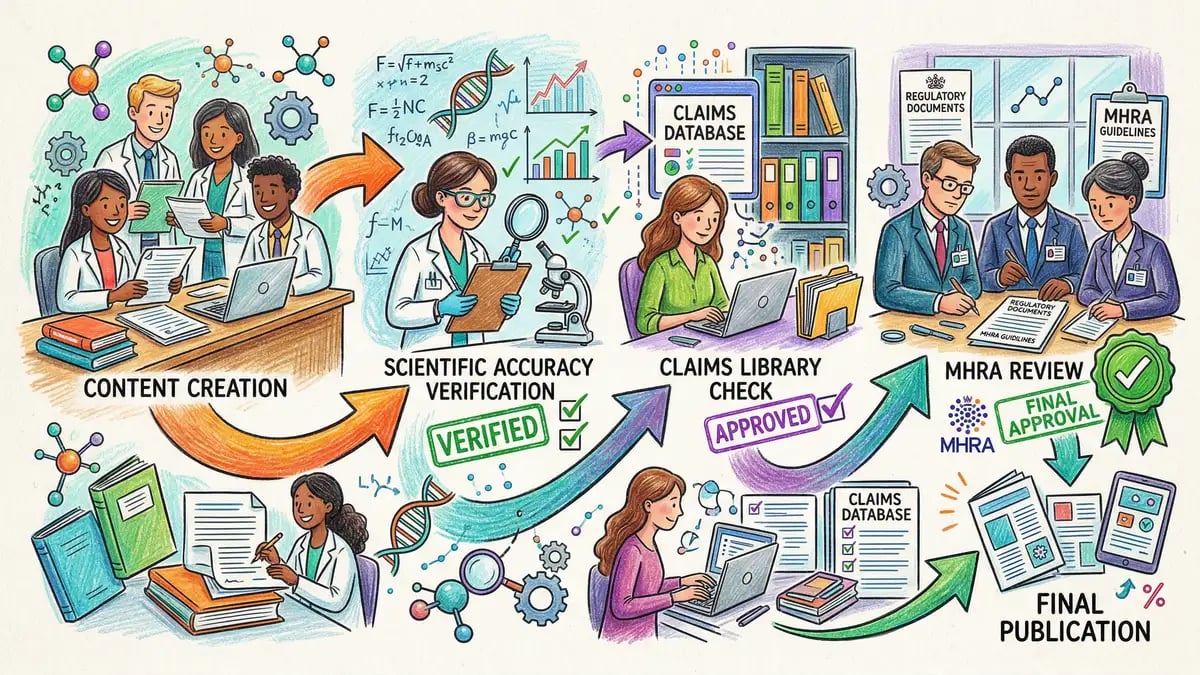
Regulatory requirements demand documented approval processes. HubSpot's workflow capabilities enable multi-stage approvals where content moves from creator to medical/scientific reviewer to regulatory/legal reviewer before publication. The system maintains timestamped records showing who approved content and when—critical documentation if regulatory agencies question promotional materials. Set SLAs for each approval stage to prevent bottlenecks whilst maintaining compliance rigour.

Balance Limitations with Benefits

Compliant promotional materials discuss both benefits and limitations. Pure marketing content showcasing only positive aspects triggers regulatory scrutiny. When creating case studies or product-related content, include honest discussion of appropriate use cases, contraindications, and limitations. This balanced approach actually enhances credibility with sophisticated life science buyers whilst satisfying regulatory requirements.

Maintain Content Version Control and Expiration

When underlying evidence changes (new clinical data, label updates, competitor information), previously-approved content may require revision or removal. Implement systematic content review cycles—many organisations review all promotional materials annually—and use HubSpot's content management to automatically expire outdated resources. This prevents situations where prospects encounter deprecated claims that no longer reflect current evidence.

⚠️ Common Compliance Pitfalls to Avoid

  • Off-label promotion: Discussing unapproved uses or indications, even in response to user questions
  • Unsubstantiated superiority claims: Stating your product is "best" or "most effective" without head-to-head data
  • Testimonial misuse: Sharing customer experiences without clear disclosure that results may vary
  • Minimising risks: Burying adverse event information or presenting safety data less prominently than efficacy claims
  • Third-party content gaps: Assuming that content from external sources (guest posts, social media) doesn't require oversight

Lauren Mitchell, VP Regulatory Affairs at a medical device company, shares her framework: "We treat inbound content exactly like we treat trade show materials—same review process, same documentation requirements, same compliance standards. The only difference is publication medium. This consistency ensures nothing slips through whilst maintaining marketing agility. Our content approval time averages 8 business days, which marketing initially resisted but now values because it eliminates re-work from compliance failures."

The investment in compliant processes pays dividends beyond avoiding regulatory issues. PwC's 2024 Life Science Marketing Study found that companies with mature compliance frameworks achieve 29% higher content publication velocity than organisations with ad-hoc review processes—because systematic workflows eliminate confusion, re-work, and approval bottlenecks. Compliance becomes a competitive advantage rather than a constraint.

Key Performance Indicators for Life Science Inbound Marketing

What gets measured gets managed. Life science marketing directors must track metrics that matter—leading indicators predicting pipeline health and lagging indicators quantifying actual revenue contribution. The challenge lies in selecting metrics that reflect the unique characteristics of life science sales: extended cycles, multiple stakeholders, and high-value but low-volume transactions.

Based on Life Science Marketing Society's 2024 benchmarking research and conversations with marketing leaders across the sector, these KPIs provide the most actionable insights:

Leading Indicators (Predictive Metrics)

1. Monthly Qualified Lead Volume

Target: 30-50 qualified leads per month for a 100-200 person life science company

Why it matters: Given 6-18 month sales cycles, current lead volume predicts pipeline health 2-3 quarters forward. Track both volume and lead score distribution to ensure quality doesn't deteriorate whilst scaling quantity.

2. Content Engagement Rate

Target: 15-20% of known contacts engaging with content monthly

Why it matters: Low engagement indicates content isn't resonating or isn't reaching target audiences. HubSpot analytics tracks engagement across all touchpoints, enabling identification of high-performing topics and formats.

3. Marketing-Qualified Lead (MQL) to Sales-Qualified Lead (SQL) Conversion

Target: 25-35% conversion rate for life science B2B

Why it matters: Low MQL→SQL conversion indicates misalignment between marketing's qualification criteria and sales' acceptance standards. This metric forces continuous refinement of lead scoring and qualification processes.

4. Average Lead Score at Conversion

Target: 75+ (on 100-point scale) for successfully closed deals

Why it matters: Analysing lead scores for won versus lost opportunities reveals which behaviours predict success, enabling optimisation of lead scoring models over time.

Lagging Indicators (Outcomes Metrics)

5. Marketing-Sourced Pipeline

Target: 35-50% of total pipeline from marketing-sourced leads

Why it matters: This metric quantifies marketing's direct contribution to revenue opportunity, providing the business case for continued or increased investment. Use multi-touch attribution to accurately measure influence across complex buyer journeys.

6. Customer Acquisition Cost (CAC) by Source

Target: Inbound CAC 40-60% lower than outbound

Why it matters: CAC comparison between inbound and outbound channels justifies channel allocation decisions. Life science companies should expect $250-400 CAC for inbound versus $800-1,200 for outbound-sourced customers.

7. Time to Closed-Won

Target: 6-8 months for inbound-sourced medical device deals; 10-14 months for biotech platform sales

Why it matters: Sales velocity impacts cash flow and capacity planning. Track separately by source—inbound-educated leads typically close 20-30% faster than cold outbound prospects because they enter the pipeline more informed.

8. Marketing ROI

Target: $4-6 revenue for every $1 marketing spend

Why it matters: Ultimate accountability metric connecting marketing investment to business outcomes. Calculate using closed-loop attribution linking marketing touches to closed revenue, then divide by fully-loaded marketing cost (headcount, technology, agencies, advertising).

Executive Dashboard Design

CFOs and CEOs don't need 47 marketing metrics. They need 5-7 KPIs demonstrating that marketing contributes to business growth. Structure your executive reporting around three questions:

  1. Is marketing generating sufficient pipeline? (Lead volume, MQL→SQL conversion, marketing-sourced pipeline percentage)
  2. Is marketing efficient? (CAC by channel, cost per MQL, marketing ROI)
  3. Is marketing improving? (Quarter-over-quarter trends in all metrics)

HubSpot's custom reporting enables creation of executive dashboards displaying these metrics in real-time with drill-down capability. When your CFO questions marketing spend, you can immediately demonstrate contribution rather than scrambling to compile data from multiple systems.

Robert Chang, CMO at a 300-person pharmaceutical services company, shares his reporting philosophy: "I present five metrics to our board: marketing-sourced pipeline percentage, CAC ratio (inbound vs outbound), MQL→SQL conversion rate, sales cycle length by source, and quarterly marketing ROI. That's it. Those five numbers tell the complete story of whether marketing is working. Everything else is operational detail that doesn't belong in the boardroom but helps my team optimise day-to-day."

Frequently Asked Questions About Life Science Inbound Marketing

How long does it take to see results from inbound marketing in life sciences?

Most life science companies observe initial lead generation within 3-4 months of launching inbound programmes, but meaningful pipeline impact requires 6-12 months given typical sales cycle length. Full programme maturity—achieving 40%+ marketing-sourced pipeline—typically takes 18-24 months. This timeline reflects the need to build content libraries, establish domain authority through SEO, and allow sufficient time for leads to progress through extended buying journeys.

What budget should life science companies allocate to inbound marketing?

Industry benchmarks suggest allocating 7-12% of revenue to marketing overall, with 60-70% of marketing budget dedicated to inbound channels for B2B life science companies. For a £10M revenue organisation, this translates to £420,000-560,000 annual inbound investment including content creation, marketing technology (HubSpot, SEO tools), and personnel. Smaller companies may allocate higher percentages whilst building market presence.

Can inbound marketing work for highly specialised life science niches?

Yes—specialisation actually enhances inbound effectiveness. Whilst search volumes may be low for ultra-specific terms (500-1,000 monthly searches), buyer intent is extremely high and competition is minimal. A company targeting "GMP cell therapy manufacturing" will generate fewer leads than one targeting "pharmaceutical equipment," but lead quality and conversion rates will be substantially higher. Focus on comprehensive content addressing every question your specialist audience asks rather than chasing volume.

How do we balance promotional content with regulatory compliance?

The most effective approach emphasises educational content (disease state information, scientific principles, industry trends) over promotional material. Educational resources require less stringent regulatory review whilst building trust and authority. Reserve product-specific promotional content for bottom-funnel stages where prospects have already identified you as a potential solution. Implement robust approval workflows in HubSpot ensuring all product-related content receives appropriate medical/regulatory/legal review before publication.

Should we create separate content for different stakeholders in the buying committee?

Absolutely. Life science purchases involve diverse stakeholders with different concerns: principal investigators focus on scientific performance, procurement emphasises pricing and terms, regulatory affairs evaluates compliance, and executives consider strategic fit. Create targeted content addressing each stakeholder's specific priorities whilst maintaining consistent brand messaging. HubSpot's smart content capabilities enable serving personalised content based on role, industry, and engagement history, ensuring each committee member receives relevant information.

Transform Your Life Science Marketing with Proven Inbound Strategies

Life science companies face unique marketing challenges—long sales cycles, complex buying committees, stringent regulatory requirements, and highly specialised audiences. Generic marketing approaches fail because they ignore these realities. Inbound marketing, properly implemented with compliant workflows and sophisticated attribution, transforms marketing from a cost centre into a predictable revenue engine.

At Whitehat, we specialise in inbound marketing for life science organisations. As a HubSpot Diamond Solutions Partner with deep expertise in regulated industries, we help biotech, pharmaceutical, and medical device companies build sustainable lead generation systems that prove ROI to sceptical CFOs. Our approach combines scientific rigour with marketing creativity—educational content that builds trust, compliant workflows that satisfy regulatory requirements, and sophisticated attribution that demonstrates clear business impact.