
Life science marketing in the UK requires a compliance-first, evidence-led digital strategy that combines SEO, content, account-based marketing and HubSpot-powered attribution to convert 8–14 month sales cycles into measurable pipeline. The most effective programmes build trust through regulatory-safe content (MHRA Blue Guide, ABPI Code), target buying committees of 8–12 stakeholders across multiple channels, and prove ROI with pipeline metrics — not vanity traffic. With 64% of life science companies outsourcing marketing and 52% already using AI, the competitive bar is rising fast.
Key Takeaways
• The UK life sciences sector is worth £94.2 billion with 6,600+ companies — marketing that ignores regulatory frameworks risks both fines and lost trust.
• Buying committees average 8–12 stakeholders across 8–14 month cycles, making multi-touch attribution essential.
• Whitepapers and technical guides convert at 18–24% to SQL — far outperforming generic content for scientific audiences.
• 54% of mid-market life science companies have adopted ABM; the best results layer it on top of inbound content.
• AI accelerates content operations but requires human scientific review — 81% of life science AI users apply it to content creation.
Life science marketing isn't regular B2B marketing with a lab coat on. When your buyers are scientists, regulatory professionals and procurement committees spending 8–14 months evaluating options, the usual playbook of gated ebooks and LinkedIn ads falls apart. The UK life sciences sector — worth £94.2 billion and home to more than 6,600 companies — demands a strategy built around evidence, compliance and measurable revenue impact. Not brand awareness. Not impressions. Pipeline.
This guide covers everything a UK biotech, medtech, pharma, CRO or CDMO marketing team needs: MHRA compliance, buyer-journey mapping, content strategy, SEO/AEO, ABM execution with realistic investment bands, lead scoring for long cycles, and HubSpot-powered attribution. Need a partner who understands life sciences? Explore our life science marketing services — UK-based, HubSpot Platinum, compliance-native.
The UK life science marketing landscape in 2026
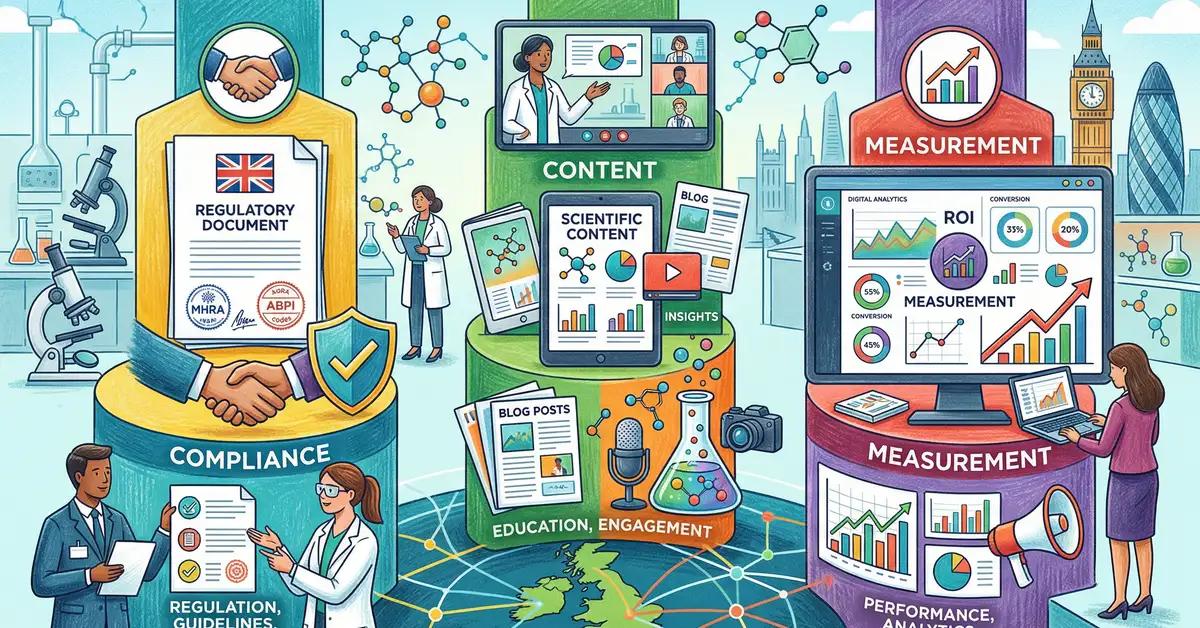
The UK is Europe's leading life sciences hub, with the government's Life Sciences Vision backed by the Golden Triangle of London, Oxford and Cambridge. But marketing maturity hasn't kept pace: SCORR's 2024 Life Science Marketing Trends Report found that 64% of life science companies outsource some or all marketing, because specialist execution in regulated industries is genuinely hard to hire for in-house. The companies pulling ahead treat compliance as a competitive advantage, measure marketing by pipeline rather than page views, and invest in systems — HubSpot, Salesforce, or both — that connect content to revenue.
Compliance-first marketing: MHRA, ABPI and building trust

In UK life sciences, "marketing" often sits in regulated territory. If your content touches prescription medicines, indications or patient outcomes, you operate under the MHRA's Blue Guide and — in pharma — the ABPI Code of Practice enforced by the PMCPA. Even for CROs, CDMOs, diagnostics and medtech where these codes don't directly apply, scientific audiences expect evidence-backed claims; make an unsupported one and you lose credibility for everything else on the page.
| Framework | Applies to | Key requirement |
|---|---|---|
| MHRA Blue Guide | All UK medicines advertising | Separate education from promotion; balanced, evidence-backed claims |
| ABPI Code | Pharmaceutical companies (via PMCPA) | No public promotion of prescription medicines; full prescribing info for HCPs |
| ASA/CAP Code | All UK advertisers (incl. digital) | Health claims substantiated; no misleading testimonials |
| UK GDPR / DPA 2018 | Any company processing personal data | Lawful basis for marketing emails; cookie consent; data minimisation |
The practical implication: build an internal claims library — a living document of approved statements, each linked to its supporting evidence. It slows you down by roughly a day per asset and saves you from the regulatory complaint that costs six months.
Crucially, treat MLR review as parallel, not serial gatekeeping. Run three tiers in parallel: educational content on a fast track (3–5 days, minimal review), technical content at standard pace (1–2 weeks, scientific validation), and promotional content through full MLR (3–6 weeks, full compliance sign-off). This typically cuts average publication latency from six weeks to 10–15 days for around 70% of your output.
Mapping the scientific buyer journey
Life science buying journeys are unlike mainstream B2B. A scientist discovers your solution at a conference; their QA/RA colleague validates your compliance credentials; procurement benchmarks you against alternatives; finance signs off eight months later — and every stakeholder has done independent research, often via different channels. McKinsey reports B2B customers now use ten or more channels to interact with suppliers, up from five in 2016, and in life sciences this is amplified because different stakeholders consume different content types.
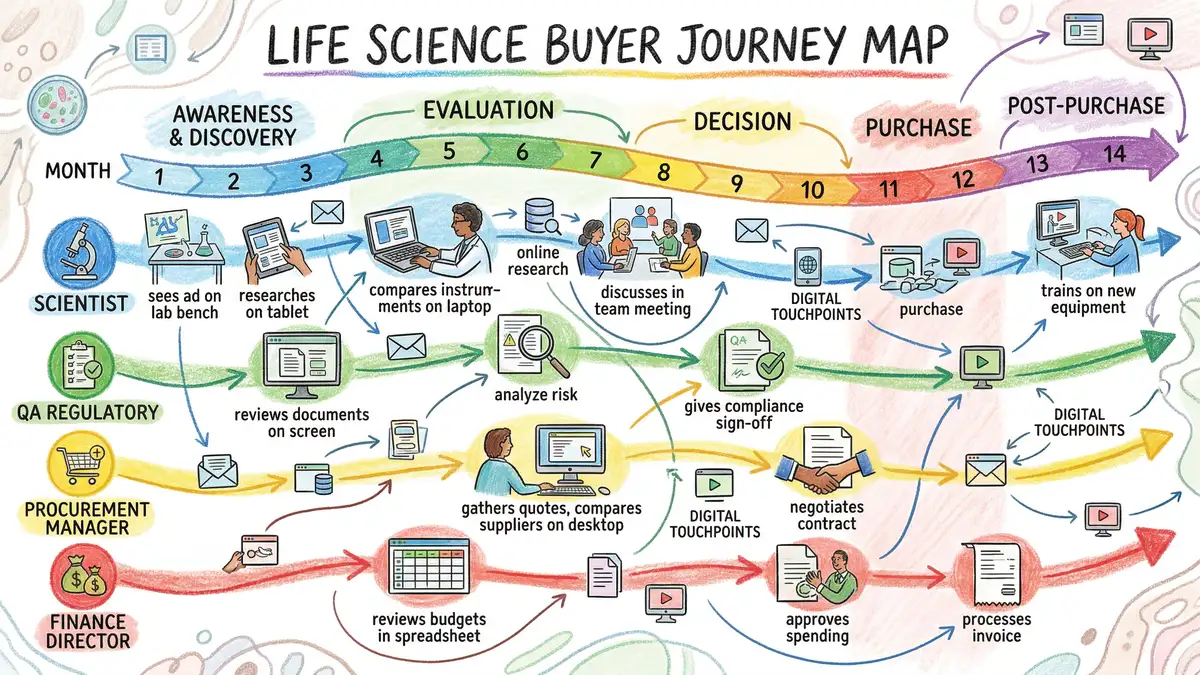
| Stakeholder | Primary concern | Content that converts |
|---|---|---|
| Scientist / end user | Does it work? What's the evidence? | Application notes, protocols, validation data, citations |
| QA / regulatory | Is it compliant? What's the risk? | Regulatory comparison guides, audit documentation |
| Procurement | What does it cost? Who else uses it? | Pricing guides, case studies, ROI calculators |
| Finance / C-suite | What's the business case? | Executive summaries, total cost of ownership, impact briefs |
Content strategy: formats that convert for scientists
Content marketing in life sciences has a higher ceiling and lower floor than any other B2B vertical. Get it right — evidence-backed, technically specific, properly cited — and whitepapers convert at 18–24% to SQL. Get it wrong and scientists close the tab before your cookie banner finishes loading. The format hierarchy is consistent:
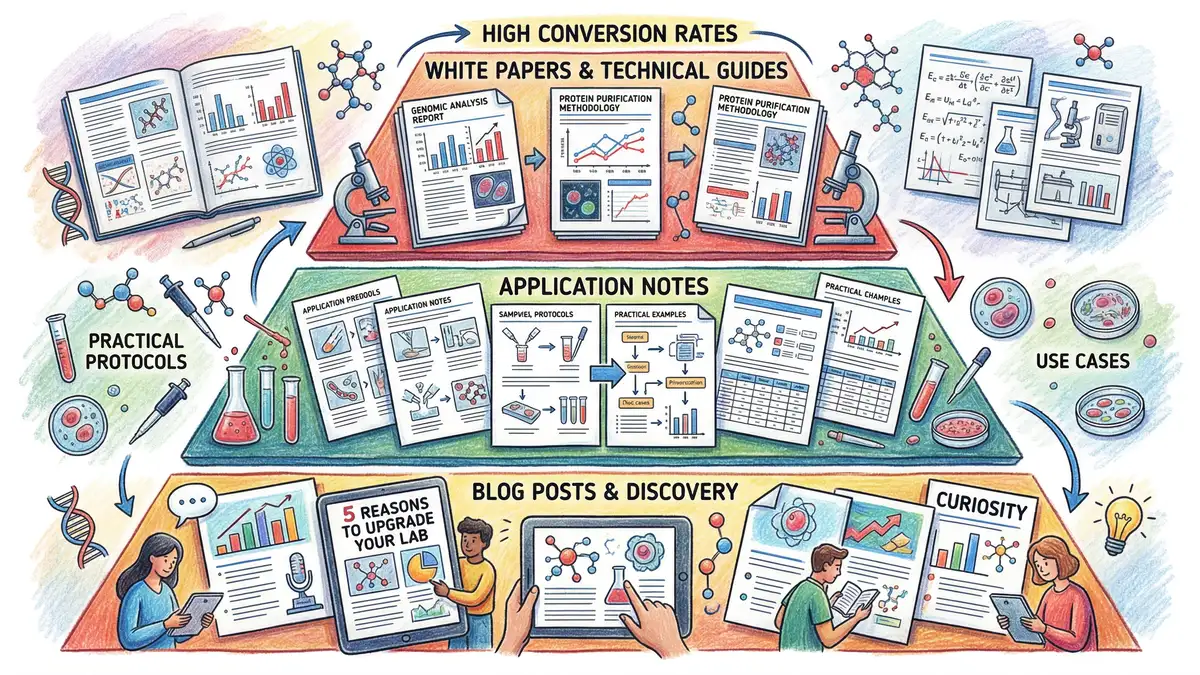
Application notes and protocols sit at the top — they answer specific technical questions and attract scientists actively evaluating solutions, achieving 40–60% download rates with warm audiences (22–28% cold). Whitepapers and technical guides serve the comparing mid-funnel; gate the high-value items, keep educational content open for SEO and AI citation. Case studies reduce perceived risk at decision stage and work best when specific to a customer segment. FAQs and comparison frameworks rank for long-tail queries and appear frequently in AI Overviews.
The mechanism that ties it together is the blog-to-whitepaper journey: an open, ungated blog post introduces the problem and earns discovery and AI citations; a CTA leads to a gated whitepaper that adds depth and filters for genuine intent. Cold gating converts at 2–4%; warm nurture to engaged readers converts at 18–24%. Topic clusters — a pillar page linked to 12–15 supporting articles — generate around 3.5× more organic traffic than isolated posts because they establish topical authority. Lead every page with a 40–60 word direct answer, use question-form headings that match how scientists search, and substantiate every claim with an inline citation.
SEO, AEO and AI visibility for life sciences
Organic search still drives the majority of B2B website traffic, and scientific buyers use Google for technical queries far more than social media. But Google's AI Overviews, ChatGPT, Perplexity and Gemini are increasingly the first touchpoint. The same practices that make content trustworthy for scientists make it citeable by AI: clear structure, evidence-backed claims, specific data and authoritative sourcing. Prioritise technical foundations (Core Web Vitals, clean architecture, indexing), structured data (FAQ, Article, Organisation and MedicalWebPage schema), pillar-cluster topic authority, systematic internal linking, and answer-first formatting. For the deeper playbook see our guide to optimising your brand for AI search.
Account-based marketing for high-value life science deals
Inbound marketing builds your foundation — organic traffic, brand authority, a library of trusted content. But when you're pursuing a £500K instrument deal or a multi-year service contract with a top-20 pharma, you need the precision of ABM layered on top. 54% of mid-market life science companies have adopted some form of ABM, and 90% of organisations now report ABM programmes, 93% rating them very or extremely successful. Life sciences holds a unique data advantage: ClinicalTrials.gov (444,000+ trials), patent filings, R&D pipeline databases, NPI databases and hospital purchasing data enable precision targeting impossible in other sectors.
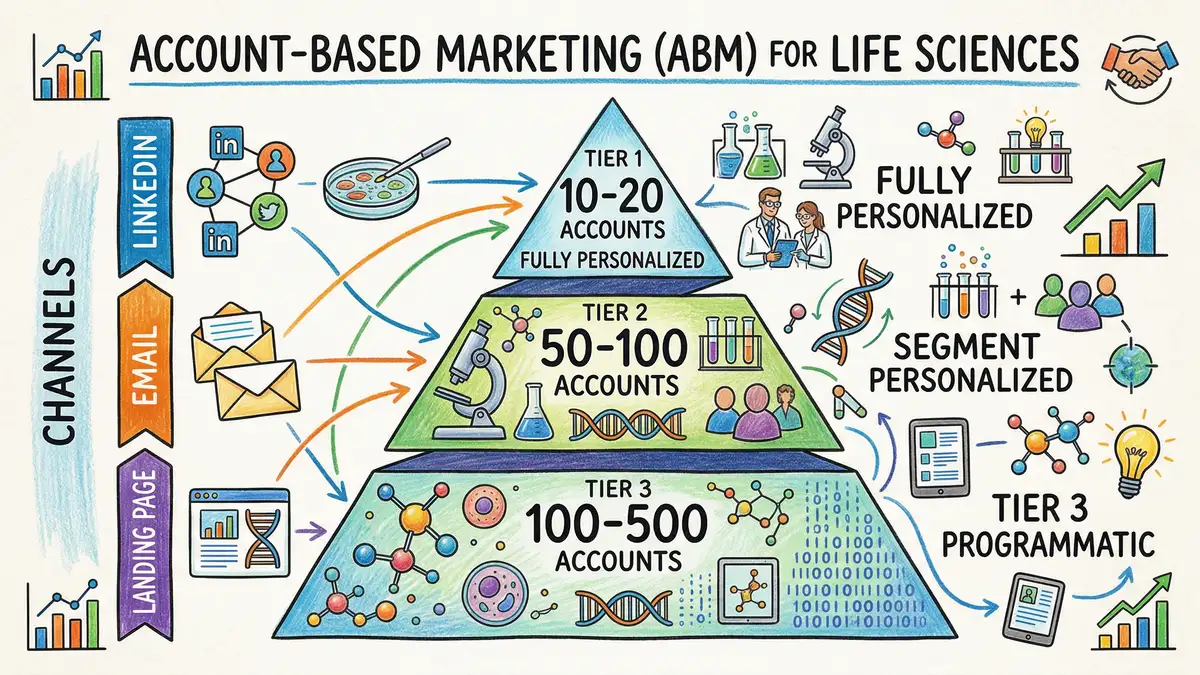
Match the tier to account value and resource capacity:
| Tier | Accounts | Investment / account / yr | Best for |
|---|---|---|---|
| Strategic (1:1) | 1–10 | £50,000–£150,000 | £500K+ LTV; bespoke, executive-level engagement |
| Scale (1:few) | 5–50 | £10,000–£25,000 | £100K–£500K LTV; segment-personalised by subsector |
| Programmatic (1:many) | 100–1,000+ | £1,000–£5,000 | Under £100K LTV; intent-triggered automation |
Expect a realistic timeline of 16–20 weeks from initiation to pilot: foundation (weeks 1–4), account selection and stakeholder mapping (5–8), content and messaging (9–12), pilot launch to 5–10 strategic accounts (13–16), then scale and optimise (months 5–12). Visible pipeline results typically appear within 90 days of pilot launch for strategic accounts; running ABM without 2–3 dedicated FTE extends timelines by 40–60%. Key Opinion Leader engagement mirrors the tiering: Tier 1 national/international experts via sponsored research and advisory boards; Tier 2 regional experts via consultation and educational collaboration; Tier 3 local influencers and early adopters via trials and peer referral — with Digital Opinion Leaders (DOLs) an emerging category building influence on LinkedIn and specialist forums. HubSpot's ABM tools, with Breeze Intelligence enrichment, support all three tiers within one platform.
Lead scoring and attribution for long sales cycles
Standard lead scoring breaks for 12–18 month cycles. Build a two-dimensional model combining a fit score (demographic) and an engagement score (behavioural), and only pass leads to sales when both exceed a threshold — this prevents premature outreach while capturing high-intent prospects mid-cycle.
| Fit score (demographic) | Engagement score (behavioural) |
|---|---|
| Company matches ICP: +20 | Pricing-page view: +25 |
| Target application: +15 | Webinar attendance: +20 |
| Budget authority: +15 | Whitepaper download: +15 |
| Decision-maker title: +10 | Case-study view: +10 |
| Grant-funded R&D: +10 | 90+ days inactive: −15 |
First-touch attribution fails for 18-month cycles; use multi-touch (time-decay) attribution instead, and configure your CRM with life-sciences-specific properties — scientific discipline, primary application, regulatory environment (MHRA/FDA/EMA), R&D budget. A webinar programme (1–2 monthly, 30–40% registration-to-attendance) and persona-specific nurture sequences running 12–16 touches over 6–12 months keep prospects engaged across the long cycle.
AI in life science marketing: opportunity and guardrails
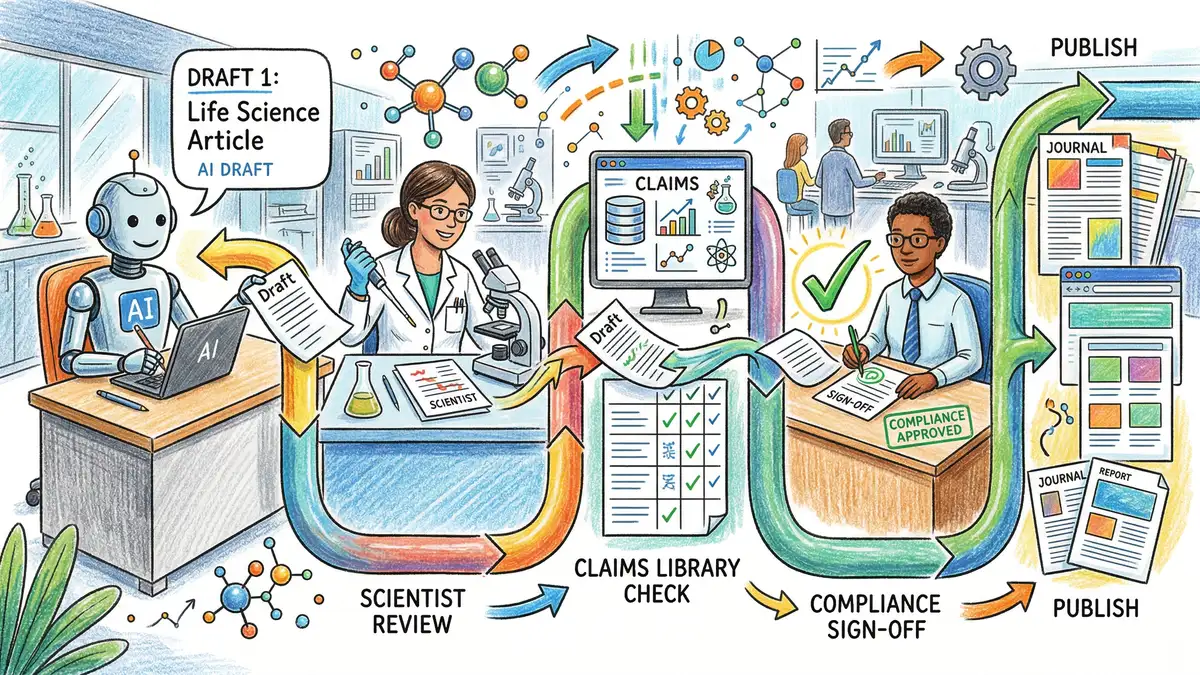
52% of life science companies already use AI, and 81% of those apply it to content creation. It accelerates drafting, repurposing and personalisation at scale — but it cannot be left unsupervised in a regulated, evidence-driven field. Every AI-assisted asset must pass human scientific review against your claims library before it enters the MLR workflow. Used this way, AI shortens production cycles without exposing you to the compliance risk of an unsupported or hallucinated claim reaching a sceptical scientific audience.
Need a life science marketing partner who gets compliance?
We help UK biotech, medtech, pharma, CRO and CDMO teams build compliance-first inbound and ABM programmes that turn long sales cycles into measurable pipeline.
Explore Life Science MarketingFrequently asked questions
What makes life science marketing different from standard B2B?
Buyers are sceptical scientists and regulatory professionals; sales cycles run 8–14 months with buying committees of 8–12 stakeholders; and much of the content sits under MHRA, ABPI or ASA/CAP regulation. Success depends on evidence-backed claims, parallel MLR workflows, and multi-touch attribution rather than vanity metrics.
How should we structure MLR review without killing momentum?
Run review in parallel tiers rather than as serial gatekeeping: educational content on a 3–5 day fast track, technical content at 1–2 weeks with scientific validation, and promotional content through full MLR at 3–6 weeks. This typically cuts average latency from six weeks to 10–15 days for around 70% of output.
What ROI does ABM deliver for life science companies?
Mature ABM programmes report around 81% higher ROI, 24% faster revenue growth, 38% higher win rates and 91% larger deal sizes. Minimum viable investment is roughly £50,000–£75,000 a year for a focused programme targeting 5–10 high-value accounts, with visible pipeline results within 90 days of pilot launch.
How do you score leads when sales cycles last 12–18 months?
Use a dual model: a fit score for demographic match (ICP, application, budget authority, decision-maker title) and an engagement score for behaviour (pricing-page views, webinar attendance, whitepaper downloads), with decay for inactivity. Pass to sales only when both scores cross the threshold.
Which content formats convert best for scientific audiences?
Application notes and protocols draw the highest-intent traffic (40–60% download rates with warm audiences), while whitepapers convert at 18–24% to SQL when introduced by open blog content. Topic clusters generate roughly 3.5× more organic traffic than standalone posts.
Ready to build a compliance-first life science marketing engine?
Get a free review and a 90-day plan covering compliance workflows, content, ABM and HubSpot attribution.
Get Your Free AuditAbout the author
Clwyd Probert is founder of Whitehat SEO and a HubSpot Diamond Partner, and runs the London HubSpot User Group. He helps UK life science companies — biotech, medtech, pharma, CROs and CDMOs — build compliance-first inbound and ABM programmes that connect content to revenue. Updated June 2026 with current UK sector data, ABM investment bands and lead-scoring guidance.
Sources: MHRA Blue Guide; ABPI Code of Practice; McKinsey B2B omnichannel research; UK BioIndustry Association. Figures reflect 2024–2026 data. Last updated June 2026.