
Marketing Attribution
Closed-loop reporting connects every marketing touchpoint to revenue outcomes by closing the data gap between your marketing automation platform and CRM. For UK B2B companies using HubSpot, this means tracking the complete journey from first website visit through to closed-won deal—and finally proving to your CFO which campaigns actually generate pipeline. According to the HubSpot State of Marketing Report 2026, 33% of marketers now cite measuring ROI as their single biggest challenge.
The UK Guide to B2B Revenue Attribution in 2026
How to connect marketing touchpoints to revenue outcomes, prove ROI to your CFO, and navigate the measurement landscape after cookie deprecation.
The problem isn't that attribution is impossible. The problem is that most organisations are still using measurement approaches designed for a world that no longer exists. Cookie deprecation, AI-powered search, and increasingly complex B2B buying journeys have fundamentally changed how we track marketing effectiveness—and most teams haven't caught up.
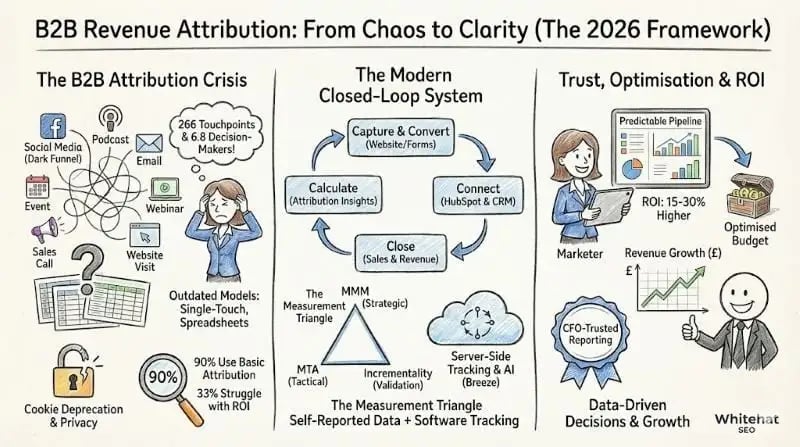
This guide covers everything UK marketing leaders need to implement closed-loop reporting in 2026: the attribution models that actually work for B2B, how to configure HubSpot's attribution tools properly, navigating UK data regulations, and building dashboards your CFO will trust.
What Is Closed-Loop Reporting?
Closed-loop reporting is a measurement framework that tracks marketing interactions from first touch through to closed revenue, creating a complete feedback loop between marketing activities and business outcomes. The "loop" closes when revenue data from your CRM flows back to inform which marketing efforts drove that revenue—enabling continuous optimisation based on actual business results rather than vanity metrics.
Think of it like a football match where you can trace exactly how a goal happened: which pass started the attack, who provided the assist, and which player finished. In marketing terms, you're identifying whether that LinkedIn post, webinar series, or SEO content cluster contributed to the deal your sales team just closed.
For UK B2B companies, closed-loop reporting typically connects three systems: your website analytics (tracking visitor behaviour), your marketing automation platform (capturing lead interactions), and your CRM (recording deal outcomes). When these systems share data bidirectionally, you can finally answer questions like "Which content actually influences revenue?" and "Where should we invest next quarter's budget?"
The Closed-Loop Reporting Process
- Capture: Visitor arrives on your website; tracking identifies the source
- Convert: Visitor becomes a lead through form submission or other conversion
- Connect: Lead data syncs to CRM with full marketing history attached
- Close: Sales team works the opportunity; deal status updates in real-time
- Calculate: Revenue attribution flows back to marketing, crediting the touchpoints involved
Why Closed-Loop Reporting Matters More Than Ever
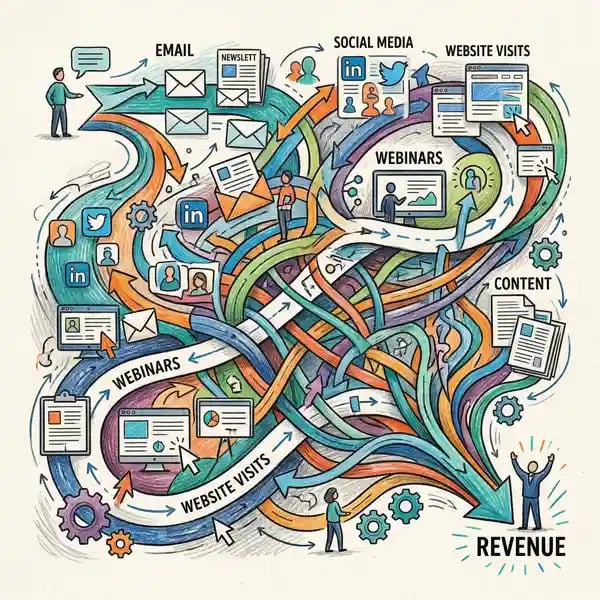
B2B marketing attribution is experiencing its most significant transformation in a decade, driven simultaneously by AI capabilities and privacy constraints—and most organisations are dangerously behind. The 2025 CMO Survey found that 63% of marketing leaders now face increased pressure from CFOs to demonstrate ROI, up from 52% the previous year.
Three forces have converged to make closed-loop reporting essential for any B2B marketing team serious about proving value:
B2B Buyer Journeys Have Become Incredibly Complex
Research from HockeyStack's analysis of 150 B2B SaaS companies reveals the average deal requires 266 touchpoints and 2,879 impressions across a customer journey lasting 211 days with 6.8 buyer stakeholders across 3.7 channels. For enterprise deals above £80,000, touchpoints jump to approximately 417.
Without closed-loop reporting, you're essentially guessing which of those hundreds of interactions mattered. And with 84% of B2B buyers reporting they've already selected their preferred vendor before contacting sales, the marketing touchpoints happening long before any sales conversation become critical to understand.
CFO Scrutiny Has Intensified
Marketing budgets have flatlined at 7.7% of overall company revenue according to the Gartner 2025 CMO Spend Survey. With 59% of CMOs reporting insufficient budget, every pound spent faces examination. The organisations that can demonstrate clear revenue attribution secure budget increases; those that can't face cuts.
Yet only 36% of marketers can accurately measure ROI, and just 28% have a solid system for measuring it. This measurement gap creates an existential risk for marketing teams—especially when economic pressures intensify.
The Cookie Landscape Has Fundamentally Shifted
Roughly 47% of the open internet is already cookieless, with Safari and Firefox blocking third-party cookies by default. Google paused full third-party cookie deprecation in Chrome, but consent rates in Europe average just 39%. Apple's App Tracking Transparency framework caused 80% of iOS users to opt out of tracking.
The implication? Traditional cross-site tracking is increasingly unreliable. Closed-loop reporting built on first-party data—tracking interactions on your own properties and connecting them to your own CRM—becomes the foundation of trustworthy measurement.
The Attribution Measurement Crisis
90%
of B2B marketers still use single-touch or basic multi-touch attribution
42%
report attribution manually using spreadsheets
86%
struggle to connect multiple stakeholders to opportunities
50–80%
of companies fail at effective closed-loop reporting implementation
B2B Attribution Models: Which One Should You Use?
For B2B companies with sales cycles exceeding 60 days and multiple decision-makers, W-Shaped or Full-Path attribution models provide the most accurate picture of marketing's contribution to revenue. Single-touch models (first-click or last-click) systematically undervalue either demand generation or conversion activities, creating distorted investment decisions.
The recommended models for B2B organisations form a hierarchy of sophistication, with your choice depending on sales cycle length, buying committee complexity, and HubSpot tier:
| Model | How It Works | Best For | HubSpot Tier |
|---|---|---|---|
| First Touch | 100% credit to first interaction | Evaluating awareness campaigns | Professional |
| Last Touch | 100% credit to final interaction | Short sales cycles, direct response | Professional |
| Linear | Equal credit across all touchpoints | Understanding full journey | Professional |
| U-Shaped | 40% first, 40% lead creation, 20% middle | B2B lead generation focus | Professional |
| W-Shaped | 30% each to first touch, lead creation, deal creation; 10% middle | B2B SaaS with defined pipeline stages | Enterprise |
| Full Path | 22.5% each to first, lead, deal, close; 10% middle | Long B2B cycles with multiple stakeholders | Enterprise |
Data-Driven Attribution: The AI-Powered Approach
Google made data-driven attribution (DDA) the default model in GA4, sunsetting rule-based models in 2023. DDA uses machine learning to analyse converting and non-converting paths, dynamically assigning credit based on what actually influenced outcomes rather than predetermined rules.
The approach uses a counterfactual Shapley Value method—comparing what happened against what could have occurred—to distribute credit. However, it requires at least 200 conversions and 2,000 ad interactions within 30 days for effective operation. Many B2B companies with lower conversion volumes may find rule-based models more reliable.
Two algorithmic approaches dominate: Shapley Value (Google's method, requires significant data volume) and Markov Models (better suited to B2B with less data, models the probability of conversion based on channel sequences).
Account-Based Attribution: Essential for B2B
Traditional lead-based attribution breaks down when 92% of B2B buying involves groups of three or more people, with buying teams averaging 6.2 decision-makers. Account-based attribution tracks engagement at the buying-group level rather than individual lead level.
This means aggregating interactions across all contacts at a target account—the CEO who watched your webinar, the procurement manager who downloaded your pricing guide, and the end-user who read your case studies—into a unified account journey. Platforms like HubSpot Enterprise, 6sense, and Demandbase support this approach.
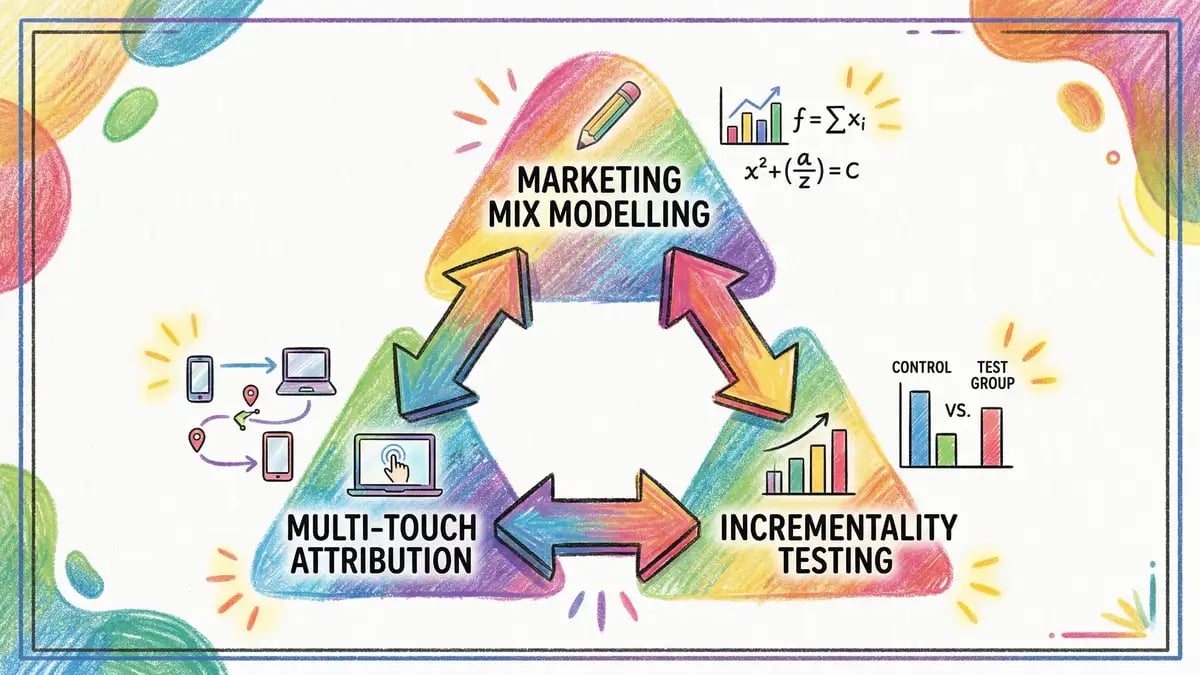
The Measurement Triangle: The Framework Modern Teams Use
The industry consensus for 2026 is that no single attribution model provides the complete picture—sophisticated marketing teams use a "measurement triangle" combining Marketing Mix Modelling, Multi-Touch Attribution, and Incrementality Testing to validate insights across methodologies.
When different measurement approaches conflict—which they frequently do—triangulation provides confidence. As one industry panel noted: "No one believes in a single, perfect source of truth anymore. The teams that feel most confident are triangulating."
Marketing Mix Modelling
Strategic top-down view. Analyses historical aggregate data to estimate each channel's impact. Privacy-resilient—doesn't depend on user-level tracking.
Multi-Touch Attribution
Tactical bottom-up view. Assigns credit to individual digital touchpoints. Real-time and granular but challenged by privacy restrictions.
Incrementality Testing
Causal proof through controlled experiments. Answers: "What would have happened without this marketing?" Resolves conflicts between MMM and MTA.
The practical workflow: Model (use MMM for strategic allocation) → Activate (use MTA for tactical optimisation) → Validate (use incrementality tests when results conflict). Results from incrementality tests can then feed back into MMM as Bayesian priors, improving future model accuracy.
Open-Source MMM Tools Making This Accessible
Marketing Mix Modelling was historically a consultancy-only discipline requiring significant investment. That's changed with open-source tools:
- Google Meridian (launched January 2025): Bayesian framework with 20+ certified partners. Designed for near real-time insights.
- Meta Robyn: Ridge regression with evolutionary hyperparameter optimisation. Strong community support.
- PyMC Labs AI MMM Agent: Compresses weeks of Bayesian modelling into hours using AI automation.
53.5% of US marketers now use MMM—up significantly from previous years. UK adoption is following the same trajectory.
Need Help With Your Attribution Setup?
As a HubSpot Platinum Partner since 2016, we configure closed-loop attribution dashboards that prove marketing ROI in 90 days.
Talk to Our HubSpot TeamSetting Up HubSpot Attribution: A Practical Guide
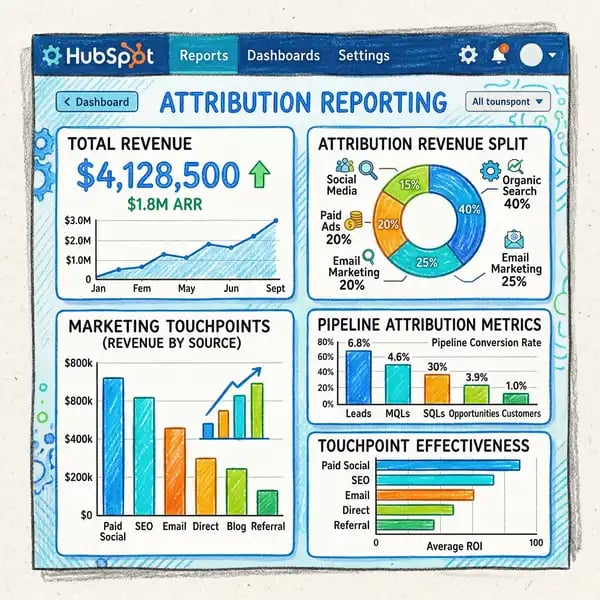
HubSpot's attribution reporting, available in Marketing Hub Professional and Enterprise, tracks three core report types: Contact Create Attribution (which interactions generate leads), Deal Create Attribution (which touchpoints create opportunities), and Revenue Attribution (which efforts produce closed-won revenue). Proper setup requires attention to data hygiene, pipeline configuration, and model selection.
Seven attribution models are available in HubSpot: First Touch, Last Touch, Linear, U-Shaped, W-Shaped, Full Path, and Time Decay. For most B2B organisations, we recommend starting with W-Shaped or Full Path if you're on Enterprise, or U-Shaped if you're on Professional.
Step 1: Get Your Data Foundation Right
Attribution reporting is only as good as your underlying data. Before enabling reports, ensure:
- Tracking code installed site-wide—including subdomains, landing pages, and any microsites
- UTM parameters consistent—use a standardised naming convention across all campaigns
- Deals associated to contacts—revenue attribution only works when deals are properly linked
- Lifecycle stages defined—clear definitions of what "MQL," "SQL," and "Opportunity" mean for your business
- Contact roles maintained—especially important for Salesforce integration users
As one expert notes: "Without proper data hygiene, even the most sophisticated attribution model will produce flawed results." If you need help getting this foundation right, our HubSpot onboarding services include attribution setup as standard.
Step 2: Access Attribution Reports
From any dashboard in HubSpot, click 'Add report'. Alternatively, navigate to Reports in the top navigation, then Reports Home, and click 'Create Report'. Select 'Attribution'.
If you're on Professional, you'll see Contact Attribution options. Enterprise users see both Contact Attribution and Revenue Attribution—the latter being essential for connecting marketing to closed-won revenue.
Step 3: Configure Your Model and Filters
Select your attribution model based on what you're trying to understand:
- Evaluating top-of-funnel campaigns? Compare First Touch against Full Path
- Understanding the full journey? Use Linear or Full Path
- Optimising conversion campaigns? Focus on Last Touch alongside W-Shaped
- Long sales cycles with multiple stakeholders? Full Path provides the most balanced view
Apply filters by date range, campaign, content type, or traffic source to focus your analysis. Save commonly used configurations as dashboard reports for ongoing monitoring.
HubSpot-Salesforce Integration: Critical Considerations
For organisations using both platforms, Whitehat regularly helps clients configure bi-directional sync that maintains attribution integrity. Key setup requirements:
- Map Salesforce Record IDs (Contact ID, Lead ID, Account ID) to HubSpot properties set to "Always use Salesforce"
- Disable "Create and associate companies" auto-setting to prevent duplicate company creation
- Standardise picklist values exactly between systems—even extra spaces cause sync failures
- Understand that HubSpot attribution reports only include interactions logged in HubSpot—sales activities conducted directly in Salesforce won't appear
This last point is crucial: for CFO-trusted reporting, you'll need to either enforce HubSpot tool usage for all customer-facing activities, or accept attribution gaps for Salesforce-only interactions.
💡 HubSpot ROI Reality Check
According to HubSpot's 2024 Annual ROI Report based on 268,000+ customers: 75% of customers saw ROI, with 64% seeing it within 4 weeks. Customers generate 107% more leads with Marketing Hub after 6 months and close 35% more deals with Sales Hub. But these results depend entirely on proper setup—including attribution configuration.
UK Data Regulations: What Changed in 2025
The UK Data (Use and Access) Act 2025, which received Royal Assent on 19 June 2025, introduced a critical cookie exemption: first-party analytics cookies and functional cookies no longer require explicit opt-in consent in the UK, provided transparency and opt-out mechanisms exist. This is a significant positive development for closed-loop reporting.
However, the same legislation dramatically increased penalties for PECR violations—from £500,000 to £17.5 million or 4% of global turnover, whichever is higher. Cookie compliance has transformed from a low-risk afterthought to an enterprise-threatening obligation.
For UK B2B marketers, this creates a uniquely advantageous position: relaxed analytics consent requirements paired with severe enforcement penalties. The optimal approach is privacy-compliant but data-rich attribution—exactly what properly configured closed-loop reporting delivers.
Practical Implications for Your Attribution Setup
- First-party analytics tracking (like HubSpot's tracking code on your own domain) is now easier to implement without friction-creating consent banners
- Third-party tracking and cross-site cookies still require explicit consent under PECR—don't assume the exemption applies universally
- Transparency requirements remain—you must clearly explain what data you collect and how you use it
- Opt-out mechanisms must be prominent and easy to use
- The ICO is actively enforcing—they checked the UK's top 1,000 websites for cookie compliance in January 2025
If you're uncertain about your current compliance status, our marketing services include compliance review as part of attribution setup.
Tackling the Dark Funnel: When Attribution Can't See
An estimated 77.5% of social media sharing happens through untraceable channels—private Slack conversations, WhatsApp messages, LinkedIn DMs, podcasts, and peer recommendations. This "dark funnel" represents the majority of B2B buyer research activity, and traditional attribution is blind to it.
B2B buying groups have 100–200 interactions with vendors during their journey, with over 70% being digital and anonymous. When a prospect finally fills out your form, your attribution system sees that moment—but misses the six months of podcast episodes, LinkedIn posts from your founder, and recommendations from their peer network that actually drove the decision.
Self-Reported Attribution: From Fringe Tactic to Standard Practice
The solution gaining widespread adoption is self-reported attribution—simply asking "How did you hear about us?" on your forms. When Refine Labs implemented this approach, all initial results pointed to organic search and their podcast—channels completely invisible to their software attribution.
The hybrid model combines software-based tracking (what you can measure) with qualitative self-reported data (what actually influenced the buyer). This is now the recommended approach for B2B organisations serious about understanding true marketing impact.
Implementation tips:
- Add "How did you hear about us?" as a required free-text field on high-intent forms (demo requests, contact forms)
- Create a standardised property in HubSpot to categorise responses
- Train sales teams to probe deeper during discovery calls—"You mentioned a colleague recommended us. Was there anything specific they said?"
- Compare self-reported data against software attribution to identify blind spots
- Use insights to validate investment in "unmeasurable" channels like podcasts, events, and community building
Three Trends Reshaping Attribution in 2026
1. Google Privacy Sandbox Has Collapsed—Accept Fragmentation
In October 2025, Google retired most Privacy Sandbox APIs due to low adoption—including the Attribution Reporting API, Topics API, and Protected Audience. Only CHIPS, FedCM, and Private State Tokens survived.
The implication is profound: there is no single Chrome-led replacement for third-party cookies coming. The industry faces permanent fragmentation across legacy cookie paths, modelled/aggregated signals, and server-side solutions. Stop waiting for a unified solution and build resilient measurement systems now.
2. Server-Side Tracking Is Becoming Standard
67% of B2B companies are already adopting server-side tracking, reporting 41% improvements in data quality. Server-side tracking moves data collection from the user's browser to company-owned servers, bypassing browser restrictions and ad blockers whilst centralising consent enforcement.
Companies leveraging first-party data strategies achieve 2.9x better customer retention and 1.5x higher marketing ROI compared to cookie-dependent approaches. Data clean rooms—secure environments for multi-party data sharing—are used extensively by one in three companies, with 87% expecting increased usage.
3. Agentic AI Is Automating Attribution Optimisation
The real frontier is "Agentic MMM"—AI agents that autonomously handle media planning, revenue forecasting, and budget optimisation. Sellforte and Ekimetrics launched agentic MMM products in October 2025. Adobe Mix Modeler combines MMM and multi-touch attribution with AI into a unified approach.
Attribution is shifting from a reporting discipline to an autonomous optimisation capability. Organisations that embrace this transition will gain significant competitive advantage in marketing efficiency.
Frequently Asked Questions
What is the difference between closed-loop reporting and marketing attribution?
Closed-loop reporting is the complete measurement framework that connects marketing touchpoints to revenue outcomes by integrating marketing automation with CRM systems. Marketing attribution is one component within that framework—the methodology for assigning credit to individual touchpoints. You need closed-loop reporting infrastructure to enable accurate attribution analysis.
Which HubSpot tier do I need for revenue attribution?
Revenue attribution—connecting marketing activities directly to closed-won deal value—requires Marketing Hub Enterprise, which starts at approximately £3,600 per month. Marketing Hub Professional (from around £800/month) offers contact attribution and deal creation attribution, which can provide significant value for organisations not ready for Enterprise investment.
How long does it take to implement closed-loop reporting properly?
For organisations with clean data foundations and straightforward tech stacks, basic closed-loop reporting can be operational within 2–4 weeks. Complex implementations involving Salesforce integration, data migration, and custom attribution models typically require 6–12 weeks. The key variable is data quality—organisations requiring significant pre-migration cleanup may need 20–40% additional time.
What is the best attribution model for B2B with long sales cycles?
For B2B organisations with sales cycles exceeding 90 days and buying committees of 3+ people, Full Path attribution typically provides the most accurate view. It distributes 22.5% credit each to first interaction, lead creation, deal creation, and closed-won, with 10% across middle touches. W-Shaped attribution is a strong alternative if you want to weight early pipeline stages more heavily.
How do I prove marketing ROI to my CFO?
CFOs want to see direct revenue impact, not vanity metrics. Build dashboards showing: (1) Cost per opportunity by channel, (2) Marketing-influenced pipeline value, (3) Marketing-sourced closed-won revenue, (4) Customer acquisition cost trends, and (5) ROI by campaign. Use HubSpot's revenue attribution reports for the data, but present in terms finance understands—avoid marketing jargon. Monthly reviews with consistent metrics build credibility over time.
Ready to Prove Marketing ROI?
Get a free attribution audit and 90-day action plan from our HubSpot Platinum team.
Get Your Free AuditReferences & Further Reading
- HubSpot (2026). State of Marketing Report 2026. Available at: https://www.hubspot.com/state-of-marketing
- HubSpot (2024). Annual ROI Report. Based on 268,000+ customers. Available at: https://www.hubspot.com/roi
- Gartner (2025). CMO Spend Survey 2025. Survey of 402 CMOs across North America, UK, and Europe.
- HubSpot Knowledge Base. Attribution Reporting. Available at: https://knowledge.hubspot.com/reports/create-an-attribution-report
- UK Parliament (2025). Data (Use and Access) Act 2025. Royal Assent: 19 June 2025.
- Google (2025). Meridian: Open-Source Marketing Mix Modelling. Available at: https://developers.google.com/meridian
- Ehrenberg-Bass Institute. How Brands Grow. Research on the 95-5 rule and B2B buyer behaviour.
Clwyd Probert
Founder, Whitehat SEO
Clwyd Probert is the founder of Whitehat, a London-based SEO and inbound marketing agency and HubSpot Platinum Partner since 2016. He runs the largest London HubSpot User Group and advises B2B companies on connecting marketing to revenue.