
Answer Engine Optimisation Google AI Overviews guide for B2B
Gartner predicts that by 2028, 90% of B2B purchases will be handled by AI agents channelling $15+ trillion in spending. Forrester expects 20% of B2B sellers will face agent-led quote negotiations in 2026 alone. The 6sense B2B Buyer Experience Report confirms buyers now complete two-thirds of their journey before engaging a seller, with 80% of interactions happening digitally. This is precisely why Whitehat SEO's services now integrate Answer Engine Optimisation alongside traditional SEO—the discovery journey has fundamentally changed.
AI Search Optimisation in 2026: The Definitive AEO/GEO Briefing for UK B2B Marketers
AI search optimisation has moved from experimental to essential for UK B2B marketers. ChatGPT now reaches 900 million weekly active users, Google AI Overviews trigger on up to 48% of tracked queries, and Forrester's 2026 Buyers' Journey Survey found generative AI tools were the single most cited interaction type for researching B2B purchases. Yet AI-referred traffic still represents roughly 1% of total web traffic—meaning the competitive window for early movers remains wide open. This briefing from Whitehat SEO synthesises every major study, platform update, and data point from the past 12 months to give UK B2B agencies an evidence-based playbook for optimising across ChatGPT, Google AI Overviews, Perplexity, and Claude.
The Market Has Shifted from Curiosity to Infrastructure
The growth numbers are staggering even by AI standards. OpenAI announced 900 million weekly active users on 27 February 2026, up from 400 million just a year earlier—a 350% increase in 18 months. ChatGPT processes 2.5 billion daily prompts and attracted 5.72 billion monthly visits in January 2026, making it the fourth most-visited website globally. Fifty million consumers now pay for subscriptions, with January and February 2026 being OpenAI's largest-ever months for new subscriber acquisition.
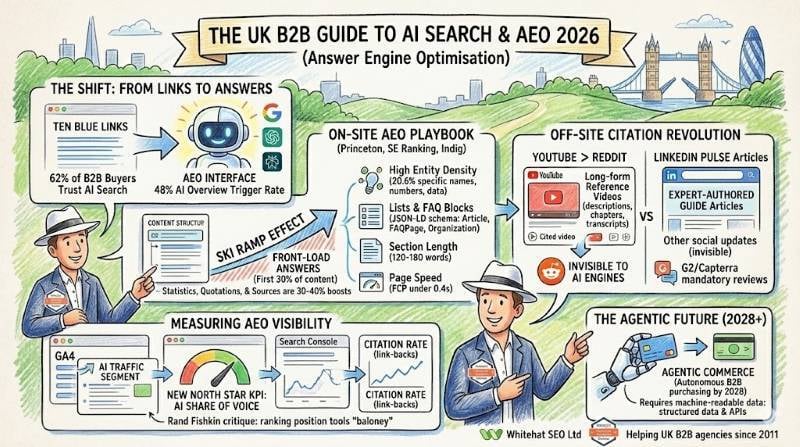
Google AI Overviews now reach 2 billion monthly users across 200+ countries and 40+ languages. BrightEdge data from February 2026 shows AI Overviews triggering on 48% of tracked queries, up 58% year-on-year—though Semrush's broader 10-million-keyword dataset puts the figure at approximately 16%, reflecting significant methodological variation. The directional trend is unambiguous: AI Overviews are expanding rapidly, with B2B Tech queries seeing coverage jump from 36% to 82% in a single year.
Perplexity AI has reached 33–45 million monthly active users with an estimated 1.2–1.5 billion monthly queries projected by mid-2026 and a $20 billion valuation. Claude has emerged as the fastest-growing AI chatbot with 14% quarterly user growth, 202.9 million monthly web visits in January 2026, and Anthropic's valuation soaring to $380 billion following a $30 billion Series G. Claude's referral traffic grew 12.8× year-on-year in 2025—small in absolute terms but the steepest growth curve of any platform.
AI Platform Market Share (January 2026)
StatCounter data: ChatGPT 80.49% | Perplexity 7.89% | Google Gemini 7.18% | Microsoft Copilot 3.5%. However, ChatGPT's dominance is eroding—Similarweb shows its broader GenAI market share falling from 87.2% to 68%, with Gemini surging to 18.2%.
B2B Buyers Are Already Using AI for Purchasing Decisions
The behavioural shift is not hypothetical. G2's 2025 Buyer Behavior Report (1,169 B2B decision-makers) found nearly 8 in 10 respondents say AI search has changed how they research, and 29% now start research via LLMs more often than Google. TrustRadius found AI use in buying research doubled year-on-year, with 80% of buyers trusting AI tools at least sometimes and 72% encountering Google AI Overviews during research. Critically, frequent AI users are also the most sceptical—62% always or very often fact-check AI outputs.
What the Research Actually Says About AI Citations
The evidence base for generative engine optimisation has matured substantially since Princeton's foundational GEO paper. Multiple large-scale studies now provide actionable—if sometimes conflicting—guidance on what gets cited by AI engines.
The Princeton GEO Study and Its Progeny
The original Princeton/Georgia Tech/Allen AI/IIT Delhi study (formally published at KDD 2024) tested 9 optimisation methods across 10,000 queries in 25 domains. Its headline finding—that GEO methods can boost visibility by up to 40%—still holds, but the specific mechanisms matter. Statistics Addition and Quotation Addition showed the strongest improvements (30–40% each), while keyword stuffing performed poorly. Lower-ranked websites benefited disproportionately from GEO, with fifth-ranked sites seeing a 115% visibility increase from adding citations—a crucial finding for challenger B2B brands.
Columbia and MIT's E-GEO study (November 2025) added nuance for commercial contexts, finding that verbosity and persuasion outperformed citations for product recommendations—a stark contrast with the original study. Different LLMs showed significantly different vulnerabilities to optimisation tactics, reinforcing the need for platform-specific strategies.
SE Ranking's 129,000-Domain Citation Factor Analysis
SE Ranking's November 2025 study used XGBoost regression with SHAP analysis across 129,000 unique domains and 100,000 prompts to identify what drives ChatGPT citations. The findings are directly actionable for UK B2B marketers:
- Referring domains is the single strongest predictor—sites with over 350,000 referring domains averaged 8.4 citations versus 1.6–1.8 for sites with fewer than 2,500
- Page speed matters dramatically: pages with First Contentful Paint under 0.4 seconds earned 6.7 citations versus 2.1 for pages over 1.13 seconds—a 3× difference
- Content length over 2,900 words earned 5.1 citations versus 3.2 for content under 800 words
- Section length of 120–180 words between headings was optimal
- Statistical data points: 19+ data points per page earned 5.4 citations versus 2.8 for minimal data
- Expert quotes lifted citations from 2.4 to 4.1 per page
Notably, .gov and .edu domains did not automatically outperform commercial sites (3.2 versus 4.0 citations), and llms.txt had negligible impact on citation likelihood.
Kevin Indig's "Ski Ramp" Pattern
Growth Memo's February 2026 analysis of 3 million ChatGPT responses and 30 million citations revealed a striking structural pattern: 44.2% of all LLM citations come from the first 30% of content (the introduction). This "ski ramp" effect is statistically indisputable (p-value of 0.0). Additionally, 78.4% of citations containing questions came from headings—AI treats H2 tags as proxies for user prompts and immediately following paragraphs as answers. Heavily cited text had an entity density of 20.6% versus the normal 5–8%, meaning content packed with specific names, numbers, and proper nouns dramatically outperforms vague prose.
Citation Patterns Differ Wildly Between Platforms
Ahrefs' analysis of 17 million citations across 75,000 brands found that 80% of sources cited by AI platforms don't appear in Google's top 100 results. Only 12% of URLs cited by ChatGPT, Perplexity, and Copilot match Google's top 10. Even within Google's own ecosystem, AI Overviews and AI Mode share only 13.7% citation overlap—they cite different sources 86.3% of the time.
Platform Updates Every UK B2B Marketer Must Know
ChatGPT Search Enters the Commerce Era
OpenAI's Q1 2026 updates have been transformative. GPT-5.3 Instant (3 March 2026) delivers improved web research with better-contextualised results. Visual search results (30 January) now show inline highlights for people, places, and products with side-panel source details. Deep Research (10 February) supports targeted websites with trackable research plans. Most significant for B2B: ChatGPT Agent has evolved from Operator into a unified agentic system that can take actions—including purchases—on behalf of users.
OpenAI launched ads in ChatGPT on 9 February 2026 for US users, with Criteo as the first ad tech partner and minimum spend around £160,000. Ads are not yet available in the UK but expansion is expected—something UK marketers should prepare for now.
Google AI Mode Arrives in Britain
The most consequential UK-specific development is Google AI Mode launching on 4 March 2026. This conversational search experience uses "query fan-out" to break complex questions into subtopics with simultaneous queries. AI Overviews now default to Gemini 3 globally, with new hover-to-expand link cards on desktop.
Critically, 93% of AI Mode sessions end without an external click (Semrush), and 75% of AI Mode sessions end without any external visit. Ads in AI Overviews are widely active for UK commercial queries; AI Mode ad placements are in closed UK trials. The European Publishers Council filed a formal antitrust complaint against Google over AI Overviews on 10 February 2026—signalling ongoing regulatory uncertainty.
Perplexity and Claude Expand Capabilities
Perplexity launched Perplexity Computer (25 February 2026), an agentic system orchestrating 19 AI models for complex workflows, alongside Samsung Galaxy S26 integration. Its citation methodology remains industry-leading, tying claims to specific sources in 78% of complex research questions versus ChatGPT's 62%.
Claude gained dynamic filtering (17 February 2026) for improved search accuracy, alongside new interactive connectors. Claude hit #1 on Apple's App Store following publicity around a Pentagon safety dispute, driving record sign-ups. Anthropic's Super Bowl ads positioned Claude as an ad-free alternative to ChatGPT—a positioning that may resonate with UK B2B buyers wary of commercial influence.
Technical Foundations That Make or Break AI Visibility
AI Crawlers Cannot Render JavaScript
This is the single most impactful technical finding for 2026. Verified by Vercel network data (billions of requests) and confirmed by JetOctopus server log analysis: GPTBot, ClaudeBot, and PerplexityBot do not execute JavaScript. They fetch JS files but see only raw HTML. Any content, schema markup, or internal links injected via client-side JavaScript are completely invisible to these crawlers.
Google-Extended inherits Googlebot's rendering service, and Applebot renders JS, but every other major AI crawler sees only server-rendered HTML. React, Angular, and Vue single-page applications are highest risk—the view-source test (not inspect element) reveals exactly what AI crawlers see. For HubSpot website implementations, this is rarely an issue since HubSpot CMS renders server-side, but custom integrations must be verified.
AI Crawler Access Checklist
AI bots now account for approximately 40–50% of Googlebot-level crawl activity. They operate in three categories that can be independently controlled via robots.txt:
- Training bots (GPTBot, ClaudeBot, Google-Extended) — block if you want to prevent content from training future models
- Search/index bots (OAI-SearchBot, Claude-SearchBot, PerplexityBot) — allow for AI search visibility
- User/retrieval bots (ChatGPT-User, Claude-User, Perplexity-User) — allow for real-time retrieval
The dominant 2026 strategy: block training bots while allowing search and retrieval bots—protecting intellectual property while maintaining AI search visibility.
Schema Markup Provides Measurable Citation Advantages
AirOps' 2026 State of AI Search report found that pages with 3+ schema types have 13% higher citation likelihood, with 61% of cited pages using multiple schema types. FAQ or HowTo schema makes pages 78% more likely to be cited, and proper heading structure alone boosts citation rates by 63%. BrightEdge independently confirms that sites with author schema are 3× more likely to appear in AI answers.
For B2B, the priority schema types are Organization (entity establishment), Author/Person (E-E-A-T signals), FAQPage (only 10.5% adoption—a clear opportunity gap), and Article schema with publication dates. Schema must be implemented in JSON-LD format within server-rendered HTML—AI crawlers cannot read JSON-LD injected via JavaScript after page load.
Page Speed Is an Unexpectedly Powerful Signal
SE Ranking's SHAP analysis revealed that pages with FCP under 0.4 seconds average 6.7 citations versus just 2.1 for pages over 1.13 seconds. JetOctopus server log data shows AI bots abandon responses exceeding 3 seconds and strongly favour pages with TTFB under 600 milliseconds and HTML file sizes under 200KB.
AI search bots also drop off sharply beyond 2–3 clicks from the homepage, meaning site architecture should keep priority content within that depth. Internal links are often the only discovery mechanism for AI crawlers—Perplexity doesn't even use XML sitemaps. Our website audit service now includes AI crawler accessibility as a standard check.
Content Structures That Earn AI Citations in 2026
Front-Load Answers, Pack in Entities and Data
The convergence across studies is clear: AI engines cite content that is structured for extraction, not necessarily the best-written content. Kevin Indig's ski ramp finding—44.2% of citations from the first 30% of text—means the opening paragraph must contain the definitive answer, packed with specific entities and data points. Entity density of 20.6% in heavily cited text (versus 5–8% normally) means replacing every vague claim with verifiable specifics: proper nouns, numbers, dates, and named frameworks.
AirOps found that nearly 80% of ChatGPT-cited pages include lists, while pages with visible "last updated" timestamps receive 1.8× more citations. Content freshness is critical: 70%+ of cited pages were updated within the past 12 months, 35.2% within the last 3 months, and pages not updated quarterly are 3× more likely to lose visibility. For commercial queries, 60%+ of citations went to content refreshed within 6 months.
FAQ Sections and Structured Formatting Still Outperform
BrightEdge found that sites implementing FAQ blocks alongside structured data saw a 44% increase in AI search citations. Comparison matrices and data tables achieve 61% citation rates (Presence AI analysis), while Q&A formats directly mirror how users query AI tools. Section length between 120–180 words per heading hits the sweet spot for AI extraction (SE Ranking).
The optimal content piece in 2026 uses sequential H1→H2→H3 hierarchy (2.8× higher citation rates per AirOps), self-contained sections that can be independently extracted, expert quotes with attribution, and specific statistics with sources. The Princeton GEO study's finding that statistics, quotations, and source citations each deliver 30–40% visibility improvements has been repeatedly validated.
Off-Site Strategy: YouTube Overtakes Reddit as Top Citation Source
The YouTube Citation Revolution
The biggest off-site shift is YouTube overtaking Reddit as the most-cited social platform in AI-generated answers as of January 2026, confirmed by four independent research firms. OtterlyAI's study of 100 million+ citation instances found YouTube represents 31.8% of social media citations, with its share doubling from 18.9% to 39.2% between August and December 2025 while Reddit's halved from 44.2% to 20.3%. YouTube appears in approximately 16% of all AI-generated answers.
Crucially, AI engines cite long-form reference-style videos—Shorts account for just 5.7% of citations. Popularity metrics (views, likes, subscribers) show near-zero correlation with citation frequency. What matters is description length (r = 0.31), hashtag presence, and chapter/timestamp structure—78% of timestamped videos cited by Google AI were cited across 2–5 distinct chapters. For B2B, this means expert commentary videos, industry analysis, and conference recordings with full transcripts, detailed descriptions, and chapter markers are the highest-value YouTube assets.
The G2-Capterra Mega-Merger Reshapes B2B Review Signals
G2 announced its acquisition of Capterra, Software Advice, and GetApp from Gartner in January 2026, creating a combined entity with 6 million verified reviews and 200 million annual software buyers. G2 is explicitly positioning the combined platform as "the trusted data foundation for B2B software in the age of AI."
Quoleady research found 100% of tools mentioned in ChatGPT answers for SaaS queries had Capterra reviews, and 99% had G2 reviews—making review platform presence effectively mandatory for AI inclusion. However, correlation between review volume and AI ranking position is weak (-0.21 for Capterra, -0.16 for G2), meaning presence matters far more than quantity.
LinkedIn Pulse Articles: A Hidden Citation Goldmine
LinkedIn is now the #2 most-cited domain in Google AI Mode (behind YouTube), appearing in approximately 15% of responses. LLMs cite LinkedIn sources 4–5× more often than previous baselines. The critical detail: LinkedIn Pulse articles make up 80% of LinkedIn citations, and only educational, guide-style articles get cited—social posts, updates, and viral content are completely invisible to AI engines. LinkedIn Pulse articles show 100% weekly growth in citations, creating a substantial first-mover advantage for B2B brands publishing structured, expert-authored educational content on the platform.
Measuring AI Visibility When the Metrics Keep Shifting
The GA4 Gap and How to Close It
Google Analytics 4 has no built-in AI channel group as of March 2026, with AI traffic misclassified as "Referral," "Direct," or "(not set)." An estimated 89% of brands can't properly track AI traffic. The immediate fix is creating custom GA4 channel groups with regex matching for chatgpt.com, perplexity.ai, claude.ai, gemini.google.com, and copilot.microsoft.com—a 15–20 minute setup that should be standard for every client.
Google Search Console added an AI Mode filter in June 2025 (Performance → Search Results → Search Appearance → AI Mode) but still cannot separate AI Overview traffic from traditional organic results. True AI influence is likely 2–3× what analytics reports due to mobile apps stripping referrer headers, zero-click interactions, and users searching for brand names after encountering them in AI responses. For HubSpot implementations, we configure AI channel tracking as standard during onboarding.
Share of Voice Is the North Star Metric
AI Share of Voice—your brand mentions as a percentage of total mentions across tracked prompts—has emerged as the primary KPI. Superlines' analysis of 34,234 AI responses across 10 platforms found citation rates vary 46× across platforms (Grok: 27.01% versus ChatGPT: 0.59%), making multi-platform measurement essential.
The recommended framework measures three layers: brand visibility (mention frequency), citation rate (link-backs to owned content), and competitive share of voice across category-relevant prompts. AirOps found that only 30% of brands remain visible from one AI answer to the next, and only 20% maintain presence across 5 consecutive runs—brands earning both mentions AND citations show 40% higher likelihood of reappearing.
A significant contrarian note from Rand Fishkin (SparkToro, January 2026): his research found less than 1-in-100 chance of identical AI results across runs, leading him to call AI "ranking position" tools "full of baloney." His methodological critique has merit—aggregate brand frequency across large samples is more reliable than position tracking, and multi-platform share-of-voice measured across 50+ prompts is the most defensible metric currently available.
What Comes Next: Agentic AI and the End of the Click
The Zero-Click Reality Intensifies
The zero-click trajectory is accelerating. SparkToro reports 58% of Google searches now end without a click. When AI Overviews appear, zero-click rates rise from 34% to 43%. In Google's new AI Mode, 93% of sessions end without an external website visit. Pew Research found users who saw an AI summary clicked a traditional result in only 8% of visits versus 15% without—nearly half.
Reuters Institute data (January 2026) shows publishers expect search traffic to decline by 43% on average over the next three years, with US publishers already seeing organic Google referrals down 38% year-on-year. The mitigation strategy is clear: optimise to be cited (not just ranked), create content AI cannot summarise (interactive tools, calculators, proprietary data), focus on transactional and commercial queries less vulnerable to zero-click, and build branded search demand.
Agentic AI Transforms the B2B Funnel
The most transformative emerging trend is agentic AI—systems that don't just answer questions but take actions. OpenAI's Agentic Commerce Protocol enables AI to browse, compare, and complete purchases within conversations. Shopify merchants can enable checkout with a single line of code. Google's Universal Commerce Protocol enables direct transactions within AI interfaces.
Gartner predicts that by 2028, 60% of brands will use agentic AI for streamlined one-to-one interactions, calling it "the end of channel-based marketing as we know it." For B2B, this means AI agents will research, compare vendors, and build shortlists autonomously. Brands must become machine-readable—structured data, API compatibility, clear entity signals, and real-time pricing. As WPP's Chief AI Officer Daniel Hulme put it: "Your newest customers won't always be human."
The SEO-AEO Balance in 2026
Traditional SEO is not dead—organic search still dominates site visits across every industry (Healthcare 42.4%, Industrials 33.8%), and Google commands 90%+ of all search traffic. But the relationship between SEO and AEO is symbiotic, not competitive. Traditional SEO practices build the authority and trust signals that AI models use to select citations. Backlinks remain the strongest predictor of ChatGPT citations (SE Ranking).
But the content layer must evolve: top-of-funnel content (how-to guides, definitions) is in free-fall (HubSpot reports 70–80% traffic losses), while bottom-of-funnel content (pricing, comparisons, case studies) is growing. The unit of competition in GEO is the individual claim—a single verifiable sentence an LLM can cite—not the page. This is why Whitehat's Answer Engine Optimisation service works alongside, not instead of, our traditional SEO services.
Conclusion: Three Structural Shifts Reshaping UK B2B Strategy
The evidence points to three structural shifts that should reshape every UK B2B agency's strategy:
- AI citation is becoming the primary mechanism for brand discovery in research-heavy buying journeys, with 85% of brand mentions in AI responses originating from third-party sources rather than owned domains—making off-site presence on YouTube, LinkedIn, Reddit, and review platforms as important as on-site optimisation.
- The technical bar has risen—server-side rendering, sub-400ms page speed, structured data, and AI crawler management are no longer optional but foundational prerequisites for AI visibility.
- Measurement must evolve from click tracking to influence mapping, with share of voice across AI platforms becoming the North Star metric even as attribution frameworks remain imperfect.
The competitive window is real. Only 22% of marketers actively track AI visibility, only 16% of brands systematically measure AI search performance (McKinsey), and most SMBs have not started GEO at all. For UK B2B agencies, the opportunity lies in combining rigorous traditional SEO foundations with the emerging playbook of entity-rich, data-dense, answer-first content distributed across the platforms AI engines trust most—and measured with the tools and frameworks that match how AI actually selects and surfaces information.
Frequently Asked Questions
What is Answer Engine Optimisation (AEO)?
Answer Engine Optimisation is the practice of structuring content so AI platforms—ChatGPT, Google AI Overviews, Perplexity, and Claude—select and cite your brand as a source in their responses. Unlike traditional SEO which focuses on ranking in search results, AEO focuses on being quoted and recommended within AI-generated answers. Whitehat SEO's AEO methodology combines answer-first content structure, schema markup for AI extraction, and authority building across the platforms AI engines trust most.
Does AEO replace traditional SEO?
No—AEO expands your organic strategy beyond "ten blue links." Traditional SEO still captures the majority of search traffic, and the authority signals it builds (backlinks, domain rating, topical relevance) are precisely what AI models use to select citations. Content optimised for AEO generally performs well in traditional SEO because it's well-structured and provides direct answers. The tactics overlap significantly, making the incremental investment modest.
How long does it take to see results from AEO?
Technical fixes like schema markup and AI crawler access can impact visibility within 2–4 weeks. Content restructuring typically shows measurable citation improvements within 60–90 days. Comprehensive AEO strategies often deliver 25–40% lifts in AI answer share-of-voice within the first 60 days of implementation. However, durable AI citations depend on authority signals and coverage that build over longer periods.
How do I track AI visibility for my brand?
Start by creating custom GA4 channel groups to track AI referral traffic (chatgpt.com, perplexity.ai, claude.ai). For visibility measurement, tools like Profound, Semrush AI Visibility Toolkit, and Otterly.AI track citations across platforms. The most defensible metric is AI Share of Voice—your brand mentions as a percentage of total mentions across 50+ category-relevant prompts, measured monthly. Manual testing across ChatGPT, Perplexity, Claude, and Google AI Mode remains essential for validation.
What technical changes do I need to make for AI visibility?
The critical technical requirements are: allow AI search crawlers in robots.txt (OAI-SearchBot, Claude-SearchBot, PerplexityBot), ensure content is server-rendered (AI crawlers cannot execute JavaScript), implement structured data in JSON-LD format, achieve sub-400ms First Contentful Paint, and keep priority content within 2–3 clicks of the homepage. Schema markup with multiple types (Article, Organization, FAQPage) provides measurable citation advantages.
References & Citations
- OpenAI (2026). How People Are Using ChatGPT — 900 million weekly active users announcement, February 2026.
- BrightEdge (2026). AI Overviews Research — 48% query trigger rate, February 2026.
- Priyanshu Gupta et al. (2024). GEO: Generative Engine Optimization — KDD 2024 paper, Princeton/Georgia Tech/Allen AI/IIT Delhi.
- SE Ranking (2025). ChatGPT Citation Factor Analysis — 129,000 domain study, November 2025.
- Kevin Indig (2026). Growth Memo: The Ski Ramp Pattern — 3 million ChatGPT responses analysis, February 2026.
- Ahrefs (2026). AI Search Citation Study — 17 million citations across 75,000 brands.
- G2 (2025). Buyer Behavior Report 2025 — 1,169 B2B decision-maker survey.
- Semrush (2026). Google AI Mode Analysis — 93% zero-click rate finding.
- SparkToro (2026). Zero-Click Search Study — 58% zero-click rate, January 2026.
- OtterlyAI (2026). YouTube Citation Revolution — 100 million+ citation instances analysis.
- AirOps (2026). State of AI Search 2026 — Schema and content structure analysis.
- Gartner (2024). Search Engine Volume Predictions — 25% decline by 2026, February 2024.
Ready to Get Your Brand Cited by AI?
Whitehat SEO helps UK B2B companies build AI visibility with evidence-based AEO strategies. As a HubSpot Diamond Partner, we track every citation improvement through to revenue.
Explore Our AEO Services