Skip to content

How to Hire a Digital Marketing Agency

Agency Selection Guide

Hiring a digital marketing agency in 2025-2026 requires evaluating capabilities that barely existed three years ago. The emergence of AI-powered search, Answer Engine Optimisation (AEO), and Generative Engine Optimisation (GEO) has fundamentally changed what "good" looks like. Agencies that haven't adapted are already obsolete—and they're still winning pitches by talking about tactics that worked in 2020.

How to Hire a Digital Marketing Agency in 2026-2027: The Complete UK Guide

AI has rewritten the rules for agency selection. Here's how to find a partner who delivers measurable results—not just promises.

This guide synthesises the latest research from Gartner, HubSpot, IAB UK, and Forrester to give you a framework for agency selection that matches the reality of modern marketing. Whether you're hiring your first agency or replacing an underperforming partner, you'll find the criteria, questions, and red flags that matter now.

At Whitehat SEO, we've been a HubSpot Diamond Partner since 2016 and run the world's largest HubSpot User Group. We see what separates agencies that deliver from those that simply present well in pitch meetings. This guide shares that perspective.


Agency Selection Guide 2026

What's Changed in Agency Selection for 2026-2027

The most significant shift in agency evaluation criteria between 2023 and 2026 is the emergence of AI competency as a non-negotiable requirement. According to HubSpot's 2026 State of Marketing report, 86.4% of marketers now use AI tools. Yet McKinsey's research confirms that marketing and sales are the business functions most commonly reporting revenue increases from AI adoption.

Here's the tension: fewer than 50% of marketers feel confident implementing AI themselves. This gap makes agency AI expertise a critical differentiator—and creates an opportunity for agencies that genuinely understand AI to charge premium rates.

The rise of AEO and GEO as core evaluation criteria

Answer Engine Optimisation (AEO) and Generative Engine Optimisation (GEO) represent the most important new service categories in a generation. These disciplines focus on getting your brand cited within AI-generated answers—not just ranking on Google.

The data makes the case compelling:

  • ChatGPT now processes 2.5 billion+ prompts daily from 800 million weekly users
  • 89% of B2B buyers have adopted generative AI as a central source for self-directed information throughout their buying process
  • AI traffic converts at 440% better than traditional organic visits, according to Semrush research
  • Only 12% overlap exists between AI citations and Google's top 10 results—meaning traditional SEO alone is no longer sufficient

When evaluating agencies, ask specifically about their AEO and GEO strategy. Agencies without a clear answer are operating from an outdated playbook.

Speed of Execution Now Matters More Than Specialisation

Here's a shift that surprised many agency leaders: speed of execution has overtaken specialised expertise as the top benefit companies seek from agencies. Sagefrog's 2026 B2B Marketing Mix Report found that "faster execution" now leads at 38%, compared to 31% for specialised expertise—a complete reversal from 2025, when expertise led at 41%.

This doesn't mean expertise is irrelevant. It means clients now expect agencies to move quickly and know what they're doing. The agencies winning work combine deep capability with operational efficiency—often through intelligent use of AI tools.

What this means for your selection process: Ask agencies how long typical deliverables take. Request examples of recent work with timelines. An agency that takes six weeks to produce a content strategy when competitors deliver in two isn't just slower—they may be structurally incapable of competing in 2026's market.

Red Flags: Traditional Warning Signs and New AI-Era Concerns

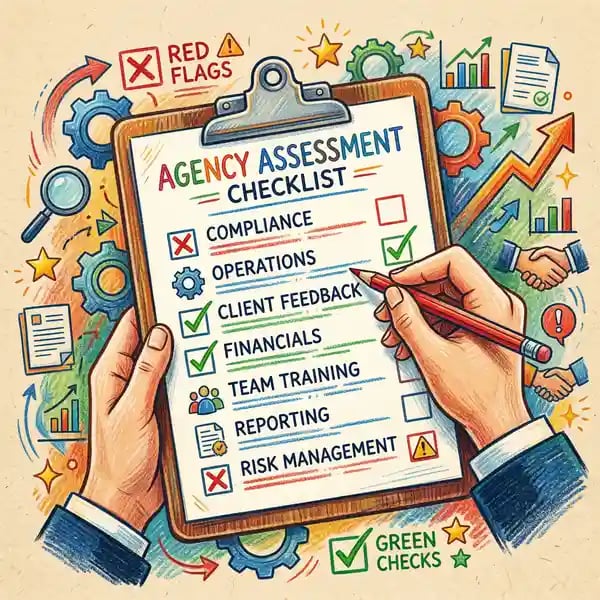
The traditional red flags remain relevant—guaranteed rankings, vague pricing, cookie-cutter strategies, poor communication, no verifiable case studies, and vanity-only metrics. But several new warning signs have emerged that are specific to 2025-2026.

New red flags to watch for

No AI search strategy whatsoever. Agencies whose services pages still talk about "taking over Google" without mentioning AI results or conversational search are running outdated playbooks. Google AI Overviews now reaches 1.5 billion+ monthly users across 200+ countries—this isn't a niche consideration.

Over-reliance on AI without human oversight. Research from The Drum shows 80% of brands have "serious concerns" about how agencies use AI on their behalf. The problem isn't AI use—it's uncritical AI use. Agencies must demonstrate balance: 50% of consumers can spot AI-generated content, and 52% are less engaged when they suspect AI authorship without human curation.

AI trend-chasing without evidence. Agencies slapping "AI-powered" on everything without demonstrable results are a significant risk. Ask for case studies with metrics. If they've "majorly pivoted" to AI without the data to support those decisions, proceed with caution.

No data privacy or ethics framework for AI. The UK Data (Use and Access) Act 2025 raised maximum PECR fines to £17.5 million or 4% of global turnover. Agencies must demonstrate robust compliance frameworks—not just lip service to GDPR.

No AEO/GEO competency. AI referral traffic currently accounts for just 1.08% of total website traffic, but it's growing explosively—AI referrals to top websites surged 357% year-over-year between June 2024 and June 2025. Agencies without a strategy here are already behind.

Ten Questions to Ask Agencies About AI Capability

Based on research from multiple authoritative sources, these are the critical questions for evaluating agency AI capability in 2025-2026:

  1. How do you integrate AI into content creation, data analysis, and campaign optimisation? Listen for specific tools and processes, not vague promises.
  2. What is your AEO/GEO strategy for AI search platforms like ChatGPT, Perplexity, and Google AI Overviews? This question alone will separate agencies who understand the shift from those who don't.
  3. What AI tools are in your tech stack, and what does each contribute? Agencies should be able to articulate why they use specific tools.
  4. How do you balance AI-generated content with human creativity and expertise? The right answer involves quality control processes, not just claims of "human touch."
  5. What data privacy and ethical AI practices do you follow—specifically regarding UK GDPR and ICO compliance? Vague answers here are a red flag.
  6. Can you show case studies demonstrating measurable ROI from AI-enhanced campaigns? Claims without evidence are worthless.
  7. How do you measure success in AI search visibility? Look for mentions of citations, brand mentions in AI responses, and AI referral traffic.
  8. What is your approach to AI content detection and maintaining authenticity? Agencies should have a thoughtful perspective here.
  9. How are you preparing clients for the predicted 25% decline in traditional search volume? Gartner's prediction is well-known—agencies should have a response.
  10. Do you use AI for predictive analytics—purchase likelihood, churn risk, customer lifetime value? This separates sophisticated operators from basic implementers.

The Hybrid Model Has Won: In-House Plus Agency

The binary choice between in-house and agency is effectively over. Sagefrog's 2026 B2B Marketing Mix Report reveals that 46% of companies now use a hybrid model (up from 36% in 2025), while fully in-house dropped to 32% and fully outsourced fell to 22%.

The ANA reports that 82% of members have in-house agencies, yet 92% still use external agencies—confirming that the models coexist rather than compete.

Why the shift to hybrid?

The primary driver for hiring agencies has shifted: "lack of internal resources" is now the number one reason at 42% (up from 37% in 2025). Meanwhile, 76% of companies say agency support helps them meet their goals—up from 71% the previous year.

AI has paradoxically accelerated both trends simultaneously. On one hand, tools like ChatGPT and HubSpot AI enable smaller in-house teams to handle tasks previously outsourced—content drafting, basic analytics, email campaigns. On the other, AI has increased the need for agency partners in specialised areas: AI search strategy (AEO/GEO), advanced predictive analytics, multi-channel orchestration, and creative testing at scale.

The cost argument: Two mid-level growth hires at £100K each cost £250K–£280K per year fully loaded when accounting for benefits, tools, training, and management overhead. Many agencies deliver a full multi-disciplinary team for £20K–£35K per month. Employee attrition—costing 50%–200% of annual salary—adds further risk to the in-house model.

UK Market Context: Budget Benchmarks and Industry Size

The UK is the largest digital advertising market in Europe and third largest globally. IAB UK's Digital Adspend Report shows the UK digital ad market reached £35.53 billion in 2024 (up 13% year-over-year), with forecasts reaching £45 billion by 2026.

Budget benchmarks every business should know

Gartner's 2025 CMO Spend Survey (402 CMOs) found that marketing budgets have flatlined at 7.7% of company revenue—down from a pre-pandemic average of 11%. Half of CMOs report budgets of 6% or less.

The breakdown by business type shows significant variation:

Business Type Marketing as % of Revenue
B2B Product Companies 6.4%
B2B Services 9.0%
B2C Product Companies 15.5%

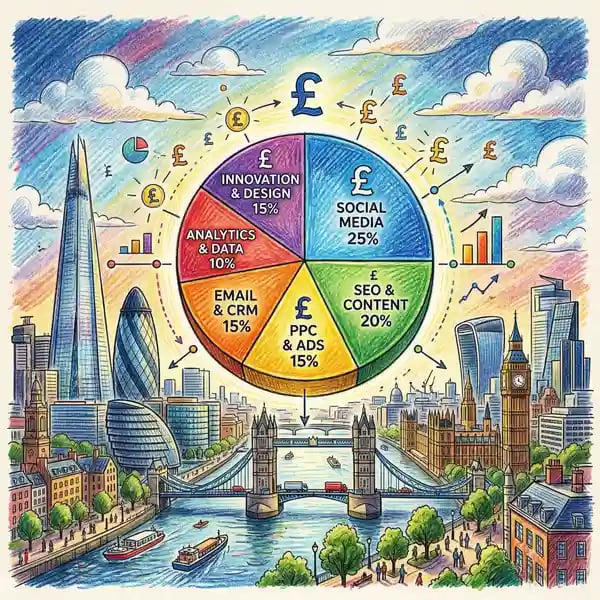
Within these budgets, 61.1% now goes to digital channels (up from 57.1% in 2024). The allocation splits roughly evenly across four categories: paid media (30.6%), MarTech (22.4%), labour (21.9%), and agencies (20.7%).

Critically, 39% of CMOs plan to cut agency budgets in 2025, with 22% saying GenAI has enabled them to reduce reliance on external agencies. This creates pressure on agencies to demonstrate clear, measurable value—and opportunity for agencies that can prove ROI.

How B2B Companies Actually Find and Select Agencies

The buyer journey for agency selection has fundamentally changed. Understanding this helps you evaluate whether an agency understands modern buying behaviour—because if they don't understand how you found them, they probably don't understand how your customers find you.

The research process

According to Wynter's survey of 100 B2B SaaS marketing executives, 58% begin by asking their professional network for recommendations, while 54% start with a category search on Google or review sites. Word-of-mouth carries the highest influence weight: 73% rank peer recommendations as their number one factor.

Self-education is nearly complete before any agency conversation happens:

  • 97% check the vendor's website before engaging
  • 81% already have a preferred vendor before first contact
  • 85% of buying teams have requirements mostly or completely set before engaging vendors
  • The average B2B buying group now involves 8.2 stakeholders (up 21% since 2015)

AI search is becoming a real discovery channel

46% of B2B buyers now use generative AI tools like ChatGPT when conducting research. One agency reported landing two £80,000+ clients who found them through ChatGPT recommendations. A new category of tools has emerged specifically to track brand visibility in AI-generated responses.

This shift has profound implications: optimised content increases inclusion in AI-generated summaries by 35–40%, and GEO optimisation produces measurable results within 8–16 weeks.

Common Mistakes and Why Agency Relationships Fail

The single most common mistake is not defining clear goals and KPIs before engaging an agency. Without specific, measurable objectives, it's impossible to evaluate performance or hold anyone accountable.

The second most frequent error is choosing on price alone. An agency charging £2,500 per month generating £25,000 in revenue vastly outperforms a £400 per month agency generating nothing. The cheapest option rarely delivers the best ROI.

Other critical mistakes include:

  • Falling for unrealistic guarantees ("guaranteed first-page rankings")
  • Accepting cookie-cutter strategies that could apply to any business
  • Failing to establish who will actually work on the account versus the pitch team
  • Treating marketing as a one-time effort rather than continuous optimisation
  • Limiting the search to local agencies only
  • Failing to evaluate agencies for AI and AEO/GEO capability—increasingly the most costly mistake

Why relationships end

Digiday's survey of client-side marketers found the primary reasons clients leave:

  • 77% cite underperforming campaigns
  • 45% leave for cheaper alternatives
  • 29% cite overbilling
  • 26% cite hidden fees

The retention data reveals clear patterns: retainer-based agencies have the lowest annual churn at 18% with an average client lifespan of 56 months, while PPC/paid ads agencies face the highest churn at 49%. The first 90 days represent peak churn risk across all models—making onboarding critical.

Why HubSpot Partnership Tier Matters for Agency Selection

The MarTech landscape now includes 15,384 solutions—a 100× increase since 2011. HubSpot powers 45.8% of B2B MarTech stacks and holds 29.4% marketing automation market share. In this context, HubSpot partnership tiers serve as a meaningful quality signal.

HubSpot's Solutions Partner Program has five tiers based on managed recurring revenue, client retention, and certifications. Diamond Partners represent less than 3% of all agencies globally—approximately 164 out of 5,500+ tiered agencies. Diamond status requires maintaining £44,000+ in monthly recurring revenue with HubSpot clients, demonstrating consistent client retention, and holding extensive platform certifications.

For clients, selecting a Diamond Partner like Whitehat SEO means working with an agency that has:

  • Proven platform mastery across marketing automation, sales enablement, customer service, and CMS
  • Priority HubSpot support for faster resolution of complex issues
  • Access to the latest capabilities before the broader market

The tier system functions as ongoing quality assurance—HubSpot evaluates partners twice yearly, and agencies can move up or down based on performance.

UK-Specific Regulatory Considerations

UK businesses now operate under UK GDPR as a separate framework from EU GDPR, with the ICO as the sole regulatory authority. Businesses offering services to EU customers must comply with both UK GDPR and EU GDPR—a dual compliance requirement that competent agencies must understand.

The UK Data (Use and Access) Act 2025 introduces several changes relevant to digital marketing:

  • PECR fines now align with UK GDPR at £17.5 million or 4% of global turnover
  • Certain "low-risk" cookies may be permitted without explicit consent (with opt-out)
  • Restrictions on automated decision-making have been eased with transparency safeguards

Agencies operating in the UK should demonstrate familiarity with:

  • ICO (data protection)
  • ASA/CAP Code (advertising standards)
  • CMA Digital Markets Unit (digital advertising oversight)
  • DMA (Data & Marketing Association)
  • IPA (Institute of Practitioners in Advertising)

The UK holds the highest e-commerce share of retail sales globally at 30% (versus 24% in the US), making digital marketing expertise particularly valuable in this market.

Frequently Asked Questions

How much should I budget for a digital marketing agency in the UK?

UK agency retainers typically range from £2,000–£8,000 per month for small-to-mid businesses and £12,000–£40,000+ per month for enterprise clients. The average retainer sits around £2,800 per month. Project-based work for strategic initiatives like HubSpot implementation typically runs £20K–£50K. Focus on ROI rather than cost alone—an agency generating 10× return on a £5,000 monthly investment outperforms a £2,000 agency generating 2× return.

What is the difference between AEO and GEO?

Answer Engine Optimisation (AEO) focuses on structuring content so AI-powered search platforms—Google AI Overviews, Bing Copilot, Perplexity—cite your brand as a source within their answers. Generative Engine Optimisation (GEO) is broader, ensuring your brand appears positively across all large language models including ChatGPT, Claude, and Gemini. Both disciplines complement traditional SEO rather than replacing it.

How long before I see results from a new agency?

Timeline varies by channel: PPC campaigns can show results within weeks, while SEO typically requires 4–6 months for meaningful improvement. The first 90 days represent peak churn risk—use this period to assess communication quality, strategic thinking, and early indicators of progress rather than expecting full ROI. Agencies that promise immediate results from organic channels are either inexperienced or being dishonest.

Should I choose a specialist agency or a full-service agency?

The hybrid model suggests most businesses benefit from working with specialists who integrate well with broader marketing efforts. Full-service agencies offer convenience but may lack depth in specific channels. The 2025-2026 market favours agencies with genuine AI and AEO expertise regardless of whether they position as specialists or generalists—capability matters more than positioning.

What makes HubSpot Diamond Partners different from other agencies?

HubSpot Diamond Partners represent less than 3% of all HubSpot agencies globally. The tier requires maintaining £44,000+ in monthly recurring revenue with HubSpot clients, demonstrating consistent retention, and holding extensive certifications. Diamond Partners receive priority support from HubSpot, early access to beta features, and access to exclusive resources—benefits that directly affect client outcomes. Learn more about Whitehat's services.

Making Your Decision

Three interconnected shifts define the 2025-2026 agency selection landscape:

AI has created both a threat and an opportunity. 39% of CMOs plan to cut agency budgets, but agencies with demonstrable AI, AEO, and GEO expertise command premium rates and deliver measurably superior results.

The hybrid model has won. Nearly half of B2B companies now blend in-house and agency resources, creating demand for agencies that can integrate seamlessly with internal teams rather than operating as isolated vendors.

The buyer journey has fragmented across peer networks, AI assistants, review platforms, and traditional search. Agencies must be visible and "citable" everywhere, not just on Google page one.

The agencies that will thrive are those that understand these shifts and have adapted their capabilities accordingly. Use this guide's criteria to separate the genuinely capable from the merely persuasive—your results depend on it.

References & Sources

  1. Gartner (2025). 2025 CMO Spend Survey. gartner.com
  2. HubSpot (2026). 2026 State of Marketing Report. hubspot.com/state-of-marketing
  3. IAB UK (2025). Digital Adspend 2024. iabuk.com/adspend
  4. HubSpot (2026). Generative Engine Optimization Statistics. blog.hubspot.com
  5. Campaign UK (2025). Marketing budgets hold at 7.7% in 2025: Gartner CMO survey. campaignlive.com
  6. HubSpot (2025). State of AI in Marketing Report. blog.hubspot.com

About Whitehat SEO

Whitehat SEO is a London-based HubSpot Diamond Partner and full-service inbound marketing agency. Founded in 2011, we run the world's largest HubSpot User Group and deliver SEO, AEO, and integrated marketing services to B2B companies across the UK. Our CEO, Clwyd Probert, is a guest lecturer at UCL.