
Marketing Strategy
Marketing Consultation: What to Expect from Agency Consultations in 2025
| Last Updated: 19 December 2025 | 12 min read
Written by the Whitehat Team
HubSpot Diamond Partner & Inbound Marketing Specialists
A marketing consultation is a strategic assessment where an agency analyses your business, competitors, and market position to identify growth opportunities and create an actionable roadmap. The best consultations go far beyond generic advice—they diagnose specific problems in your marketing performance and provide data-backed recommendations aligned to your commercial objectives. At Whitehat, our consultations combine competitive analysis, technical audits, and strategic planning to help UK businesses achieve predictable, measurable growth.
Marketing consultations have transformed significantly in recent years. The global marketing consulting market reached approximately £25-35 billion in 2024, with digital marketing consulting commanding 31.6% market share. Yet despite this growth, 64% of CMOs report lacking sufficient budget to execute their strategies—making consultations that demonstrate clear ROI more critical than ever.
 For UK businesses specifically, the pressure is acute: marketing budgets decreased 15% in 2024 whilst lead generation targets rose 36% simultaneously. This squeeze means consultations must deliver measurable strategic value, not generic presentations. Agencies that understand this dynamic—and can articulate clear paths to return on investment—are winning more clients despite the challenging environment.
What businesses actually want from marketing consultations today
Modern clients expect consultations to feel like strategic workshops rather than sales pitches. According to Gartner's 2024 CMO Spend Survey, the top priorities driving consultation demand are demonstrating ROI (69%), revenue generation (59%), and digital marketing expertise (55%). Businesses aren't seeking generic marketing overviews—they want consultations that immediately address their most pressing challenges.
The Setup 2024 Marketing Relationship Survey found that deep business understanding and effective communication ranked as the top two qualities clients seek in agency partners. Notably, 26% of businesses prioritise proven past results when selecting agencies—three times more important than reviews—indicating consultations must demonstrate track record, not merely promise outcomes.
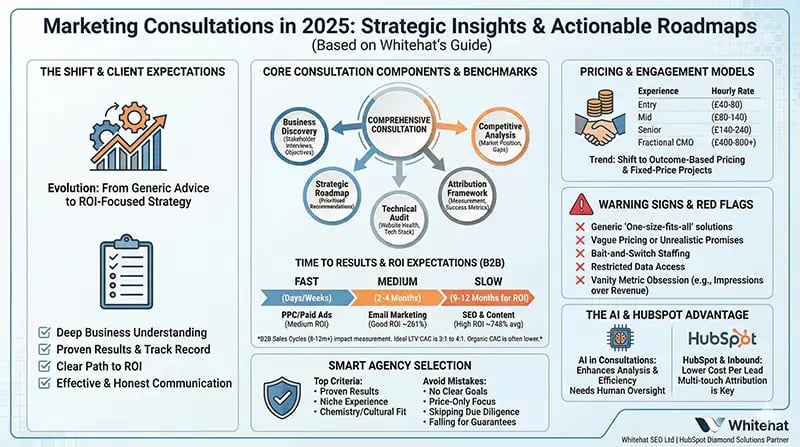
What a comprehensive consultation should include:
- Business discovery: Stakeholder interviews, objective alignment, and current performance assessment
- Competitive analysis: Market positioning, competitor strategies, and gap identification
- Technical audit: Website performance, SEO health, and technology stack evaluation
- Strategic roadmap: Prioritised recommendations with timelines and budget requirements
- Attribution framework: Measurement approach and success metrics definition
The consultation discovery process has evolved considerably. Pre-meeting questionnaires have become standard practice, with agencies using digital onboarding forms to gather business context before formal sessions. Modern discovery includes stakeholder mapping across multiple decision-makers, BANT qualification (Budget, Authority, Need, Timeline), and increasingly, AI-assisted research into competitor positioning and market dynamics.
Marketing consultation pricing: What UK businesses should expect
Marketing consultation pricing varies dramatically by experience level and scope. Understanding current 2024-2025 benchmarks helps UK businesses evaluate whether proposals represent fair value or opportunistic pricing.
| Experience Level | Hourly Rate | Monthly Retainer |
|---|---|---|
| Entry-level consultants | £40–80 | £500–2,000 |
| Mid-level consultants | £80–140 | £1,000–10,000 |
| Senior consultants | £140–240 | £5,000–20,000 |
| Fractional CMOs | £400–800+ | £10,000–50,000+ |
Project-based engagements typically range from £1,000–5,000 for small projects to £20,000–100,000+ for complex enterprise consultations. The UK consulting market grew approximately 9% in 2024 and is projected to grow 6.4–8.7% in 2025, with AI services, digital technology, and cost reduction consulting driving expansion.
A significant trend is the shift toward outcome-based pricing—linking consultation fees to measurable business outcomes rather than traditional billable hours. Fixed-price engagements and "try before you buy" micro-engagements are growing, with some firms accepting contingency-based assignments tied to achieving specific client goals.
Red flags that signal a consultation is a waste of time
Research consistently identifies warning signs that distinguish valuable consultations from glorified sales pitches. The most critical red flag is failing to ask about your business model. As Ben Dutter of Power Digital notes: if an agency isn't asking about how your business generates revenue or failing to grasp your core operations, it's a clear sign they're not equipped to craft a strategy that aligns with your goals.
⚠️ Warning signs to watch for:
- One-size-fits-all presentations without customisation to your specific situation
- Vague pricing structures or unwillingness to provide detailed cost breakdowns
- Unrealistic promises like guaranteed rankings or "page one in 30 days"
- Bait-and-switch staffing where senior team members pitch but juniors execute
- Restricted data access—agencies that won't give you admin access to your own accounts
- Vanity metric obsession focusing on impressions rather than business outcomes
The Mayple Marketing Industry Survey found 37% of agency partnerships fail due to "big promises, low results," whilst 12.9% fail from lack of transparency. These findings underscore why thorough vetting during the consultation phase prevents costly mismatches.
UK businesses should specifically verify GDPR compliance, ICO registration, and ethical data handling practices. The 2024 Agency Marketing Benchmark Report found 58% of UK agencies scored below benchmark on their own marketing, with 46% "not practising what they preach"—making it essential to scrutinise whether agencies can deliver what they claim.
Marketing ROI benchmarks that inform realistic expectations
Understanding current performance benchmarks helps businesses evaluate both consultation recommendations and eventual results. The data reveals significant variation across channels, with SEO delivering the highest average ROI at 748%—but requiring 9–12 months to break even. Email marketing offers more immediate returns with 261% ROI and 3–6 month break-even timelines.
B2B Customer Acquisition Cost by Industry (2024–2025)
- B2B SaaS: £190 average CAC
- Business Consulting: £425 average CAC
- Financial Services: £625 average CAC
- Legal Services: £595 average CAC
- Manufacturing: £575 average CAC
- Education: £910 average CAC (highest across sectors)
The ideal LTV:CAC ratio remains 3:1 to 4:1, and businesses should expect organic acquisition channels to consistently outperform paid channels in cost efficiency. First Page Sage data shows organic CAC is 40–60% lower than inorganic (paid) CAC across nearly every B2B industry.
For email marketing, UK businesses should benchmark against 39.5–42% open rates, 2–5% click-through rates, and 2.4% conversion rates. However, the DMA UK's 2024 report notes B2B delivery rates dropped from 96.8% to 92.1% due to job changes and list decay, making list hygiene increasingly critical.
Time to results: What marketing campaigns actually deliver
One of the most common misalignments between businesses and agencies involves timeline expectations. Research consistently shows different marketing tactics require fundamentally different patience levels.
PPC and paid advertising deliver the fastest initial results—within days to weeks—but require 1–3 months for meaningful ROI and 3–6 months for optimisation and full impact. Email marketing similarly shows quick initial results but needs 2–4 months for meaningful engagement patterns to emerge.
Content marketing and SEO represent the opposite end of the spectrum. First Page Sage data shows SEO typically requires 4–6 months for initial results, 9–12 months for meaningful ROI, and 12–24 months for full impact. This aligns with Mezzanine Growth research showing Year 1 often involves higher spend than profit generated as an investment phase, with Years 2–3 producing powerful and growing ROI.
💡 Key insight
B2B sales cycles compound these timelines. With average B2B sales cycles of 8–12 months or longer, evaluating marketing ROI requires matching measurement windows to actual customer decision timeframes. If your average sales cycle is 60 days, immediate ROI reporting will miss future conversions still progressing through the pipeline.
How AI is reshaping marketing consultations and audits
The integration of AI into marketing represents the most significant shift in consultation methodology since digital marketing emerged. McKinsey's State of AI 2025 report shows 88% of organisations now use AI in at least one business function, up from 78% in 2024. Within marketing specifically, HubSpot data indicates 69.1% of marketers have integrated AI into their operations.
For consultations specifically, AI is transforming competitive analysis and audit processes. Tools like Crayon and Klue provide AI-powered dashboards with anomaly detection and real-time competitor tracking. SEMrush and Ahrefs use AI for keyword research, backlink analysis, and content gap identification. MarketMuse offers AI-driven content strategy and competitive content scoring.
The efficiency gains are substantial: marketers report saving 3+ hours per piece of content and 2.5+ hours daily with AI tools. CoSchedule research shows 83% of marketers using AI report increased productivity, whilst 84% report improved speed of delivering high-quality content.
UK adoption is accelerating rapidly. The Incorporated Society of British Advertisers reports 41% of UK advertisers now use generative AI in workflows—up from just 9% in April 2024. Among UK SMEs, 45% had integrated AI by 2024, up from 25% in 2022, with medium-sized enterprises (50–249 employees) reaching 65% adoption.
However, consultations must balance AI capabilities with human insight. Wharton research from 2025 found ChatGPT users produce less diverse ideas than human-only groups, with only 6% of AI-generated ideas being unique versus 100% in human groups. AI "flattens thinking"—teams converge on similar solutions. Best practice is to start with human ideas before introducing AI, and HubSpot data shows that 86% of marketers using AI for content make edits before publishing.
At Whitehat's AI consultancy practice, we combine AI-augmented analysis with strategic human oversight to deliver consultations that leverage the best of both capabilities.
Inbound marketing effectiveness and the HubSpot ecosystem
Inbound marketing continues demonstrating superior performance over outbound approaches. Current data shows inbound leads cost 61% less than outbound leads, with inbound marketing conversion rates 10× higher (14.6% versus 1.7% for lead conversion). After five months of consistent inbound marketing, average cost per lead drops 80%.
The HubSpot partner ecosystem has grown into a £36 billion opportunity projected for 2029, nearly tripling from £13.7 billion in 2025. HubSpot serves over 268,000 customers globally with 2,000+ apps in its marketplace. The average HubSpot customer has 9+ apps installed, and customers with integrations show 10%+ higher retention rates.
For UK agencies, HubSpot's Solutions Partner Program offers tiered benefits from Gold through Elite status. Since February 2024, every Solutions Partner receives a dedicated Partner Development Manager for business development support. The programme includes a £10M Partner Growth Fund for eligible partners, co-marketing campaigns, and the Partner Matching Program connecting customers with certified partners.
Attribution and measurement have become critical consultation components. Modern retail consumers need 56 touchpoints on average before completing a purchase, yet only 17% of advertisers can holistically assess their digital channels' performance. Multi-touch attribution delivers 25% increase in customer retention for those who implement it effectively, whilst U-shaped (position-based) attribution models show 20% increase in effectiveness over simpler models.
As a HubSpot Diamond Partner running the world's largest HubSpot User Group in London, Whitehat brings deep platform expertise to every consultation—ensuring recommendations are both strategically sound and technically implementable within your existing or planned technology stack.
The selection criteria businesses actually use to choose agencies
Research reveals the factors that most influence agency selection decisions. The Setup 2024 Marketing Relationship Survey identified proven past results (26%), niche industry experience (21%), and good communication (13%) as the top three criteria. Chemistry and cultural compatibility ranked as critical factors for long-term retention.
How businesses find agencies matters too. Word-of-mouth accounts for 23.3% of agency discoveries, with referrals at 19.4%, online advertising at 13.6%, and search engines at 10.7%. This distribution underscores why reputation and client satisfaction drive sustainable agency growth.
Common mistakes when selecting agencies:
- Not defining clear goals before starting the search
- Choosing based on price alone (often leads to corner-cutting and poor results)
- Skipping due diligence on references and case studies
- Falling for unrealistic guarantees
- Failing to verify who will actually work on the account versus who pitches
For UK businesses specifically, the agency landscape includes over 25,000 marketing agencies in a sector worth £32.4 billion. The B2B Marketing UK Agencies Benchmarking Report 2024 provides ranking frameworks, with Edelman UK holding the #1 position for the fourth consecutive year. Businesses should verify GDPR compliance, confirm ICO registration, and assess agencies' own marketing sophistication—given nearly half of agencies struggle to practise what they preach.
Ready for a consultation that delivers real insight?
Whitehat's strategic consultations combine AI-augmented competitive analysis, HubSpot expertise, and data-driven recommendations to create actionable roadmaps for UK B2B businesses.
Book Your Consultation →Frequently asked questions about marketing consultations
How much should a marketing consultation cost in the UK?
Marketing consultation costs in the UK range from £40–80 per hour for entry-level consultants to £400–800+ per hour for fractional CMOs. Project-based engagements typically cost £1,000–5,000 for small projects and £20,000–100,000+ for complex enterprise consultations. The value should be assessed against the strategic insight provided and potential ROI, not just the hourly rate.
How long does it take to see results from marketing agency work?
Timeline varies significantly by channel. PPC delivers initial results within days but requires 3–6 months for full optimisation. SEO typically needs 4–6 months for initial results and 9–12 months for meaningful ROI. For B2B companies with longer sales cycles (8–12 months), measurement windows must align with actual customer decision timeframes.
What should I ask during a marketing consultation?
Ask about their experience in your specific industry, request case studies with measurable results, understand who will actually work on your account, clarify their reporting and communication cadence, and ask how they measure success. Critically, assess whether they ask insightful questions about your business—agencies that don't seek to understand your revenue model cannot create aligned strategies.
What's the difference between a marketing consultant and a marketing agency?
Marketing consultants typically provide strategic advice, audits, and recommendations whilst you execute internally. Marketing agencies provide both strategy and execution—they implement campaigns, create content, manage advertising, and handle ongoing optimisation. Many businesses benefit from agency partnerships that combine strategic consultation with done-for-you implementation.
How do I know if a marketing agency is right for my business?
Look for proven results in your industry (26% of businesses prioritise this), strong communication (13% cite this as critical), and cultural fit. Verify their own marketing sophistication—46% of UK agencies don't practise what they preach. Check certifications (like HubSpot Diamond Partner status), client testimonials, and whether they provide transparent pricing and clear accountability frameworks.
What ROI should I expect from marketing agency services?
ROI varies by channel and industry. SEO delivers the highest average ROI at 748% but requires 9–12 months to break even. Email marketing offers 261% ROI with faster returns. The ideal LTV:CAC ratio is 3:1 to 4:1. Organic channels typically deliver 40–60% lower customer acquisition costs than paid channels. Set realistic expectations based on your industry benchmarks and chosen marketing mix.
References and sources
- Gartner Peer Community — 2024 Marketing Priorities and Challenges: Insights from the Field
- Mayple — Marketing Industry Trends Survey: How Brands Hire Marketers
- First Page Sage — Average Customer Acquisition Cost (CAC) By Industry: B2B Edition
- DMA UK — Email Marketing Benchmarking Report 2024
- Synergist — Key Findings from the Agency Marketing Benchmark Report 2024
- HubSpot — Marketers Double AI Usage in 2024
- CoSchedule — State of AI in Marketing Report 2025
- Power Digital — 8 Critical Agency Red Flags to Avoid
- Influencer Marketing Hub — Artificial Intelligence (AI) Marketing Benchmark Report 2025