
AI & AEO
Author signals have fundamentally shifted from traditional SEO to AI-centric optimisation. Google's December 2025 Core Update extended E-E-A-T requirements beyond YMYL topics to virtually all competitive queries, whilst AI platforms like ChatGPT, Perplexity, and Google AI Overviews each evaluate authority through distinct—and sometimes contradictory—lenses.
Authorship, E-E-A-T, and Author Signals for SEO and AI Search in 2026
Why author signals matter more than ever—and how to optimise for both Google and AI answer engines like ChatGPT and Perplexity.
KEY INSIGHT
Brand search volume—not backlinks—now shows the strongest correlation (0.334) with AI citations, according to research from Conductor and Profound. Authors who build presence across Wikipedia, Reddit, and LinkedIn are 2.8× more likely to be cited by AI systems. The question is no longer just "how do I rank?"—it's "how do I become an entity that AI recommends?"
For marketing directors and content strategists at B2B companies, this creates both challenge and opportunity. The old playbook of author bios and bylines remains necessary but insufficient. Today, authors must become recognisable entities—established through Wikidata entries, consistent cross-platform presence, third-party citations, and content that demonstrates genuine first-hand experience.
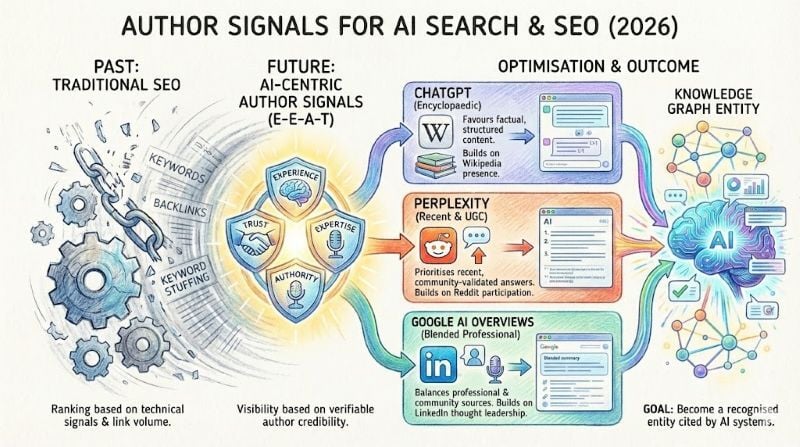
Whitehat SEO's analysis of current research reveals a critical insight: citation patterns differ dramatically between AI platforms. This guide breaks down what's changed, what works, and how to build author authority that performs across both traditional search and the emerging AI search landscape.
Google's E-E-A-T Framework Has Expanded Significantly
The September 2025 Search Quality Rater Guidelines (181 pages) reinforce that Trust is the most important member of the E-E-A-T family. Google's quality raters—approximately 16,000 globally—now evaluate content against stricter standards that apply universally, not just to health and finance topics.
The four components work together but serve distinct purposes:
- Experience: First-hand or life experience for the topic—tested products, visited locations, or lived through situations being discussed.
- Expertise: Necessary knowledge or skill demonstrated through credentials, qualifications, and depth of understanding.
- Authoritativeness: Recognition as a go-to source, evidenced by third-party citations and industry standing.
- Trustworthiness: Accuracy, honesty, safety, and reliability of content—the foundation upon which the other elements rest.
The guidelines explicitly state that YMYL pages with absolutely no information about the website or content creator should receive the "Lowest" rating. For authors, this means bylines must link to comprehensive profile pages showing background, credentials, and topical expertise—a bare minimum that many sites still fail to implement.
"Write for humans, not for ranking systems, whether those systems are traditional search or LLM-powered experiences."
— Danny Sullivan, Google Search Liaison
AI Search Engines Evaluate Authors Differently Than Traditional Google
Here's the uncomfortable truth: no major AI platform consistently displays individual author names. Attribution happens at the domain or publication level. However, E-E-A-T signals strongly influence which content gets cited—and each platform has distinct preferences that require different optimisation approaches.
ChatGPT Citation Patterns
ChatGPT sources 80.4% of citations from .com domains and 11.3% from .org sites. Wikipedia dominates at 47.9% of top-10 citations. The platform favours encyclopaedic, factual content with clear semantic HTML structure—content that includes APA-style citations, labelled reference sections, and consistent author formatting performs best.
Critically, ChatGPT cites only approximately 5 domains per response—50% fewer opportunities than traditional Google results. This scarcity makes authority signals even more important.
Perplexity AI Behaviour
Perplexity operates differently. Reddit represents 46.7% of top citations for user-generated content queries, with YouTube at 2.0% overall. The platform uses real-time web search with numbered footnotes linking to sources, prioritising recent content with visible "last updated" dates, definition boxes with plain language answers, and mini decision tables for comparisons.
Google AI Overviews
Google's AI Overviews explicitly leverage E-E-A-T, with author/creator credibility potentially prioritised over site authority according to Google documentation. Reddit appears in 2.2% of citations, YouTube at 1.9%. The system blends professional and community sources, selecting based on demonstrated expertise, comprehensive coverage, clear semantic structure, and cited references.
| Platform | Top Source Type | Content Preference |
|---|---|---|
| ChatGPT | Wikipedia (47.9%) | Encyclopaedic, factual, structured |
| Perplexity | Reddit (46.7% for UGC) | Recent, definition-focused, comparative |
| Google AI Overviews | Blended (professional + community) | E-E-A-T signals, comprehensive coverage |
| Claude | Capterra (B2B), authoritative sources | Longer coherent passages, recent content |
Research-Backed Methods That Boost AI Visibility
Princeton University's 2024 study on Generative Engine Optimisation (GEO) provides empirical evidence for what actually works. The researchers tested multiple content enhancement methods across 10,000 queries and found that specific approaches can boost AI visibility by up to 40%.
GEO Methods Ranked by Effectiveness
- Citing sources and adding quotations: Up to 40% improvement
- Including statistics with specific numbers: 30-40% improvement
- Fluency optimisation: 15-30% improvement
- Keyword stuffing: Performed worse than baseline
That last finding deserves emphasis: traditional SEO tactics like keyword stuffing actively hurt AI visibility. The shift toward natural language processing means content must be genuinely useful and well-written, not just technically optimised.
Whitehat SEO's work with B2B clients using Answer Engine Optimisation strategies confirms these findings. Content structured with clear citations, specific data points, and authoritative sources consistently outperforms content optimised purely for keyword density.
Author Schema Markup Requires Precise Implementation
Google's schema documentation (updated December 2025) provides clear guidance on author markup. Whilst schema.org doesn't define mandatory properties, Google's implementation priorities are evident—and getting them right helps both traditional search and AI systems understand who created your content.
The sameAs Property Is Critical
For entity reconciliation—helping search engines and AI understand that the "Jane Doe" on your site is the same person as the one on LinkedIn—the sameAs property links to authoritative external profiles.
Priority links to include:
- Wikidata (directly feeds Google's Knowledge Graph)
- Wikipedia (if applicable)
- LinkedIn profile
- Professional directories relevant to your industry
Avoid including Google's internal Knowledge Graph IDs (/g/ or /m/ codes) as these can change without notice.
Article Schema Best Practices
When connecting articles to authors, Google explicitly advises:
- Include all authors separately—don't merge names into a single string
- Use Person type for individuals, Organisation for company-authored content
- Put only the name in the name property—use honorificPrefix and jobTitle for titles
- Link to author profile pages using the url property
Research confirms AI systems use structured data, though not as a direct ranking signal. BrightEdge found pages with robust schema have higher citation rates in AI Overviews, and LLMs grounded in knowledge graphs achieve 300% higher accuracy. However, schema reinforces visible content—it doesn't replace it. Tests showed schema-only content hidden from pages failed extraction across all AI platforms.
Knowledge Graph Recognition Requires Multi-Platform Consistency
Authors become recognised entities in Google's Knowledge Graph through sufficient search interest, authoritative references, and consistent identity across platforms. The Knowledge Graph contains over 500 billion facts about 5 billion entities—getting included requires deliberate effort.
Wikidata as Primary Entry Point
For authors who don't meet Wikipedia's strict notability requirements, Wikidata offers an alternative pathway. Create an entry with essential statements: instance of (human), name, occupation, employer, official website, and social media accounts. Then link your Wikidata entry in your schema's sameAs property for the strongest Knowledge Graph signals.
Google's John Mueller recommends linking to "a common or central place where everything comes together for this author—could be something like a social network profile page." This "entity home" becomes the canonical reference for cross-site author recognition.
THE MULTI-PLATFORM IMPERATIVE
Brands appearing across Wikipedia, Reddit, and LinkedIn are 2.8× more likely to be cited by AI systems. Citation overlap between platforms is only 6-16%, meaning optimisation for one platform doesn't guarantee visibility on others. A multi-platform presence strategy isn't optional—it's essential.
Author Page Architecture That Demonstrates Expertise
The structure of author pages directly impacts E-E-A-T signals. Archive pages (lists of articles) serve different purposes than hub pages (comprehensive profiles), and most sites need both. Whitehat SEO's work with HubSpot implementations consistently shows that author hub pages drive both ranking improvements and conversion increases.
Essential Author Hub Page Components
Header section: Professional headshot (minimum 400×400px), full name as H1, job title and credentials as H2, verification badges where applicable.
Credentials block: Years of experience, professional certifications (especially critical for YMYL topics), educational background, awards and recognitions, media mentions, and speaking engagements.
Social proof: Testimonials about the author's work, publications featured in, client logos for B2B, substantial follower counts.
Content portfolio: Dynamic list of all articles by author, categorised by topic, with featured pieces highlighted and guest contributions on other sites listed.
Topical Authority Through Content Clustering
The pillar-cluster model remains essential for demonstrating author expertise. Map topic silos to specific expert authors—don't spread one author across unrelated topics. All content within a silo should link together, signalling depth to both traditional search and AI systems.
Single-author sites should disable author archives to avoid duplicate content, building deep topical authority under one recognised entity. Multi-author sites should enable archives, assign authors to specific topic areas, and implement "Written by [Writer] | Reviewed by [Expert]" attribution for junior content.
Digital PR and Third-Party Mentions Drive AI Visibility
Brand mentions have become critical for AI search visibility. Research shows brands with healthy mixes of links and unlinked mentions are featured 40% more often in AI responses. Google's algorithms now recognise unlinked mentions as "implied links"—signals of credibility without hyperlinks.
HARO Alternatives for 2026
After HARO was discontinued as Connectively in December 2024 and relaunched by Featured.com in April 2025, several alternatives have emerged for building expert citations:
- Source of Sources: Created by HARO founder Peter Shankman; 2,000+ journalists, 30,000+ users
- Qwoted: Real-time alerts with detailed filtering
- Help a B2B Writer: Focused on B2B publications
- #JournoRequest on X/Twitter and BlueSky: Free hashtag monitoring
- Roxhill: UK-focused journalist access
53% of HARO-style queries originate from sites with Domain Rating 70+, making expert responses high-value for authority building.
Podcast Appearances as Authority Signals
Podcast guesting delivers lasting SEO benefits: backlinks from show notes on high-domain-authority platforms (Apple Podcasts, Spotify), contextual links surrounded by relevant content, and episodes that remain online indefinitely. Google now scans audio files for relevance, making transcripts and clear topic discussion valuable. For B2B marketers, appearing on industry podcasts builds both traditional SEO signals and the brand mentions that AI systems increasingly rely upon.
Tools and Metrics for Tracking Author Visibility
The AI search monitoring landscape has matured rapidly. Several specialised tools now track author and brand mentions across ChatGPT, Perplexity, Google AI Overviews, Gemini, and other platforms.
| Tool | Platforms Tracked | Starting Price |
|---|---|---|
| Otterly.AI | 6 AI platforms, GEO audits | $29/month |
| Peec AI | ChatGPT, Perplexity, Gemini, Grok | $29/month |
| Profound | Enterprise citation database (680M+) | Custom pricing |
| SE Ranking | AIOs, ChatGPT, Gemini | $55/month |
| HubSpot AEO Grader | ChatGPT, Gemini, Perplexity | Free |
Current benchmarks show AI referral traffic averages 1.08% of total website traffic, growing approximately 1% month-over-month. ChatGPT accounts for 87.4% of AI referral traffic. AI Overviews trigger on 25.11% of Google searches, with healthcare reaching 48.75%.
For B2B companies already using HubSpot for marketing attribution, tracking AI visibility alongside traditional metrics provides a more complete picture of brand reach and authority.
Future Trends Through Mid-2027
EU AI Act Implementation
Full enforcement begins 2 August 2026, with fines up to €15M or 3% of global turnover. AI providers must publish training data summaries, and AI-generated content must be clearly labelled. Publishers can enforce opt-outs from text and data mining, potentially strengthening author attribution rights—a development that may benefit content creators who've invested in building verifiable expertise.
E-E-A-T Trajectory
Google's December 2025 update signals the direction: E-E-A-T applied universally, author expertise verified beyond bio declarations (checking whether authors publish elsewhere in the industry), and first-hand experience content significantly outperforming theoretical content. Content depth measurement has evolved—focused 800-word pieces can outrank 3,000-word superficial content when they demonstrate genuine expertise.
AI Traffic Growth Projections
Semrush predicts LLM traffic could rival traditional Google search by 2027. For some business categories, LLM traffic may overtake traditional search in H2 2026. The question for brands has shifted from "how to grow AI referral traffic" to "how to grow brand visibility inside AI experiences"—a fundamental reframing that requires investment in author authority, not just keyword rankings.
Frequently Asked Questions
How long does it take to build meaningful author recognition?
The timeline for building author recognition that impacts search visibility is typically 6-12 months minimum. This includes establishing consistent cross-platform presence, earning third-party citations, implementing proper schema markup, and creating a body of content demonstrating expertise. Quick wins exist—proper author pages and schema can be implemented immediately—but substantive authority requires sustained effort.
Should I optimise differently for ChatGPT versus Google AI Overviews?
Yes, but with caveats. ChatGPT favours encyclopaedic content and heavily cites Wikipedia—building Wikipedia presence (where notable) or ensuring factual, well-cited content helps. Google AI Overviews weight E-E-A-T signals more heavily and blend professional with community sources. The common thread is clear attribution, cited sources, and demonstrated expertise. Focus on these fundamentals first, then consider platform-specific optimisation.
Is E-E-A-T a direct ranking factor?
No, E-E-A-T is not a direct ranking factor—it's a framework used by Google's quality raters to evaluate search results. However, the signals that demonstrate E-E-A-T (author credentials, cited sources, first-hand experience, third-party validation) do influence how Google's algorithms assess content quality. Think of E-E-A-T as describing what quality looks like, rather than being a technical ranking signal itself.
Do small websites have a chance with E-E-A-T and AI visibility?
Yes—and in some ways, smaller sites have advantages. Almost 90% of ChatGPT citations come from content ranking position 21+ in traditional search, meaning lower-ranked content can dramatically outperform position-1 pages when optimised for AI citation. Small sites with genuine expertise, clear author attribution, and well-structured content can compete effectively against larger competitors with generic, authority-less content.
The Path Forward for Author Authority
Author signals for SEO and AI search have entered a new era. The traditional approach of bylines and author boxes remains necessary but insufficient. Authors must become recognisable entities—established through Wikidata entries, consistent cross-platform presence, third-party citations, and content that demonstrates genuine first-hand experience.
The key insight from current research is that AI platforms each have distinct source preferences, requiring a multi-platform strategy: Wikipedia presence for ChatGPT, Reddit participation for Perplexity, LinkedIn thought leadership for Google AI Overviews and B2B visibility. Authors who build presence across all these platforms whilst maintaining consistent entity information will be positioned for visibility across both traditional and AI search through 2027.
For UK agencies advising clients—and for B2B companies building their own visibility—the actionable framework is clear: establish a comprehensive entity home page with complete Person and ProfilePage schema, link to authoritative external profiles via sameAs, build topical authority through clustered content under recognised experts, pursue high-authority digital PR placements, and monitor visibility across AI platforms using specialised tools. The timeline for building meaningful author recognition remains 6-12 months minimum—but the competitive advantage for early movers will compound as AI search continues its rapid growth.
Ready to Future-Proof Your Visibility?
Whitehat SEO helps B2B companies build author authority and AI visibility that drives measurable pipeline. Let's discuss your strategy.
Book a Discovery CallReferences
- Aggarwal, P., Murahari, V., Rajpurohit, T., Kalyan, A., Narasimhan, K., & Deshpande, A. (2024). GEO: Generative Engine Optimization. Proceedings of the 30th ACM SIGKDD Conference on Knowledge Discovery and Data Mining. arxiv.org/abs/2311.09735
- Google. (2025). Search Quality Rater Guidelines. guidelines.raterhub.com
- Google Search Central. (2025). Creating Helpful, Reliable, People-First Content. developers.google.com
- Conductor. (2026). AEO/GEO Benchmarks Report: Analysis of 13,770 domains. conductor.com
- Schema.org. (2025). Person Schema Documentation. schema.org/Person