
Should your dental practice invest in Google Ads? For many UK practices, PPC delivers the fastest route to new patient enquiries — but only when campaigns are built correctly. Average dental PPC costs in the UK range from £1.50 to £4.50 per click, with conversion rates between 5-12% from well-optimised landing pages. Get it right and you'll generate a predictable stream of booked appointments. Get it wrong and you'll burn through budget with nothing to show for it.
This guide breaks down everything UK dental practices need to know about Google Ads in 2026: realistic costs and benchmarks, campaign structure, keyword strategy, landing page optimisation, compliance requirements, and critically, how PPC compares to SEO for dentists as a long-term growth channel.
£1.50–£4.50
Average CPC
Cost per click for UK dental keywords
5–12%
Conversion Rate
From optimised PPC landing pages
3:1–5:1
Typical ROAS
Return on ad spend for dental PPC
60%+
Phone Enquiries
Dental leads arrive via phone, not forms
Sources: Wordstream Healthcare Vertical Analysis 2024, Google Ads Industry Benchmarks 2024
How Much Does Google Ads Cost for a Dental Practice in the UK?
Dental PPC costs vary significantly by keyword category, location, and competition. London practices typically pay 20-35% more than regional areas, and specialist treatment keywords command premium rates. Here's what to expect based on current UK benchmarks.
| Keyword Category | Average CPC | Conversion Rate | Notes |
|---|---|---|---|
| Emergency Dentist | £2.50–£4.50 | 10–14% | Highest conversion intent — patients need immediate care |
| Dental Implants | £3.50–£5.50 | 8–11% | High-value treatment, longer decision cycle |
| Invisalign / Braces | £2.00–£4.00 | 7–10% | Branded keyword; affluent areas command premium |
| Dentist Near Me | £1.50–£3.00 | 5–8% | High volume but lower intent — research phase |
| NHS Dentist | £0.80–£1.50 | 6–9% | Lower competition, price-sensitive audience |
| Teeth Whitening | £1.20–£2.50 | 5–8% | Cosmetic margin supports higher bids |
Source: Wordstream Healthcare Vertical Analysis Q1-Q2 2024. Note: Expect 10-15% annual inflation in competitive markets.
Monthly Budget by Practice Size
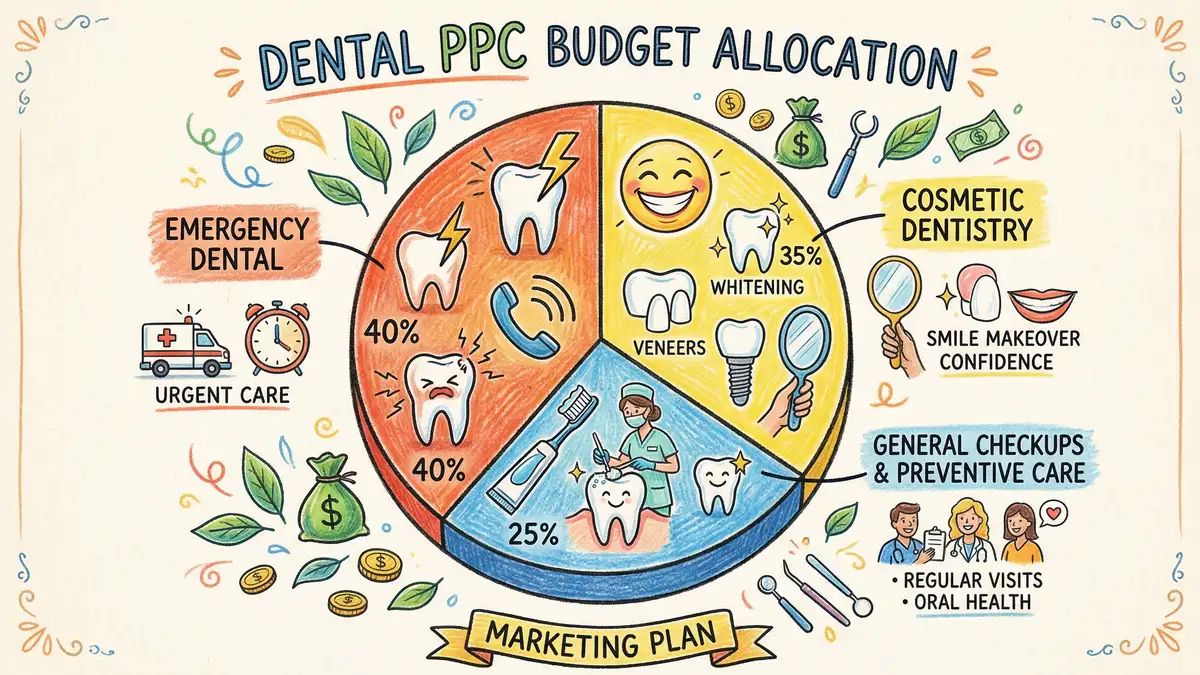
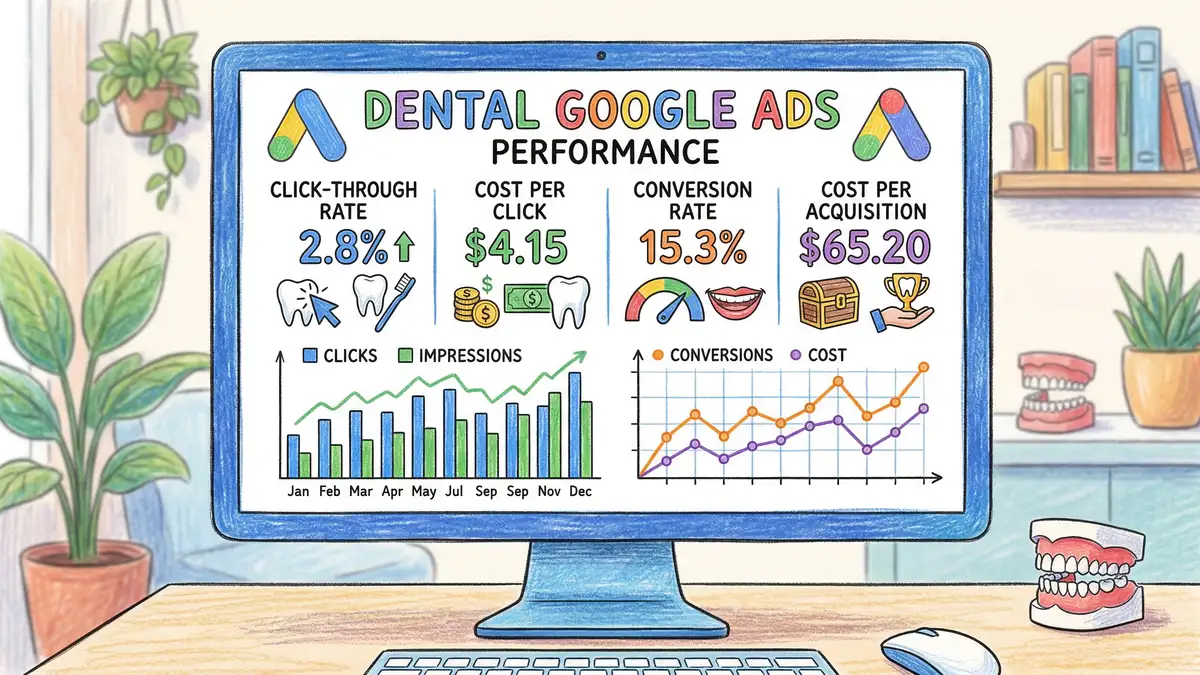
Budget allocation should match your practice capacity and growth targets. A solo practitioner spending £400-700 per month can expect 25-40 qualified enquiries, while a multi-surgery group investing £2,000-3,500 generates 250-350 enquiries with better cost efficiency. The key metric is cost per acquisition (CPA): well-optimised dental campaigns achieve a CPA of £8-15 per lead, with a target return on ad spend of 3:1 to 5:1.
How Should You Structure Google Ads Campaigns for a Dental Practice?
The biggest mistake dental practices make is running a single campaign targeting all services. Effective dental PPC requires separate campaigns segmented by treatment type, each with its own budget, keywords, ad copy, and dedicated landing page.
Emergency Dentistry Campaign
Highest conversion intent (10-14% CR). Use exact and phrase match for "emergency dentist near me," "dentist open now," and "urgent dental care." Allocate 25% of total budget. Landing page must emphasise same-day availability and prominent phone number.
High-Value Treatment Campaigns
Separate campaigns for implants, Invisalign, and cosmetic dentistry. These have the highest revenue per conversion and justify premium CPCs. Allocate 40-50% of budget. Each treatment needs its own landing page with pricing transparency and trust signals.
General / NHS Services Campaign
Lower CPCs but higher volume. Use phrase match for "NHS dentist near me," "dental check-up [city]," and "new patient dentist." Allocate 20-25% of budget. These patients often convert to higher-value private treatments over time.
Brand Protection Campaign
Always bid on your own practice name using exact match. This prevents competitors from capturing patients searching specifically for you. Costs are minimal (£1-5 CPA) but essential. Allocate 5-10% of budget.
Key Takeaway
Quality Score directly impacts your costs. Dental practices with a Quality Score of 7-10 achieve 30-50% lower CPCs than practices scoring 4-6 on identical keywords. Quality Score improves when ad copy, keywords, and landing pages are tightly aligned — which is why campaign segmentation by treatment type is non-negotiable.
What Keywords Should Dentists Target in Google Ads?
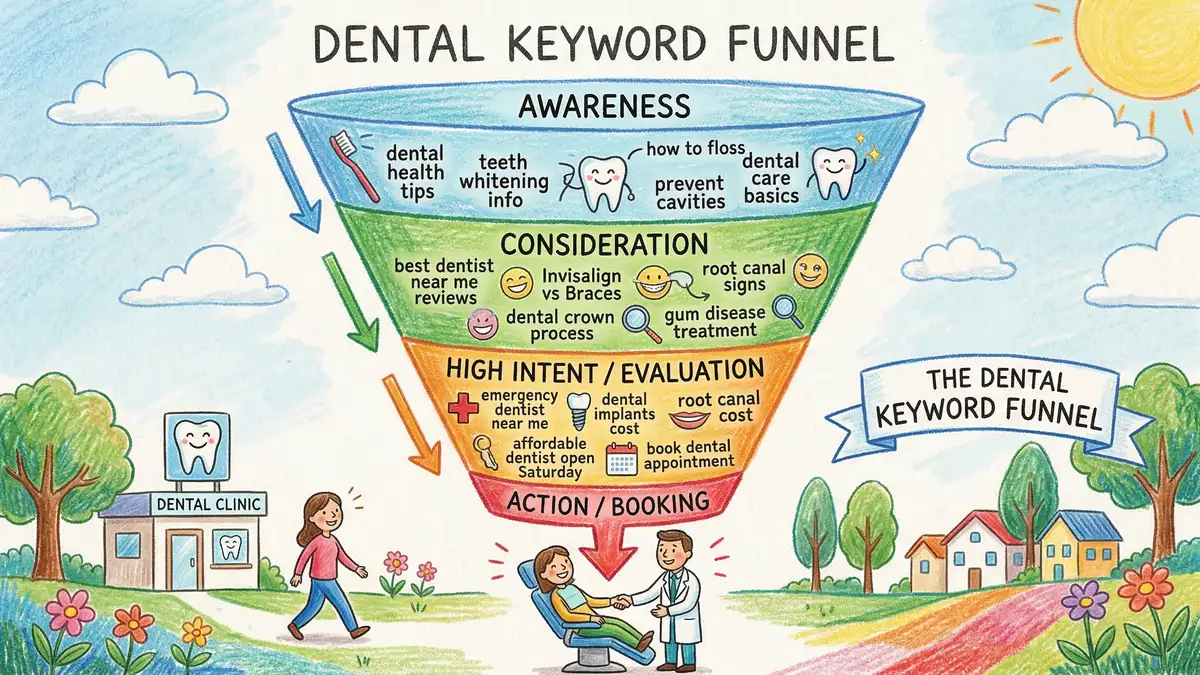
Keyword strategy determines whether your budget generates booked appointments or wasted clicks. The most effective approach is a tiered system based on conversion intent, with budget weighted heavily toward the highest-intent terms.
Tier 1 — Emergency (25% of budget): "Emergency dentist near me," "dentist open now," "urgent dental care." These convert at 10-14% because patients need immediate treatment. Use exact and phrase match only.
Tier 2 — Service-Specific (40-50% of budget): "Dental implants cost UK," "Invisalign near me," "cosmetic dentistry [city]." The sweet spot for ROI — high intent with strong revenue per conversion. Use exact and phrase match.
Tier 3 — Informational (20-25%): "How much do dental implants cost," "Invisalign vs braces." Lower conversion but builds awareness. Effective when paired with content-rich landing pages.
Negative Keywords: Where Most Dental Budgets Leak
Without proper negative keyword management, a significant portion of your budget is wasted on irrelevant searches. Every dental campaign needs negatives for job searches ("dental jobs," "dental nurse salary"), educational queries ("dental school," "dental courses"), DIY solutions ("how to brush teeth," "teeth cleaning at home"), and geographic exclusions for areas outside your service radius. Review your search terms report weekly during the first month, then fortnightly once campaigns stabilise.
Want to know if PPC is right for your practice?
We'll analyse your local competition and recommend the right mix of SEO and PPC for your growth targets.
What Makes a High-Converting Dental Landing Page?
Sending PPC traffic to your homepage is one of the most expensive mistakes in dental advertising. Every campaign needs a dedicated landing page matching the specific treatment the patient searched for. High-performing dental landing pages convert at 10-14%, while poorly designed pages drop below 3%.
| Element | Best Practice | Impact on CR | Priority |
|---|---|---|---|
| Headline Match | Mirror the search query exactly — "Emergency Dentist in Manchester" not "Welcome to Our Practice" | +15-25% | Critical |
| Form Simplicity | 3-5 fields maximum: name, phone, reason for visit | +20-40% | Critical |
| Trust Signals | GDC registration, CQC rating, 20+ patient reviews at 4.5+ stars | +15-30% | Critical |
| Phone Number | Bold, clickable (tel: link), sticky on mobile — 60%+ of leads call | +20-35% | Critical |
| Page Speed | Under 2 seconds on mobile — 40% of visitors leave after 3 seconds | +10-25% | High |
| Price Transparency | Show price ranges — "Implants from £1,200-£2,000" | +10-15% | High |
Track Phone Calls or Fly Blind
60-70% of dental enquiries arrive by phone, yet only 35% of practices implement call tracking. Without it, you're measuring less than half your conversions and making budget decisions on incomplete data.
Set up call tracking with a minimum 30-second duration threshold to filter out wrong numbers. Tools like CallRail or Google Ads Call Extensions integrate directly with your campaigns to attribute phone leads to specific keywords.
How Does Google Ads Compare to SEO for Dental Patient Acquisition?
This is the question every dental practice owner asks. The honest answer: the best practices use both, because PPC and local SEO serve fundamentally different purposes in your patient acquisition funnel.
Google Ads (PPC)
Speed: Immediate visibility from day one. Control: Precise budget, targeting, and scheduling. Cost: Pay per click — stops generating leads when you pause spending. Best for: New practices, launches, emergency services, high-value treatments, seasonal promotions, and testing which keywords convert before investing in SEO.
SEO (Organic Search)
Speed: 3-6 months to see meaningful results. Control: Less precise but broader reach. Cost: Investment compounds over time — generates leads indefinitely once ranking. Best for: Long-term sustainable growth, building brand authority, reducing dependence on paid channels, and dominating the Map Pack for ongoing patient acquisition.
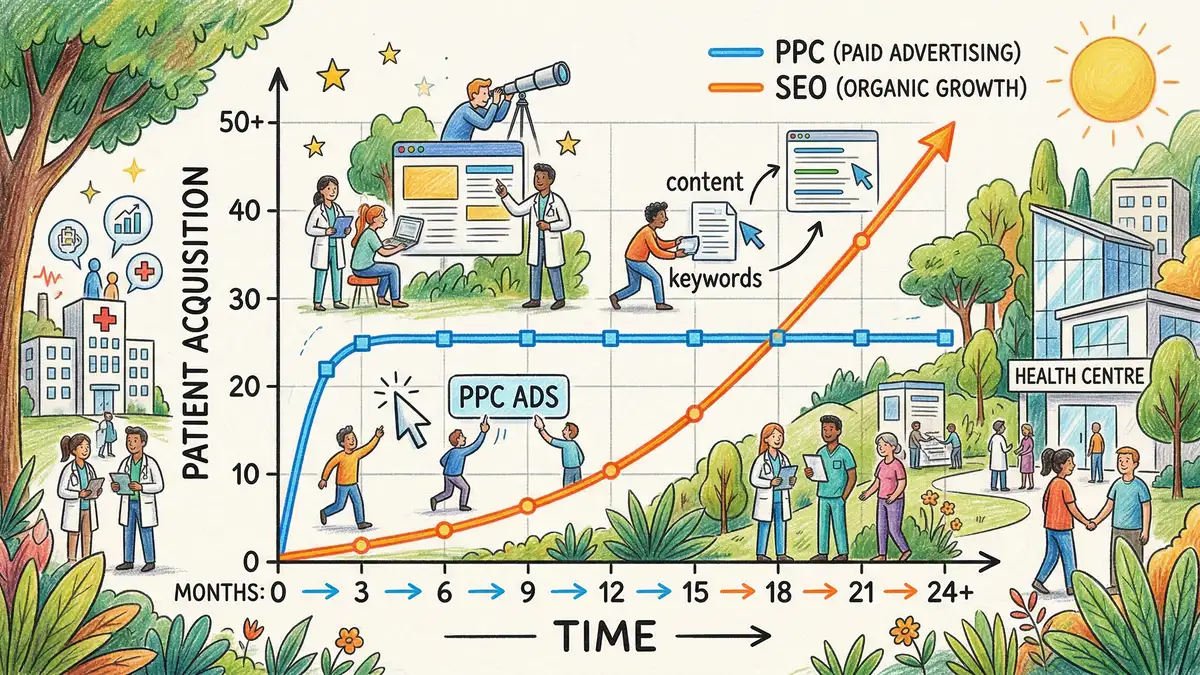
The smartest budget allocation for most dental practices follows this pattern: launch PPC immediately to generate patient flow and revenue, then invest a portion of that revenue into SEO. As organic rankings strengthen over 6-12 months, gradually reduce PPC spend on keywords where you now rank organically — while maintaining PPC for high-value treatments, emergency services, and any gaps in organic coverage.
Research shows that a blended PPC + SEO strategy outperforms either channel alone. PPC data reveals which keywords actually convert to appointments, informing your SEO content strategy. And strong organic rankings improve your Quality Score in Google Ads, reducing CPCs even on keywords where you're bidding.
What Ad Extensions Should Dental Practices Use?
Ad extensions increase your ad's visibility, click-through rate, and Quality Score at no additional cost per click. Every dental campaign should include these five essential extensions:
Call extensions — display your phone number directly in the ad. Since 60%+ of dental leads come by phone, this is non-negotiable. Set call scheduling to only show during staffed hours.
Location extensions — show your practice address and distance from the searcher. Links to Google Maps for driving directions. Essential for "near me" searches.
Sitelink extensions — add links to specific pages below your main ad: "Emergency Appointments," "Dental Implants," "Our Reviews," "Pricing." These increase CTR by 10-15% and improve Quality Score.
Callout extensions — highlight key differentiators: "Same-Day Appointments," "Open Weekends," "Free Consultation," "0% Finance Available."
Structured snippets — list your services: "Services: Implants, Invisalign, Whitening, Emergency Care, Cosmetic Dentistry."
What Are the GDC and ASA Compliance Rules for Dental Ads?
Running Google Ads for a dental practice in the UK carries specific regulatory obligations that don't apply to most other industries. Non-compliant ads risk both Google suspension and GDC regulatory action.
The General Dental Council's Standards of Practice require that all advertising — including PPC ad copy — is evidence-based, not misleading, and doesn't create unjustified treatment expectations. You cannot use before-and-after imagery in ads unless it meets strict criteria: realistic lighting, no misleading angles, documented patient consent, and substantiation that results are typical. Pricing claims must be transparent and verifiable. The design of your dental website and landing pages must also comply.
The Advertising Standards Authority (ASA) enforces the Committee of Advertising Practice Code, which applies to all paid advertising. Claims like "best dentist in [city]" require substantiation. Testimonials must be genuine and verifiable. Any health claims must be supported by evidence. The ASA can and does take enforcement action against non-compliant dental practices.
The Bottom Line
Always display your GDC registration number on landing pages. Avoid superlative claims ("best," "cheapest," "guaranteed") unless you can substantiate them. Show price ranges rather than fixed prices to avoid misleading patients. And never use before-and-after images in ad copy — save these for landing pages where you can provide full context and comply with GDC guidance.
Frequently Asked Questions
How much should a dental practice spend on Google Ads per month?
Budget depends on practice size and growth targets. A solo practitioner should start with £400-700/month, targeting 25-40 qualified enquiries. Small groups (2-4 dentists) typically invest £900-1,500/month for 80-120 enquiries. Medium groups (5-10 dentists) allocate £2,000-3,500/month. Start conservatively, track results for 90 days, and scale spend on campaigns delivering positive ROAS.
What's a good conversion rate for dental Google Ads?
The industry average is 5-8% for dental landing pages. Good performance is 9-12%, and excellent campaigns with highly optimised landing pages achieve 12-16%+. Emergency dentistry keywords typically convert highest (10-14%) because patients need immediate treatment. If your conversion rate is below 5%, your landing page likely needs improvement rather than your keyword strategy.
Should I use Performance Max campaigns for my dental practice?
Only if your campaigns generate more than 100 conversions per month — Performance Max needs sufficient training data to optimise effectively. For most dental practices, standard Search campaigns with manual CPC bidding deliver better ROI and more control. Performance Max risks spreading your budget across irrelevant placements (Display, YouTube) where dental conversion rates are much lower.
Are Local Service Ads available for UK dentists?
As of March 2026, Local Service Ads remain limited in UK dental availability. They're primarily active in the US and Australia, though Google has been testing the model with some UK dental practices. LSAs use a pay-per-lead model (rather than pay-per-click) and display a "Google Guaranteed" badge. Monitor Google's announcements for UK expansion — when available, LSAs typically deliver lower cost-per-lead than standard Search ads.
Can I bid on competitor dental practice names in Google Ads?
Yes — bidding on competitor brand names is legally permitted in the UK. However, you cannot use a competitor's name in your ad copy (only as a keyword). The strategy typically delivers lower conversion rates (2-4%) compared to non-branded keywords and can damage relationships in your local professional community. A conservative approach is to focus 95%+ of budget on non-branded, high-intent keywords and only consider competitor bidding if you have clear differentiators.
How do I track whether Google Ads is actually generating patients?
Implement three layers of tracking: Google Ads conversion tracking on your booking form submission, call tracking with a unique number per campaign (minimum 30-second duration threshold), and Google Analytics 4 integration to follow the patient journey from click to enquiry. Tag phone calls as "appointment booked," "information requested," or "wrong number" to calculate true cost per acquired patient, not just cost per click.
Need Help Building a Dental PPC Strategy That Delivers ROI?
We build integrated SEO and PPC strategies for dental practices across the UK. Whether you're starting from scratch or optimising existing campaigns, we'll help you get more patients for less spend.
Clwyd Probert
Founder & MD, Whitehat SEO
Clwyd has helped UK dental practices, healthcare providers, and professional services firms build sustainable growth through integrated SEO, PPC, and content strategies for over 15 years. He specialises in data-driven campaigns that deliver measurable patient acquisition. dental SEO services