
Technical SEO & Website Performance SEO audit services
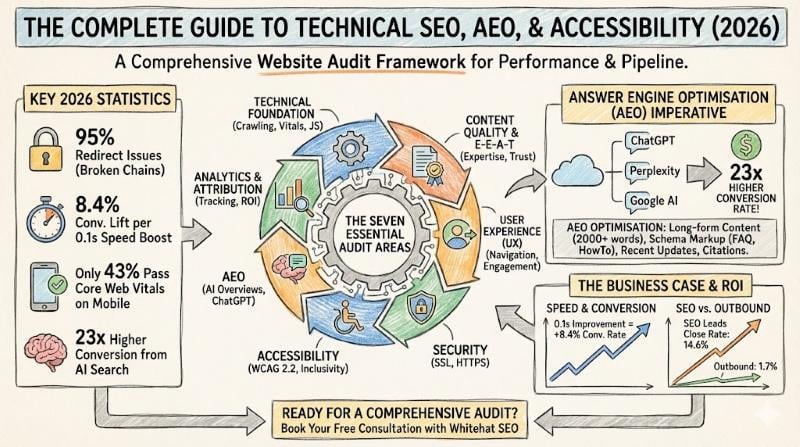
A comprehensive website audit in 2026 spans traditional technical elements plus emerging AI considerations. Whitehat SEO's audit methodology covers all seven areas to ensure nothing undermines your organic performance.
The Complete Guide to Technical SEO, AEO, and Accessibility
A comprehensive website audit in 2026 must cover technical SEO, Answer Engine Optimisation (AEO), and accessibility compliance—not just traditional ranking factors. Only 43% of websites pass all Core Web Vitals on mobile, AI answer engines now appear in 30% of search queries, and zero-click searches dominate over 60% of Google results. The ROI is clear: a 0.1-second improvement in page speed can boost conversions by 8.4%, while thorough audits consistently deliver 250-500% traffic improvements within 12 months.
Core Web Vitals: Current Thresholds and Pass Rates
Google's Core Web Vitals remain confirmed ranking factors, with INP (Interaction to Next Paint) replacing FID in March 2024 as the responsiveness metric. Understanding these thresholds is essential for any website audit conducted by Whitehat SEO or any competent technical SEO team.
| Metric | Good | Needs Improvement | Poor |
|---|---|---|---|
| LCP (Largest Contentful Paint) | ≤2.5s | 2.5–4.0s | >4.0s |
| INP (Interaction to Next Paint) | ≤200ms | 200–500ms | >500ms |
| CLS (Cumulative Layout Shift) | ≤0.1 | 0.1–0.25 | >0.25 |
According to the HTTP Archive Web Almanac 2024, individual metric pass rates reveal where sites struggle most: 59% achieve good LCP (the hardest metric to pass), 74% achieve good INP, and 79% achieve good CLS on mobile devices.
Counter-intuitively, the top 1,000 websites perform worse than average—only 40% pass Core Web Vitals on mobile—likely due to complex functionality and third-party scripts. WordPress sites have improved dramatically from approximately 28% in 2023 to a 46% mobile pass rate in 2024, reflecting core platform optimisations.
Google assesses Core Web Vitals using the 75th percentile of page loads from real Chrome users via the Chrome User Experience Report (CrUX). This means 75% of your site visits need to meet thresholds—not just average performance. As Google's John Mueller has clarified, there's no need to obsess over each fractional point, but meeting these benchmarks should be a baseline expectation for any business serious about organic performance.
Technical SEO Issues Remain Pervasive Across Most Websites
Whitehat SEO's analysis of client audits aligns with broader industry research. An Ahrefs study of 1,002,165 domains found technical issues are nearly universal. The most common problems affecting rankings and user experience include:
- 95.2% have 3XX redirects present (often benign, but redirect chains can be problematic)
- 80.4% have missing image alt attributes (accessibility and image SEO impact)
- 72.9% have missing or empty meta descriptions
- 72.3% have slow page speeds exceeding best-practice thresholds
- 59.5% have missing or empty H1 tags
- 51.3% have multiple H1 tags (less critical in HTML5, but can indicate poor structure)
Link rot presents a significant challenge for established websites. A Pew Research study from 2024 found that 25% of pages from 2013–2023 became inaccessible by late 2023, with 21% of government pages and 23% of news pages containing at least one broken link. Separately, Ahrefs found 66.5% of links created in the past nine years are now dead.
Page speed benchmarks reveal considerable room for improvement. Only 42% of mobile sites achieve good Time to First Byte (under 800ms)—a figure that hasn't improved since 2020. The median mobile Total Blocking Time sits at 1,209 milliseconds, six times the 200ms best-practice target. For B2B companies running SEO services or relying on organic traffic, these technical fundamentals directly impact pipeline.
The Seven Essential Areas of a 2026 Website Audit
1. Technical SEO Foundation
Crawlability via robots.txt and XML sitemaps, indexation status in Google Search Console, Core Web Vitals optimisation, mobile-first design (with 62.54% of organic search traffic now from mobile), HTTPS implementation, canonical tags, and structured data validation. JavaScript rendering deserves particular attention—33% of SEOs don't feel comfortable investigating JS-based issues, yet nearly two-thirds of professional crawls now use JavaScript rendering.
2. Content Quality and E-E-A-T Signals
Content auditing prioritises E-E-A-T signals (Experience, Expertise, Authoritativeness, Trustworthiness), with Google's addition of "Experience" emphasising firsthand expertise. Key checks include thin content detection, duplicate content via algorithmic analysis, title tags (50–60 characters), meta descriptions (150–160 characters with CTAs), and proper heading hierarchy. For businesses working with HubSpot onboarding, content structure directly impacts how effectively your CRM can track content performance.
3. User Experience (UX) Auditing
Navigation depth (key pages reachable within three clicks), engagement metrics, form optimisation, pop-up compliance, and custom 404 pages. UX issues don't just frustrate visitors—they send signals to search engines about content quality and relevance.
4. Security Auditing
SSL certificate verification, mixed content warnings, and reviewing Google Search Console for manual actions and security issues. HTTPS adoption now exceeds 96% of Chrome page loads, making it effectively mandatory for any business expecting to rank.
5. Accessibility Auditing
WCAG 2.2 Level AA compliance is required for UK public sector organisations, and WCAG 2.1 AA is best practice for private sector under the Equality Act 2010. The WebAIM Million 2025 study found an average of 51 accessibility errors per homepage, with 79.1% suffering from low-contrast text issues. With one in five UK residents having a long-term disability, accessibility affects both compliance and market reach.
6. Answer Engine Optimisation (AEO)
This emerging audit category examines how well your content is structured for AI answer engines like ChatGPT, Google AI Overviews, Perplexity, and Claude. Whitehat SEO's Answer Engine Optimisation service addresses this critical new dimension of visibility. We cover AEO in detail below.
7. Analytics and Attribution
Verifying tracking implementation, conversion goal configuration, and attribution model accuracy. For businesses using HubSpot's marketing platform, this includes ensuring proper CRM integration so every organic visit can be traced through to revenue.
Answer Engine Optimisation: The New Audit Imperative
The rise of AI answer engines—Google AI Overviews, ChatGPT, Perplexity, Microsoft Copilot—has created an entirely new audit dimension that most businesses haven't yet addressed. SparkToro reports organic link clicks dropped approximately 4% from March 2024 to March 2025, while zero-click searches rose approximately 3%.
Gartner forecasts 25% of organic search traffic will shift to AI chatbots by 2026. But here's the critical insight for B2B companies: Ahrefs data shows visitors from AI search drove 12.1% of signups despite representing only 0.5% of traffic—a 23× higher conversion rate than traditional organic. These visitors arrive pre-qualified, having already received an AI endorsement of your business.
AI Overviews now appear for approximately 30% of US desktop keywords as of September 2025. Research from seoClarity shows they reduce click-through rates significantly, but 97% cite at least one source from the top 20 organic results, with 75% of citations from positions 1–12. Pages ranking in position one have a 33% chance of appearing in AI Overviews versus just 13% at position ten.
What Whitehat's AEO Audit Examines
AI Crawler Access: Your robots.txt configuration determines whether AI platforms can index your content. Key crawlers include GPTBot (OpenAI training), OAI-SearchBot (ChatGPT search results), ChatGPT-User (live queries), Google-Extended, ClaudeBot, and PerplexityBot. Currently, 21% of top 1,000 websites block GPTBot, making it the second-most-blocked crawler. Blocking GPTBot prevents training inclusion, while blocking OAI-SearchBot prevents ChatGPT search visibility.
Content Structure for AI Citation: Research shows long-form content (2,000+ words) gets cited three times more than shorter content, 76.4% of ChatGPT's most-cited pages were updated within 30 days, and statistics receive 40% higher citation rates than qualitative statements. Schema markup—particularly FAQPage, HowTo, Product, Organisation, and Review types—provides explicit entity relationships AI systems can confidently extract.
Platform Citation Patterns: ChatGPT (which switched from Bing to Google in July 2025) draws 27% of citations from Wikipedia and favours news outlets like Reuters. Perplexity over-indexes on Reddit (3.4% higher than expected) and YouTube (9.5% of citations). Only 12% of sources overlap across ChatGPT, Perplexity, and Google AI features—suggesting platform-specific optimisation may be necessary for comprehensive visibility.
UK B2B Website Audit Requirements
UK B2B organisations face specific compliance and optimisation requirements that generic audits often miss.
Accessibility Compliance
The Equality Act 2010 requires "reasonable adjustments" for private sector websites, with WCAG 2.1 AA as the accepted best practice. The Public Sector Bodies Accessibility Regulations 2018 mandate WCAG 2.2 AA compliance plus published accessibility statements. The European Accessibility Act came into force in June 2025—while not directly applicable post-Brexit, UK businesses selling into the EU must comply.
UK GDPR and Cookie Compliance
Cookie consent requires prior, explicit opt-in before setting non-essential cookies, with equal prominence for accept/reject options. The ICO's January 2025 review found 134 of the top 200 UK websites failed cookie compliance. The Data (Use and Access) Act 2025 introduced new exceptions for first-party analytics with easy opt-out. Non-compliance penalties reach £17.5 million or 4% of global turnover.
B2B Buyer Journey Considerations
B2B audit priorities differ from B2C. The 2025 UK Buyer Experience Study (MarketOne/6sense, 754 UK buyers) found UK B2B buyers control 57% of the journey before vendor contact, with an average of 16 interactions per person with the winning vendor. Content audits should prioritise case studies (rated most effective by 69% of B2B marketers), whitepapers, and content serving multiple stakeholder personas—the average B2B buying group includes 8.2 stakeholders. Lead generation benchmarks show B2B conversion rates averaging 2.9% overall, with forms containing fewer than five fields converting 35–45% better than longer forms.
The ROI of Comprehensive Website Audits
The business case for thorough website audits is supported by rigorous research. The Google/Deloitte "Milliseconds Make Millions" study analysed 37 brands across 30 million sessions with statistically significant methodology at 95% confidence.
Results showed a 0.1-second speed improvement increased conversion rates by 8.4% for retail and 10.1% for travel, with average order value rising 9.2% for retail. Speed impacts extend to user behaviour: bounce probability increases 32% as load time rises from one to three seconds, and 90% from one to five seconds. Blue Triangle research found product pages with two-second LCP had 40–50% higher conversion rates than pages with four to five second LCP.
| Industry | SEO ROI (1–3 Years) |
|---|---|
| Real Estate | 1,389% |
| Financial Services | 1,031% |
| B2B SaaS | 702% |
Source: FirstPageSage industry research
Case studies from major agencies consistently show dramatic improvements: Vodafone achieved 31% better LCP resulting in 8% sales increase and 10% organic traffic growth; Yahoo! Japan improved CLS from 0.14 to 0.05, driving 15.1% more page views per session and 13.3% longer sessions. SEO leads close at 14.6% compared to 1.7% for outbound marketing—an 8.5× improvement in conversion efficiency.
How Often Should You Audit Your Website?
Expert consensus recommends the following audit cadence:
- Quarterly comprehensive audits for most business websites
- Monthly deep dives for high-traffic or e-commerce sites
- Weekly quick checks via Google Search Console and automated monitoring
- Immediate audits following algorithm updates, site migrations, or traffic drops exceeding 20%
Whitehat SEO's website audit service provides comprehensive analysis across all seven audit areas, with clear prioritisation and actionable recommendations that connect technical findings to business outcomes.
Frequently Asked Questions
How much does a website audit cost in the UK?
Website audit costs vary depending on site size and complexity. Basic automated audits typically start at £500, while comprehensive audits with detailed recommendations range from £1,500 to £5,000. Enterprise-level websites with complex architectures may require more extensive auditing, costing £10,000 or more. Whitehat SEO provides free initial consultations to assess specific needs and provide custom quotes.
How long does a thorough website audit take to complete?
A thorough website audit typically takes two to four weeks to complete. This includes initial crawling and data collection (three to five days), technical analysis (five to seven days), content and UX review (three to five days), and report compilation with recommendations (three to five days). Larger websites or those with complex technical issues may require additional time.
What's the difference between a technical SEO audit and a website audit?
A technical SEO audit focuses specifically on factors affecting search engine crawling and indexing—site architecture, page speed, mobile-friendliness, and indexation issues. A comprehensive website audit is broader, encompassing technical SEO plus content quality, user experience, accessibility compliance, security, AEO readiness, and analytics accuracy. For most B2B businesses, the comprehensive approach delivers better ROI.
Should I block AI crawlers from my website?
For most B2B businesses, blocking AI crawlers is a mistake. AI search traffic converts at 23× higher rates than traditional organic, and visibility in AI responses builds brand authority with buyers researching solutions. The exception is if you have proprietary content you don't want used for AI training—in which case, you can block GPTBot and ClaudeBot while allowing OAI-SearchBot for ChatGPT search visibility.
How quickly will I see results from fixing audit findings?
Timeline varies by issue type. Technical fixes like broken links and redirect chains can show improvements within days of Google's next crawl. Core Web Vitals improvements typically take two to four weeks to reflect in field data. Content optimisation and AEO improvements usually show measurable results within three to six months. Whitehat SEO's audit reports prioritise quick wins alongside strategic improvements for balanced short and long-term gains.
Ready to Audit Your Website for 2025?
Website audits in 2025 have expanded beyond technical checklists into strategic assessments of multi-platform visibility. The 43% mobile Core Web Vitals pass rate represents significant opportunity for sites willing to invest in optimisation. The emergence of AEO as a distinct discipline—with 23× higher conversion rates from AI search traffic—demands immediate attention.
Whitehat SEO's comprehensive audit service covers all seven critical areas, with clear prioritisation that connects technical findings to business outcomes. We don't just identify problems—we tell you which ones matter most for your pipeline and how to fix them.
Book Your Free Consultation →References & Sources
- HTTP Archive Web Almanac 2024: Performance
- Google Web.dev: Core Web Vitals Best Practices
- Ahrefs: Technical SEO Study of 1 Million+ Domains
- WebAIM Million 2025: Accessibility Analysis
- Google/Deloitte: Milliseconds Make Millions Study
- Google Search Central: Core Web Vitals Documentation
- ICO: Cookie Compliance Guidance