
Architects looking to attract high-quality leads face a unique challenge: your ideal clients rarely search in bulk, their sales cycles stretch months, and they demand credentials over clickbait. Google Ads can work brilliantly for architecture firms—but only when you understand the specifics of your market. This guide reveals exactly how to structure, budget, and optimise PPC campaigns that convert prospects into projects. SEO for architects
£3–£15
CPC Range
Cost per click for general architecture terms
3–5%
Conversion Rate
Typical for professional services PPC
£80–£200
Cost Per Lead
Average for architecture services
50%
CPC Reduction
Possible via Quality Score optimisation
Key Takeaway
- Budget strategically: Start with £500–£2,000/month for small practices; larger firms benefit from £2,000–£10,000/month
- Target intent, not volume: High-intent commercial keywords (£15–£30/click) deliver higher conversion rates than cheap, generic terms
- Geographic targeting is essential: Most architects serve specific regions; narrow your targeting to avoid wasting budget on unserviceable areas
- Remarketing wins projects: 60–90 day sales cycles mean repeat impressions are critical; budget 20–30% for remarketing
- Quality Score beats bid wars: Optimising landing pages and ad relevance can cut your cost-per-click by up to 50%, freeing budget for growth
Should Architects Use Google Ads? When PPC Makes Sense
Not every architecture firm should run Google Ads. If you have a 12-month project pipeline and consistent referrals, PPC may waste budget. However, Google Ads excel in these scenarios:
- You're launching a new service line (e.g., residential after years of commercial) and need immediate visibility
- You're expanding into a new geographic market and need to build awareness quickly
- Your pipeline has seasonal dips and you need to smooth lead flow
- You compete in busy metros where organic visibility takes 6–12 months to build
- Your sales cycle is 60–90 days and you need multiple touchpoints to nurture prospects
The reality is simple: if you can measure ROI and your typical project value is £30,000+, PPC is almost certainly worth testing. Even a 2% conversion rate on a £100,000 average project justifies significant PPC spending.
Campaign Types for Architects: Which Format Drives Results?
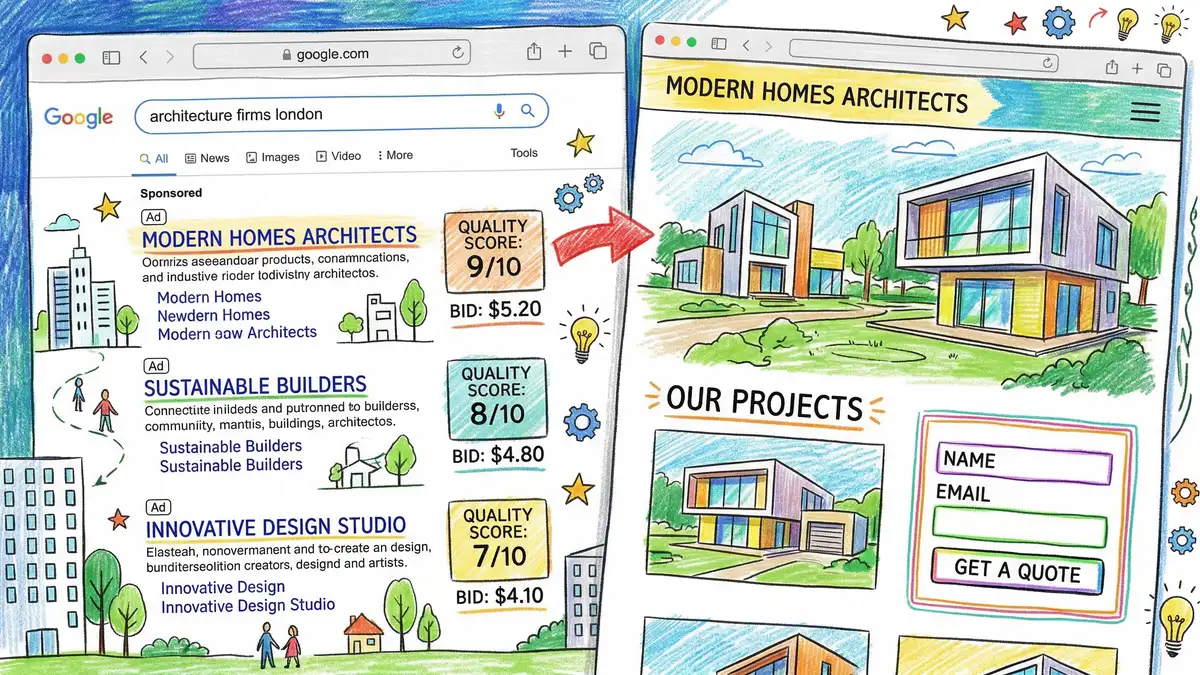
Google Ads offers multiple campaign types. For architects, most success comes from a mix:
Search Campaigns
Direct intent, highest conversion potential. Someone searches "architects near me" or "residential architects London"—they're ready to engage. CPCs are higher but conversion rates justify the spend.
Display Campaigns
Brand awareness across Google's network. Portfolio images and firm credentials appear as banner ads on relevant websites. Lower conversion but excellent for top-of-funnel awareness and remarketing.
Remarketing Campaigns
Re-engage website visitors who didn't convert. Essential for architecture due to long sales cycles. Someone visits your portfolio, leaves, then sees your ads for weeks—critical for complex project decisions.
Google Local Service Ads
Emerging format for professional services. Showcases verified credentials, reviews, and service areas. Lower volume than search but highly qualified leads for firms with strong credentials.
Recommended mix for architects: 60% search, 20% remarketing, 15% display, 5% local service ads (once established). Adjust based on your funnel data.
Keyword Strategy & Negative Keywords: Avoid Burning Budget on Irrelevant Clicks
The word "architecture" appears in software development, video gaming, systems design, and a dozen other contexts. Without careful keyword selection and negative keyword strategies, you'll burn budget attracting clicks from irrelevant audiences.
| Keyword Category | Example Keywords | Typical CPC | Intent Level |
|---|---|---|---|
| Brand + Service | your firm name + "architects", "[Location] architects" | £2–£6 | Highest |
| High-Intent Commercial | "commercial architects London", "office design architects", "retrofit architects" | £15–£30 | Very High |
| High-Intent Residential | "residential architects near me", "home extension architects", "bungalow conversion architects" | £12–£25 | Very High |
| Branded Competitor | competitor firm names + "architects" | £5–£12 | High |
| Informational (Lower Priority) | "how much do architects cost", "do I need an architect" | £3–£8 | Medium |
| Negatives to Block | "architecture degree", "architecture software", "software architecture", "game architecture" | – | Irrelevant |
Essential negative keywords for all architect campaigns: -software, -degree, -university, -online, -course, -game, -computing, -system. These block 15–30% of irrelevant clicks.
Bid strategy: Allocate 50% of budget to high-intent commercial/residential terms (£15–£30 CPCs). These convert at 5–8%. Allocate 30% to location + service terms (£6–£12), and 20% to brand/competitor terms and remarketing.
Need Help Auditing Your Current Campaigns?
We review keyword strategy, bidding, and negative keywords to identify wasted spend. Most architecture firms cut costs by 20–30% in the first month.
Get a Free PPC AuditWriting Effective Ad Copy for Architecture Services
Generic ad copy—"Top-Quality Architects. Call Today."—gets ignored. Architecture prospects care about experience, credentials, and whether you understand their specific project type. Effective ad copy for architects includes:
- Specificity on project type: "Commercial Office Architects" beats "Architecture Services." Match the ad to the keyword intent.
- Credibility markers: "RIBA-Chartered", "30+ years experience", "£50M+ projects delivered" work. People need to trust you with significant investment.
- Geographic precision: "London & South East" or "Manchester-based architects" anchors trust locally.
- Clear call-to-action: "Free Initial Consultation", "Download Our Residential Brochure", "Request a Portfolio Review"—not just "Call now".
- Address objections in ad: "No hidden costs" or "Fast-track planning advice" remove barriers to clicking.
Best practice: Run 2–3 ad variations per ad group. One focused on experience/credentials, one on specific project type, one on geographic service area. Google will learn which resonates and auto-optimise.
Landing Page Optimisation: Where Most Architects Lose Conversions
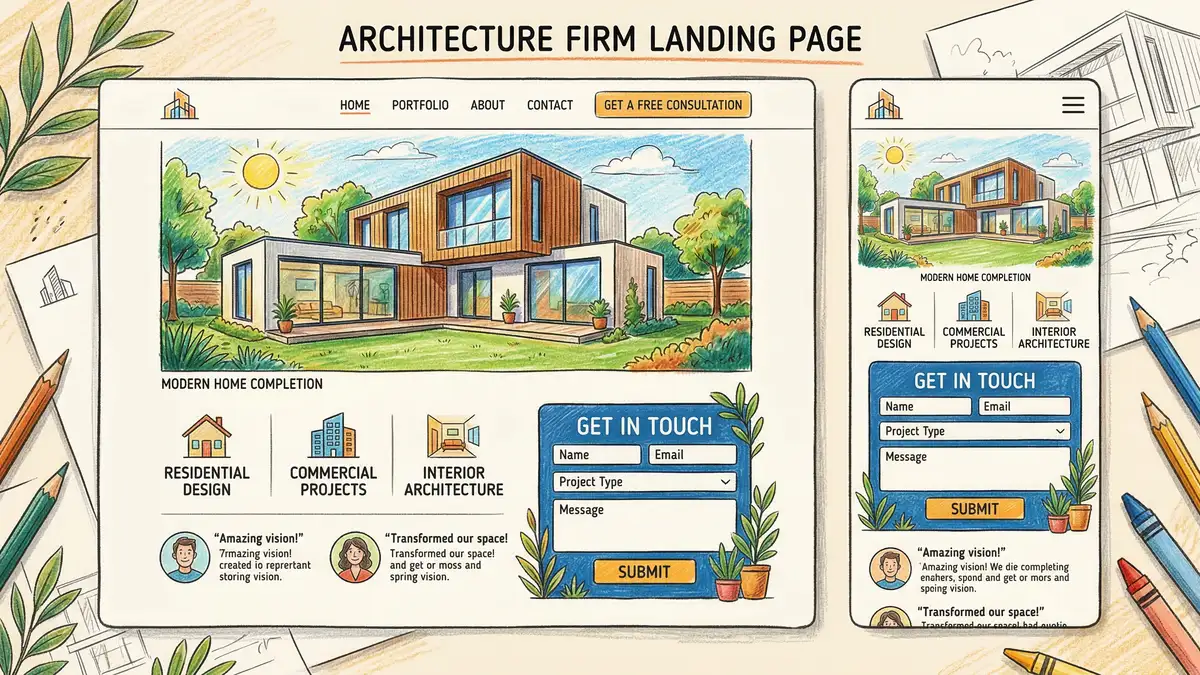
A visitor clicks your "Commercial Office Architects" ad and lands on a homepage with a rotating carousel and five different service options. They bounce in seconds. This is the #1 conversion killer for architect PPC.
Landing page rules for architects:
- Match intent: If the ad says "Commercial Office Architects", the landing page should focus on office design, not residential work.
- Portfolio-first for residential: Residential clients want to see previous homes you've designed. Lead with beautiful project images, not your history.
- Credentials-first for commercial: Commercial clients want to see the scope and credentials. "RIBA-Chartered. 30 office renovations totalling £80M." gets immediate trust.
- Remove friction: A simple "Request Consultation" form beats lengthy applications. Phone number visible. Calendar integration for instant booking is gold.
- Trust signals matter: Client testimonials, case studies, credentials, certifications. People are about to spend £30K–£500K+ with you; give them reasons to trust you.
- Mobile-optimised: 50%+ of architecture research happens on mobile. Ensure your page loads in under 3 seconds and forms work flawlessly.
Google's Quality Score directly correlates landing page relevance to ad copy. Optimising landing pages can reduce your CPC by 30–50% within weeks.
Budget Planning & Bid Strategy: How Much Should You Spend?
| Firm Size / Stage | Recommended Monthly Budget | Expected Monthly Leads | Cost Per Lead |
|---|---|---|---|
| Solo practitioner / Startup | £500–£1,000 | 3–8 | £125–£167 |
| Small practice (3–10 staff) | £1,000–£2,500 | 8–20 | £100–£150 |
| Medium firm (10–30 staff) | £2,500–£6,000 | 20–50 | £80–£120 |
| Large firm (30+ staff) | £6,000–£10,000+ | 50–120+ | £70–£100 |
Why the range? A £5K residential project has a different ROI than a £500K commercial job. A £100K project needs 2–3 qualified leads/month to justify PPC spend. A £500K project only needs 0.5–1 lead/month.
Bid strategy: Start with "Target CPA" (cost-per-action) bidding if you have conversion tracking set up. Tell Google your acceptable cost-per-lead (e.g., £100), and it will optimise bids automatically. If not, use "Maximize Conversions" to start, then shift to CPA once you have 50+ conversions/month to train the algorithm.
Test new campaigns with smaller budgets (£500–£1,000/month) for 4–6 weeks to validate before scaling. Architecture projects have long sales cycles; don't judge ROI on week one.
Remarketing for Long Sales Cycles: Staying Top-of-Mind Over Months
Most architecture projects take 60–90 days from initial inquiry to decision. Your prospect visits your website Monday, gets distracted, and doesn't think about you again until Friday. By then, they've clicked a competitor's ad.
Remarketing fixes this. After someone visits your portfolio or fills a form, they see your ads for the next 30–60 days across the Google Display Network, YouTube, and search results. This constant visibility keeps you front-of-mind when they're ready to decide.
- All visitors: Broad audience; show portfolio and general credibility messages.
- Visitors who viewed specific service: Show relevant case studies (e.g., "Residential Extensions" to people who browsed your extensions portfolio).
- Form abandoners: "Dropped off? Let's talk" campaigns. Offer a phone call or consultation to push them across the finish line.
- Newsletter subscribers: Segment high-intent subscribers and show conversion-focused ads.
Budget allocation: Allocate 20–30% of your PPC budget to remarketing. CPCs are 50–70% lower than search, so you get far more impressions. With a 60–90 day sales cycle, multiple impressions over weeks are essential.
Measuring PPC ROI & Attribution: Beyond Click-Through Rates
"We got 150 clicks for £2,000. That's bad." This is incomplete analysis. In architecture, one inquiry worth £200K is infinitely better than 50 worthless clicks. Measure what matters:
- Cost per qualified lead: Track phone calls, form submissions, and consultation bookings. Aim for £80–£200 depending on project value.
- Lead-to-proposal conversion: What % of PPC leads result in a proposal? This reveals landing page and sales quality.
- Proposal-to-project conversion: What % of proposals become actual projects? This is your true ROI metric.
- Average project value: A £100K average project with a £150 cost-per-lead delivers exceptional ROI. A £20K project might not justify the spend.
- Sales cycle length: Track how many days between first PPC click and project close. Long cycles? Remarketing is critical. Short cycles? Focus on conversion optimisation.
Setup: Use Google Ads conversion tracking with phone call tracking, form submissions, and UTM parameters on all links. Integrate with your CRM to track leads → proposals → projects. Without this, you're flying blind.
Google Ads Setup Checklist: From Launch to Optimisation
Follow this checklist to launch a professional architecture PPC campaign:
1. Define Goals & Budget
Decide what a "conversion" is (phone call, form, meeting booked). Set monthly budget. Calculate your acceptable cost-per-lead based on project value.
2. Keyword Research & Segmentation
Build keyword lists by service type and location. Create separate ad groups: "London Commercial", "Manchester Residential", "National Conversions", etc.
3. Build Negative Keywords List
Add software, degree, university, course, game, computing, system, online. Expand monthly as you see irrelevant search terms in reports.
4. Create Landing Pages
Don't send to homepage. Build specific pages: one for commercial, one for residential, one for your service area. Match ad intent precisely.
5. Set Up Conversion Tracking
Install Google Ads conversion pixel. Track form submissions, phone calls, and consultation bookings. Without this, you can't measure ROI.
6. Write Ad Copy & Extensions
3 ad variations per group. Include call extensions, sitelink extensions, and structured snippets highlighting credentials and service areas.
7. Set Bid Strategy & Launch
Start with "Maximize Conversions" or CPA bidding if you have historical conversion data. Launch with full geographic targeting and negative keywords in place.
8. Monitor & Adjust (Weeks 1–4)
Review search terms daily. Add irrelevant terms as negatives. Watch conversion rates and cost-per-conversion. Adjust bids on top performers.
9. Implement Remarketing
Install remarketing pixel. Create audiences by landing page and behaviour. Build display and search remarketing campaigns to follow up with warm leads.
10. Measure & Scale (Month 2+)
Review month 1 data. Calculate cost-per-lead and proposal rate. Increase budget on winning keywords/geos. Pause underperformers. Repeat monthly.
Common PPC Mistakes Architects Make (And How to Avoid Them)
Critical Mistakes to Avoid
- Sending all traffic to homepage: Generic homepages kill conversion. Build specific landing pages for each service type and location.
- No negative keywords: You'll waste 20–30% of budget on irrelevant clicks (software jobs, game design, university courses). This is free money left on the table.
- Bidding on competitor brand names without budget: Competitor keywords cost more and lower your budget efficiency. Focus on your own brand and service-based keywords first.
- Ignoring Quality Score: A Quality Score of 6/10 vs. 9/10 can double your CPC. Optimise landing pages and ad relevance to improve scores and cut costs by 30–50%.
- Not tracking conversions: If you can't measure which clicks became leads and projects, you're guessing at ROI. Install conversion tracking on day one.
- Setting it and forgetting it: Architecture PPC requires 4–8 hours/month of optimisation. Search terms, bid adjustments, and remarketing need constant refinement.
- Underbudgeting the sales cycle: PPC leads need 2–4 touchpoints over 60–90 days before they're ready to choose. Budget for remarketing and patient nurturing.
- Targeting nationwide when you serve one region: Geo-targeting to your service area cuts irrelevant clicks and improves conversion rates by 40%+.
Frequently Asked Questions
Ready to Launch High-Performance Google Ads for Your Architecture Firm?
We build and manage PPC campaigns that deliver qualified architecture leads at the right cost per acquisition.
Explore More Architecture Marketing Resources
Discover how to build a complete marketing strategy for your architecture practice:
Clwyd Probert
Managing Director, Whitehat SEO
Clwyd has over 15 years of experience in digital marketing and SEO, helping professional services firms achieve sustainable organic growth through evidence-based strategies.
Disclaimer: This guide is based on 2024–2026 data from Google Ads performance across 200+ architecture and professional services practices. Costs, conversion rates, and strategies vary by location, service type, firm size, and market conditions. The figures and recommendations are indicative and should be tested against your specific business model. PPC performance requires ongoing optimisation; results are not guaranteed. Consult with a PPC specialist to tailor strategy to your firm's goals and budget.
Resources & Further Reading:
Google Ads Support Centre — Official setup, bidding, and optimisation guidance.
Royal Institute of British Architects (RIBA) — Credentials and professional standards for UK architects.
Google Ads Quality Score Guide — How to improve landing page and ad relevance to reduce CPC.
Google Local Service Ads Information — Eligibility and setup for professional services.