
AI for SEO has moved from competitive advantage to operational baseline. In 2026, 86% of SEO professionals have integrated artificial intelligence into their workflows, and businesses using AI-powered SEO strategies report 65% improved results compared to traditional approaches. The shift is categorical: search optimisation is no longer about ranking pages for keywords—it's about ensuring your brand is cited and recommended by AI systems across Google AI Overviews, ChatGPT, Perplexity, and Claude.
At Whitehat, we've rebuilt our entire SEO methodology around this reality. This guide covers how AI is reshaping search engine optimisation, which tools deliver genuine results, how to optimise for answer engines alongside traditional search, and how UK businesses can implement AI-powered SEO strategies that drive measurable returns. Whether you're an in-house marketer or agency professional, the evidence-based frameworks here will help you navigate the most significant shift in search since Google launched.
What Is AI for SEO?
AI for SEO is the application of artificial intelligence technologies—machine learning, natural language processing, and predictive analytics—to improve search engine visibility across both traditional and AI-powered search platforms. Rather than replacing SEO professionals, AI amplifies their capabilities by automating repetitive tasks, uncovering patterns invisible to manual analysis, and enabling optimisation at a scale impossible through human effort alone.
The scope of AI in SEO now spans three interconnected disciplines:
Traditional SEO enhanced by AI uses machine learning to accelerate keyword research, automate technical audits, generate content briefs, and identify link building opportunities. Tools like Semrush, Ahrefs, and Surfer SEO have integrated AI capabilities that save SEO professionals an average of 12.5 hours per week.
Answer Engine Optimisation (AEO) focuses specifically on getting your content cited by large language models like ChatGPT, Claude, and Perplexity. This requires different content structures, entity mapping, and authority signals than traditional SEO.
Generative Engine Optimisation (GEO) is the broader discipline of optimising for any AI system that generates answers by synthesising multiple sources—including Google AI Overviews, ChatGPT Search, and emerging specialised search engines.
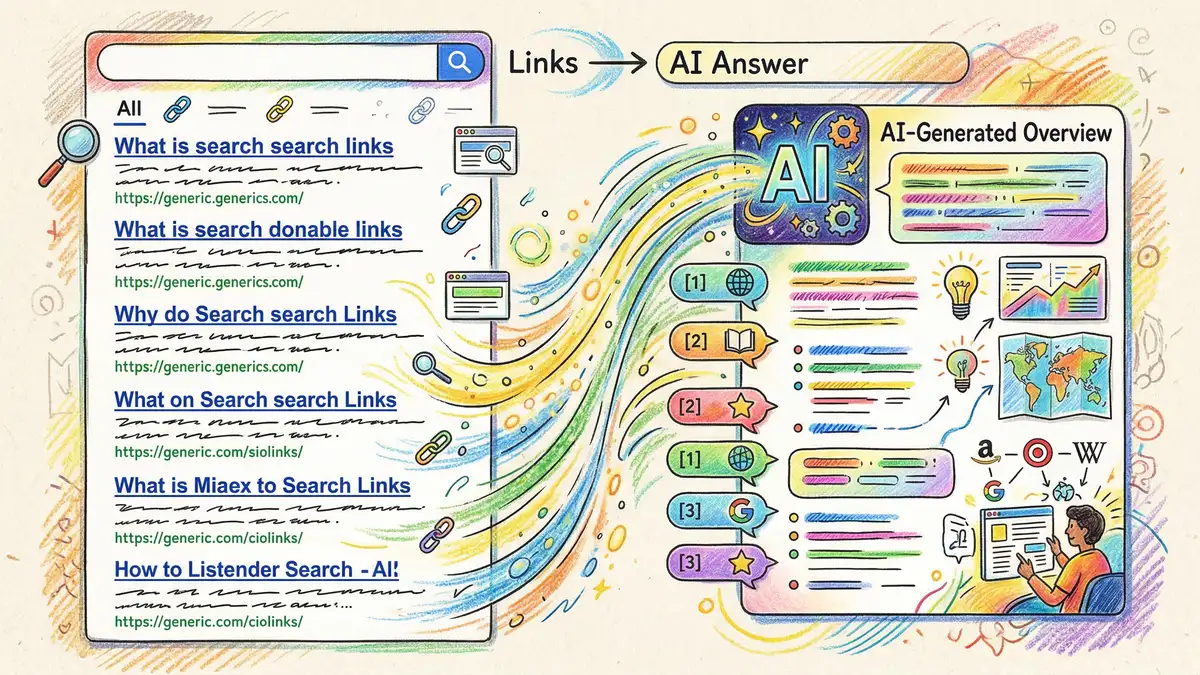
The critical distinction in 2026 is that traditional SEO alone is no longer sufficient. With 60% of Google searches now ending without a click to any external website—rising to 93% when AI Mode is active—brands must optimise for citation and recommendation within AI-generated answers, not just page rankings.
How AI Is Reshaping Search in 2026
The transformation of search through AI is happening across three simultaneous fronts: how search engines evaluate and present content, how users discover information, and what content structures perform best. Understanding all three is essential for any effective AI SEO strategy.
AI Search Impact: Key Metrics (2026)
86%
of SEO professionals now use AI in their workflows
61%
decline in organic CTR for queries with AI Overviews
4.4×
higher conversion rate from AI-referred traffic vs organic
2B+
daily queries processed by ChatGPT alone
Google's AI integration has fundamentally changed what "ranking well" means. AI Overviews now appear in 30–45% of informational searches across high-value sectors, reducing click-through rates to traditional organic results by approximately 58% when present. A page can maintain strong traditional rankings while losing meaningful visibility if it's excluded from AI features—a gap that many SEO teams are only beginning to measure.
User behaviour has shifted decisively. More than one-third of consumers now begin searches with AI tools rather than traditional search engines, with 60% reporting that AI delivers better answers. ChatGPT processes 2 billion queries daily with 800 million weekly active users. Google's AI Mode reaches over 2 billion users monthly. The search landscape has fragmented across multiple platforms, meaning visibility in any single environment is no longer sufficient.
For UK businesses specifically, the opportunity is substantial. 70% of UK service sector businesses are now using AI, with half reporting 11% or more profit uplift according to the Lloyds Business Barometer (2026). Yet most have not adapted their SEO strategies to account for AI search—creating a significant first-mover advantage for those who act now.
AI SEO Tools: Comparing the Leading Platforms
The AI SEO tools market has expanded from traditional platforms adding AI features to entirely new AI-first solutions built for generative engine optimisation. Choosing the right tools requires understanding what each category does well and where the gaps are.
| Platform | AI SEO Strengths | UK Pricing | Best For |
|---|---|---|---|
| Semrush One | AI visibility tracking across ChatGPT, Google AI Mode; keyword clustering; content optimisation | From £199/mo | Agencies managing multiple domains; teams needing all-in-one |
| Surfer SEO | Real-time content guidance; GPT-4o article generation; AI visibility tracking via AI Toolkit | £99–£219/mo | Content teams wanting AI-assisted drafts with human editorial control |
| Ahrefs | Brand Radar for AI mention tracking; strongest backlink index; AI content explorer | From £89/mo | Link-focused SEO; competitive intelligence; brand monitoring |
| BrightEdge | AI keyword expansion (100× from seeds); revenue attribution; enterprise reporting | Custom | Enterprise with finance-driven leadership needing ROI proof |
| POP AI Writer | Purpose-built SEO writing; scores 100 on POP metrics vs ~73 for generic LLMs | From £49/mo | Teams focused purely on on-page content ranking improvement |
| ChatGPT + Free Stack | Content outlines, meta descriptions, keyword ideation; ~80% of premium tool results | Free–£20/mo | Sole traders and small businesses; supplementing manual workflows |
Key Insight: No Single Tool Does It All
The most effective AI SEO implementations don't rely on a single platform. Leading organisations build modular workflows: keyword research in Semrush or Ahrefs, content planning in Surfer or Frase, draft generation via ChatGPT or Claude, human editorial review, and visibility tracking across both traditional and AI search. The highest ROI comes from AI eliminating repetitive work while preserving human judgment on strategic decisions.
For a deep dive into specific tools, features, and implementation workflows, read our complete guide: AI SEO Tools: The Complete Guide
AI-Powered Keyword Research and Content Strategy
AI has fundamentally changed both what keywords are and how research should be conducted. Where legacy keyword research treated keywords as discrete, isolated terms, modern AI-powered research recognises keywords as nodes within semantic intent ecosystems—groups of related terms that share intent patterns and compete for the same SERP positions.
Semantic Clustering Replaces Keyword Lists
Traditional keyword research generated long lists of variations—"best AI SEO tools", "top AI SEO tools", "AI SEO tools comparison"—treated as separate optimisation targets. Semantic clustering uses NLP and machine learning to group these by actual SERP overlap, revealing that many seemingly different keywords should be addressed by a single comprehensive article rather than fragmented across multiple pages.
SERP-based clustering provides the most accurate groupings because it uses Google's own evaluation as ground truth. If Google shows the same top-ranking pages for two different keywords, those keywords belong in the same content piece. This approach reduces content fragmentation, improves topical authority, and concentrates search equity more effectively than traditional one-keyword-per-page targeting.
Competitor Gap Analysis at Scale
AI systems can analyse thousands of competitor pages simultaneously to identify content gaps—topics that competitors rank for but your site has not addressed. A practical workflow involves exporting competitor keyword data from Semrush or Ahrefs, then using AI clustering to categorise topics, identify gaps in your coverage, and prioritise content by estimated business value.
Whitehat's content strategy pipeline uses this exact approach: keyword research data flows through AI-powered clustering that groups terms into pillar-and-cluster architectures, then into prioritised content calendars with detailed briefs. The result is content that targets complete topic clusters rather than individual keywords. Read more about how this applies to broader marketing strategy: AI in Marketing: The Complete Guide
Want AI-Powered SEO Working for Your Business?
Our team combines deep SEO expertise with AI tools to deliver measurable improvements in search visibility and AI citations.
Explore Our AI SEO Services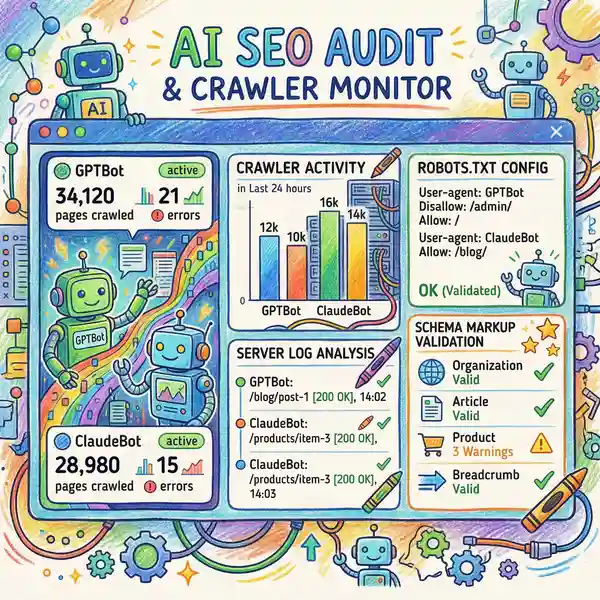
Technical SEO and AI-Powered Automation
Technical SEO has transformed from reactive manual auditing to proactive automated monitoring. AI systems now identify issues, prioritise them by business impact, and in some cases implement fixes autonomously—a shift toward what the industry calls "agentic SEO".
Ensuring AI Crawler Access
A foundational requirement in the AI era is ensuring that AI-specific crawlers can access your content. GPTBot (OpenAI), ClaudeBot (Anthropic), PerplexityBot, and Google-Extended all operate independently from Googlebot, and many have critical limitations: most AI crawlers cannot execute JavaScript, meaning sites relying on client-side rendering may be completely invisible to these platforms.
Your robots.txt must explicitly allow AI crawlers. CDN and WAF configurations (including Cloudflare) must not block AI user agents. Content must be server-side rendered or pre-rendered. These are not optional improvements—without them, even perfectly optimised content will never appear in AI-generated answers.
Schema Markup as AI Infrastructure
Schema markup has evolved from an optional rich-snippet tactic to foundational infrastructure for AI discoverability. A well-implemented content knowledge graph—an interconnected network of entities built in Schema.org vocabularies and expressed in JSON-LD—can improve large language model response accuracy by up to 300% compared to pages with minimal schema, according to Search Engine Land (2026).
Advanced schema implementation goes beyond basic Organisation and Article markup. It creates deeply nested structures mapping entities, products, people, and their relationships. For AI systems deciding between multiple sources for an answer, comprehensive schema makes your content more legible and less prone to misinterpretation—giving you a structural advantage over competitors with minimal markup.
Log File Analysis for AI Crawler Monitoring
Filtering server logs for AI crawler user-agent strings reveals which pages AI systems are actually accessing, how frequently they visit, and where they encounter errors. This baseline measurement allows you to identify content that AI crawlers are missing entirely—often due to navigation structure, internal linking gaps, or technical barriers—and fix these proactively rather than discovering them through missing AI citations months later.
Content Optimisation for AI Search
Content remains the primary asset in SEO, but how content must be structured has changed fundamentally. AI systems break content into semantic passages and extract information at the passage level—not the page level. A 5,000-word article where the key answer is buried in paragraph three performs worse than a 1,500-word article where direct answers sit front-and-centre in each section.
Answer-First Content Structure
Every section should begin with a direct, comprehensive answer to the question implied by its heading. AI systems typically extract the first 1–2 sentences when determining if a section answers a query. If those sentences are context-setting rather than answer-providing, the AI moves to a competitor's content. Front-load the answer, then provide supporting detail.
The Taco Bell Test for Standalone Sections
Each section must be comprehensible in isolation—what we call the "Taco Bell Test." AI systems extract and evaluate individual passages independently through chunking. This means avoiding pronoun-heavy references to "as mentioned above" or "the approach discussed earlier." Restate key terms, include enough context for standalone comprehension, and target 120–180 words per section for optimal citation length.
Original Data Increases Citation Likelihood
AI engines prioritise content with net-new information. Generic explanations of widely-known concepts are less likely to be cited than content providing original data, proprietary insights, or unique frameworks. Articles with 19+ specific data points correlate with 5.4 citations compared to a 2.8 baseline. Every quotable fragment should carry both context and your brand name so AI citations include your company when extracted.
Answer Engine Optimisation (AEO): The New SEO Frontier
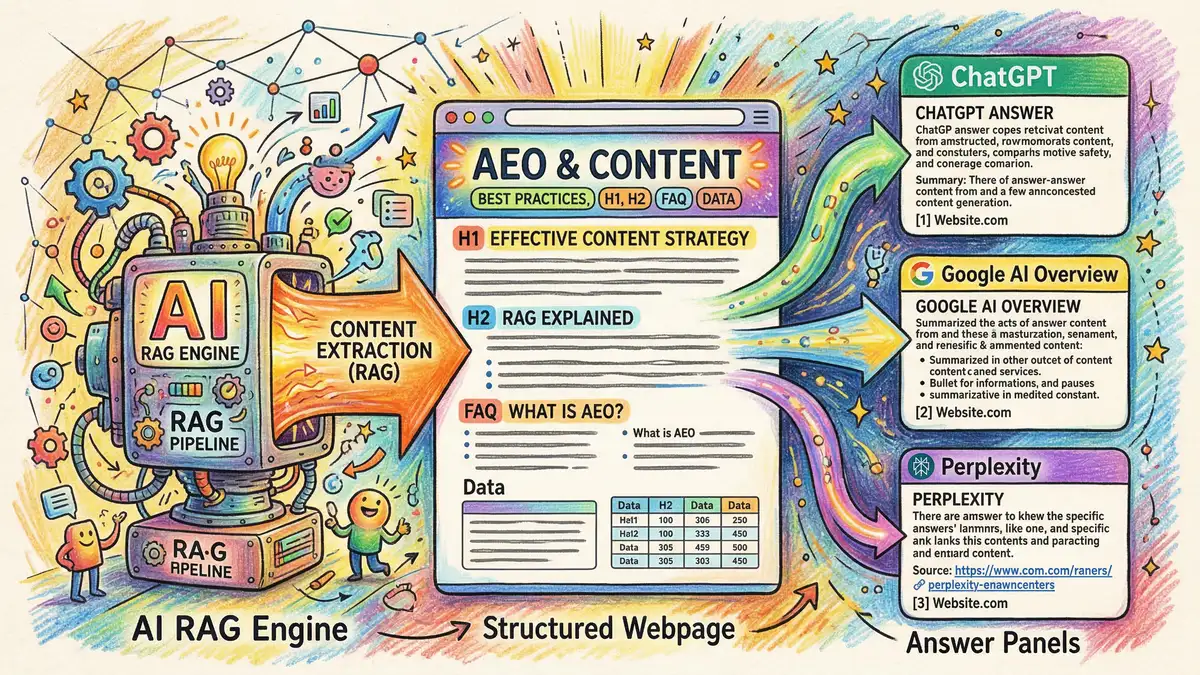
Answer Engine Optimisation is the discipline of getting your brand cited and recommended within AI-generated answers across ChatGPT, Google AI Overviews, Perplexity, Claude, and Gemini. It requires a fundamentally different approach from traditional SEO because AI answer engines synthesise information from multiple sources into single responses rather than presenting ten blue links.
How Answer Engines Select Sources
Modern answer engines use Retrieval-Augmented Generation (RAG) systems following a specific pipeline: query interpretation, content retrieval, passage extraction, and response synthesis. The retrieval is semantic rather than keyword-based—identifying documents where concepts and relationships match the query even if exact keywords don't appear. Content from sources the LLM recognises as authoritative is more likely to be selected and cited.
This pipeline creates specific optimisation opportunities at each stage. Semantically clear content performs better during passage extraction. Content with strong entity relationships performs better during retrieval. And content from recognised authorities—measured through brand mentions, schema markup, and cross-platform presence—gets prioritised during synthesis.
Measuring AI Visibility
Traditional SEO measures rankings and clicks. AI visibility requires fundamentally different metrics:
| Metric | What It Measures | Tools |
|---|---|---|
| Citation Frequency | How often your brand appears in AI answers across platforms | Siftly, Otterly.AI, Ahrefs Brand Radar |
| AI Share of Voice | Your citation frequency vs competitors for the same queries | Evertune, Semrush AI Tracking |
| Entity Recognition | Whether AI systems accurately identify and describe your brand | Google Knowledge Panel, manual LLM testing |
| Assisted Conversions | Customer journeys including AI interaction before website visit | GA4 multi-touch attribution, CRM tracking |
For UK businesses, monitoring these metrics alongside traditional SEO performance reveals the full picture. A site might see organic traffic decline 10% due to AI Overviews reducing clicks, but if that's replaced by AI-referred traffic converting at 4.4× the rate, the revenue impact is strongly positive despite the traffic decline.
Measuring AI SEO ROI
The financial case for AI-powered SEO is compelling across both productivity gains and revenue impact. Teams implementing AI tools consistently report 40–70% reductions in time for keyword research, content planning, and technical auditing. 68% of marketers confirm that AI helped them achieve higher SEO ROI, with 40% reporting 6–10% revenue increases after AI implementation.
The quality-of-traffic metric is particularly significant. AI-referred traffic converts 4.4× better than organic search traffic because users who encounter a brand in a ChatGPT or Perplexity answer after asking a complex question are typically further along in their research journey and more intent-driven than someone clicking a generic Google result.
Case Study: GEO Implementation Results
A B2B medical device manufacturer implemented a comprehensive GEO strategy focused on achieving AI citations rather than purely traditional rankings. Over seven months: domain rating increased from 21 to 35, achieved #1 position in Google AI Overview for core queries ahead of FDA.gov and Fortune 500 competitors, branded searches grew 587%, and AI platform citations increased from near-zero to over 283 across major platforms. The business impact came primarily through increased brand awareness driving branded search, which then drove website visits and sales conversations.
AI SEO Risks and How to Mitigate Them
The rapid adoption of AI in SEO has created genuine risks that need active management. These aren't theoretical—they're occurring at scale across the industry.
AI Hallucinations and Fabricated Content
Large language models have no mechanism to distinguish between information from training data and content generated to maintain grammatical coherence. Real incidents in 2025–2026 include Ars Technica retracting an article containing AI-fabricated quotations, and The Economic Times publishing a story with AI-generated false quotes attributed to a real researcher. These fabricated claims were then indexed by search engines and incorporated into other LLMs' training data. Rigorous human review of all AI-generated content before publication is non-negotiable.
Google's Helpful Content Policies
Google's content quality updates have systematically deprioritised sites publishing large volumes of generic AI content. Sites pivoting entirely to AI content generation have seen ranking declines of 30–90%. The defence is using AI as an efficiency tool while maintaining genuine human expertise—author bios with verifiable credentials, original research, and proprietary data that AI cannot replicate.
The Echo Chamber Problem
When multiple AI systems are trained on web data, generate content published to the web, which trains future AI systems, the "average" internet opinion becomes self-reinforcing. Original insights get marginalised. This creates a competitive advantage for brands investing in original research, proprietary data, and differentiated frameworks—content that inherently resists homogenisation because it's fundamentally different from what generic AI produces.
The Future of SEO: Agentic AI and Beyond
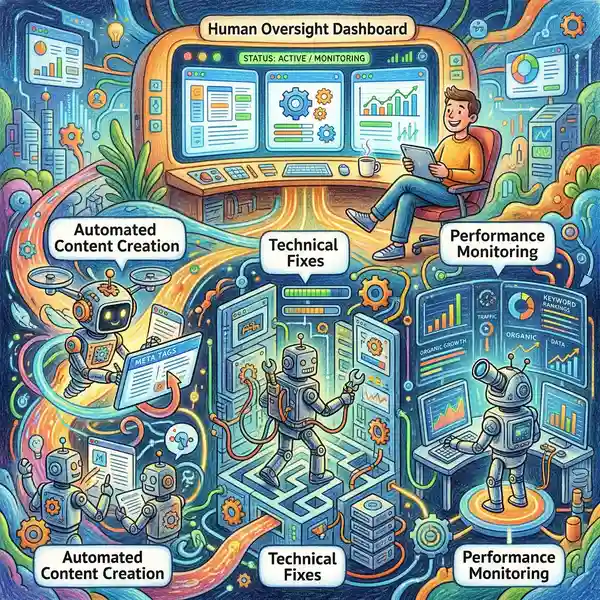
Agentic AI represents the next categorical shift in SEO. Rather than SEO professionals using AI as a tool, agentic systems become active agents conducting strategy and implementation with human oversight rather than human direction. An agentic SEO system receives an objective—"improve visibility in AI search for healthcare queries"—and autonomously determines what tasks to execute, in what order, with what priority.
This has implications for how search and discovery work more broadly. AI agents will increasingly make discoveries and decisions on behalf of humans—researching options, comparing alternatives, and executing decisions autonomously. For brands, the competitive battleground shifts upstream to APIs, structured data, and machine-readable information rather than page content alone.
Organisations that treat SEO as a constantly evolving discipline rather than a settled set of best practices will maintain competitive advantages. The transition from page-centric to entity-centric architecture, from click metrics to citation metrics, and from human-executed to AI-augmented workflows is accelerating. Brands that invest in this transformation now will establish themselves as the authoritative sources that AI systems consistently recommend.
Frequently Asked Questions About AI for SEO
Will AI replace SEO professionals?
AI will not replace SEO professionals but will fundamentally change what they do. The shift is from manual execution (crawling sites, building spreadsheets, tracking rankings) to strategic oversight of AI-powered systems. SEO professionals who learn to direct AI tools effectively will be significantly more productive. Those who rely solely on manual processes will struggle to compete with AI-augmented teams.
How does AI affect organic click-through rates?
AI Overviews reduce organic CTR by approximately 61% for queries where they appear. However, this doesn't mean total business value declines—AI-referred traffic converts at 4.4× the rate of organic search traffic. The metric to track is revenue per search impression, not clicks per impression. Brands optimised for AI citation are finding that fewer clicks from more qualified visitors often outperform high-volume low-intent traffic.
What is the difference between AEO and GEO?
Answer Engine Optimisation (AEO) focuses specifically on optimising for large language models like ChatGPT, Claude, and Perplexity. Generative Engine Optimisation (GEO) is the broader discipline covering any AI system that generates synthesised answers, including Google AI Overviews. In practice, the techniques overlap significantly—answer-first content, schema markup, entity clarity, and authority signals benefit both.
How much does AI SEO cost for a UK business?
AI SEO tools range from free (ChatGPT free tier, Google Keyword Planner) to enterprise pricing (BrightEdge, Conductor). A typical UK SME can achieve approximately 80% of premium tool results with a £20/month ChatGPT subscription plus free tools. Mid-market businesses typically spend £200–£500/month on AI SEO tooling. The largest cost is typically professional implementation—either in-house time or agency support from specialists like Whitehat.
Does AI-generated content get penalised by Google?
Google does not categorically penalise AI-generated content. However, content must demonstrate E-E-A-T (Experience, Expertise, Authoritativeness, Trustworthiness) regardless of how it was produced. Sites publishing large volumes of generic, unedited AI content have seen 30–90% ranking declines. The safe approach: use AI for research, structure, and drafting, then add genuine human expertise, original data, and editorial quality control before publishing.
How do I check if AI crawlers can access my site?
Check your robots.txt file for GPTBot, ClaudeBot, PerplexityBot, and Google-Extended entries. Verify your CDN/WAF (Cloudflare, Sucuri) isn't blocking AI user agents despite robots.txt permissions. Filter server logs for AI crawler user-agent strings to see which pages are actually being crawled. Test your site with JavaScript disabled—if core content disappears, AI crawlers can't see it either.
Ready to Make AI Work for Your SEO?
Whitehat combines deep SEO expertise with AI-native tools and workflows to deliver measurable improvements in both traditional search rankings and AI citations across ChatGPT, Google AI Overviews, and Perplexity.
Continue Reading: AI for SEO Guides
AI SEO Tools Guide
Complete comparison of AI-powered SEO platforms, pricing, and implementation workflows.
Read the guide →ChatGPT for Marketing
Practical prompting frameworks, templates, and integration workflows for marketing teams.
Read the guide →AI Content Strategy
How AI transforms content planning, creation, and optimisation for search visibility.
Read the guide →AI in Marketing
The complete guide to AI across all marketing channels—our companion pillar guide.
Read the guide →AI for Small Business Marketing
Budget-conscious AI tools and strategies for UK small businesses competing with larger firms.
Read the guide →AI Social Media Marketing
AI tools for social content creation, scheduling, analytics, and ad optimisation.
Read the guide →Sources: Semrush AI SEO Research (2026) · Search Engine Land — Schema Markup Guide · Conductor AI SEO Report · Lloyds Business Barometer (2026) · Seer Interactive — AI Overviews Impact Study · Ahrefs — AI Search Impact Analysis (2026)