
The UK AI market is booming. The dedicated artificial intelligence sector generated £23.9 billion in revenue in 2025—a 68% year-on-year surge. Yet beneath this explosive growth lies a critical reality: approximately 95% of generative AI pilots fail to produce measurable business impact. For UK leaders caught between the imperative to deploy AI and the reality that internal teams lack the expertise to succeed, AI consulting has become a strategic necessity, not an optional investment. This guide equips you with everything you need to evaluate, select, and partner with the right AI consulting firm to transform your organisation.
95%
AI Pilots Fail
Without expert guidance
£23.9B
UK AI Market Size
2025 revenue sector-wide
90%
Expect Growth
UK AI businesses in 2026
26.4%
CAGR Growth
2024–2025 compound annual rate
Sources: UK Government AI Research & Innovation, Industry Market Report 2026
Why AI Consulting Has Become Essential for UK Organisations
The gap between AI ambition and execution capability is widening. UK businesses recognise the competitive imperative to deploy artificial intelligence—whether for automating processes, enhancing customer insights, or creating new revenue streams. Yet most organisations lack the internal expertise to navigate the complexity of modern AI implementation successfully.
This is where AI consulting bridges the gap. Expert consultants accelerate your journey from strategy to measurable business outcomes by providing:
- Strategic clarity on where AI creates genuine competitive advantage within your industry and business model
- Technical due diligence on infrastructure, data maturity, and model selection to avoid costly missteps
- Vendor evaluation and contract negotiation to ensure you're not overpaying for generic solutions
- Change management support to ensure your teams adopt AI tools rather than resist them
- Risk mitigation around governance, compliance, and responsible AI principles
Key Takeaway
AI consulting is not a luxury service. It is the mechanism by which UK organisations reduce pilot failure rates, accelerate time-to-value, and compete effectively in a market where AI is rapidly becoming table-stakes.
What AI Consulting Services Include
The scope of AI consulting varies significantly depending on your maturity level and business priorities. Below is a breakdown of the core service categories you'll encounter:
| Service Category | What It Covers | Expected Outcomes |
|---|---|---|
| AI Strategy & Roadmap | Business opportunity mapping, use-case prioritisation, technology selection, skills gap analysis | Clear 12–24 month roadmap aligned to business objectives with cost-benefit scenarios for each initiative |
| AI Readiness Assessment | Data infrastructure evaluation, team capability review, governance maturity, compliance readiness | Executive summary of strengths, gaps, and recommended investments before implementation begins |
| Model Development & Fine-Tuning | Custom model training, foundation model selection, prompt engineering, performance optimisation | Production-ready AI models tailored to your specific business processes and data patterns |
| Implementation & Integration | Architecture design, API integration, legacy system connectors, deployment pipeline setup | AI systems operationalised within your existing tech stack with minimal disruption |
| Change Management & Adoption | Training programmes, user documentation, stakeholder communication, resistance management | Sustained adoption with minimal user resistance and measurable engagement across affected departments |
| Governance & Compliance | Risk assessment, ethical guidelines, regulatory compliance (GDPR, AI Act), bias audits, monitoring frameworks | Governance policies and audit trails that satisfy regulatory requirements and internal risk standards |
| Ongoing Support & Optimisation | Model monitoring, performance tuning, retraining cycles, technical helpdesk, roadmap evolution | Continuous improvement with models that adapt to changing business conditions and data distributions |
Sources: Industry Best Practices 2026, AI Consulting Service Standards
Most UK consulting firms will configure these services into bespoke engagements. A readiness assessment may take 4–8 weeks and cost £15,000–£40,000, whilst a full strategy and implementation programme could span 6–18 months and cost £100,000–£500,000+ depending on complexity and team size.
How to Choose the Right AI Consulting Partner
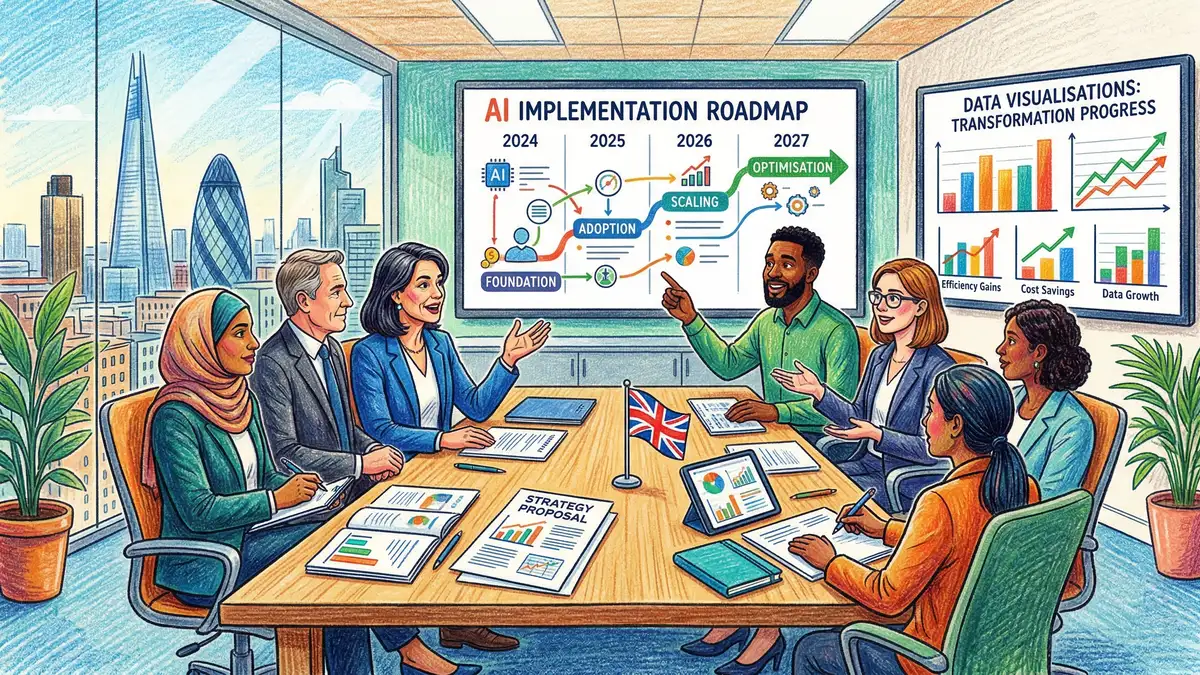
Selecting an AI consulting firm is a critical strategic decision that will shape how effectively you deploy artificial intelligence across your organisation. The consulting landscape is crowded—from boutique AI specialists to large management consultancies. Here are the criteria that separate excellent partners from mediocre ones:
1. Proven Track Record in Your Industry
Ask consultants to provide case studies and client references in your sector. AI implementation varies significantly across industries—what works for a financial services firm may not work for manufacturing. Look for evidence that the firm understands your industry's specific constraints, data challenges, and regulatory environment. Request interviews with 2–3 similar-sized clients from the same sector.
2. Depth of Technical Expertise
The firm should employ PhDs or equivalent in machine learning, engineers with production deployment experience, and data architects. During initial conversations, ask detailed technical questions about their approach to model selection, infrastructure requirements, and performance monitoring. Beware of consultants who can only talk about strategy—you need both business and technical depth.
3. Clear Governance and Risk Processes
Ask how they approach responsible AI, bias testing, GDPR compliance, and risk mitigation. Given the UK's emerging AI Assurance Programme and increasing regulatory scrutiny, consultants who gloss over governance are a red flag. Look for firms with dedicated ethics and compliance specialists.
4. Skills Transfer and Knowledge Retention
The best AI consultants don't create dependency—they build internal capability. Ask how they structure engagements to transfer knowledge to your team. Do they pair consultants with internal staff during implementation? Do they provide training and documentation? Will they help you hire and onboard permanent AI talent?
5. Transparent Pricing and Contractual Clarity
Avoid consultants who quote vague daily rates or open-ended retainers. Request fixed-fee phase gates or value-based pricing models that align consultant success with your business outcomes. Get everything in writing—scope, deliverables, timelines, support terms, and escalation procedures.
Ready to evaluate your AI consulting options? Let us help you assess your AI consulting needs and potential partners.
Discuss Your AI Consulting NeedsUnderstanding AI Consulting Costs and ROI

One of the most common questions from UK business leaders is straightforward: How much does AI consulting actually cost, and what's the return? The answer depends on scope, but here's what you should expect:
Cost Structure by Engagement Type
AI Readiness Assessment: £15,000–£40,000 for 4–8 weeks of work. Ideal starting point if you're uncertain about your technical foundation.
Strategic Roadmap Development: £30,000–£75,000 for 6–12 weeks. Consultants map your competitive opportunities and build a 12–24 month execution plan.
Pilot Implementation: £50,000–£150,000 for 2–4 months. Limited in scope (single use case, single department) to prove value before scaling.
Full-Scale Deployment: £200,000–£1,000,000+ across 6–18 months. Multi-use-case implementation with infrastructure, model development, integration, and change management across your organisation.
Calculating ROI
The ROI of AI consulting varies widely, but research from McKinsey and Boston Consulting Group shows that well-executed AI implementations deliver 3–5x return on consulting investment within 18–24 months. Key ROI drivers include:
- Labour cost reduction: Process automation, reduced manual tasks, higher team productivity
- Revenue uplift: Better customer insights, personalisation, cross-selling, new AI-enabled product lines
- Quality improvement: Reduced errors, faster decision-making, better compliance
- Competitive advantage: Differentiation through AI capabilities that competitors lack
The Bottom Line on ROI
AI consulting cost should not be viewed as an expense—it is an investment in capability. The firms that see the best returns are those that allocate 15–25% of their AI budget to consulting and strategy, not those trying to minimize consulting fees. Under-investing in expert guidance is the fastest path to failed pilots.
Common Mistakes When Hiring AI Consultants
After reviewing hundreds of AI consulting engagements, several patterns emerge in how UK businesses misallocate consulting resources:
Choosing Based on Hourly Rate Alone
The cheapest consultant often delivers the slowest results. UK businesses save £500 on daily consulting rates and then burn £50,000 in salary costs waiting for mediocre advice. Focus on value per outcome, not cost per hour.
Bringing in Consultants Too Late
Many organisations only hire consultants after a failed pilot. By then, teams are demoralised and stakeholder confidence is damaged. Expert guidance at the strategy phase (before any implementation) prevents costly rework.
Insufficient Internal Engagement
Consultants can advise, but your internal teams must execute. If key stakeholders are not invested in the consulting process, recommendations sit on shelves. Allocate senior leader time to guide the engagement.
Skipping Governance and Risk Assessment
Some consultants focus only on technology and ignore governance. With the UK AI Bill and emerging AI Act, compliance is non-negotiable. Ensure consultants include ethical review, bias testing, and regulatory assessment in their scope.
AI Consulting by Industry: Sector-Specific Guidance
AI implementation priorities differ dramatically across industries. Here's what to focus on when selecting a consultant for your sector:
Financial Services
Priority focus: Fraud detection, regulatory reporting, credit scoring, risk management. Consultants must have experience with FCA compliance, model validation for lending decisions, and consumer credit governance.
Healthcare & Life Sciences
Priority focus: Patient outcome prediction, drug discovery acceleration, diagnostic imaging, clinical trial optimisation. Consultants need NHS integration experience, medical data governance expertise, and understanding of MHRA regulatory pathways.
Retail & E-Commerce
Priority focus: Demand forecasting, customer segmentation, recommendation engines, supply chain optimisation. Consultants should demonstrate success in high-volume transaction environments and real-time prediction at scale.
Red Flags vs. Green Flags: A Consultant Evaluation Checklist
Red Flags
- Promises of 100% accuracy or unrealistic AI performance claims
- No case studies or references available in your industry
- Team consists primarily of business consultants with minimal technical background
- Insists on proprietary tools or lock-in contracts
- Unwilling to discuss governance, ethics, or compliance frameworks
- Vague pricing with no clear scope or deliverables
- No mention of change management or internal team training
Green Flags
- Clear case studies with measurable ROI outcomes and client references
- PhD and production engineering expertise on the core team
- Structured engagement phases with clear success criteria and phase gates
- Governance and ethics discussion as standard part of scoping
- Fixed-fee or value-based pricing with transparent deliverables
- Emphasis on knowledge transfer and internal team capability building
- Willing to provide references from similar companies in your sector
The Future of AI Consulting: Trends to Watch in 2026
The UK AI consulting market is evolving rapidly. Here are the trends shaping how organisations should approach consulting partnerships in 2026:
1. Outcome-Based Pricing Models
Traditional time-and-materials engagements are giving way to value-based or success-sharing models. Look for consultants willing to tie fees to measurable outcomes—cost reduction, revenue uplift, or adoption metrics.
2. Specialisation Over Generalisation
The best consultants are moving from "full-service AI" to deep vertical expertise. Whether fintech, manufacturing, or healthcare, you'll get better results from consultants who know your industry inside out.
3. Governance and Responsible AI as Table-Stakes
With UK AI Assurance, the AI Bill, and emerging global regulations, responsible AI and governance are no longer optional add-ons. Leading consultants embed ethics, bias testing, and compliance into every engagement.
4. Hybrid Engagement Models
Rather than all-consultant or all-internal, best-in-class engagements pair external expertise with dedicated internal teams. Consultants are embedded longer and transition into knowledge-sharing and capability-building roles.
Frequently Asked Questions
How long does a typical AI consulting engagement take?
Most strategic engagements range from 4–16 weeks depending on scope. A readiness assessment is typically 4–8 weeks. A full strategy and roadmap is 6–12 weeks. Implementation partnerships may span 6–18 months. Always ask for a detailed project plan with phase gates and decision points.
Should I hire a strategy firm or a technical implementation partner?
Ideally, both—but in sequence. Start with a strategy consultant to clarify priorities and build a roadmap. Then partner with an implementation specialist who excels at turning that roadmap into operational reality. Some firms do both well; vet them on both dimensions before committing.
What's the difference between generative AI consulting and general AI consulting?
Generative AI consulting focuses specifically on large language models, foundation models, and generative use cases (content generation, chatbots, code generation). General AI consulting includes predictive models, computer vision, process automation, and broader AI strategy. Most UK organisations need both—ask consultants about their portfolio in each area.
How do I ensure consultants transfer knowledge to my team?
Include explicit knowledge transfer in your contract. Require paired programming sessions, documentation, training programmes, and hiring support. Structure engagements so consultants work alongside your team rather than in isolation. Phase out consultant involvement gradually—don't have them disappear overnight.
How much should I expect to budget for AI consulting?
Budget 15–25% of your total AI initiative costs for consulting and strategy. If your AI budget is £500,000 over two years, allocate £75,000–£125,000 to consulting. This is not luxury—it is the foundation that prevents 95% of pilots from failing. Under-investing in expert guidance is the fastest path to wasted investment.
What questions should I ask in initial consulting conversations?
Key questions: (1) Show me 3 case studies from similar-sized companies in my sector. (2) Who are the PhD-level technologists on your team? (3) How do you approach governance and bias testing? (4) What's your pricing model and how do you define success? (5) How do you structure knowledge transfer? (6) Can you provide references I can call directly? If consultants avoid or minimize these, they are not the right partner.
Ready to Transform Your AI Strategy?
The right AI consulting partner accelerates your journey from strategy to measurable business impact. We help UK organisations evaluate opportunities, select partners, and execute AI initiatives that deliver real ROI.
Clwyd Probert
Managing Director, Whitehat SEO
Clwyd leads Whitehat's AI consulting practice, advising UK enterprises on AI strategy, vendor selection, and governance frameworks. With over a decade of experience in digital transformation and AI implementation, he has guided organisations from financial services to healthcare through successful AI deployments that generate measurable business impact.
Sources: UK Government AI Research & Innovation, McKinsey AI Report 2024, Boston Consulting Group AI Insights, UK AI Assurance Programme 2026

Explore Related AI Consulting Articles how AI is changing SEO in 2026
Dive deeper into AI consulting with these in-depth guides covering specific aspects of AI implementation, assessment, and selection:
AI Consulting for Small Business
Tailored guidance for SMEs on cost-effective AI implementation and vendor selection.
Complete framework for auditing existing AI systems for bias, performance, and compliance.
Evaluate your organisation's technical foundation and readiness for AI deployment.
Specialised guidance for implementing large language models and generative use cases.
Detailed breakdown of consulting investment models and ROI benchmarks for 2026.
How to Choose an AI Consultant
Step-by-step framework for evaluating and selecting the right consulting partner.
Understand the consulting methodology and engagement phases that drive successful outcomes.
Real-world examples of successful AI transformations and measurable business outcomes.