
Global AI adoption in marketing has accelerated sharply since 2024. McKinsey's 2025 global survey found 79% of organisations now use generative AI — up from 33% in 2023. The CMO Survey from Duke University and Deloitte quantifies the shift precisely: AI and machine learning now power 24.2% of all marketing activities, nearly doubling from 13.1% in 2024, with marketing leaders projecting that figure will reach 55.9% within three years. Yet only 6% of organisations qualify as high performers extracting real bottom-line value. For B2B marketers, the challenge is no longer whether to adopt AI but how to move from scattered experiments to scaled, measurable impact.
How Widespread Is AI Adoption in Marketing in 2026?
Near-universal adoption. Rare business impact. That paradox defines 2026: McKinsey's global survey finds 88% of organisations now use AI in at least one business function — up from 72% in 2024 — with marketing and sales ranking among the top deployment areas. But only 6% extract meaningful bottom-line value. The gap between tool adoption and value creation is the central tension shaping AI marketing strategy this year.
88%
AI Adoption Rate
Organisations using AI in at least one function
24.2%
Marketing Activities
Powered by AI — doubled since 2024
7.7%
Budget Share
Marketing spend as % of revenue — flat since 2024
6%
High Performers
Organisations extracting real AI value
Sources: McKinsey Global AI Survey 2025, Duke University & Deloitte CMO Survey 2026, Gartner CMO Spend Survey 2025
Budget allocations reflect this momentum. Martech and AI spending currently represents 19% of marketing budgets according to the CMO Survey, expected to climb to 31.7% within five years. Gartner's 2025 CMO Spend Survey found just 1% of CMOs said generative AI investments are not a current priority. Yet budgets remain constrained — marketing spend sits at 7.7% of company revenue, flat from 2024 and down from 9.5% three years prior. The result: CMOs must fund AI transformation within shrinking envelopes, with 59% reporting insufficient budget to execute their strategy.
| Metric | 2024 | 2026 | Source |
|---|---|---|---|
| AI adoption (any function) | 72% | 88% | McKinsey Global Survey |
| Generative AI adoption | 65% | 79% | McKinsey Global Survey |
| AI in marketing activities | 13.1% | 24.2% | CMO Survey (Duke/Deloitte) |
| Marketing budget (% revenue) | 7.7% | 7.7% | Gartner CMO Spend Survey |
| AI high performers | ~5% | 6% | McKinsey Global Survey |
Sources: McKinsey State of AI 2025, CMO Survey Spring 2026, Gartner CMO Spend Survey 2025
The enterprise-SMB divide remains pronounced. Nearly half of companies with over $5 billion in revenue have reached AI scaling stage, compared with just 29% of companies under $100 million. The UK Government's DSIT AI Adoption Research, published January 2026, found only 1 in 6 UK businesses (16%) currently use any AI technology — dramatically lower than marketing-specific surveys suggest. However, among those businesses that have adopted AI, 72% use it for marketing — tied with administration as the most common application. The UK AI market is projected to grow at 27.6% CAGR through 2030, positioning the UK as Europe's AI investment leader despite comparatively modest adoption breadth.
Key Takeaway
AI adoption is near-universal at 88%, but only 6% of organisations extract real business value. The gap is not in tooling — it is in strategy, data readiness, and governance. For B2B marketers, the competitive advantage lies in closing this execution gap, not in adding more tools.
What Is Agentic AI and Why Does It Matter for B2B Marketers?
Agentic AI is the defining technological shift of 2025–2026. Unlike copilots that assist humans step by step, AI agents plan, reason, and execute autonomously — possessing four key capabilities: reasoning, memory, tool use, and delegated authority. McKinsey frames agentic AI as the foundation of the next-generation operating model. BCG research indicates effective AI agents accelerate business processes by 30–50% and reduce low-value work time by 25–40%. As of late 2025, 62% of businesses have begun experimenting with AI agents, with 23% already scaling deployments.
HubSpot Breeze
The most comprehensive CRM-native agent platform for mid-market B2B. Includes Customer Agent (resolves 50%+ support tickets), Prospecting Agent, Content Agent that learns brand voice, and 15+ pre-built agents across the Breeze Marketplace.
Salesforce Agentforce
Enterprise heavyweight with 119% agent growth in H1 2025. Offers campaign co-creation from brief through audience segmentation, content drafting, journey orchestration, and activation across the full sales-marketing lifecycle.
Adobe AI Agents
Centres on creative production with Content Production Agent that interprets marketing briefs and auto-produces channel-specific assets. Strongest for teams managing large volumes of visual and video creative.
Sources: HubSpot INBOUND 2025 Announcements, Salesforce Dreamforce 2025, Adobe Summit 2025
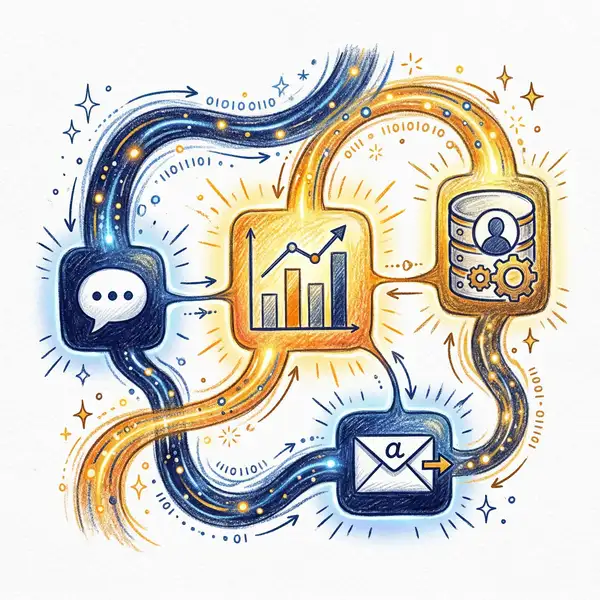
The specialist tool landscape is consolidating around agentic capabilities. Jasper now offers 100+ specialised AI agents and content pipelines. Writer launched its AI Agent Builder before OpenAI's equivalent, focusing on enterprise multi-step processes. B2B-specific platforms like 6sense and Demandbase are layering AI agents onto their intent data and ABM infrastructure. The global AI agents market has reached $12 billion in 2026 and is projected to hit $52.6 billion by 2030 at 46.3% CAGR. For B2B marketers evaluating these options, Whitehat's AI consultancy services help organisations navigate platform selection and implementation.
How Are AI Answer Engines Changing Organic Search?
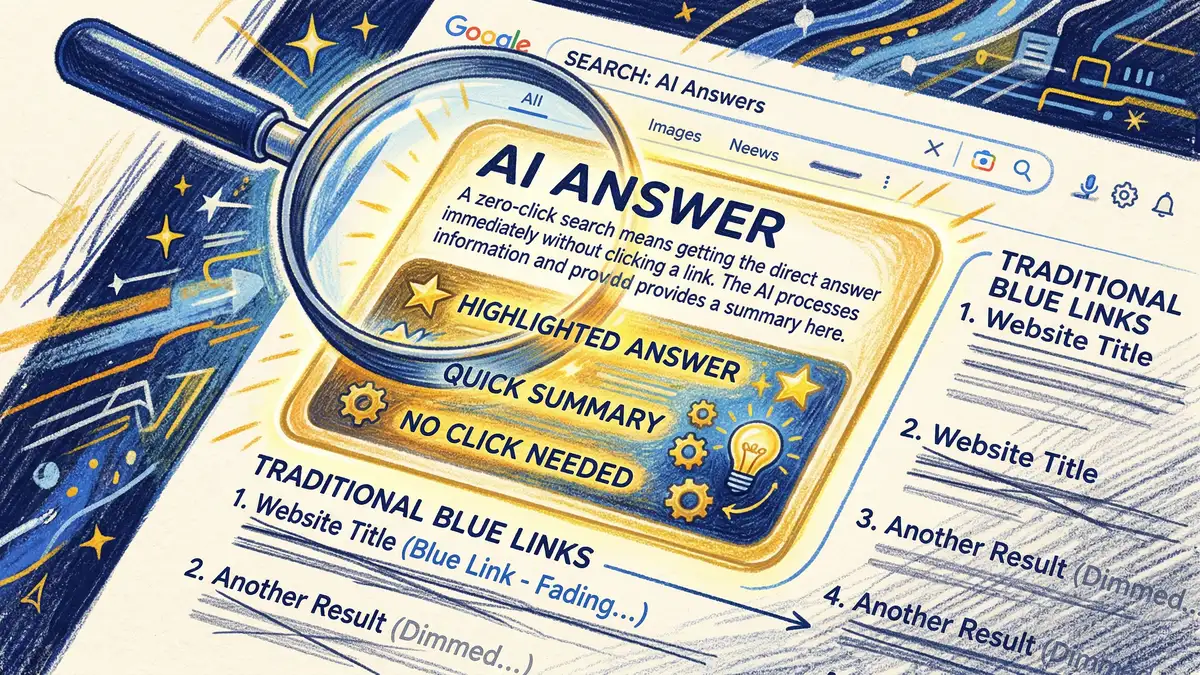
AI answer engines have fundamentally altered the search landscape. Google AI Overviews reduce organic click-through rates by up to 61% for informational queries, while zero-click searches now account for 58–69% of all searches. But the story is not purely negative: AI-sourced traffic converts at approximately 23 times the rate of traditional organic traffic and carries 4.4 times higher economic value. For B2B companies, being cited in an AI Overview generates more qualified traffic than ranking third in traditional results.
| Search Impact Metric | Finding | Source |
|---|---|---|
| Organic CTR drop with AI Overviews | −61% (1.76% → 0.61%) | Seer Interactive |
| Zero-click search rate (US) | 58.5–69% | Semrush / Similarweb |
| AI Overview appearance rate | 13–19% of queries | Semrush 10M keyword study |
| ChatGPT weekly active users | 900 million | OpenAI |
| Perplexity AI monthly queries | 780 million (+800% YoY) | Perplexity |
| AI traffic conversion premium | 23× traditional organic | Industry analysis |
Sources: Semrush AI Overviews Study 2025, Seer Interactive 2025, Pew Research Center 2025
This shift has given rise to Generative Engine Optimisation (GEO) and Answer Engine Optimisation (AEO) as critical disciplines. Research from Brandlight suggests the overlap between top Google links and AI-cited sources has dropped from 70% to below 20%. Semrush found approximately 90% of pages cited by ChatGPT Search rank position 21 or lower in traditional organic results — a pattern explored in our analysis of AI engine citation behaviour. Yet 47% of brands still lack a GEO strategy, representing a significant competitive gap.
The Bottom Line
Traditional SEO alone is no longer sufficient. AI-sourced traffic converts 23× better than traditional organic, but capturing it requires a fundamentally different content strategy: answer-first structure, citation-worthy data, expert attribution, and comprehensive AEO measurement frameworks.
Discover how Whitehat's integrated SEO and AEO services help B2B companies capture both traditional and AI-powered search traffic.
View SEO ServicesWhat Does AI Co-Creation Mean for Content Marketing?
AI content tools have matured from novelty to necessity. An estimated 85–88% of marketers now use AI in content creation, with 93% reporting it accelerates production. But 2026 marks a critical transition: from AI-assisted production to genuine co-creation with agentic workflows where human authenticity becomes the competitive edge. The Content Marketing Institute's panel of 42 experts identifies this shift as the defining content trend of the year.
Google's stance provides important clarity. The search engine does not penalise content for being AI-generated — its focus remains on quality, originality, and user benefit regardless of production method. An Ahrefs survey of 600,000 pages found 82% of high-ranking pages contain some form of AI-generated content, with no significant correlation between AI content and poor rankings. The winning formula: AI as co-creator with human editorial oversight, which performs 4.1 times better than fully automated output.
The Trust Trap
Common mistake: Publishing AI-generated content at scale without human editorial oversight, assuming volume compensates for quality.
The reality: When consumers notice AI-generated content, they are four times more likely to trust a brand less (31%) than more (7%), according to eMarketer's April 2026 research. Fully automated output underperforms human-AI co-creation by 4.1×. Volume without authenticity erodes trust faster than it builds pipeline.
Hyper-personalisation capabilities have reached production scale. Some 92% of businesses now use AI-driven personalisation, and McKinsey's research shows it improves marketing efficiency by 10–30%, with fast-growing companies deriving 40% more revenue from personalised experiences. AI video has also reached an inflection point: BCG reports 68% of CMOs are deploying or planning AI for video generation, while the IAB projects AI-generated video will account for 40% of all video ads by 2026. For B2B marketers, personalised video at scale — product demos, executive thought leadership, multilingual content — is now economically viable.
How Is AI Regulation Affecting Marketing in 2026?
The EU AI Act reaches full applicability on 2 August 2026 for most operators, including critical transparency obligations requiring AI-generated synthetic content to be marked and chatbot interactions to disclose AI involvement. This directly affects marketing content creation and conversational AI deployments across Europe. For a detailed breakdown of UK-specific requirements, see our UK AI policy guide for B2B marketers.

The UK maintains its sector-specific approach with no dedicated AI Bill as of April 2026, though one may appear in the King's Speech on 13 May 2026. The ICO announced agentic AI as a focus area for 2026, monitoring developers and deployers for data protection compliance. ICO enforcement escalated sharply in 2025 with fines reaching £19.6 million, followed by a £14.47 million Reddit fine in February 2026 — its largest children's data fine ever. The ASA's AI-powered Active Ad Monitoring System is expected to review 40 million advertisements in 2026, shifting enforcement from reactive to proactive.
Consumer trust remains the elephant in the room. Gartner's consumer survey found 78% say explicit labelling of AI content is "very important" for maintaining trust. The perception gap between marketers and consumers is striking: 77% of advertisers share positive sentiment toward AI versus just 38% of consumers. Meanwhile, 51.7% of B2B marketers recognise an AI skills gap in their teams, with 68% receiving no formal generative AI training and AI-proficient professionals commanding 20–30% salary premiums.
What Do Analysts Predict for AI Marketing in 2027 and Beyond?
The major analyst firms are converging on a shared narrative: the hype phase is ending, and 2026–2027 will separate AI winners from the rest. Gartner predicts 60% of brands will use agentic AI for one-to-one interactions by 2028, with 40% of enterprise applications embedding task-specific AI agents by end of 2026 — an 8× increase from 2025. Most dramatically, Gartner forecasts that by 2028, 90% of B2B buying will be AI-agent-intermediated, pushing $15 trillion through AI agent exchanges.
$463B
Marketing AI Opportunity
Potential productivity value — McKinsey
$2.52T
Global AI Spend 2026
44% year-over-year increase
$52.6B
Agentic AI Market 2030
46.3% CAGR from $12B in 2026
Sources: McKinsey 2025, Forrester 2026 Predictions, Gartner 2025
Forrester strikes a more cautious tone, declaring that in 2026 the AI hype period ends. Their B2B predictions warn companies will lose over $10 billion from ungoverned generative AI use through declining stock prices, legal settlements, and fines. They expect advertisers to cut display ad budgets by 30% as consumers migrate to AI-generated summaries. McKinsey quantifies the opportunity differently: AI could drive $463 billion in marketing productivity, with agentic AI powering over 60% of the increased value. Their State of Marketing Europe 2026 report reveals generative AI ranked just 17th out of 20 in CMO priorities — but McKinsey warns this underestimates both the urgency and the opportunity.
What Should B2B Marketers Do Right Now?
Three structural shifts demand immediate attention. The companies that win in 2026–2027 will not be those with the most AI tools, but those that close the gap between adoption and measurable, governed, customer-trusted impact.
Adopt Dual Search Optimisation
With 58–69% zero-click rates and AI Overviews suppressing organic CTR by up to 61%, pursue a dual optimisation strategy for both traditional search and AI citation. The fact that AI-sourced traffic converts 23× better reframes the narrative from traffic loss to quality gain. Implement answer-first content structure, citation-worthy statistics, and comprehensive schema markup.
Invest in Data Readiness Before Agent Deployment
Agentic AI is not a future trend but a present reality requiring investment decisions now. HubSpot Breeze, Salesforce Agentforce, and Adobe's agent ecosystem each offer distinct value propositions. The critical enabler is not the tools themselves but data readiness — clean CRM data, unified customer profiles, and cross-platform interoperability determine whether agents deliver value or frustration.
Build Governance as Competitive Advantage
With the EU AI Act reaching full force in August 2026 and consumer scepticism widening, invest early in transparency, governance frameworks, and human-AI collaboration models. The skills gap — recognised by over 51% of B2B marketers — is the single highest-leverage investment area. Organisations providing targeted AI education see 43% higher project success rates.
Measure What Matters — Revenue, Not Rankings
Connect every AI marketing initiative to pipeline, CAC, or LTV — never rankings in isolation. Use AEO measurement frameworks alongside traditional SEO KPIs. Track AI-sourced conversions separately. The £5:1 ROI threshold should be your benchmark for justifying continued AI investment to the board.
Frequently Asked Questions
What percentage of organisations are using AI in marketing in 2026?
According to McKinsey's 2025 global survey, 88% of organisations now use AI in at least one business function, with marketing and sales among the top deployment areas. The CMO Survey reports AI powers 24.2% of all marketing activities — nearly double the 13.1% recorded in 2024. However, only 6% of organisations qualify as high performers extracting meaningful bottom-line value.
How are AI answer engines affecting organic search traffic?
AI Overviews have reduced organic click-through rates by up to 61% for informational queries. Zero-click searches now account for 58–69% of all searches. However, AI-sourced traffic converts at 23 times the rate of traditional organic traffic and carries 4.4 times higher economic value, making Answer Engine Optimisation (AEO) a critical discipline for B2B marketers.
What is the difference between AI copilots and AI agents?
AI copilots assist humans with tasks, requiring human oversight for each step. AI agents plan, reason, and execute autonomously, possessing four key capabilities: reasoning, memory, tool use, and delegated authority. Examples include HubSpot's Breeze agents, Salesforce Agentforce, and Adobe's Content Production Agent. As of late 2025, 62% of businesses have begun experimenting with AI agents.
Does Google penalise AI-generated content?
No. Google does not penalise content for being AI-generated — its focus remains on quality, originality, and user benefit regardless of production method. An Ahrefs survey of 600,000 pages found 82% of high-ranking pages contain some AI-generated content. The winning formula is AI as co-creator with human editorial oversight, which performs 4.1 times better than fully automated output.
When does the EU AI Act take effect for marketing?
The EU AI Act reaches full applicability on 2 August 2026 for most operators. This includes transparency obligations requiring AI-generated synthetic content to be marked and chatbot interactions to disclose AI involvement — directly affecting marketing content creation and conversational AI deployments. The EU's Digital Omnibus proposal may offer grace periods, with providers of pre-August 2026 generative AI potentially having until February 2027 for content-marking compliance.
How much should B2B companies spend on AI marketing tools?
Marketing budgets currently sit at 7.7% of company revenue, with martech and AI representing 19% of that — expected to climb to 31.7% within five years. For mid-market B2B companies (£5M–£100M turnover), the critical investment is not in adding more tools but in data readiness and governance frameworks that enable existing tools to deliver measurable ROI. Target a £5:1 return threshold.
What is the AI skills gap in marketing and how do you close it?
Marketing Week's survey found 51.7% of B2B marketers recognise an AI skills gap in their teams, while 68% receive no formal generative AI training. AI-proficient professionals command 20–30% salary premiums, and job listings requiring AI skills increased 71%. Organisations providing targeted AI education see 43% higher project success rates — making structured upskilling the single highest-leverage investment for most marketing teams.
What is the best AI marketing platform for HubSpot users?
HubSpot's Breeze AI ecosystem is the most comprehensive CRM-native agent platform for mid-market B2B companies already using HubSpot. It includes a Customer Agent resolving 50%+ support tickets, a Prospecting Agent with buyer committee insights, and a Content Agent that learns brand voice. For companies needing help maximising their HubSpot AI capabilities, Whitehat provides specialist AI consultancy and implementation services as a HubSpot Diamond Partner.
Ready to Turn AI Adoption into Measurable Pipeline Growth?
Whitehat helps UK B2B companies close the gap between AI experimentation and revenue impact — through integrated SEO, AEO, and HubSpot implementation proven to deliver £5:1 ROI in 90 days.
Sources: McKinsey Global AI Survey 2025, Gartner CMO Spend Survey 2025, Duke University & Deloitte CMO Survey 2026, UK Government DSIT AI Adoption Research 2026, Semrush AI Overviews Study 2025, Forrester B2B Predictions 2026, eMarketer AI Trust Study 2026
Clwyd Probert
CEO & Founder, Whitehat SEO
Clwyd Probert is a guest lecturer at UCL and leads the world's largest HubSpot User Group in London. As CEO of Whitehat — a HubSpot Diamond Solutions Partner — he helps UK B2B companies transform their marketing from random acts into predictable pipeline through integrated SEO, Answer Engine Optimisation, and HubSpot implementation.