
AI & Marketing Insights
Marketing stands at a decisive inflection point. AI has reshaped virtually every function, yet the industry's workforce remains dangerously undertrained, increasingly burned out, and structurally unprepared for what comes next. According to Whitehat SEO's analysis of the latest government statistics, industry surveys, and analyst forecasts, the central finding is clear: organisations and individuals who close the AI training gap in 2026 will capture an outsized share of value being created; those who don't will face compounding disadvantage.
Marketing Employment and AI Transformation AI in marketing in 2026: What the Data Reveals
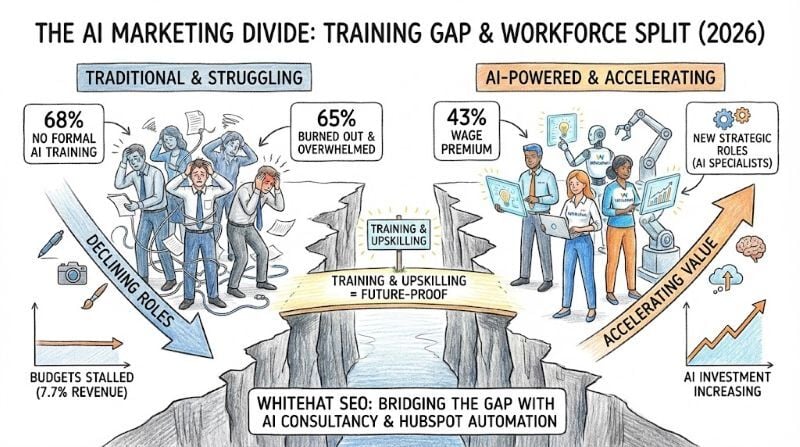
The AI training gap—not AI itself—is the primary threat to marketing careers. With 91% of teams using AI but 68% receiving no formal training, the profession is splitting into two tiers.
This comprehensive report synthesises data from the U.S. Bureau of Labor Statistics, Gartner's 2025 CMO Spend Survey, HubSpot's State of Marketing, the Marketing AI Institute, and multiple industry sources to map where marketing employment stands—and where it's heading through 2030.
The Employment Landscape: UK vs US in 2026
The UK and US marketing job markets share similar pressures but exhibit distinctly different trajectories. In the United States, the Bureau of Labor Statistics reports 407,000 marketing managers employed as of 2024, earning a median annual wage of $161,030—the highest official figure on record. The BLS projects 6% growth from 2024 to 2034, generating approximately 36,400 annual openings.
The UK presents a more cautious picture. The advertising and marketing economy employed 253,000 people in 2023, a 5% increase on 2022. However, the IPA Bellwether Report charts a year of turbulence: budgets rebounded to +5.5% in Q2 2025 before collapsing to a complete flatline of 0.0% in Q4 2025. The preliminary outlook for 2026/27 stands at just +1.7%—one of the weakest in Bellwether survey history.
| Metric | United States | United Kingdom |
|---|---|---|
| Marketing employment | 407,000 managers | 253,000 total |
| Median salary | $161,030 (£128,000) | £44,000–£65,000 |
| Projected growth (2024-2034) | 6% | +1.7% (2026/27) |
| Employers planning to hire | 65% | 76% |
| Skills shortage reported | — | 88% |
Yet marketing unemployment in the US remains remarkably low. Marketing managers sit at 3.3% unemployment, advertising and promotions managers at 2.6%—both well below the national rate of 4.4%. The picture that emerges is not one of wholesale job destruction but of rapid reallocation: execution roles are contracting while strategic, AI-augmented positions expand.
AI Adoption Has Reached Near-Universality
The headline numbers are staggering. According to HubSpot's 2025 State of AI Report, 91% of marketing leaders say their teams use AI to assist their work. The Marketing AI Institute's survey of nearly 1,900 marketers found that 60% are now either piloting or scaling AI—an 18-percentage-point jump since 2023. Daily AI usage among marketers nearly doubled in a single year, from 37% in 2024 to 60% in 2025.
The tools landscape is dominated by a clear hierarchy. ChatGPT commands 90% usage among surveyed marketers, followed by Google Gemini at 51% and Claude at 33%. Content creation remains the primary use case at 35% of AI marketing activity, followed by data analysis and insights (30%), workflow automation (20%), and AI-powered research (15%).
"AI is table stakes in 2026. The gap isn't who is using AI—it's how well they're using it."
— HubSpot State of Marketing 2026
UK and US marketers show interesting cultural differences. According to Contentful's research, EMEA marketers adopt a methodical, compliance-ready approach, with 58% selectively testing AI tools under a defined plan and 32% emphasising governance skills. US marketers emphasise experimentation and rapid testing, with 37% focusing on campaign optimisation compared to just 26% in EMEA.
For organisations looking to implement AI strategically, Whitehat SEO's AI consultancy and implementation programme helps B2B companies move from AI-curious to AI-operational within 3-6 months.
The AI Skills Gap: The Defining Crisis of 2026
If adoption has reached near-universality, training has not come close to keeping pace. This disconnect represents the single most consequential finding in the data.
The Marketing AI Institute's 2025 survey reveals that 68% of marketers functionally have no AI training from their employers—44% report none exists, 21% say it's "in development," and 3% are unsure. Adobe's survey of 400+ American marketers puts the figure even lower: only 23% have received any on-the-job AI training.
68%
of marketers receive no formal AI training
78%
use AI tools not approved by employers
57 hrs
average personal learning time invested
Into this vacuum has rushed "shadow AI"—the unsanctioned use of AI tools by employees operating without formal approval, governance, or training. 78% of employees admit to using AI tools not approved by their employer. IBM's 2025 Cost of Data Breach Report found that shadow AI incidents account for 20% of all breaches at an elevated cost: $4.63 million per breach versus $3.96 million for standard incidents.
Self-directed learning has become the norm. Adobe's survey found that nearly four in five marketers spent personal time and money outside work building new skills in the past year, averaging 57 hours of off-the-clock learning and investing an average of $310 from their own pockets.
The financial reward for those who do upskill is substantial. PwC's 2025 Global AI Jobs Barometer found that AI skills command a 43% wage premium—up from 25% just one year earlier. Marketing job listings requiring AI skills have increased by 71%.
Salary Benchmarks: A Two-Tier Market Is Forming
The salary data for 2025–2026 confirms that an AI-driven compensation divide is emerging across both markets. In the US, the marketing manager median salary of $161,030 represents the highest official figure recorded. Robert Half projects overall salary growth for marketing and creative roles moderating to just 1.5% in 2026. However, AI-adjacent roles are bucking this trend: digital strategists are projected to see +5.0% growth, marketing analytics managers +3.7%, and content strategists +3.3%.
New roles are commanding extraordinary compensation:
- Chief AI Revenue Officers: $200,000–$300,000+
- AI Marketing Automation Directors: $140,000–$200,000
- Marketing Machine Learning Engineers: $135,000–$200,000
In the UK, the picture is complicated by widening pay inequities. Average marketing salaries sit around £44,000–£50,800, with Marketing Managers in London earning approximately £65,000 compared to £54,000 in Northern England. AI, automation, and analytics roles have seen salary increases of 7–9%, outpacing general marketing salary growth of 4–5%.
For UK businesses looking to maximise their marketing ROI while navigating these salary pressures, Whitehat SEO's HubSpot workflow automation solutions can help teams achieve more with existing resources—HubSpot's 2025 ROI Report found that workflows save teams an average of 2.5 hours daily.
Job Displacement: Transformation, Not Wholesale Replacement
The most nuanced picture concerns which roles are being eliminated, which are being created, and at what pace. The data supports a conclusion of significant transformation rather than wholesale replacement, though specific role categories face severe pressure.
Forrester projects that 32,000 US advertising agency jobs (7.5% of the total workforce) will be lost to automation by 2030, with 15% of agency jobs eliminated in 2026 alone. An analysis of 180 million job postings from January 2023 to October 2025 provides granular evidence:
- Computer graphic artists: down 33% year-over-year
- Photographers: down 28%
- Writers (copywriters, copy editors, technical writers): down 28%
- Journalists: down 22%
- PR specialists: down 21%
The pattern is unmistakable: creative execution roles are in steep decline while strategic creative leadership roles are holding steady. Creative directors, creative managers, and creative producers show far more resilience than execution-level counterparts.
New roles are emerging rapidly. LinkedIn data shows AI has already created 1.3 million new roles globally, with AI Engineer as the fastest-growing job title. In marketing specifically, new positions include AI Content Strategist, AI Marketing Specialist, Marketing Automation Architect, and the emerging Chief AI Revenue Officer.
For marketers looking to future-proof their skills, understanding AI personalisation techniques and how to leverage platforms like HubSpot's Breeze AI is becoming essential.
Marketing Budgets Stall While AI Investment Accelerates
Marketing budgets remain under extraordinary pressure. Gartner's 2025 CMO Spend Survey found budgets flat at 7.7% of company revenue for the second consecutive year—down from 9.5% just three years prior. Half of CMOs report budgets of 6% or less, and 59% say their budgets are insufficient to execute strategy.
Within these constrained budgets, AI spending is claiming an increasing share. AI now represents approximately 9% of total marketing budgets, up from 7% in 2024. The CMO Survey found that AI usage powers 17.2% of marketing efforts, with projected growth to 44.2% within three years. Only 1% of CMOs told Gartner that GenAI investments are not currently a priority.
Digital channels now account for 61.1% of total marketing spend—the highest since Gartner began tracking in 2013. Paid media continues to dominate, accounting for 30.6% of marketing budgets. However, Gartner reports that 22% of CMOs said GenAI has already enabled them to reduce reliance on external agencies, and 39% plan to cut agency budgets further.
For businesses seeking to maximise impact from constrained budgets, understanding what HubSpot CRM is used for and how to leverage its automation capabilities can deliver significant efficiency gains.
Burnout Is Worsening—Despite AI Tools
The wellbeing data is alarming. Marketing Week's 2026 Career and Salary Survey shows burnout metrics worsening across every dimension year-over-year:
- 65.3% feel overwhelmed (up from 58.1% in 2025)
- 60.7% feel undervalued (up from 56.1%)
- 55.1% are emotionally exhausted (up from 50.8%)
The marketing industry now registers the highest burnout rate of any industry, with 83.3% of marketers reporting burnout at some stage in their careers—30% higher than the general workforce.
The Productivity Paradox
Workday's 2026 "Beyond Productivity" report found that while 85% report AI saves them 1–7 hours per week, approximately 37% of those time savings are lost to rework—correcting errors, rewriting content, and verifying output. For every 10 hours of efficiency gained through AI, organisations "pay back" 4 hours fixing low-quality output.
A UC Berkeley/Harvard Business Review study found that AI tools didn't reduce work but consistently intensified it—employees voluntarily worked at a faster pace, took on broader scope, and extended hours because AI made "doing more" feel possible.
The 2026–2030 Outlook: Acceleration, Not Stabilisation
The expert consensus for the next five years centres on three dynamics: accelerating AI capability, a critical training inflection point, and structural workforce transformation that rewards adaptability over incumbency.
McKinsey projects $2.9 trillion in potential economic value from AI in the US, with marketing and sales as the functions most commonly reporting revenue increases from AI deployment. Their broader workforce forecast anticipates 12 million occupational transitions in the US alone by 2030.
The PwC 2025 Global AI Jobs Barometer captures the acceleration most starkly: the AI skills wage premium jumped from 25% to 43% in a single year, while productivity in AI-exposed industries nearly quadrupled from 7% to approximately 28%. These are not incremental shifts—they represent a step-change in the economic returns to AI proficiency.
Five Strategic Implications for Marketing Leaders
1. The AI Training Deficit Is the Primary Threat
With 68% of marketers receiving no formal AI training while 78% use unauthorised tools, organisations are simultaneously demanding AI adoption and refusing to support it. The $3.70-to-$10.30 return per dollar invested in AI training makes the business case unambiguous.
2. A Two-Tier Compensation Structure Has Already Formed
The 43% AI skills wage premium is accelerating, not stabilising. Marketers who develop AI proficiency are entering a seller's market; those who don't face stagnating compensation and increasing job insecurity.
3. Creative Execution Faces Existential Pressure
The 28–33% year-over-year decline in job postings for copywriters, graphic artists, and photographers is not a blip—it's a structural shift. The future belongs to those who direct and quality-assure AI output rather than produce content manually.
4. Burnout and the Productivity Paradox Are Underappreciated Risks
The 37% rework tax on AI time savings, combined with the 65.3% overwhelm rate among marketers, suggests organisations are capturing far less value from AI than they assume. Job redesign matters as much as tool deployment.
5. The Hybrid Workforce Model Is Becoming Structural
With 46% of B2B companies expected to adopt hybrid models by 2026 and fractional executive adoption growing 245%, the permanent full-time marketing team is giving way to flexible ecosystems that blend in-house strategists, AI tools, fractional leaders, and specialist freelancers.
Frequently Asked Questions
What percentage of marketing teams use AI in 2026?
According to HubSpot's 2025 State of AI Report, 91% of marketing leaders report their teams use AI to assist their work. Daily AI usage among marketers nearly doubled in a single year, from 37% in 2024 to 60% in 2025, making AI adoption near-universal in the profession.
How much more do marketers with AI skills earn?
PwC's 2025 Global AI Jobs Barometer found that AI skills command a 43% wage premium—up from 25% just one year earlier. Marketing job listings requiring AI skills have increased by 71%, indicating strong demand for AI-proficient marketers.
Which marketing roles are most at risk from AI?
Creative execution roles face the steepest decline: computer graphic artists (down 33%), writers and copywriters (down 28%), and photographers (down 28%) year-over-year. Strategic and leadership roles—creative directors, marketing managers, and AI specialists—show more resilience.
What is the current marketing budget benchmark?
According to Gartner's 2025 CMO Spend Survey, marketing budgets average 7.7% of company revenue—flat for the second consecutive year. Half of CMOs report budgets of 6% or less. Within these budgets, AI investment is rising and now represents approximately 9% of total marketing spend.
How can marketing teams close the AI skills gap?
Organisations that invest in structured AI training report 43% higher success rates in deploying AI projects, with Microsoft-IDC research showing an average return of $3.70 per dollar invested—rising to $10.30 for top-performing organisations. Whitehat SEO's AI Excellence Programme combines AI education with practical implementation to help teams become AI-operational within 3-6 months.
Ready to Close Your AI Skills Gap?
Whitehat SEO's AI Excellence Programme helps B2B companies move from AI-curious to AI-operational within 3-6 months. Combine strategic AI education with hands-on HubSpot implementation.
Learn About AI Consultancy →References & Sources
- U.S. Bureau of Labor Statistics – Advertising, Promotions, and Marketing Managers Occupational Outlook
- Gartner 2025 CMO Spend Survey
- HubSpot State of Marketing Report 2026
- HubSpot State of AI Report 2025
- Marketing AI Institute – 2025 State of Marketing AI Report
- PwC Global AI Jobs Barometer 2025
- Forrester Research – Agency Workforce Projections
- McKinsey State of AI Report 2025