
Last Updated: 1 February 2026
How to Network Effectively in B2B Marketing: A UK Professional's Guide
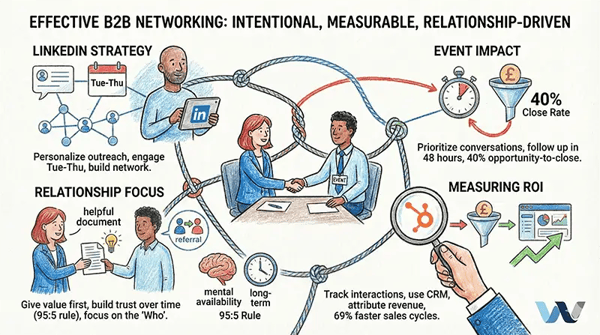
B2B networking remains the highest-converting lead generation channel, with referrals delivering 71% higher conversion rates than other sources and event-sourced leads achieving 40% opportunity-to-close rates. For UK marketers, combining LinkedIn's 44.4 million British users with strategic in-person events creates a relationship-driven pipeline that outperforms paid advertising on both cost and quality metrics.
Yet most B2B marketers approach networking without a clear strategy. They collect business cards at conferences, send generic LinkedIn connection requests, and wonder why none of it translates into pipeline. The difference between networking that generates revenue and networking that wastes time comes down to three things: intentionality, measurement, and follow-through.
This guide provides UK-specific strategies, current benchmarks from 2025-2026 research, and practical frameworks for B2B marketing professionals. Whether you are a Marketing Director at a SaaS company or Head of Demand Generation at a professional services firm, these approaches will help you build a network that contributes directly to revenue. Tools like HubSpot CRM make it possible to track relationship-to-revenue attribution, turning networking from a vague activity into a measurable channel.
Why B2B Networking Still Outperforms Digital Marketing Channels

Despite the sophistication of modern digital marketing, B2B purchasing decisions remain fundamentally relationship-driven. According to research from Harvard Business Review, 84% of B2B decision-makers start their buying process with a referral. This is not nostalgia for older sales methods; it reflects how complex B2B purchases actually work.
The numbers tell a compelling story. B2B companies with active referral programmes report 71% higher conversion rates compared to those relying solely on inbound marketing, according to ThinkImpact's 2025 analysis. Referred customers also deliver 16% higher lifetime value and 37% better retention rates. When Whitehat SEO analyses pipeline attribution for clients using HubSpot, referral-sourced opportunities consistently close faster and at higher values than marketing-qualified leads from other channels.
Event-sourced leads perform particularly well in the mid-market B2B space. Data from The Digital Bloom's 2025 pipeline benchmarks shows event leads achieving 40% opportunity-to-close conversion rates, making them the strongest bottom-of-funnel channel measured. This explains why 78% of event organisers identify in-person events as their most impactful marketing channel, according to Bizzabo's February 2025 research.
The cost dynamics also favour networking. While the average B2B cost per lead sits around £157, referral-generated leads cost approximately £20, according to Sopro's 2025 benchmark report. Even accounting for the time investment in relationship building, the economics strongly favour strategic networking over purely paid acquisition strategies.
How to Network on LinkedIn for B2B Lead Generation
LinkedIn dominates B2B networking in the UK. With 44.4 million British users as of November 2024, according to Statista, the platform represents the primary digital networking channel for marketing professionals. However, most B2B marketers use LinkedIn ineffectively, treating it as a broadcast channel rather than a relationship-building platform.
The Belkins/Expandi 2025 study of over 20 million LinkedIn outreach attempts provides clear benchmarks. Connection requests with a personalised message achieve 26.42% acceptance rates. Messages to new connections with personalisation receive 9.36% reply rates, compared to just 5.44% without personalisation. This 72% improvement from personalisation represents the difference between effective networking and noise.
Industry matters significantly for LinkedIn networking success. Legal and professional services professionals respond at 10.42%, the highest rate measured. Healthcare follows at 9.25%, then retail and consumer goods at 9.17%. Software and SaaS sits at just 4.77%, reflecting the saturation of automated outreach in the technology sector. UK B2B marketers targeting technology companies need to invest more in genuine relationship building rather than scaled outreach.
Timing affects results more than many marketers realise. The same Belkins research shows Tuesday (6.90% response rate) and Monday (6.85%) outperforming other weekdays, with weekends showing notably lower engagement. For UK professionals, this means scheduling outreach for early-week mornings when recipients are planning their working week.
Sales representatives who excel at quota consistently maintain larger, more active LinkedIn networks. According to Lead Forensics data cited in TryKondo's 2025 benchmarks, reps performing at 150% or more of quota are twice as likely to have expanded their LinkedIn connections in the past year. Notably, 31% of high-performing reps have closed deals over £400,000 without ever meeting the buyer face-to-face, demonstrating that digital networking can support even complex, high-value sales.
Making the Most of B2B Events and Conferences
In-person events have rebounded strongly since 2023. According to Bizzabo's research, 54% of B2B attendees plan to attend more in-person events in 2026 compared to 2025. The format split has stabilised at approximately 60% in-person, 35% virtual, and 5% hybrid events.
Event ROI justifies the investment for companies that approach events strategically. Fortune Business Insights reports that 48% of brands achieve 300-500% ROI through event marketing. The key differentiator is preparation and follow-up rather than the event attendance itself.
Key UK Events for B2B Marketing Professionals
The UK offers several high-value networking opportunities for B2B marketers:
- B2B Marketing Live (ExCeL London, November): The UK's largest B2B marketing event with 120+ speakers and 4,000+ attendees. Excellent for meeting marketing leaders across industries.
- B2B Ignite (London, July): Focused on research-backed marketing strategies with 70+ speakers and exclusive case studies.
- Technology for Marketing (ExCeL London, September): UK-leading MarTech and AI event, CPD-accredited, ideal for marketing technology professionals.
- London HubSpot User Group: The world's largest HubSpot user community, meeting regularly for practical sessions on marketing automation and CRM. Whitehat SEO organises these events, bringing together HubSpot users across the UK.
- BrightonSEO (April/May and October): Essential for SEO and digital marketing professionals seeking technical knowledge and industry connections.
Freeman's research shows that 81% of event attendees are most interested in networking with industry experts, not just attending sessions. This means your event strategy should prioritise conversations over content consumption. Identify 5-10 specific people you want to meet before each event, research their work, and prepare thoughtful questions that go beyond surface-level introductions.
The Art of B2B Relationship Building
Effective B2B networking requires a fundamental mindset shift from transaction to relationship. Jill Rowley, former HubSpot advisor and social selling pioneer with 24 years in B2B SaaS, captures this succinctly: buyer behaviour has shifted from the "How" economy to the "Who" economy. Buyers now ask "Who can help me solve X?" and seek out trusted nodes in their network rather than searching for vendors.
The 2024 LinkedIn-Edelman B2B Thought Leadership Impact Report provides evidence for this shift. Nine in ten executives are more receptive to outreach from companies producing quality thought leadership. At any given time, 95% of B2B buyers are not actively seeking goods or services, a finding known as the 95:5 rule from Ehrenberg-Bass research. This means networking should focus on building relationships before prospects enter buying mode, not identifying and pursuing active buyers.
Jon Miller, co-founder of Marketo and architect of modern B2B marketing automation, reinforces this in his January 2026 predictions: complex purchases require human validation, relationship-building, and trust. AI may compress research time, but people sign contracts. The marketers who build genuine relationships during the 95% "out-of-market" period are the ones who get called when prospects enter buying mode.
Practical relationship building follows a consistent pattern. Provide value before asking for anything. Share relevant articles, make introductions, offer genuine help with problems. Track these interactions in your CRM so you can maintain appropriate follow-up cadence. HubSpot onboarding includes setting up contact relationship tracking that makes this systematic rather than random.
How to Measure Your Networking ROI

The inability to measure networking ROI keeps it undervalued in many marketing organisations. According to HubSpot's 2025 State of Marketing report, 21% of B2B marketers cite proving ROI as their primary challenge. Only 4% measure marketing ROI over timeframes longer than six months, despite average B2B sales cycles running six months or longer.
Effective networking measurement requires tracking at multiple levels. Input metrics include events attended, connections made, follow-up conversations scheduled, and time invested. Process metrics cover connection-to-conversation conversion rates, average time from introduction to meeting, and content shared or value provided. Output metrics link back to revenue: opportunities influenced, deals where relationships played a role, and referral-generated pipeline value.
For B2B marketers using HubSpot, relationship tracking becomes systematic. Create custom properties for "Relationship Source" and "Introduced By" to capture referral chains. Use deal influence reporting to attribute revenue to networking activities. Build dashboards that show cost-per-opportunity from networking compared to other channels.
Companies that close sales 69% faster typically have formal referral programmes with tracking mechanisms, according to ThinkImpact research. The tracking itself improves outcomes because it creates accountability and reveals which networking activities produce results.
UK Networking Culture: What Makes British B2B Different
British professional networking operates by different cultural norms than American-style networking, and understanding these differences improves effectiveness for UK marketers and international professionals working with UK clients.
Self-promotion is viewed differently in British business culture. Where American networking culture encourages direct discussion of achievements, British professionals often respond negatively to what they perceive as boasting. The practical implication: let your work speak, share results when directly relevant, and focus conversations on the other person's challenges rather than your capabilities.
Communication style also differs significantly. Research from TollFreeForwarding surveying 1,000 UK and 1,000 US workers found notable interpretation gaps. When a British colleague says "That's an interesting idea," 32% mean "your idea is ridiculous." Similarly, "I have a few amends" from 43% of British respondents actually means "this needs complete rewriting." These indirect communication patterns extend to networking, where British professionals may signal interest or disinterest through subtle cues that direct communicators miss.
Relationship-building pace differs too. British business culture generally separates social and professional contexts more distinctly. Pub conversations after events serve relationship purposes but often avoid direct business discussion. Trust builds over multiple interactions rather than single intensive meetings. International marketers working UK accounts should plan for longer relationship development timelines.
UK Business Networking Organisations
Several organisations provide structured networking opportunities across the UK:
- BNI UK: The UK's largest business networking organisation with 13,000+ members. Their "Givers Gain" philosophy emphasises providing referrals before expecting them. BNI UK chapters generated £304 million in referral business in the past 12 months.
- Chartered Institute of Marketing (CIM): Regional networks in Greater London, Scotland, South West, and Aberdeen offer marketing-specific networking with CPD-approved events.
- Institute of Directors (IoD): Regional breakfast briefings and Emerging Leaders Series provide access to senior business leaders.
Want to Build Your Professional Network?
Whitehat runs the largest London HubSpot User Group — join us for networking events that connect B2B marketing leaders across the UK.
Join Our Next EventFrequently Asked Questions
How long does it take to see ROI from B2B networking activities?
Most B2B networking ROI becomes visible within 6-12 months, aligning with typical B2B sales cycles. Initial relationship-building takes 2-3 months, with referral opportunities emerging after 4-6 months of consistent engagement. Companies with formal tracking systems using tools like HubSpot CRM typically identify attributable revenue faster than those relying on informal methods.
Is LinkedIn or in-person networking more effective for B2B?
Both channels serve different purposes and work best in combination. LinkedIn enables scale and initial connection, with 26.42% acceptance rates for personalised requests. In-person events build deeper relationships and achieve 40% opportunity-to-close rates for event-sourced leads. The most effective approach uses LinkedIn to identify and research prospects, then deepens relationships through in-person interaction.
How many networking events should I attend each quarter?
Quality outweighs quantity. Most B2B marketing professionals benefit from 2-4 well-chosen events per quarter plus consistent weekly LinkedIn engagement. The key is thorough preparation and systematic follow-up rather than maximising attendance. One event with 10 meaningful conversations and proper follow-up outperforms five events with superficial interactions.
What is the best way to follow up after meeting someone at an event?
Follow up within 48 hours while the conversation remains fresh. Reference something specific you discussed rather than sending generic messages. Provide immediate value by sharing a relevant article, making an introduction, or offering help with a challenge they mentioned. Schedule a brief video call to continue the conversation rather than leaving the relationship dormant.
How do I network authentically without feeling like I am selling?
The discomfort typically comes from approaching networking with a sales mindset. Instead, focus on learning about the other person's challenges, sharing knowledge genuinely, and making introductions that help others. Jill Rowley's advice applies: to be interesting, be interested in something other than yourself. When you build relationships without immediate agenda, sales opportunities emerge naturally from trust.
Ready to Grow Your Organic Pipeline?
Get a free audit and 90-day action plan from our team.
Get Your Free AuditBuilding Your B2B Networking Strategy
B2B networking remains among the highest-ROI activities available to marketing professionals. With referrals delivering 71% higher conversion rates and event leads closing at 40%, the investment in relationship building produces measurable pipeline impact. The key is treating networking as a strategic channel with proper measurement rather than an ad hoc activity.
For UK marketers, the combination of LinkedIn's 44.4 million British users, strong regional event calendars, and established networking organisations creates abundant opportunity. Success requires understanding British communication norms, investing in genuine relationship building before prospects enter buying mode, and systematically tracking relationship-to-revenue attribution.
Start by auditing your current networking approach: How many relationships have contributed to pipeline in the past year? Can you attribute revenue to specific connections? If you cannot answer these questions, implementing relationship tracking in your CRM should be your first priority. From there, build a deliberate strategy combining digital and in-person networking, measure results, and refine your approach based on what actually generates revenue. view our pricing
Clwyd Probert
Founder, Whitehat SEO
Clwyd Probert is the founder of Whitehat, a London-based SEO and inbound marketing agency and HubSpot Platinum Partner since 2016. He runs the largest London HubSpot User Group and advises B2B companies on connecting marketing to revenue.
References
- Belkins/Expandi (2025). What are B2B LinkedIn Outreach Benchmarks? belkins.io
- Bizzabo (2025). The Events Industry's Top Marketing Statistics. bizzabo.com
- The Digital Bloom (2025). 2025 B2B SaaS Funnel Benchmarks. thedigitalbloom.com
- LinkedIn/Edelman (2024). B2B Thought Leadership Impact Report. linkedin.com
- Sopro (2025). B2B Cost Per Lead Benchmarks by Channel and Industry. sopro.io
- Statista (2024). LinkedIn Users in the United Kingdom. statista.com
- ThinkImpact (2025). B2B Referral Statistics. thinkimpact.com
- TryKondo (2025). B2B Sales Benchmarks 2025. trykondo.com