
Video Marketing
Video now accounts for 82.5% of all global internet traffic, up from 73% in 2016. The average person watches approximately 17 hours of online video weekly, with Gen Z consuming a remarkable 7.2 hours daily. This shift in media consumption fundamentally changes how B2B buyers research and evaluate solutions.
Video Marketing in 2025: Statistics, Trends and B2B Revenue Growth Strategies
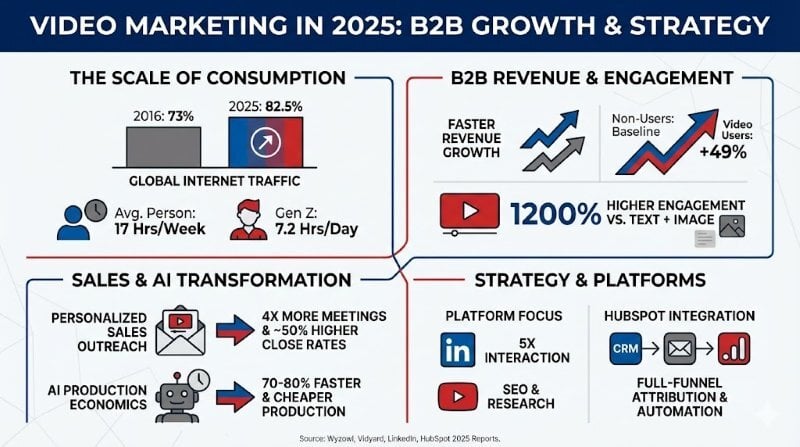
Video marketing drives 49% faster revenue growth for B2B companies, with 91% of businesses now using video as a core marketing tool—an all-time high according to Wyzowl's 2025 research. The transformation is unmistakable: B2B buyers watch an average of 5–8 video pieces before engaging with sales, whilst AI-powered video creation has surged from 18% to 63% adoption in just two years. For HubSpot-powered businesses, integrating video across the marketing and sales flywheel has never been more critical—or more accessible.
Whitehat SEO's analysis of video marketing trends reveals that short-form content now delivers 2.5 times more engagement than long-form, and sales teams using personalised video outreach report 64% higher response rates. This guide covers the essential statistics, platform strategies, and implementation approaches that B2B marketing directors need to capture video's revenue potential in 2025.
The scale of video consumption has reached unprecedented levels
The B2B buyer journey has become overwhelmingly digital and video-centric. Research from Wyzowl shows that 70% of B2B buyers watch videos throughout their sales journey, and 67% of the buyer journey happens digitally before any sales conversation. When given the choice, 78% of consumers prefer watching a short video to learn about products and services—compared to just 9% preferring text-based content.
KEY B2B VIDEO STATISTICS FOR 2025
- 96% of people have watched an explainer video to learn about a product
- 85% have been convinced to buy after watching a brand's video
- 49% faster revenue growth reported by companies using video
- 1,200% higher engagement rates for B2B video versus text and image content combined
- Up to 80% conversion rate boost from adding video to landing pages
For B2B specifically, the impact is striking. Companies using video report significantly faster revenue growth than non-users, and B2B video content achieves substantially higher engagement rates than text and image content combined. Adding video to landing pages can boost conversion rates by up to 80%, according to Eyeview Digital research—a statistic that makes video integration essential for any inbound marketing strategy.
B2B sales teams are transforming outreach with personalised video
Video has moved beyond marketing into the heart of B2B sales processes. Nearly 60% of sales representatives now use video in their outreach, with personalised video messaging delivering transformative results. According to Vidyard's 2025 Video in Business Benchmark Report, sales teams using custom video report 64% higher response rates than text-only approaches, and video emails generate 16 times higher click-to-open rates than non-personalised alternatives.
The tactical impact is measurable across the entire sales cycle. Including "video" in email subject lines increases open rates by 7–19% and click-through rates by 65%. Personalised video outreach books four times more meetings than traditional prospecting. Sales teams using video report nearly 50% higher close rates, and over one-third of sales professionals cite shortened sales cycles when using video.
| Video Tactic | Impact |
|---|---|
| "Video" in subject lines | 7–19% higher open rates, 65% higher CTR |
| Personalised video outreach | 4× more meetings booked |
| Sales teams using video | ~50% higher close rates |
| Hybrid video (selfie + screen share) | Highest response rates reported |
| Videos under 60 seconds | 65% of viewers watch to completion |
Vidyard's benchmark report reveals explosive growth in sales video creation, with users producing 88% more videos than the previous year—an average of 37 videos per user annually, up from approximately one per month. The hybrid video format combining selfie and screen share delivers the highest response rates, with over 50% of sales professionals confirming this approach outperforms alternatives. Asynchronous video tools like Vidyard, Loom, and HubSpot's native video features have become essential for modern sales teams.
AI has fundamentally changed video production economics
The most significant shift in video marketing since 2019 is AI's impact on video creation. 63% of video marketers now use AI tools to create or edit marketing videos—up from just 18% in 2023. This adoption has compressed production timelines by 70–80% and reduced production costs by a similar margin for many organisations.
AI video tool adoption has reached critical mass. Synthesia, serving over 90% of Fortune 100 companies, enables avatar-based video creation across 140+ languages. HeyGen offers 300+ AI voices with voice cloning capabilities. The AI video generator market reached £490 million in 2024 and is projected to hit £2 billion by 2032 at a 19.5% compound annual growth rate.
Primary AI Video Use Cases
Pre-production
Scripting and brainstorming—top use case
Captions
Over 60% of marketers use AI for caption generation
Translation
30%+ leverage AI for multi-language translation
AI Avatars
12× increase in adoption during 2024
The ROI case for AI-powered personalisation is compelling. Personalised AI video campaigns achieve 4.5 times higher click-through rates, generate three times more conversions, and deliver 40% higher ROI in e-commerce applications. Importantly, 65% of consumers express interest in receiving AI-generated video from brands, with millennials (78%) and Gen Z (76%) showing the highest receptivity. Whitehat SEO's AI for marketers guide provides detailed implementation strategies for integrating these tools into your workflow.
Platform strategies have diverged for B2B effectiveness
LinkedIn: the B2B video powerhouse
LinkedIn has emerged as the dominant platform for B2B video. Video posts on LinkedIn are shared 20 times more than any other content type, and native video drives five times higher interaction rates than text or image posts. LinkedIn Live videos receive seven times more reactions than standard video posts. The platform saw a 36% year-over-year increase in video viewership during 2024, with video uploads growing 34% annually.
LinkedIn video best practices have crystallised around several key factors. Critically, 80% of LinkedIn videos are watched without sound, making captions mandatory rather than optional. Videos under 15 seconds achieve the highest engagement, whilst those under 30 seconds see 200% higher completion rates. Thought-leadership video ads deliver 1.7 times higher click-through rates and 1.6 times higher engagement than standard formats.
YouTube remains essential for B2B
90% of video marketers use YouTube, and 50.9% of B2B decision-makers conduct product research there. YouTube's position as the world's second-largest search engine provides unique SEO value. Brands mixing YouTube Shorts with long-form content grow their channels 41% faster than those focusing on a single format.
YouTube Shorts now leads short-form engagement with a 5.91% engagement rate—surpassing TikTok's 5.75%. Daily views have grown from 30 billion in 2021 to 70–90 billion in 2024–2025, with channels uploading Shorts increasing by 50% year-over-year. Short-form video delivers the highest ROI for B2B at 55% according to LinkedIn's 2024 B2B Benchmark Report.
| Platform | B2B Usage | Key Advantage |
|---|---|---|
| 70% of video marketers | 5× higher interaction vs other content | |
| YouTube | 90% of video marketers | SEO value + decision-maker research |
| YouTube Shorts | 5.91% engagement rate | Highest short-form engagement |
| 66% of video marketers | Live video: 6× more engagement |
Video types that drive B2B conversions
The most effective video formats for B2B marketing follow a consistent hierarchy based on usage and impact. Explainer videos lead at 68–75% usage, with 96% of consumers having watched one to learn about products. Customer testimonials have become the most popular singular use case in 2024, delivering the highest trust-building impact.
| Video Type | Usage Rate | Key Impact |
|---|---|---|
| Explainer videos | 68–75% | Up to 80% landing page conversion lift |
| Customer testimonials | 39–57% | Highest trust-building impact |
| Product demos | 32–39% | 49% of buyers say demos add most value |
| Webinars | 56% | 73% of attendees become leads |
| Training videos | 45% | Highest engagement rates |
Webinars deliver exceptional B2B results. Average attendance rates reach 35–50% of registrants, with 56% conversion rates to desired actions. The cost per lead averages just £57 compared to £650 for trade shows. Notably, 89% of webinar leads come from live attendees rather than on-demand viewers, though 40% of total views occur on-demand—extending content lifespan significantly.
Live-action video dominates production at 51% of all marketing videos created, followed by animated (23%) and screen-recorded (19%). However, Wistia's research confirms that production value doesn't necessarily correlate with engagement—audiences willingly watch low-budget content including webcam recordings when the content provides genuine value. This insight is particularly relevant for teams implementing B2B video marketing strategies with limited resources.
Video SEO and AI search visibility require new approaches
Video can increase organic traffic by 157% and makes content 53% more likely to appear on page one of search results. Approximately 26% of Google search results now include videos, with HD quality appearing significantly more often in top positions.
The critical ranking factors for video SEO in 2025 are: watch time (total minutes viewed), audience retention (percentage watched), click-through rate from search results, engagement signals (likes, comments, shares), and keyword relevance across titles, descriptions, and spoken content.
Video SEO Ranking Factors for 2025
- Watch time — Total minutes viewed remains the primary signal
- Audience retention — Percentage of video watched indicates quality
- Click-through rate — Thumbnail and title optimisation matters
- Engagement signals — Likes, comments, shares boost visibility
- Keyword relevance — In titles, descriptions, and spoken content
Google AI Overviews, launched in May 2024, now appear for approximately 8.71% of keywords. When expanded, AI Overviews contain an average of 7.2 links, with 33.4% of those links ranking in the top 10 organic results. AI Overviews combined with featured snippets occupy 67% of desktop screens and 75.7% of mobile screens—making video optimisation for these formats increasingly important.
VideoObject schema markup has become essential for video discoverability. Required properties include video name, thumbnail URL, and upload date. Recommended additions include description, duration, content URL, and embed URL. For videos to appear in AI-generated answers across Google, Perplexity, and similar platforms, content must include proper transcripts, comprehensive captions, and complete metadata. Whitehat SEO's SEO services include comprehensive video optimisation strategies aligned with these requirements.
Budget realities have shifted toward in-house and AI-assisted production
Video marketing budgets typically represent 21% of total marketing spend, with most companies allocating dedicated video budgets. The majority of businesses spend under £4,000 per video, with 50% investing under £400 per video. Global video ad spend reached £153 billion in 2024 and is projected to hit £193 billion by 2028.
In-house production has become the dominant model. 59% of businesses now create videos entirely in-house, with external outsourcing dropping from 24% in 2024 to just 10% in 2025. The remaining 32% use a hybrid approach combining internal teams with external specialists for specific projects.
| Production Method | Typical Cost Range |
|---|---|
| In-house with AI tools | Under £400 per video |
| Freelancers | £24–£80 per hour |
| Remote production companies | £200–£400 per minute |
| Agencies/production companies | £80–£140 per hour; avg project £34,000 |
| Live-action demos | £800–£2,400 per minute |
AI has compressed costs significantly. Zoom reported savings of up to £1,200 per employee using AI video tools. The perception of costs is shifting: 30% of marketers believe costs are getting cheaper, 32% see no change, whilst 38% report increases—largely driven by production quality expectations rising alongside capabilities.
HubSpot's video ecosystem enables end-to-end implementation
For HubSpot users, native video hosting provides ad-free playback across pages, emails, blogs, and CRM records. Marketing Hub Professional/Enterprise supports up to 50 videos with advanced features including custom thumbnails, caption uploads, and CTA/form overlays. Content Hub tiers extend capacity to 150–500 videos.
HubSpot's Breeze AI features (announced 2024–2025) include AI clipping to identify shareable moments, auto-generated titles and descriptions, AI translations for multilingual captions, and omnichannel reporting tracking views across social and web-hosted content.
Key HubSpot Video Integrations
Vidyard Integration
- AI-powered video workflows
- CRM-tracked viewer engagement
- Workflow triggers based on views
- AI avatar automation sequences
Wistia Integration
- HubSpot form embedding within videos
- Lead capture from webinars
- Media Bridge library access
- Deep analytics integration
Whitehat SEO's HubSpot onboarding services include video integration setup, ensuring your team can leverage these capabilities from day one. As a HubSpot Diamond Partner, we've implemented video-integrated workflows for clients across manufacturing, professional services, and SaaS sectors.
The strategic imperative for B2B video in 2025
The 2024–2025 video marketing landscape presents clear imperatives for B2B organisations. Video is no longer optional—91% adoption among businesses reflects its transition from differentiator to table stakes. The AI transformation has democratised high-quality video production, with 63% of marketers now using AI tools and costs dropping by 70–80% for many use cases. Short-form content delivers the highest ROI at 55% for B2B, whilst LinkedIn has emerged as the dominant B2B video platform with five times higher interaction rates for video versus other content types.
For sales teams, personalised video outreach represents one of the highest-impact opportunities available, delivering 64% higher response rates and four times more booked meetings. The integration of video throughout HubSpot's ecosystem—from marketing automation to CRM to sales enablement—enables organisations to capture these benefits systematically rather than through isolated experiments.
The most significant insight for 2025 may be Wistia's finding that production value doesn't determine engagement—content value does. This shift, combined with AI-powered production tools, means B2B organisations of all sizes can now compete effectively through video. The question is no longer whether to invest in video marketing, but how quickly organisations can build the capabilities to capture the 49% faster revenue growth that video-enabled companies achieve.
Frequently asked questions about B2B video marketing
How much should a B2B company budget for video marketing in 2025?
Most B2B companies allocate 21% of their total marketing budget to video, with typical per-video costs ranging from under £400 for in-house AI-assisted production to £34,000 for agency-produced content. The majority of businesses (50%) spend under £400 per video, making video marketing increasingly accessible for companies of all sizes.
What video length works best for B2B marketing?
For B2B marketing, videos under 60 seconds retain 65% of viewers to completion, making them ideal for initial outreach. LinkedIn videos under 30 seconds see 200% higher completion rates. However, for detailed product demos and webinars, longer formats (20–60 minutes) are appropriate and show the highest conversion rates according to Wistia data.
Which platforms should B2B companies prioritise for video distribution?
LinkedIn and YouTube should be the primary focus for B2B video. LinkedIn delivers 5× higher interaction rates for video versus other content, whilst 50.9% of B2B decision-makers use YouTube for product research. YouTube Shorts now offers the highest short-form engagement rate at 5.91%, making a combined short and long-form strategy most effective.
How can sales teams use video to improve response rates?
Sales teams using personalised video outreach report 64% higher response rates and book 4× more meetings. The hybrid video format (selfie combined with screen share) delivers the highest engagement. Including "video" in email subject lines increases open rates by 7–19% and click-through rates by 65%.
Is AI-generated video effective for B2B marketing?
Yes—63% of video marketers now use AI tools for video creation, with adoption driving 70–80% reductions in production time and costs. AI-personalised video campaigns achieve 4.5× higher click-through rates. Importantly, 65% of consumers are receptive to AI-generated brand video, with millennials (78%) and Gen Z (76%) showing the highest acceptance.
References and sources
- Wyzowl — Video Marketing Statistics 2025 (11 Years of Data)
- Vidyard — Video in Business Benchmark Report 2025
- Vidyard — The State of Sales & Virtual Selling Report
- LinkedIn Marketing Solutions — B2B Benchmark Report 2024
- HubSpot — State of Marketing Report 2024
- Wistia — Video Marketing Resources and Research
Ready to integrate video into your marketing strategy?
Whitehat SEO helps B2B companies implement video marketing strategies that drive measurable pipeline growth.
Book a Discovery CallRelated Articles marketing services view our pricing