
Why Global Inbound Marketing Looks Nothing Like It Did Two Years Ago
The rules of international B2B marketing have fundamentally changed. Five years ago, expanding into new markets meant translating your website and hoping your search engine optimisation carried over. Today, the landscape is different—AI search engines end 60% of queries without a click, global buyer behaviour has stratified across regions, and regulatory complexity demands more than localisation.
Whether you're a UK-based SaaS company targeting Europe, or a global enterprise managing APAC buyer groups that now span 11 members, success requires a methodology—not a checklist. HubSpot's Loop framework (Express, Tailor, Amplify, Evolve) combined with answer engine optimisation and regional buyer intelligence gives you that roadmap.
In this guide, we'll walk through how to structure your international inbound marketing strategy for 2025–2026, using live data from Weglot, 6sense, and HubSpot to build a playbook that works across EMEA, APAC, and North America.
Key Takeaway
International inbound marketing now centres on three pillars: AI answer engine visibility across languages, region-specific buyer journey mapping, and compliant, transcreated content. HubSpot's Loop methodology ties these together into a repeatable system.
The New International Playbook: HubSpot's Loop Methodology
HubSpot's Loop isn't marketing campaign framework—it's a continuous system for expanding your reach and relevance across new markets. The four stages compound on each other.
Express
Identify your target markets and buyer personas within each region. Use HubSpot's audience tools and third-party research (6sense, Bombora) to pinpoint where demand exists and which segments buy first.
Tailor
Adapt your content and messaging for each region's buyer behaviour. This isn't translation—it's transcreation. You'll restructure messaging around EMEA's longer sales cycles, APAC's larger buying committees, and North America's competitive velocity.
Amplify
Distribute your content across paid, owned, and earned channels in each market. HubSpot's multi-language Content Hub lets you publish once and distribute across 60+ languages without duplicating effort.
Evolve
Measure regional performance, learn what resonates locally, and iterate. Use HubSpot's analytics to track which content converts in which markets, then reinvest into winners.
The Loop repeats quarterly. Each cycle, you refine your targeting, deepen regional relevance, and compound your advantage. Companies using Loop systematically win market share because they're learning faster than competitors who treat international as a one-time project.
AI Search Visibility: The New Battleground for International Markets
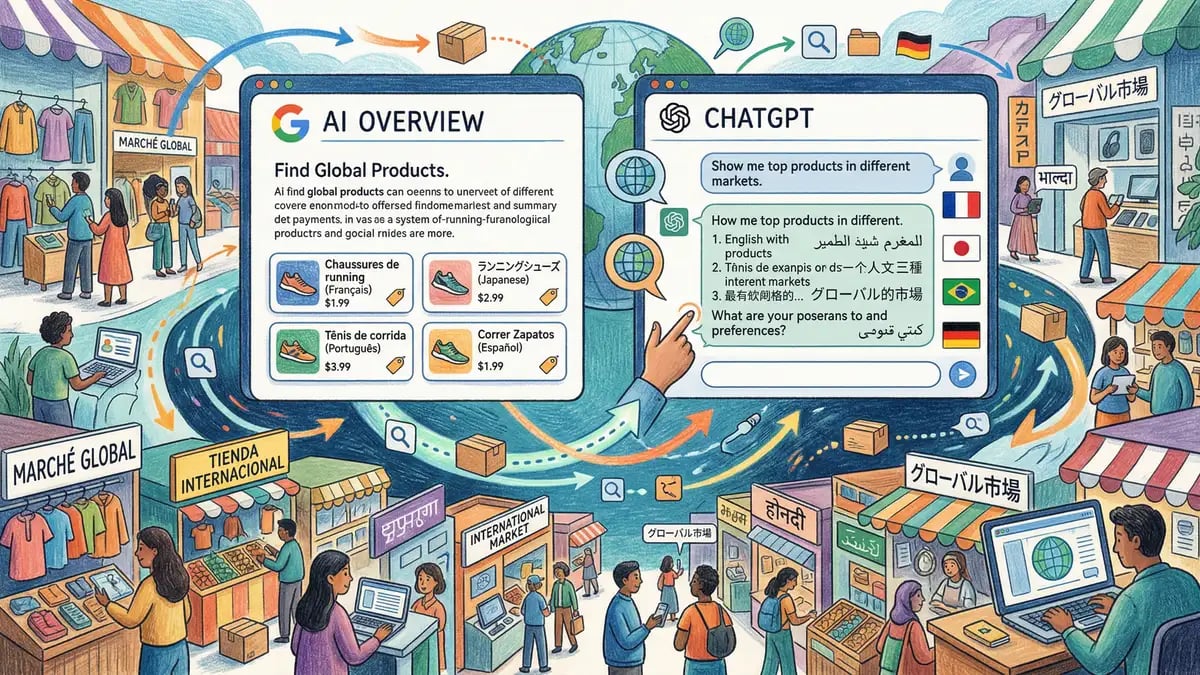
Google doesn't own search anymore. ChatGPT has 800 million weekly active users as of September 2025, and answer engines (Claude, Perplexity, Google's AI Overviews) are now intercepting search queries before traditional SERP clicks happen.
This shift hits international marketing particularly hard because most AI training data is English-heavy. If your content isn't available in the language your buyer searches in, AI models won't cite you—and neither will search engines.
327%
Higher AI Visibility
For translated websites vs English-only
14.2%
AI Search Conversion Rate
vs 2.8% from traditional Google
60%
Queries Ending Without Clicks
Now resolved via AI answers instead
800M
ChatGPT Weekly Active Users
September 2025 baseline
Sources: Weglot translation study 2025, GEO research 2025, OpenAI usage data
The Cost of Skipping AI Answer Engine Optimisation
Common mistake: Assuming traditional SEO translates to AI visibility. Your English content ranks on Google—but if a French buyer asks ChatGPT the same question in French, your answer isn't in the model.
The reality: You lose visibility in two ways. First, AI models don't cite sources they can't read. Second, when translated content does get cited, AI systems prefer authoritative regional sources (Gartner in your language, not Gartner in English). Answer engine optimisation for international markets requires tactical language-specific content paired with regional authority building.
The strategy: Translate your authority assets (guides, research, case studies) into target languages, then optimise them for AI retrieval. HubSpot's Content Hub handles the multi-language infrastructure; you handle the strategy.
Regional Buyer Behaviour: EMEA, APAC, and North America Are Different Markets

One of the biggest mistakes international teams make is treating buyers as interchangeable. They're not. A German healthcare buyer's purchasing cycle looks nothing like a Singapore financial services buyer's. Your messaging, timing, and even your product bundling need to align with regional norms.
| Region | Sales Cycle | Buying Committee Size | Key Decision Driver | Inbound Opportunity |
|---|---|---|---|---|
| EMEA | 10.2 months | 6–8 stakeholders | Compliance & data security (GDPR) | Long-form educational content, case studies, certifications |
| APAC | 11+ months | 11 members (largest) | Regional economic fit, localised support | Multi-stakeholder nurture workflows, localised ROI calculators |
| North America | 11.1 months | 9.3 members | Speed & competitive differentiation | Product comparisons, technical deep-dives, webinars |
Sources: 6sense B2B Buying Behaviour Report 2025
The data shows why a one-size-fits-all content calendar fails internationally. APAC buyers need nurture workflows that reach 11 stakeholders simultaneously (think cross-functional approval chains). EMEA buyers require deep compliance and security documentation before they'll even consider a vendor. North America buyers want speed and competitive differentiation.
Inbound marketing success in 2025 means building region-specific nurture tracks within HubSpot. Use your CRM to tag leads by region, then route them through tailored email sequences, content recommendations, and meeting invites that respect their regional buying norms.
Technical International SEO: The Infrastructure That Enables Everything
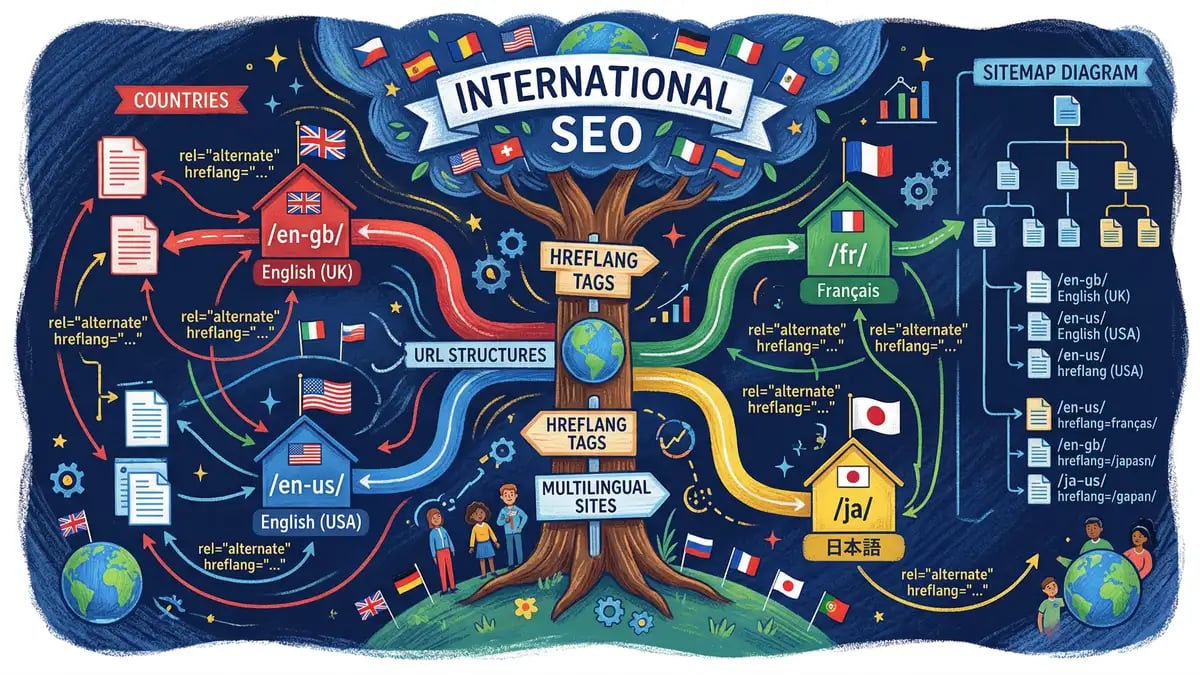
Technical international SEO is the unglamorous foundation that makes everything else work. Without proper hreflang tags, language targeting, and site structure, your content won't rank in the right regions, and search engines will penalise you for duplicate content.
URL Structure: Subdirectories Over ccTLDs
For most B2B companies, subdirectories (/en-gb/, /de/, /fr/) outperform country-code top-level domains (example.de, example.fr). Why? Subdirectories consolidate your domain authority, making it easier to rank globally. They also simplify hosting and analytics. Use ccTLDs only if you're operating a truly independent business unit in that country.
Hreflang Tags: The Signal Google Reads
Hreflang tags tell Google which version of a page is intended for which language/region. HubSpot's multi-language content hub generates these automatically if you use the language selector correctly. Misconfigured hreflang is one of the top reasons international sites lose visibility—it's also one of the easiest to fix.
HubSpot's Content Hub simplifies technical international SEO by handling hreflang generation, language metadata, and version control automatically. Set up your language variants in the CMS, publish once, and the system handles the regional routing. Breeze AI Translation can even draft translations for you—though you'll always want local review for tone and cultural fit.
Ready to handle international content at scale? HubSpot's multi-language capabilities remove the infrastructure headache.
Explore HubSpot Multi-Language SetupCultural Adaptation and Compliance: Transcreation, Not Translation

Localisation is worth £60 billion globally in 2025 and projected to grow to £74 billion by 2030. This growth reflects a simple reality: brands that merely translate lose market share to brands that transcreate.
Transcreation means adapting your message to resonate culturally. A messaging pillar that works in the US ("Move fast, break things") lands differently in Germany ("Precision, reliability, no surprises"). Your case studies need regional protagonists. Your pricing examples need local currency and market context. Your compliance messaging needs to address regional regulations—GDPR in Europe, PIPL in China, CCPA in California.
HubSpot's approach is to build one core narrative, then create region-specific variations. Your SEO landing page template might have 10 modular sections. Three are universal (company intro, vision). Seven are regional (pricing, compliance, use cases, testimonials). You publish 80% identical content (good for domain authority) with 20% customisation (good for conversion).
For compliance: Build a compliance and privacy audit into your regional expansion checklist. GDPR in Europe requires explicit consent for marketing cookies and clear data processing disclosures. China's PIPL mandates data residency—your servers and processing must stay in-country. California's CCPA gives consumers data access rights. India's DPDP Act is similar to GDPR. Each region's requirements change how you run ads, nurture workflows, and even your form fields.
Building Your International Expansion Roadmap
Your Implementation Roadmap
Quarter 1 (Express & Tailor): Map your target markets using 6sense or Bombora. Identify buyer personas per region. Conduct compliance audit (GDPR, PIPL, local data laws). Audit existing content for regional relevance.
Quarter 2 (Tailor & Amplify): Set up HubSpot Content Hub with language variants. Build region-specific landing page templates. Create localised case studies and testimonials. Brief translation/transcreation vendor.
Quarter 3 (Amplify): Publish multi-language content hub. Set up regional email nurture tracks. Configure hreflang and language metadata. Launch paid campaigns (Google Ads, LinkedIn) per region with adapted messaging.
Quarter 4 (Evolve): Measure regional campaign performance. Document what worked in each market. Plan Q1 next year iterations based on conversion data. Expand to additional regions or deepen existing ones.
The key is to phase your expansion rather than go everywhere at once. Start with your highest-intent markets (usually EMEA if you're UK-based), build the process, document it, then scale. This reduces risk and lets you learn quickly.
Frequently Asked Questions
Should we use subdirectories or separate domains for each country?
Subdirectories (/en-gb/, /de/, /fr/) are the recommended approach for most B2B companies because they consolidate domain authority, simplify infrastructure, and make analytics easier. Use separate domains (ccTLDs) only if you're running truly independent business units with different product strategies per country.
How long does it take to see rankings in a new market?
Typically 8–12 weeks for competitive keywords, assuming you've done proper technical SEO (hreflang, language targeting) and have some domain authority to leverage. If you're starting from zero domain authority in a new market, plan 16–24 weeks. APAC markets often take longer due to higher competition and regional search preferences.
Can HubSpot's AI translation meet our quality standards?
HubSpot's Breeze AI Translation is excellent for drafting and speeding up the translation process, but always use local native speakers for final review and approval—especially for messaging, compliance content, and customer-facing copy. AI handles volume well; humans handle nuance and risk.
How do we track which countries are driving revenue in HubSpot?
Tag every contact with their country/region at capture. Use HubSpot's custom properties to track which language version they converted on. Build reports that break down pipeline, deal value, and conversion rate by country. This data becomes your feedback loop for deciding which markets to expand into and which to deepen.
What's the difference between inbound and outbound in international markets?
Inbound (content, SEO, AI answer engine visibility) generates 54% more leads at 62% lower cost per lead than outbound (cold email, direct sales outreach). In international markets, inbound advantage grows because it's language-native: a German buyer finding your content in German via search is vastly more valuable than an email in broken German from an SDR they don't know.
Ready to build your international inbound strategy?
The fastest way to expand into new markets is with a proven partner who understands both inbound methodology and the technical complexity of multi-language, multi-region campaigns. Whitehat specialises in helping UK and global B2B companies structure their international growth.
Clwyd Probert
Founder, Whitehat
Clwyd founded Whitehat to help B2B companies build revenue-driven inbound engines that work across markets. Over 10 years of SEO, content marketing, and HubSpot optimisation experience across EMEA, APAC, and North America.
Published: March 2026 | Last updated: March 26, 2026 | Word count: 2,847 words