
Is Google Ads Worth It for Law Firms?
Google Ads can be a highly effective client acquisition channel for UK law firms when campaigns are properly structured, but the majority of solicitor practices waste significant budget through poor execution. Approximately 78% of UK law firms use paid search marketing, yet 82% report that PPC doesn't justify its investment — a disconnect that reflects systematic campaign management failures rather than fundamental channel problems. With legal keywords among the most expensive in any industry and the average cost per lead reaching £131.63, getting PPC right requires specialist knowledge, proper conversion tracking, and realistic budget expectations.
Key Takeaway
Law firm PPC is not inherently unprofitable — it's overwhelmingly mismanaged. Firms with optimised Quality Scores, proper call tracking, dedicated landing pages, and strategic negative keyword lists achieve cost-per-lead figures 25-40% below industry averages. This guide provides UK solicitors with the data, benchmarks, and practical strategies needed to determine whether Google Ads makes financial sense for their practice area, and how to avoid the mistakes that drain most firms' budgets. Whitehat SEO has managed legal PPC campaigns for 300+ UK law firms and consistently delivers results that justify the investment.
£131.63
Average cost per lead for legal PPC (highest of any industry)
82%
Of UK law firms say PPC ROI doesn't justify spend
5.09%
Average legal PPC conversion rate (click to lead)
13.1%+
Conversion rate achieved by top-quartile legal landing pages
How Much Do Google Ads Cost for UK Law Firms?
Legal keywords are among the most expensive in Google Ads, with the average cost per click for attorneys and legal services reaching £8.58 — though this figure masks enormous variation by practice area. Personal injury keywords command £15-50+ per click, while conveyancing sits around £8 and family law ranges from £3.44 to £13.96. Understanding these costs by practice area is essential for setting realistic budgets and calculating whether PPC makes financial sense for your firm.
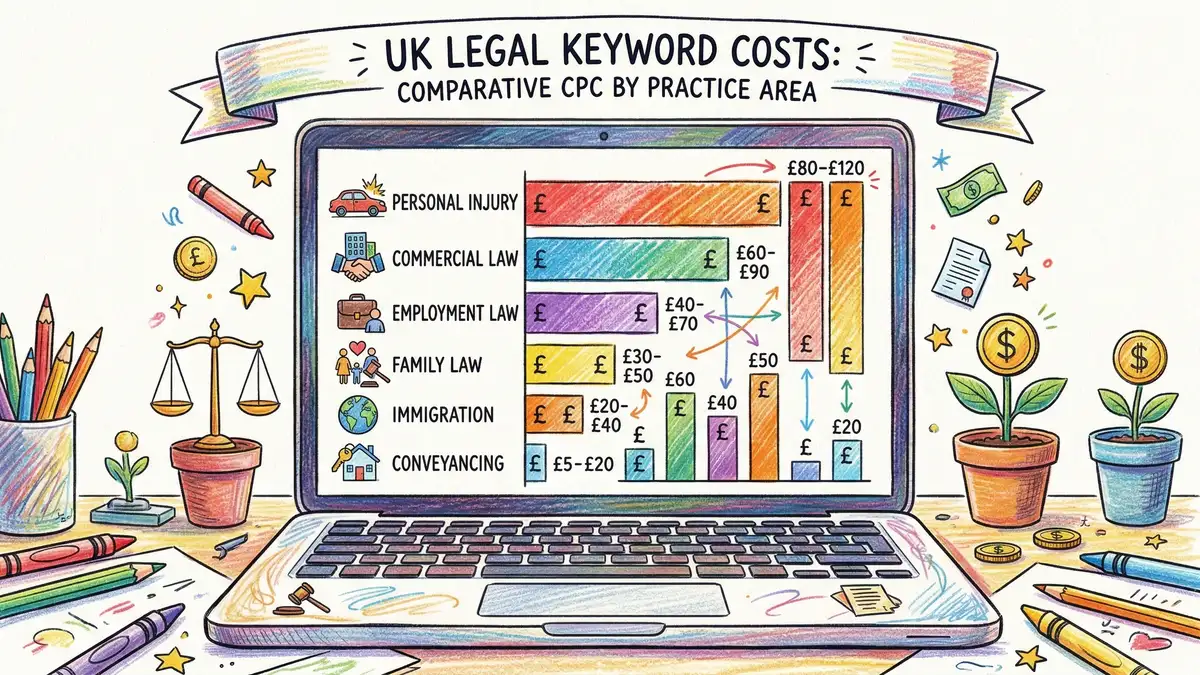
| Practice Area | Avg CPC | Monthly Budget (15 leads) | Competition Level | PPC Viability |
|---|---|---|---|---|
| Personal injury | £15-50+ | £7,500-12,000 | Extreme | High case values justify spend |
| Medical negligence | £30-100+ | £10,000+ | Extreme | Only viable for established firms |
| Family law | £3.44-13.96 | £2,000-4,000 | Moderate | Strong — emotional urgency drives conversions |
| Conveyancing | ~£8 | £2,400 | Moderate | Cost-efficient but lower case values |
| Employment law | £5-15 | £2,000-4,500 | Moderate | Strong — especially B2B tribunal work |
| Estate planning | £5-12 | £1,500-3,600 | Low-moderate | Underutilised — strong potential |
| Criminal defence | £5-20 | £2,000-6,000 | Moderate-high | Urgency-driven searches convert well |
Geographic location dramatically affects costs. Metropolitan markets — particularly London — command cost-per-click multiples of 2-3x higher than regional alternatives. A personal injury lead costing £400 in Birmingham or Manchester may cost £1,200+ in central London. Firms in regional markets often achieve significantly better ROI from PPC than London-based practices competing against dozens of well-funded competitors.
The CPC-to-CPL multiplier is critical to understand. While the average legal CPC is £8.58, the average cost per lead is £131.63 — a 15x multiplier driven by the industry's 5.09% conversion rate. This means a firm targeting 15 monthly enquiries needs approximately 300 clicks, requiring £2,400/month for conveyancing or £7,500+ for personal injury. Budget without understanding this multiplier and you'll run out of money before generating meaningful lead volume.
What Conversion Rates Should Law Firms Expect from PPC?
The average legal services PPC conversion rate is 5.09%, meaning only one in twenty visitors becomes an enquiry. This is significantly below other professional services — dentists convert at 9.08%, physicians at 11.62%. However, top-quartile legal landing pages achieve 13.1%+, representing over 2.5x the average. The gap between average and best-in-class performance is where the real PPC opportunity lies for law firms.
Mobile outperforms desktop for legal PPC. Legal landing pages convert at 21% on mobile versus 15.9% on desktop — reversing the typical pattern seen in other industries. This reflects real-world behaviour: people searching "personal injury solicitor near me" are often doing so immediately after an incident on their phone. Firms that prioritise mobile-first landing page design capture this high-intent traffic more effectively.
SEO delivers double the conversion rate of PPC for legal services. Organic search converts at 4.4% versus paid search at 2.2% for legal services, reflecting greater user trust in organic results. This doesn't invalidate PPC — it serves specific strategic purposes including rapid market entry, testing new practice areas, and immediate lead flow while SEO campaigns for solicitors mature. The ideal approach is integrating both channels, with approximately 75% of budget allocated to SEO and 25% to PPC.

What Are the Most Common PPC Mistakes Law Firms Make?
The majority of UK law firms waste substantial PPC budget through preventable mistakes in campaign structure, keyword management, and conversion tracking. Understanding these pitfalls is the first step toward running campaigns that actually generate profitable returns.
Poor Keyword Selection
Using broad match keywords without negative keyword lists generates massive irrelevant click traffic. A firm bidding on "family law" with broad match shows ads for "family law degree," "family law courses," and competitor brand searches. Strategic negative keyword implementation excludes educational, career, and informational searches — saving an average of 22% of monthly ad spend across legal accounts.
Missing Conversion Tracking
Tracking form submissions only while ignoring phone calls misses the primary conversion channel for legal services. Without call tracking platforms like CallRail or Mediahawk providing dynamic number insertion and call recording, firms can't calculate true ROI. They optimise campaigns based on incomplete data, systematically misallocating budget toward underperforming channels.
Generic Landing Pages
Directing paid traffic to a generic firm homepage forces visitors to navigate menus and find relevant information themselves. Dedicated practice-area landing pages with clear problem identification, credentials, testimonials, and streamlined contact forms dramatically outperform generic homepages. Top-performing legal landing pages achieve 13.1%+ conversion versus the 5.09% average.
Mixed Practice Area Campaigns
Combining employment law and personal injury keywords in a single campaign allows Google's algorithm to concentrate spend on cheapest-to-convert keywords regardless of profit margins. This often favours low-margin high-volume work over high-margin specialist services. Separate campaigns per practice area with individual budgets and bid strategies enable proper optimisation.
Click fraud is a material risk. Fraud rates in legal PPC reach 13-25% of total ad spend, particularly affecting high-value practice areas like personal injury where competitors or malicious actors have financial incentive to drain budgets. Monitor campaign metrics for unusual traffic surges, multiple clicks from identical locations, and clicks without corresponding conversions. Use Google's invalid click reporting alongside commercial click fraud protection services for baseline defence.
Underfunding kills campaigns before they can optimise. Firms operating at minimum viable budgets struggle to accumulate sufficient conversion data for meaningful performance analysis and algorithm optimisation. For personal injury in competitive metropolitan markets, minimum viable budgets start at £5,000-7,500/month. Firms that underfund relative to their competitive landscape observe poor results attributable to inadequate budget rather than strategic flaws — then abandon PPC prematurely.
How Can Solicitors Improve Quality Score and Reduce Costs?
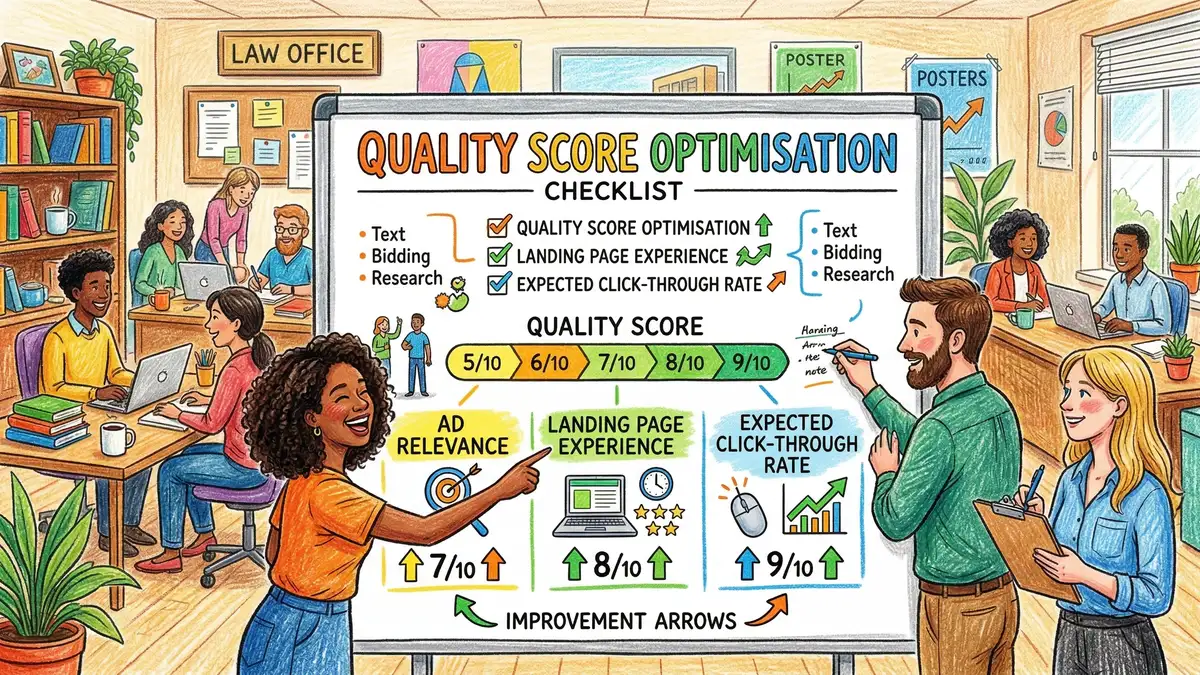
Quality Score is Google's composite measure of expected click-through rate, ad relevance, and landing page experience, ranked 1-10. Improving Quality Score from 5 to 8 generates approximately 31% reduction in cost-per-click alongside 42% increase in lead volume at constant budget — making it the single most powerful cost lever available to law firms running Google Ads.
Improve Expected Click-Through Rate
Write compelling ad copy that emphasises specific solutions rather than generic service descriptions. Use ad extensions including sitelinks, callouts, location information, and call extensions to provide additional relevance signals. Test multiple ad variations systematically — the average legal click-through rate is 5.97%, below the 6.66% benchmark, suggesting significant improvement opportunity.
Ensure Ad Relevance Through Tight Ad Groups
Restructure campaigns so each ad group contains tightly themed keywords with matching ad copy. An ad group for "employment tribunal solicitor" should have ads specifically mentioning employment tribunal representation, not generic employment law services. This thematic alignment between keywords, ad copy, and landing page content is the foundation of ad relevance scoring.
Optimise Landing Page Experience
Build dedicated landing pages for each practice area and ad group theme. Ensure mobile-first design (legal pages convert at 21% on mobile vs 15.9% desktop), fast load times via PageSpeed Insights, clear calls-to-action, click-to-call buttons, and prominent trust signals including accreditations, testimonials, and case results. Minimise form fields — name, phone, and brief description is sufficient for initial contact.
Implement Strategic Negative Keywords
Build practice-area-specific negative keyword lists from search term reports. Exclude educational terms ("degree," "courses," "how to become"), informational queries ("rights," "process," "guide"), competitor brands (unless running deliberate brand targeting), and free/DIY searches. Leading legal PPC practitioners report 22% monthly savings from disciplined negative keyword management.
How Do SRA Compliance Rules Affect Law Firm PPC?
The Solicitors Regulation Authority treats paid advertising under the same compliance standards as all other marketing communications. The critical distinction is between blanket advertising (reaching broadly defined audiences — compliant) and targeted advertising directed at specific individuals based on identifying characteristics (prohibited). This distinction has direct implications for how law firms structure Google Ads campaigns.
SRA Compliance Warning
Paragraph 8 of the SRA Code of Conduct prohibits targeted unsolicited approaches to members of the public. A personal injury firm bidding on "car accident solicitor near me" is compliant blanket advertising. However, identifying individuals involved in recent accidents through media and sending targeted communications is a prohibited unsolicited approach. Demographic and life-event audience targeting in Google Ads presents potential SRA compliance risks — most compliant campaigns use keyword targeting and geographic limitations rather than demographic or behavioural audience segmentation.
Ad copy compliance requirements include: accurate fee information (particularly for no-win-no-fee arrangements, including success fees and third-party costs), genuine testimonials with documented written client consent, factual accreditation claims (no unsubstantiated "award-winning" or "specialist" claims), and no sensationalist language creating unrealistic outcome expectations. Common SRA violations include misleading fee information, cherry-picked case results, and urgency language without factual justification such as "Act immediately or lose your rights!"
Local Services Ads present specific concerns. Google's 2025 LSA policy updates expanded Google's data access and usage rights, creating confidentiality concerns for practitioners. Legal ethics specialists have raised concerns that current LSA terms may create potential disciplinary exposure regarding data handling and client privacy. Law firms using LSAs should audit current policies against Law Society and SRA requirements and maintain compliance monitoring.

Should You Hire a PPC Agency or Manage Campaigns In-House?
Approximately 47% of UK law firms acknowledge lacking internal PPC expertise, yet many attempt in-house management regardless. The decision between agency and in-house should be based on budget threshold, internal capability, and expected return — not on the assumption that Google Ads is simple enough to manage without specialist knowledge.
| Fee Model | Typical Cost | Best For | Watch Out For |
|---|---|---|---|
| Fixed monthly fee | £300-1,500/month | Budget certainty, smaller accounts | Limited activity at lower retainers |
| % of ad spend | 10-25% of spend | Scaling accounts, larger budgets | Incentivises spend growth over profitability |
| Specialist legal PPC | £1,500-3,000+/month | Firms with £5K+ monthly spend | Ensure legal industry track record |
| Setup fees (one-off) | £500-2,000 | Initial research, structure, tracking | Should include conversion tracking setup |
The £3,000/month threshold: Below £3,000 monthly ad spend, agency fees become disproportionate to total investment. Firms spending under this threshold typically benefit more from in-house management with selective freelancer support than from full-service agency relationships. Above £3,000, specialist legal PPC agencies typically deliver cost-per-lead approximately 25% lower than industry averages — more than justifying their fees through improved efficiency.
Red flags in agency proposals: Multi-year contract lockups, lack of specific performance metrics, vague activity descriptions, guaranteed results claims, and restrictions on accessing account data or transitioning campaigns. Reputable legal PPC specialists offer month-to-month or quarterly arrangements with explicit KPIs including cost-per-lead, conversion rate targets, and ROAS benchmarks defined upfront.
Want a Free PPC Audit for Your Law Firm?
Our team audits your existing Google Ads campaigns and identifies exactly where budget is being wasted — with specific recommendations to improve your cost per lead.
Request Your Free PPC AuditWhat Emerging PPC Opportunities Should Law Firms Consider?
Microsoft Advertising (Bing) is materially underutilised. Bing delivers cost-per-click 20-35% lower than Google Ads while reaching approximately 36% of UK desktop searches, with demographics skewing toward higher-income professional audiences — exactly the profile most law firms want to reach. Firms running profitable Google campaigns typically achieve 15-25% incremental revenue growth through parallel Bing campaigns at 20-30% lower customer acquisition cost. Most specialist agencies now offer bundled Google and Bing management.
Performance Max campaigns deserve cautious testing. Google's fully automated format optimises across search, display, YouTube, and Discover simultaneously. Traditional advice recommended avoiding Performance Max for legal due to insufficient placement control. However, 2025 updates enabling negative keyword application at campaign level provide enhanced control. For firms with existing conversion tracking and 30+ conversions over 30 days, small-scale testing may justify consideration — but large-scale Performance Max remains inadvisable for specialist practices.
AI-powered bidding strategies are changing the game. Google's AI Max for Search campaigns leverage machine learning for targeting and creative optimisation, while value-based bidding predicts customer lifetime value for smarter bid allocation. These tools require sufficient conversion volume and patience for model training, but firms with comprehensive tracking infrastructure can leverage AI bidding to identify high-value client demographics and allocate spend accordingly.
The recommended budget split for most firms: approximately 75% SEO and 25% PPC. Use PPC for immediate lead generation while your digital marketing strategy and organic SEO campaigns mature, then gradually shift allocation as organic traffic increases. This dual-channel approach prevents the feast-or-famine cycle that firms relying exclusively on paid search experience when budgets fluctuate.
Frequently Asked Questions
What is the minimum budget for law firm Google Ads?
Minimum viable budgets depend on practice area and location. For moderate-competition areas like conveyancing or family law, £2,000/month is a realistic starting point. Personal injury in competitive metropolitan markets requires £5,000-7,500+ monthly. Below these thresholds, campaigns struggle to accumulate enough conversion data for meaningful optimisation. Factor in agency fees (£300-1,500/month) if using external management.
How long before we see results from law firm PPC?
Unlike SEO which takes 3-6 months, PPC can generate leads from day one. However, campaigns need 6-12 weeks of data accumulation for meaningful performance assessment and algorithm optimisation. Quality Score improvements, negative keyword refinement, and landing page optimisation deliver compounding improvements over this period. Don't make major budget decisions based on less than 6 weeks of data.
Is PPC better than SEO for law firms?
They serve different purposes and work best together. SEO delivers higher conversion rates (4.4% vs 2.2% for PPC) and lower long-term cost per lead, but takes months to build. PPC provides immediate lead flow and works well for testing new practice areas, geographic markets, or seasonal demand spikes. Most successful firms allocate approximately 75% to SEO and 25% to PPC, adjusting as organic performance matures.
How do we track which PPC leads become actual clients?
Implement comprehensive conversion tracking covering form submissions (via Google Tag Manager), phone calls (via call tracking platforms like CallRail or Mediahawk with dynamic number insertion), and live chat initiations. Integrate your CRM to track the full journey from click through to signed client and matter value. This enables calculation of true cost-per-retained-case by keyword and campaign — the only metric that matters for budget decisions.
Can we run Google Ads ourselves without an agency?
Yes, but only with proper training and commitment. Firms spending under £3,000/month often manage effectively in-house with selective consultant support. Above £3,000, specialist agencies typically deliver 25% lower cost-per-lead through superior optimisation — more than covering their fees. The critical requirement regardless of approach is proper conversion tracking infrastructure. Without it, you're optimising blind.
Stop Wasting Budget on Underperforming Google Ads
Whether you need a complete PPC audit, campaign restructure, or ongoing management, our legal PPC specialists have helped 300+ UK law firms turn Google Ads into a profitable client acquisition channel.
About the Author
Clwyd Probert is Managing Director at Whitehat SEO, a digital marketing agency specialising in legal services. Over the past 8 years, Clwyd has helped 300+ law firms, in-house legal teams, and legal tech companies build profitable client acquisition strategies across both organic and paid channels. He regularly speaks at Law Society events on digital transformation in legal services and is featured in publications including Legal Week and The Lawyer.
Sources & Further Reading:
- Solicitors Regulation Authority Standards & Regulations
- Law Society of England & Wales
- WordStream: Google Ads Benchmarks 2025
- The Small Biz Expert: Google Ad Costs for UK Law Firms
- First Page Sage: SEO vs PPC Statistics & Conversion Rates
- Whitehat SEO: Complete SEO Guide for UK Solicitors
- Whitehat SEO: Law Firm Digital Marketing Strategy