
Published: 8 February 2026 | Updated: 8 February 2026
By Clwyd Probert, CEO & Founder, Whitehat SEO
The Intelligence Explosion: What UK Businesses Must Do Before 2028
The intelligence explosion, where AI systems become capable enough to accelerate their own improvement, is no longer a theoretical concept. With over $630 billion committed to AI infrastructure in 2026 alone and leading AI labs forecasting artificial general intelligence (AGI) by 2027 to 2030, UK businesses face a narrow window to prepare. Whitehat SEO's AI consultancy helps mid-market companies build practical strategies for this shift.
What Is the Intelligence Explosion?
The intelligence explosion is a concept first proposed by mathematician I.J. Good in 1965. Good argued that once machines reach a sufficient level of intelligence, they could design even smarter machines, which would in turn design smarter machines still, triggering a rapid, self-reinforcing cycle of capability improvement. For decades, this remained a thought experiment. In 2026, the evidence suggests we are approaching that threshold.
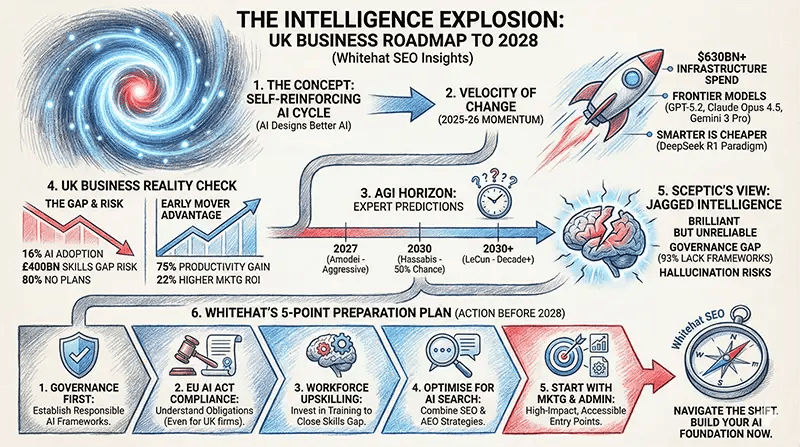
The practical implication for UK businesses is significant. AI systems are no longer limited to narrow tasks like spam filtering or product recommendations. Current frontier models, including GPT-5.2, Claude Opus 4.5, and Gemini 3 Pro, can outperform human experts across a wide range of knowledge-work benchmarks. GPT-5.2 beats human professionals on 70.9% of knowledge-work tasks at 11 times the speed and less than 1% of the cost, according to OpenAI's published benchmarks (December 2025).
How the AGI Race Accelerated Since 2024
When Whitehat SEO first published this article in September 2024, the original referenced roughly $100 billion in projected AI investment. That figure is now a footnote. The Stargate Project, announced at the White House in January 2025, committed $500 billion over four years for AI infrastructure. Combined Big Tech capital expenditure for 2026 is projected at over $630 billion, with Amazon planning $200 billion, Google $175 to $185 billion, and Meta $115 to $135 billion (Fortune, February 2026). Globally, AI infrastructure spending is projected to reach $2.5 trillion in 2026 (Gartner, January 2026).
The pace of capability improvement has been staggering. In January 2025, Chinese lab DeepSeek released its R1 reasoning model, matching OpenAI's o1 at roughly one hundredth of the training cost (approximately $6 million). The release wiped $593 billion from Nvidia's market capitalisation in a single day and shifted the industry paradigm from "bigger is better" to "smarter is cheaper" (MIT Technology Review, January 2025).
By late 2025, multiple frontier models surpassed human expert performance on standardised benchmarks. Claude Opus 4.5 became the first model to break 80% on SWE-bench Verified, a software engineering benchmark. Gemini 3 Pro scored 91.9% on GPQA Diamond, exceeding human expert performance of approximately 89.8%. The year 2025 was widely characterised as "the year of AI agents", with systems capable of autonomous multi-day workflows, filing pull requests, and managing complex business processes without human oversight.
What Major AI Lab Leaders Predict for AGI
Dario Amodei, CEO of Anthropic, holds the most aggressive public timeline. In Anthropic's official submission to the White House OSTP in March 2025, the company stated: "We expect powerful AI systems will emerge in late 2026 or early 2027." Amodei defines "powerful AI" as systems with intellectual capabilities matching or exceeding Nobel Prize winners across most disciplines. He has also warned that unchecked AI adoption could reduce half of all entry-level white-collar jobs and push unemployment to 10 to 20% within one to five years (60 Minutes, December 2025).
Sam Altman, CEO of OpenAI, declared in January 2025: "We are now confident we know how to build AGI as we have traditionally understood it." His June 2025 essay went further, stating the "takeoff has started" and that "intelligence too cheap to meter is well within grasp." However, by August 2025, Altman walked back the term AGI as "not a super useful term."
Demis Hassabis, CEO of Google DeepMind, compressed his estimate from "at least a decade" (October 2024) to a "50% chance in the next five years, so by 2030" (mid-2025). He coined the term "jagged intelligence" to describe current AI, noting systems that win International Mathematical Olympiad gold medals but fail elementary problems.
Not everyone agrees. Meta's Chief AI Scientist Yann LeCun maintains AGI needs "new science" beyond current architectures and remains "at least a decade, probably much more" away. Gary Marcus points to underwhelming real-world performance relative to benchmark hype. A January 2026 Polymarket prediction showed only 9% probability of OpenAI achieving AGI by 2027, revealing a gap between corporate optimism and market scepticism. These competing perspectives matter for UK businesses planning their AI strategies, as explored in Whitehat's AI progress tracker.
How UK Businesses Are Responding to the Intelligence Explosion
The most authoritative UK adoption data comes from the DSIT AI Adoption Research (January 2026), based on 3,500 telephone interviews. The headline finding: only 16% of UK businesses currently use at least one AI technology. A further 5% plan to adopt, while 80% neither use nor plan to adopt AI. Among firms that do use AI, marketing (72%) and administration (72%) are the most common deployment areas, followed by IT at 64%.
The productivity story is encouraging but incomplete. 75% of UK businesses using AI report improved workforce productivity, yet 77% have not yet seen revenue changes, with only 12% reporting increases. ONS data shows UK adoption climbing from 9% in September 2023 to 23% by late September 2025, a steep upward trajectory. Globally, 88% of organisations now use AI in at least one function, but only 7% have fully scaled it across their operations (McKinsey State of AI, November 2025).
For UK mid-market businesses, this represents both a challenge and an opportunity. The UK AI sector attracted £24.25 billion in private investment commitments since July 2024, averaging £200 million per day (UK Government AI Action Plan, January 2026). The UK government has met 38 of its 50 action plan commitments and delivered over one million free AI courses. Yet the gap between investment at the national level and adoption at the business level remains vast.
The Business Case for Early AI Adoption
The commercial evidence for AI adoption is building rapidly. AI-driven marketing campaigns deliver 22% higher ROI, 32% more conversions, and 29% lower acquisition costs compared to traditional methods, according to McKinsey research cited across multiple industry sources. Nearly two-thirds of B2B revenue leaders in the UK and EU report positive ROI within the first year of AI implementation. HubSpot's 2025 research found 75% of marketing leaders reporting positive returns from AI investments, with only 4% seeing negative results.
Industries most exposed to AI capabilities are achieving three times higher growth in revenue per employee compared to least exposed industries (PwC Global AI Jobs Barometer, June 2025). The competitive gap is widening. Only 33% of B2B marketers currently use generative AI to personalise campaigns (LinkedIn B2B Marketing Benchmarking Report), leaving significant room for early movers to build advantages in areas like answer engine optimisation and AI-powered content strategy.
The workforce economics are equally significant. Research from King's College London found that firms highly exposed to AI capabilities reduced total employment by 4.5% on average, concentrated in junior positions (down 5.8%), while average pay rose by over £1,300. AI skills carry a 23% wage premium in the UK, and workers in AI-exposed sectors see wages rising twice as fast as those in less exposed sectors (PwC/Oxford University, 2025). The UK AI skills gap could cost up to £400 billion in lost growth potential by 2030 (Skills England/DSIT, October 2025).
What the Sceptics Say (And Why It Matters)
A credible assessment of the intelligence explosion must address why some experts believe the hype is overblown. Yann LeCun argues that current large language models lack fundamental reasoning capabilities and that AGI requires entirely new architectural approaches. Gary Marcus has consistently highlighted the gap between impressive benchmark performance and real-world reliability, noting GPT-5's "underwhelming performance relative to hype."
Demis Hassabis's concept of "jagged intelligence" captures the current reality well. Today's AI systems produce work that is simultaneously brilliant and unreliable. A model can win an International Mathematical Olympiad gold medal, then hallucinate basic facts in the same conversation. For UK businesses, this means AI adoption requires governance, not just enthusiasm. According to Trustmarque's AI Governance Index (July 2025), 93% of UK organisations use AI in some form, but only 7% have fully embedded governance frameworks. Only 4% say their data and infrastructure is fully prepared for AI at scale.
Corporate leaders also have financial incentives to promote imminent AGI. Promising transformative AI keeps investment flowing. Anthropic's valuation surged from $61.5 billion in March 2025 to $350 billion by December 2025, with revenue jumping from $1 billion to $5 billion annualised in eight months. OpenAI is seeking a $100 billion funding round at roughly $830 billion valuation. This context is important when evaluating timeline predictions from the same companies building the technology.
How UK Businesses Can Prepare Before 2028
Whether AGI arrives in 2027 or 2035, the direction of travel is clear. UK businesses that build AI foundations now will compound advantages regardless of the exact timeline. The UK government's deliberately light-touch regulatory approach, relying on five cross-sector principles (safety, transparency, fairness, accountability, and contestability) applied by existing regulators, creates both flexibility and uncertainty. A comprehensive UK AI Bill is not expected before the second half of 2026, meaning businesses must self-regulate in the interim.
Whitehat SEO recommends a phased approach for mid-market businesses based on five priorities:
- Establish AI governance now. With 87% of UK business leaders expecting Responsible AI to become a strategic differentiator within two to three years (Experian, November 2025), embedding governance frameworks is no longer optional. Only 7% of UK organisations have done this so far.
- Understand EU AI Act obligations. The EU AI Act's GPAI model obligations took effect in August 2025, with full application in August 2026. UK businesses placing AI systems on the EU market must comply regardless of location, with fines reaching €35 million or 7% of global turnover.
- Invest in workforce upskilling. The £400 billion skills gap risk by 2030 makes AI training a strategic imperative. The UK government has committed to upskilling 10 million workers by 2030 and delivered over one million free courses by mid-2025.
- Optimise marketing for AI search. With AI engines like ChatGPT, Perplexity, and Google AI Overviews changing how buyers discover solutions, businesses need both traditional SEO and answer engine optimisation strategies to maintain visibility.
- Start with marketing and administration. These are the top two AI deployment areas among UK adopters (72% each). For B2B companies, AI-powered content creation, lead scoring, and campaign personalisation offer the most accessible entry points through platforms like AI consulting services integrated with existing CRM and marketing automation.
The UK AI Security Institute's Frontier AI Trends Report (December 2025) adds urgency. AI models now complete expert-level cyber tasks 50% of the time, up from approximately 9% in 2023. Self-replication success rates went from 5% to 60% in the same period. These capabilities make AI literacy a business-critical skill, not a future aspiration.
Frequently Asked Questions
What is the intelligence explosion in simple terms?
The intelligence explosion describes a scenario where AI systems become capable enough to improve their own design, triggering a rapid cycle of accelerating intelligence. First proposed by mathematician I.J. Good in 1965, this concept is now considered plausible by leading AI researchers, with several predicting it could begin between 2027 and 2030.
When will AGI be achieved?
AGI timeline predictions vary significantly. Anthropic's CEO predicts late 2026 or early 2027. Google DeepMind's CEO estimates a 50% chance by 2030. Meta's Chief AI Scientist says at least a decade. A 2023 survey of 2,778 AI researchers placed 50% probability at 2040, with 10% chance by 2027.
How will the intelligence explosion affect UK businesses?
Currently, only 16% of UK businesses use AI, with marketing and administration as the top deployment areas. Firms adopting AI report 75% productivity improvements and 22% higher marketing ROI. However, 80% of UK businesses have no plans to adopt AI, creating a competitive window for early movers. Whitehat SEO's AI consultancy helps businesses navigate this transition.
What is the UK government doing about AI?
The UK government published its AI Opportunities Action Plan One Year On report in January 2026, showing £24.25 billion in private investment commitments and 38 of 50 action plan commitments met. The UK takes a deliberately light-touch regulatory approach, with no dedicated AI legislation expected before late 2026, contrasting with the EU AI Act's prescriptive framework.
How can mid-market businesses prepare for AGI?
Start with AI governance frameworks (only 7% of UK organisations have them), understand EU AI Act compliance requirements if you serve European markets, invest in workforce upskilling to address the £400 billion skills gap risk, and optimise marketing for AI search engines. Whitehat SEO recommends beginning with marketing and administration, the two most common AI deployment areas among UK adopters.
References
- DSIT/IFF Research AI Adoption Research, January 2026
- UK Government AI Opportunities Action Plan One Year On, January 2026
- UK AI Security Institute Frontier AI Trends Report, December 2025
- McKinsey State of AI 2025, November 2025
- PwC Global AI Jobs Barometer, June 2025
- Gartner AI Spending Forecast, January 2026
- Fortune: Big Tech AI Capital Expenditure, February 2026
- MIT Technology Review: DeepSeek, January 2025
- CBS News: Dario Amodei 60 Minutes Interview, December 2025
- Experian Responsible AI Report, November 2025
- Skills England/DSIT Skills Report, October 2025
Is Your Business Ready for the Intelligence Explosion?
Whether AGI arrives in 2027 or 2035, the businesses that build AI foundations now will lead their markets. Whitehat SEO helps UK mid-market companies develop practical AI strategies, from answer engine optimisation to full AI consultancy and implementation.
Book Your AI Readiness Assessment HubSpot CRM view our pricing