
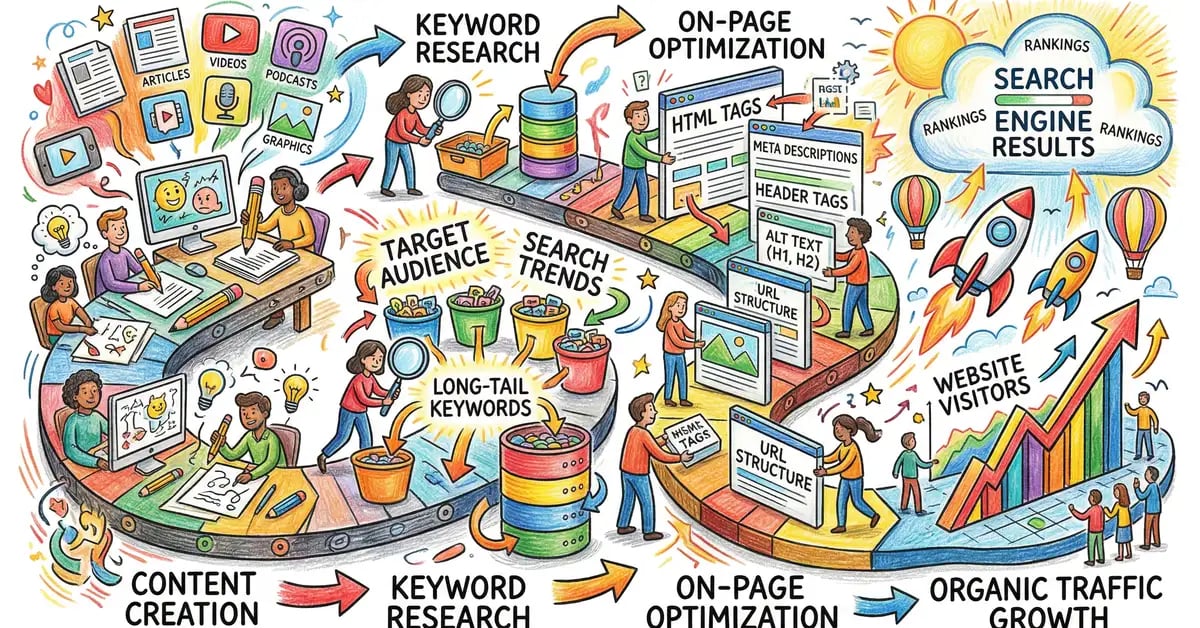
In 2025, ranking is only half the battle. Buyers increasingly get answers directly on the search results page—or inside AI tools—which means your content has to be extractable, citeable and trustworthy. For example, research found that 59.7% of EU Google searches in 2024 resulted in zero clicks, the answer was found without visiting a website. That's your cue to write content that wins both clicks and citations.
This guide shows a practical, joined-up approach: what to fix first, how to plan content around intent, how to optimise for modern search features (including AEO/GEO), and how to keep improving. Whether you're building a content strategy from scratch or optimising existing content, the principles remain the same: integrated content and SEO compounds results.
Direct Answer (AEO-Ready)
To integrate content marketing with SEO, start with keyword and audience research, create genuinely useful content that answers real questions, and then optimise every page for search—titles, headings, internal links, schema and speed. Publish consistently, promote content to earn links and engagement, and refresh top performers so rankings and leads compound over time.
Why content marketing and SEO need each other
SEO and content marketing are separate disciplines. Treating them as separate strategies is where things go wrong. SEO makes your site accessible and discoverable. Content marketing gives search engines something genuinely useful to rank—and gives buyers a reason to trust you.
Reality check: In recent B2B research, 74% of B2B marketers said content marketing helped generate demand or leads in the last 12 months, and 49% said it helped generate sales or revenue. That's what integration buys you: content that earns attention and converts.
- SEO without content is a technically perfect shop with empty shelves.
- Content without SEO is a brilliant shop in a dark alley—nobody finds it.
- Integrated means every content decision is informed by search intent, and every SEO decision is informed by the buyer journey.
AI changes the interface, not the fundamentals. When AI-generated answers reduce clicks, the content that wins is the content that's easy to quote, easy to verify, and clearly attributed. That's why AEO and GEO best practice should be built into the structure of every article you publish.
SEO vs content marketing: what's the difference?
If you're aligning teams or budgets, it helps to be precise. Here's a simple breakdown:
| Area | SEO (Search Engine Optimisation) | Content Marketing |
|---|---|---|
| Goal | Earn visibility for relevant searches and improve organic performance. | Build trust and demand by publishing useful content for buyers. |
| Main levers | Technical foundations, on-page optimisation, links, internal structure. | Topics, messaging, formats, distribution, editorial consistency. |
| Best when… | It's grounded in what customers actually search for (intent). | It's built around discoverability, structure and findability. |
The integration point is simple: SEO is your demand radar. Content marketing is your demand engine. One finds what people want. The other creates the best answer.
Nail the technical SEO foundations first
If your technical SEO is shaky, your best content becomes a victim of physics. Before you scale content, make sure search engines can crawl, understand and trust your site. The foundations matter more than most people admit.
- Indexation hygiene: clean sitemaps, correct canonical tags, and no accidental "noindex".
- Site performance: fast pages, stable layout, mobile-first UX.
- Information architecture: clear topic clusters and internal linking so authority flows.
- On-page basics: titles, headings, image alt text, and sensible URLs.
- Structured data: schema that helps machines extract meaning (Article, FAQPage, HowTo).
Pro tip: If you're not sure where the technical landmines are, start with a crawl audit. It's cheaper to fix foundations before you publish 30 articles on top of them. A solid technical foundation turns content marketing from a gamble into an asset.
Create high-quality content aligned with real search intent
"High quality" is vague. Let's make it measurable: content is high quality when it answers the right question for the right buyer, with enough specificity that the reader doesn't need ten tabs open to finish the job.
Start with intent, not keywords
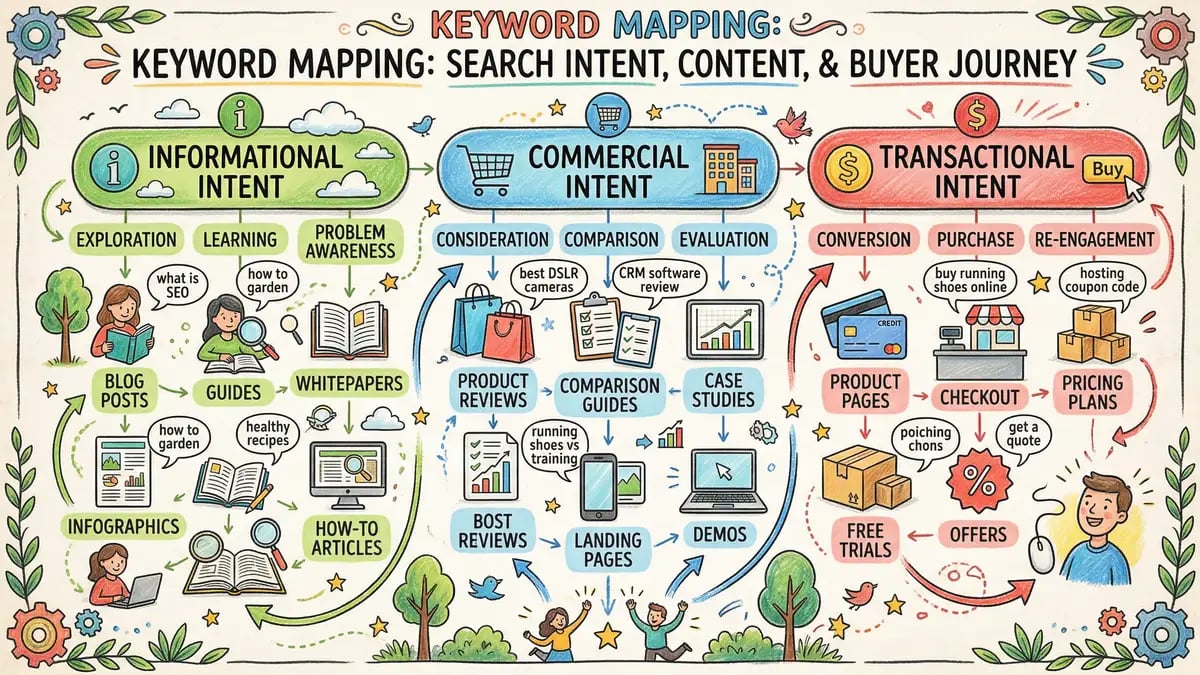
Keywords are a clue. Intent is the truth. A quick way to capture intent is to classify topics into four types:
- Informational: "What is…?", "How does… work?"
- Commercial investigation: "Best…", "vs", "reviews"
- Transactional: "Hire", "pricing", "agency", "audit"
- Navigational: "Brand + service name"
Build a topic cluster (so one post isn't doing all the work)
One-off blog posts are fragile. Clusters are resilient and create compounding authority. A cluster has three parts:
- A pillar topic (broad guide covering the whole subject)
- Supporting posts (specific questions, comparisons, "how to" guides)
- Internal links connecting them with clear, descriptive anchor text
A practical benchmark: research shows that average article length is 1,333 words, and that strong results correlate with longer, more detailed articles (especially 2,000+ words). This isn't about padding—it's about depth. Detailed content ranks better and earns more links.
On-page SEO: optimise content without making it unreadable
Good on-page optimisation doesn't feel like optimisation. It feels like clarity. Your job is to make it easy for a human to scan and easy for a machine to parse.
A practical on-page checklist
- Title and meta description: lead with the topic, add a clear benefit.
- Headings: one H1, then logical H2/H3 structure with question-format headings where useful.
- Early answer: include a 40–60 word direct answer (like the one above) for AEO.
- Internal links: link to relevant service pages and supporting resources with descriptive anchors.
- Schema: use Article + FAQPage (and HowTo when you have steps) so answers can be extracted cleanly.
- Images: compress, use meaningful alt text, and keep visuals purposeful (not decorative).
Worth knowing: Analysis of millions of Google results found that the number one result has an average of 3.8 times more backlinks than positions two through ten. Additionally, adding three seconds of time on site correlates with ranking one position higher. Readable structure and helpful depth support both metrics.
A 6-step workflow
- Get the foundations right: fix crawl and index issues, speed problems and messy site structure.
- Map topics to intent: pick questions your buyers actually ask, then build clusters.
- Create expert content: clear answers, examples, sources, and a point of view.
- Optimise on-page: titles, headings, internal links, and structured data.
- Distribute: email, social, partners, communities—don't rely on "publish and pray".
- Refresh and compound: update winners, improve weak posts, and keep building authority.
Promote and distribute: earn links, earn attention, earn results
If you want SEO results, you need signals: links, mentions, engagement, repeat visits and branded search. High-quality content helps—but only once people actually see it. Distribution is often the overlooked part of the equation.
- Share deliberately: LinkedIn, newsletters, communities, partners, and relevant industry groups.
- Repurpose: turn a guide into a slide deck, a post into a checklist, and FAQs into short videos.
- Earn citations: pitch your best resources to industry publications and niche directories (quality only).
- Build internal authority: link from related posts to your strongest page on the topic.
Distribution without strategy feels like spam. With strategy—targeting the right channels, repurposing thoughtfully, and promoting to relevant audiences—it compounds your rankings and builds brand visibility.
AEO/GEO: how to get surfaced in AI answers (without gaming it)
Answer Engine Optimisation (AEO) and Generative Engine Optimisation (GEO) are not "new SEO". They're what happens when the interface changes: instead of ten blue links, users ask a question and get a synthesised answer. Your job is to make your content the best source for that synthesis.
Make your content easy to quote
- Lead with the answer: 40–60 words, then expand with depth and examples.
- Use question headings: they match how people prompt AI tools and voice assistants.
- Add FAQs: cover natural follow-on questions (fan-out thinking).
- Use structured data: Article + FAQPage + HowTo where applicable.
- Show your workings: cite reputable sources and include dates so claims are verifiable.
Voice search is still meaningful: Recent research notes that over 20% of the global population used voice search, and marketers increasingly recognise voice search optimisation. Structured answers combined with clear headings put you in the best position to be read out or summarised accurately.
AEO isn't a separate discipline—it's good content structure done properly. When you make content easy to quote, easy to verify, and clearly attributed, you win in both traditional search and AI systems.
Continuous improvement: analyse, update, repeat
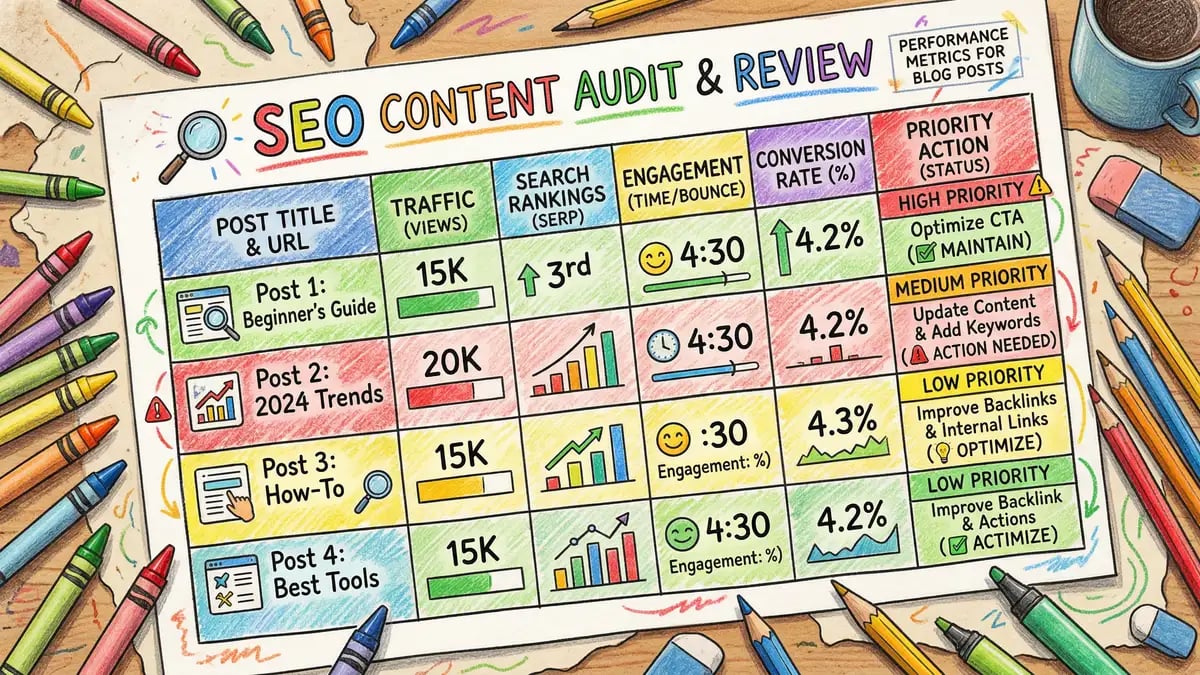
Integration is not a project. It's a system. The system is simple: publish, measure, improve, and keep going. This cycle compounds results over time.
- Measure: organic traffic, rankings, conversions, assisted conversions, and engagement.
- Refresh: update facts, improve clarity, add new FAQs, and tighten internal linking.
- Consolidate: merge thin posts into stronger "best answer" pages (then redirect).
- Double down: when a topic works, expand the cluster and build supporting content.
Most teams see early movement in 6–12 weeks (indexing, impressions, a few rankings), with stronger growth over 3–6 months as content earns trust, links and engagement. Competitive topics and sites with technical issues take longer. Consistent publishing and refresh cycles speed up compounding gains.
Key Takeaways
- Integration is essential: SEO without content is an empty shop. Content without SEO is invisible. Together, they compound.
- Fix foundations first: Technical SEO, site speed, crawlability and indexation matter before you publish at scale.
- Start with intent: Keywords are clues. Intent is the truth. Build content clusters around buyer questions, not individual keywords.
- Optimise for readability and machines: Clear structure, question headings, early answers and schema serve both humans and AI systems.
- Distribution matters: Publishing is only half the job. Promotion, repurposing and earned coverage amplify results.
- AEO is structure, not tricks: When content is easy to quote, verify and attribute, it wins in both Google Search and AI systems.
- Continuous improvement compounds: Measure, refresh, consolidate and double down. Consistent cycles beat sporadic bursts.
Frequently asked questions
What's the difference between content marketing and SEO?
SEO is the process of improving how easily your pages are discovered, understood and ranked in search engines. Content marketing is the creation and distribution of useful content that attracts and educates buyers. SEO helps people find your content; content gives SEO something worth ranking.
Why is content marketing important for SEO?
Google ranks pages that best satisfy a searcher's question. Content marketing creates those pages: guides, articles, tools and case studies that demonstrate experience and expertise. Strong content also earns links and engagement signals. Without content, SEO has little to optimise or promote.
Can you do SEO without content marketing (or vice versa)?
You can fix technical SEO without publishing much, but you'll struggle to rank for competitive queries because there's nothing substantial to match search intent. Likewise, publishing content without SEO often means it never reaches page one. The strongest results come from doing both together, consistently.
How long does it take to see results from integrating content and SEO?
Most teams see early movement in 6–12 weeks (indexing, impressions, a few rankings), with stronger growth over 3–6 months as content earns trust, links and engagement. Competitive topics and sites with technical issues take longer. Consistent publishing and refresh cycles speed up compounding gains.
How do you measure ROI from content marketing and SEO?
Track organic sessions, rankings and assisted conversions for each content cluster, not just page views. Connect forms, calls and pipeline back to first-touch and multi-touch attribution in GA4 or HubSpot. Then compare cost per lead and cost per opportunity against paid channels to calculate ROI.
What's the connection between content clusters and SEO performance?
Content clusters build topical authority. A pillar post (broad guide) linked to supporting posts (specific questions) tells search engines you have comprehensive coverage of a topic. This signals expertise and helps multiple pages in the cluster rank. Clusters also improve user experience because readers can navigate from the overview to deeper dives without leaving your site.
Should I prioritise technical SEO or content creation?
Fix the technical foundations first, then scale content. A technically sound site with good content beats a fast site with thin content every time. But don't let perfectionism on technical SEO prevent you from publishing. Get the basics right (crawlability, indexation, speed, mobile), then publish consistently and improve content over time.
How important is backlinking in a content and SEO strategy?
Backlinks remain one of the strongest ranking signals. High-quality content that earns natural links outperforms thin content that doesn't. Instead of chasing links, create content worth linking to (research, original insights, comprehensive guides), then promote it to relevant audiences, industry publications and communities that might cite it. Distribution amplifies backlink opportunities.
About the Author
Clwyd Probert is the founder of Whitehat, a London-based SEO and inbound marketing agency and HubSpot Diamond Partner. With over 15 years of experience in digital marketing strategy, he helps B2B companies across the UK build sustainable organic growth through data-driven approaches.