
Marketing Operations explore our digital marketing FAQs
Marketing teams without documented processes operate in a state of perpetual reinvention. Every campaign launch, every handoff, every approval cycle requires someone to remember how things were done last time—or worse, to figure it out from scratch.
Marketing Process Documentation: The Complete Guide to SOPs, Templates & Tools [2026]
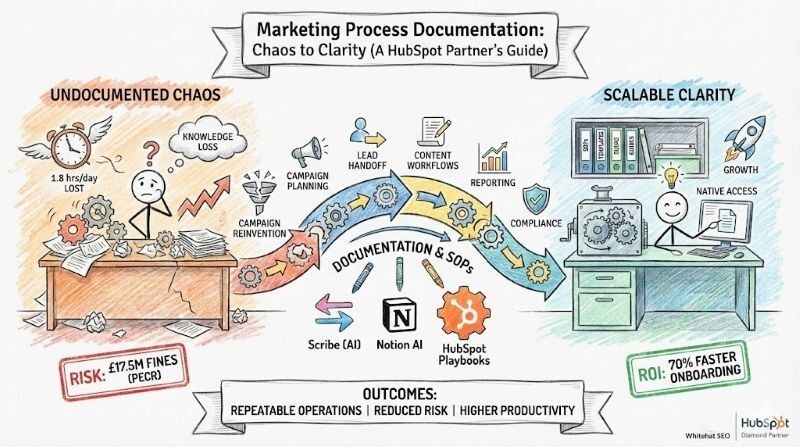
Marketing process documentation is the systematic recording of your team's workflows, standard operating procedures (SOPs), and decision-making frameworks. According to McKinsey research, employees spend 1.8 hours every day—9.3 hours per week—searching for and gathering information, costing UK businesses billions in lost productivity annually. Whitehat SEO, as a HubSpot Diamond Partner, has helped hundreds of B2B companies transform undocumented chaos into repeatable, scalable marketing operations.
The True Cost of Undocumented Marketing Processes
The numbers are stark. Research from Slite's 2025 Enterprise Search Survey found that 9 out of 10 internal searches fail on the first attempt—a 9.5x performance gap compared to Google's external search accuracy. This means your team members are constantly interrupting colleagues (81% report doing so regularly) just to find information that should be readily accessible.
For UK businesses specifically, the productivity drain is significant. Gallup's State of the Global Workplace report reveals that 83% of UK employees are either disengaged or have doubts about their employer—among the most concerning figures in Western Europe. This disengagement costs the UK economy up to £70 billion annually in lost productivity, and poor knowledge management is a major contributor.
| Productivity Impact | Finding | Source |
|---|---|---|
| Time lost to information searching | 1.8 hours/day (9.3 hours/week) | McKinsey |
| Annual cost to Fortune 500 companies | $31.5 billion | IDC |
| Internal search first-attempt failure rate | 90% | Slite (2025) |
| Knowledge unique to departing employees | 42% | Panopto |
| UK productivity cost from disengagement | £70 billion/year | Gallup |
Perhaps most alarming is what happens when employees leave. Panopto's research found that 42% of institutional knowledge is unique to individual employees and isn't shared. When that person departs, their colleagues literally cannot perform 42% of that job function. For marketing teams with complex campaign workflows, attribution models, and vendor relationships, this knowledge loss can set programmes back months.
What Marketing Processes Should You Document?
Not every marketing activity requires a formal SOP. Focus your documentation efforts on processes that are repeated regularly, involve multiple team members or departments, carry compliance requirements, or represent critical handoff points between marketing and sales.
At Whitehat SEO, we recommend documenting these core marketing operations first:
Campaign Planning & Launch
Campaign brief templates, approval workflows, asset creation checklists, channel-specific launch procedures, and post-launch monitoring protocols. Document who signs off at each stage and what "done" looks like.
Lead Management & Handoff
Lead scoring criteria, MQL/SQL definitions, sales handoff procedures, lead routing rules, and follow-up timelines. This is where most marketing-sales friction originates, and documentation eliminates ambiguity.
Content Production Workflows
Content brief templates, SEO optimisation checklists, editorial calendars, approval chains, publishing procedures, and content refresh schedules. Include your SEO requirements at the briefing stage, not as an afterthought.
Reporting & Attribution
Report templates, data source documentation, attribution model specifications, KPI definitions, and stakeholder distribution lists. When everyone agrees on what metrics mean, meetings become more productive.
Compliance & Data Processing
GDPR consent collection procedures, suppression list management, data retention policies, legitimate interest assessments, and PECR compliance for electronic marketing. This isn't optional—it's legally required.
For HubSpot users, many of these documentation needs can be addressed through the platform's native Playbooks feature, which embeds SOPs directly into the workflows where they're needed. This is a significant advantage over standalone documentation tools—your team doesn't need to leave HubSpot to find the process they should follow.
UK GDPR & PECR: Why Documentation Is Now a Legal Requirement
For UK B2B marketers, documentation isn't just about efficiency—it's about compliance. The UK Data (Use and Access) Act 2025, which received Royal Assent in June 2025, fundamentally changed the risk profile for marketing operations.
⚠️ Critical Compliance Change for 2026
PECR (Privacy and Electronic Communications Regulations) fines have increased from a maximum of £500,000 to £17.5 million or 4% of global turnover—a 3,500% increase in potential penalties. This brings direct marketing violations in line with UK GDPR breach penalties.
Source: ICO Official Announcement
The ICO explicitly requires documented evidence of compliance. For B2B marketing specifically, this means maintaining records of:
- Lawful basis documentation—Even B2B contact data (individual names and email addresses) constitutes personal data under UK GDPR. You must document your lawful basis for processing, typically legitimate interest for B2B direct marketing.
- Legitimate Interest Assessments (LIAs)—These must be documented before you begin processing. An undocumented LIA is effectively no LIA at all.
- Consent records for electronic marketing—PECR requires consent for most electronic marketing to individuals. Your consent management process must be documented and auditable.
- Suppression list procedures—How do opt-outs flow through your systems? This needs to be documented and testable.
- Data retention schedules—How long do you keep marketing data, and what triggers deletion? Document it.
The compliance argument alone justifies investment in marketing process documentation. With potential fines now in the millions, undocumented processes represent material business risk that should be addressed at board level.
If you're using HubSpot, the platform's audit trail capabilities provide a strong foundation for compliance documentation. However, you still need to document the decisions behind your configurations—why you chose specific data retention periods, how you determined legitimate interest, and what your consent collection process looks like. Our HubSpot onboarding services include compliance documentation as standard.
AI-Powered Documentation Tools: 2026 Comparison
The documentation tools landscape has evolved dramatically. AI-powered platforms can now capture workflows automatically, generate SOP drafts from screen recordings, and even keep documentation updated as your processes change. Here's how the leading options compare for UK HubSpot users:
| Tool | Starting Price | Key AI Features | HubSpot Integration | Best For |
|---|---|---|---|---|
| Scribe | Free (browser ext.) / £13/user/mo | Auto-capture workflows, 12x faster than manual | ✓ Native | Software process documentation |
| Whale | ~£119+/mo (flat rate) | "Alice" AI assistant, quiz generation, video-to-guide | ✓ Native | SOP management + team training |
| Notion AI | £20/user/mo (Business plan) | Multi-model AI, AI Agents (Notion 3.0) | Zapier only | All-in-one workspace/wiki |
| Loom AI | Free (5-min) / £20/mo with AI | Auto titles/summaries/chapters, 50+ languages | Embed only | Video documentation |
| Trainual | $249/mo + $1,000 setup | AI draft generation, template library | Zapier only | Employee onboarding/training |
| HubSpot Playbooks | Included in Pro+ | Breeze AI integration, in-context guidance | ✓ Native | Sales/marketing playbooks |
Our recommendation for HubSpot users: Start with HubSpot's native Playbooks for sales and marketing handoff documentation—it's included in your subscription and lives where your team already works. Layer in Scribe for capturing software-based processes (it has a native HubSpot Marketplace integration), and consider Whale or Trainual if you need more comprehensive training and onboarding capabilities.
The key is choosing tools that integrate with your existing stack rather than creating another documentation silo. The whole point is reducing the time spent searching for information—adding another disconnected system works against that goal.
The ROI of Marketing Process Documentation
Documentation often falls victim to the "important but not urgent" trap. Teams know they should do it, but immediate campaign demands always take priority. Understanding the concrete ROI helps make the business case for investment.
50%
higher new hire productivity with standardised onboarding
Source: SHRM
82%
improvement in new hire retention
Source: Brandon Hall Group
24%
productivity increase from knowledge-sharing
Source: Tulane University
60%
reduction in onboarding time
Source: Whale customer data
Let's make this concrete. If your marketing team has 10 people, and each saves just 1 hour per week through better documentation (a conservative estimate given the McKinsey finding of 9+ hours lost weekly), that's:
- 10 hours per week recovered team capacity
- 520 hours per year—equivalent to 3 months of full-time work
- At an average loaded cost of £50/hour, that's £26,000 in recovered productivity annually
Add in faster onboarding (new marketers reaching productivity 2 months earlier, per Texas Instruments research), reduced knowledge loss from departures, and compliance risk mitigation, and the business case becomes compelling.
For growing B2B companies, documentation also enables scalability. You can't grow a marketing function if every process lives in someone's head. At some point, you need repeatable systems that work regardless of who's executing them. That's what professional marketing operations look like, and it's what we help our clients build through marketing services.
Documenting Marketing Processes in HubSpot
HubSpot offers several native features for process documentation that many users overlook. As a HubSpot Diamond Partner, Whitehat SEO has helped implement documentation systems across hundreds of HubSpot portals. Here's what works:
HubSpot Playbooks
Playbooks are interactive, in-context guides that appear alongside contact, company, or deal records. They're perfect for documenting lead qualification criteria, discovery call frameworks, and handoff procedures. The key advantage: documentation lives where the work happens, not in a separate system your team forgets to check.
Workflow Annotations
Every HubSpot workflow supports internal notes and annotations. Use these to document why automations exist, what they should achieve, and what to check when troubleshooting. When someone inherits your workflows, they'll thank you.
Property Descriptions
Custom properties should include detailed descriptions explaining what the field captures, when it should be populated, and what values mean. This prevents the "what does this field actually mean?" confusion that plagues most CRMs.
Knowledge Base (For Internal Use)
While HubSpot's Knowledge Base is designed for customer-facing content, many organisations create an internal-only portal for team documentation. This keeps everything in one platform and leverages HubSpot's search and categorisation capabilities.
Breeze AI Integration
HubSpot's Breeze Copilot can help generate first drafts of documentation by analysing existing workflows and suggesting process descriptions. It's not a replacement for human review, but it significantly accelerates the documentation process.
The critical success factor isn't the tool—it's making documentation maintenance someone's explicit responsibility. Assign ownership, schedule quarterly reviews, and build documentation updates into your change management process. Otherwise, SOPs become outdated almost immediately.
Getting Started: Your 30-Day Documentation Sprint
Trying to document everything at once is a recipe for failure. Instead, we recommend a focused 30-day sprint that establishes momentum and demonstrates quick wins:
Week 1
Audit & Prioritise
List all marketing processes. Score each on frequency (how often it runs), risk (what happens when it fails), and complexity (how many people/steps involved). Document your top 5 priority processes first.
Week 2
Document Core Workflows
Create SOPs for your top 5 processes. Use a consistent template: trigger, steps, responsible parties, outputs, and related documentation. Keep it simple—perfect is the enemy of done.
Week 3
Test & Refine
Have someone unfamiliar with each process attempt to follow your documentation. Note where they get stuck and refine accordingly. If they can't follow it, the documentation isn't complete.
Week 4
Systematise Maintenance
Assign documentation owners. Schedule quarterly reviews. Add "update documentation" to your process change checklist. Build the habit before scaling to more processes.
The goal isn't to document everything in 30 days—it's to establish a documentation practice that continues. Start with the highest-impact processes and expand from there.
Frequently Asked Questions
How often should marketing SOPs be updated?
Review documentation quarterly at minimum, and update immediately whenever processes change. The most common documentation failure is allowing SOPs to become outdated, which destroys team trust in the system.
What's the difference between an SOP and a process document?
SOPs (Standard Operating Procedures) are detailed, step-by-step instructions for completing specific tasks. Process documents describe broader workflows that may encompass multiple SOPs. For marketing teams, start with process-level documentation and create detailed SOPs for complex or high-risk activities.
Do I need separate documentation for GDPR compliance?
Yes. UK GDPR and PECR require specific documented records including Records of Processing Activities (ROPA), Legitimate Interest Assessments, Data Protection Impact Assessments, and consent records. These should be maintained separately from operational SOPs but linked where relevant.
How do I get buy-in for documentation from a busy team?
Focus on immediate pain points. If your team spends hours answering the same questions from new hires, or if campaign handoffs regularly fail, documentation solves those specific problems. Start with one high-pain process, demonstrate the time savings, then expand.
Can AI tools fully automate documentation?
AI tools like Scribe can automate the capture of software-based workflows—recording clicks and generating step-by-step guides. However, they can't capture the reasoning behind decisions, edge cases, or tribal knowledge. AI accelerates documentation but doesn't replace human judgment about what matters.
Need Help Getting Your Marketing Operations in Order?
As a HubSpot Diamond Partner, Whitehat SEO helps B2B companies build scalable, documented marketing operations. From HubSpot configuration to compliance documentation, we'll get your systems working as hard as your team.
Talk to Our Team →References & Citations
- McKinsey Global Institute. "The social economy: Unlocking value and productivity through social technologies." mckinsey.com
- Slite. "Enterprise Search Survey Report 2025." slite.com
- Information Commissioner's Office. "UK organisations stand to benefit from new data protection laws." ico.org.uk
- Addleshaw Goddard. "The Data (Use and Access) Act 2025: Top 7 Changes." addleshawgoddard.com
- Panopto. "Workplace Knowledge and Productivity Report." panopto.com
- SHRM. "Onboarding New Employees: Maximizing Success." shrm.org
- Brandon Hall Group. "The True Cost of a Bad Hire." brandonhall.com
- Gallup. "State of the Global Workplace Report." gallup.com