
Digital Marketing Strategy
The digital marketing landscape has fundamentally transformed since 2019. The global market has doubled from approximately £160 billion to £330 billion, yet beneath this growth lies significant turbulence. According to SparkToro's 2025 State of Digital Agencies survey, only 12% describe the agency world as "very healthy," with 41% calling it "a struggle."
HIRING A DIGITAL MARKETING AGENCY IN 2025: THE EVALUATION FRAMEWORK
To hire the right digital marketing agency in 2025, evaluate three critical capabilities: genuine AI integration with human oversight, demonstrated expertise in Generative Engine Optimisation (GEO), and transparent pricing with measurable ROI frameworks. With 91% of agencies now using or exploring generative AI, the differentiator isn't AI adoption itself—it's how effectively agencies balance AI efficiency with authentic human creativity while proving business impact.
For businesses seeking agency partners, this turbulence creates both risk and opportunity. The agencies that have adapted—integrating AI thoughtfully, developing expertise in emerging disciplines like GEO, and maintaining transparent, performance-based relationships—are delivering significantly better outcomes than their peers. The agencies that haven't adapted are becoming increasingly dangerous to work with.
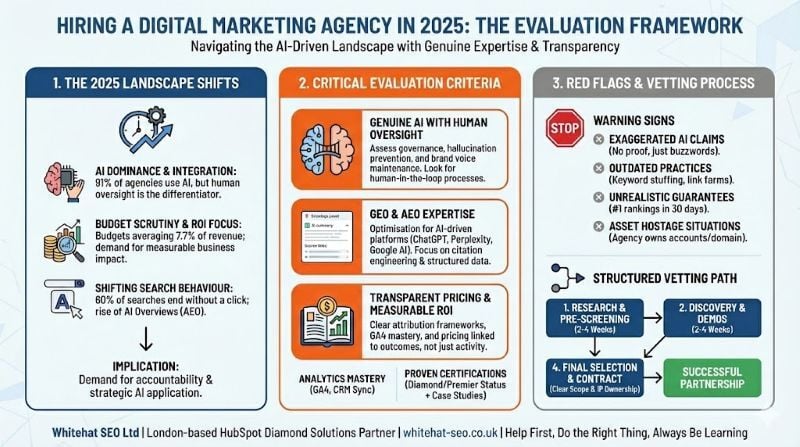
This guide provides the frameworks, benchmarks, and red flags you need to make an informed agency selection decision. We've drawn on our experience as a HubSpot Diamond Partner working with B2B and B2C organisations across multiple sectors, combined with the latest industry research, to give you practical evaluation criteria that actually matter.
The agency industry has undergone seismic shifts
Marketing budgets tell part of the story. Gartner's CMO Spend Survey found budgets fell to 7.7% of company revenue in 2024—the lowest since the pandemic—before recovering slightly to 7.7% again in 2025. This budget pressure means clients demand more accountability and measurable ROI from agency partners than ever before. The days of paying for activity without outcomes are ending.
Client-agency relationships have simultaneously lengthened and become more fraught. The ANA/4As April 2025 study reveals average tenure has doubled to approximately seven years since 2016, yet 40% of clients plan to switch agencies within six months. The primary reason isn't budget constraints—it's dissatisfaction with delivery. Agencies that fail to demonstrate value face churn regardless of relationship length.
The pandemic permanently altered agency operations as well. Today, 55% of agencies operate hybrid models and 26% remain fully remote, compared to just 3% working remotely pre-COVID. This operational shift has implications for how agencies collaborate, deliver work, and maintain quality control—factors worth considering in your evaluation.
AI has become the defining capability differentiator
The integration of artificial intelligence represents the most significant change in agency capabilities since programmatic advertising. According to Forrester research, 82% of agencies have moderately or significantly integrated AI into workflows. HubSpot's 2025 survey of 1,700 marketers shows 43% use generative AI for content creation and 35% for data analysis and reporting.
However, AI adoption brings both opportunity and risk. Some 53% of agencies now believe AI poses a significant threat to their business model, up from 44% in 2024. Bain & Company estimates generative AI could affect 47% of marketing activities, potentially saving 24% in marketing labour time. Yet Forrester predicts only 7.5% of agency roles will be automated by decade's end—AI is augmenting human creativity, not replacing it.
What to ask about AI governance
The agencies winning new business demonstrate sophisticated AI governance. When evaluating partners, ask specifically: "What AI tools do you use and how do you maintain human oversight?" and "How much of your strategy is actually AI-specific versus general best practices?" Look for agencies that can articulate their human-in-the-loop processes, explain how they prevent AI hallucinations in client content, and show measurable ROI from AI-driven campaigns. With 70% of marketers having experienced at least one "AI incident" (off-brand outputs or factual errors), oversight frameworks are essential.
Consumer perception adds another dimension. Research shows 46% of consumers now dislike companies using AI to generate content, and 43% are less likely to purchase from them. The best agencies balance AI efficiency with authentic human creativity and maintain brand voice integrity. At Whitehat, we treat AI outputs as first drafts requiring human refinement—a typical 1,500-word article that previously required 8–10 hours can now take under two hours, but quality control frameworks remain non-negotiable.
GEO and AEO represent the new SEO frontier
Perhaps no service offering better illustrates agency evolution than Generative Engine Optimisation (GEO) and Answer Engine Optimisation (AEO). These disciplines optimise content for AI-driven platforms like ChatGPT, Perplexity, Claude, and Google's AI Overviews—a critical shift given that 60% of Google searches now end without a click, with content consumed directly in AI summaries.
Gartner predicts a 25% drop in traditional search engine volume by 2026. Up to 47% of searches already feature AI-generated overviews. Agencies offering genuine GEO services focus on AI crawler optimisation, citation engineering, knowledge panel management, and content structure optimisation for AI-friendly formats.
When evaluating GEO capabilities, ask agencies about metrics like Generative Appearance Score (frequency in AI responses), Share of AI Voice (proportion of AI answers mentioning your brand), and AI Citation Tracking. Request examples of clients appearing in ChatGPT or Perplexity responses with verified attribution.
⚠️ A word of caution on GEO claims
Google's John Mueller warns that "the higher the urgency and the stronger the push of new acronyms, the more likely it's a scam." Hundreds of self-proclaimed "GEO experts" have materialised making exaggerated claims. Genuine GEO expertise builds on solid SEO foundations—be sceptical of agencies that position GEO as an entirely separate discipline requiring premium fees without demonstrating core technical competence first.
What modern agency selection criteria look like
Evaluating agencies in 2025 requires examining capabilities that barely existed in 2019. Beyond traditional factors like portfolio quality and industry experience, consider these essential criteria:
Analytics and attribution mastery
This has become non-negotiable. Agencies must demonstrate GA4 expertise, CRM syncing capabilities, and multi-touch attribution modelling. Only 20% of marketers have fully integrated marketing data with their tools—agencies that solve this problem deliver significantly more value. When we onboard clients at Whitehat, HubSpot integration and attribution setup are typically among the first priorities, because without clear measurement, you can't prove ROI or optimise effectively.
Certification and partnership verification
Certifications provide baseline qualification, though they're not sufficient on their own. Google Premier Partners represent the top 3% of partners based on client growth, retention, and product diversification. HubSpot Diamond Partners maintain high customer retention scores and manage significant monthly recurring revenue. Meta Business Partners must demonstrate substantial ad spend with qualifying placements.
However, certifications prove tool knowledge—not necessarily strategic expertise or cultural fit. Always verify practical experience through case studies and reference calls. An agency might hold every certification available but lack the strategic thinking to translate platform capabilities into business outcomes.
AI maturity assessment
Examine the depth of an agency's AI stack (machine learning, predictive analytics, LLM guardrails), proven ROI from case studies, human-in-the-loop processes, and transparent reporting showing AI impact. Ask specifically how they balance AI efficiency with maintaining authentic brand voice—the agencies that can articulate this tension thoughtfully are likely more sophisticated than those offering simple automation.
Red flags have evolved for the AI era
The FTC has cracked down on AI marketing claims, warning that AI has become a "marketing term" subject to abuse. In August 2025, the FTC sued Air AI for deceptive claims about business growth potential, with consumers losing up to £200,000. Operation AI Comply targeted companies using AI to supercharge deceptive practices, including tools enabling fake reviews.
Watch for these updated warning signs:
Exaggerated AI claims
Some agencies charge £40,000+ for "revolutionary AI optimisation strategies" that amount to basic content optimisation. Technical jargon overload often masks lack of genuine expertise. Ask agencies to explain their methodology in plain English and demonstrate specific AI-driven results with verifiable metrics.
Outdated practices disguised as services
Black hat SEO techniques including keyword stuffing, link farms, cloaking, and private blog networks (PBNs) still occur in 2025. As one industry expert noted: "The most dangerous thing a company can do in 2025 is hire an SEO vendor still playing by 2012 rules." These practices risk significant penalties from search engines—and the reputational damage can far exceed any short-term gains.
Unrealistic guarantees
If an agency promises "rank #1 on Google in 30 days" or guarantees viral results, pause immediately. Real digital marketing requires time, testing, and iteration. No agency can legally guarantee specific rankings, viral outcomes, or exact ROI—only effort, methodology, and deliverables. Agencies making such guarantees are either naive about how search actually works or deliberately misleading you.
Asset ownership hostage situations
When agencies insist on owning your domain, website, or ad accounts, you create dangerous dependency. Your digital assets become hostage if you terminate the relationship. Always maintain full admin access to all accounts—any agency reluctant to provide this is waving a significant red flag about their confidence in retaining your business on merit.
FTC fake review violations
As of October 2024, the FTC's final rule on fake reviews carries penalties starting at £42,000 per violation. Fake or AI-generated reviews without disclosure, purchasing reviews, and selective suppression of negative reviews are explicitly banned. Brands are liable even if contractors violate these rules—so if an agency suggests review manipulation as part of their strategy, end the conversation immediately.
Current pricing benchmarks and ROI expectations
Agency pricing varies significantly by size, service type, and geography. Current monthly retainer ranges in the UK market include approximately £400–£4,000 for small agencies and freelancers, £4,000–£12,000 for mid-sized agencies, and £12,000–£75,000+ for enterprise-level partners.
| Service | Monthly Range (UK) |
|---|---|
| SEO | £400–£25,000 (enterprise to £40,000) |
| PPC/Google Ads management | £1,200–£8,000 |
| Social media marketing | £750–£16,000 |
| Content marketing | £1,600–£25,000 |
| Full-service digital marketing | £4,000–£16,000 |
Return on investment benchmarks provide context for evaluating agency performance. Email marketing delivers £36–£40 per £1 spent (3,600%+ ROI), making it the highest-performing channel. SEO ranks highest for cost-effectiveness with approximately 5:1 returns. Google Ads averages 2:1 ROI, though cost per click increased for 86–87% of industries between 2024–2025.
For B2B marketers, average cost per lead is approximately £160, with good digital marketing ROI considered 500%+. Below 200% may not be profitable once you factor in internal costs and opportunity costs. Industry-specific cost per lead varies dramatically—legal services average £115 (highest), while automotive repair averages £22 (lowest).
The vetting process that actually works
Effective agency evaluation follows a structured process. Rushing through any stage typically creates problems downstream.
Pre-screening research (2–4 weeks)
Review the agency's own marketing quality—if they can't market themselves effectively, be sceptical about their ability to market you. Check blog content for expertise and recency. Verify partnership badges via official directories (not just their claims—agencies do sometimes overstate their status). Search reviews across multiple platforms including Clutch, G2, and Google Business Profile. Look for patterns in both positive and negative feedback.
Discovery calls (2–4 weeks)
Focus on questions that reveal true capability rather than rehearsed pitch material. Ask: "How will you learn about our business model and revenue streams?" "How do you tie platform metrics to business outcomes like lifetime value and revenue?" "Who specifically will work on our account and what's their experience?" Pay attention to red flags—if they completely bash past partners, that's often a warning sign about how they handle relationships.
Reference checks (1–2 weeks)
This step deserves serious attention and is often rushed. Ask past clients: "On a scale of 0–10, how likely are you to re-hire them? Why that answer?" "What would you wish had been different?" "How did they handle challenges or disagreements?" Always conduct reference checks by phone, not email—you'll get more candid responses. Seek unofficial references beyond the provided list when possible.
RFP processes (for significant engagements)
RFPs make sense when you know the end goal but not the best approach, when transitioning from an unsatisfactory agency, or when projects require 3+ months of engagement. Include clear scope, budget range (sharing budget upfront leads to better proposals), timeline, evaluation criteria, and specific questions. Invite 5–6 agencies—more creates excessive overhead without proportional benefit. Expect the total RFP process to take 6–12 weeks.
Contract terms that protect your interests
Beyond pricing, contract terms significantly impact outcomes. Negotiate clear scope definitions with revision limits, full admin access to all accounts (analytics, ads, social media), and IP ownership ensuring you own all work product upon payment.
Exit clauses deserve particular scrutiny. Standard practice includes 30–60 days written notice and termination for material breach with a 30-day cure period. Watch for automatic renewal clauses, excessive termination penalties, and 12+ month contracts without performance clauses. Agencies confident in their value often offer shorter initial contracts—they know they'll retain you based on results rather than contractual lock-in.
Performance SLAs should specify response time commitments, reporting frequency, meeting cadence, and escalation procedures. Sample elements include post-meeting recaps within one business day, monthly performance reports by the 5th of the following month, and quarterly strategy reviews with documented action items.
The framework for 2025 agency selection
Hiring a digital marketing agency in 2025 requires evaluating capabilities that didn't exist six years ago while maintaining focus on timeless fundamentals. The most successful partnerships share common characteristics: genuine AI integration with human oversight, demonstrated expertise in emerging areas like GEO/AEO, transparent pricing and reporting, and alignment between agency specialisation and client needs.
Three essential questions to guide your decision
- Can this agency demonstrate measurable results in your industry using current methodologies? Ask for case studies with specific metrics—not testimonials about how nice they are to work with, but evidence of business impact.
- Do they maintain clear governance around AI usage while genuinely leveraging its capabilities? The best agencies can articulate both the benefits and the risks of their AI integration.
- Will they function as a strategic partner focused on business outcomes rather than a vendor reporting vanity metrics? Ask how they connect marketing activities to revenue, not just traffic or engagement.
The investment in thorough vetting pays dividends. With agency relationships now averaging seven years, selecting the right partner represents a significant strategic decision. Use the frameworks, red flags, and evaluation criteria in this guide to make an informed choice that positions your business for success in an increasingly AI-driven marketing landscape.
Frequently asked questions
How much does a digital marketing agency cost in 2025?
Digital marketing agency costs in 2025 range from £400–£4,000 monthly for small agencies and freelancers, £4,000–£12,000 for mid-sized agencies, and £12,000–£75,000+ for enterprise-level partners. Service-specific pricing varies: SEO runs £400–£25,000 monthly, PPC management £1,200–£8,000, and full-service retainers typically start at £4,000–£16,000 monthly.
What is GEO and why does it matter for agency selection?
Generative Engine Optimisation (GEO) is the practice of optimising content to appear in AI-generated responses from platforms like ChatGPT, Perplexity, and Google AI Overviews. With 60% of Google searches now ending without a click and Gartner predicting a 25% drop in traditional search volume by 2026, agencies with genuine GEO expertise can help brands remain visible as search behaviour shifts toward AI assistants.
What are the biggest red flags when hiring a marketing agency?
The biggest red flags include exaggerated AI claims without demonstrable results, guarantees of specific rankings or viral outcomes, insistence on owning your domain or ad accounts, outdated SEO practices like link farms or keyword stuffing, and opaque pricing structures. Also watch for agencies that cannot explain their methodology in plain English or provide verifiable case studies with measurable outcomes.
How long should I expect the agency selection process to take?
A thorough agency selection process typically takes 6–12 weeks. This includes 2–4 weeks for research and shortlisting, 2–4 weeks for discovery calls and demonstrations, and 2–4 weeks for proposal evaluation, reference checks, and contract negotiation. Rushing this process often leads to poor partnerships that cost more in the long run.
What certifications should a reputable digital marketing agency have?
Key certifications to look for include Google Premier Partner status (top 3% of partners), HubSpot Diamond or Elite Partner status (indicating significant managed revenue and high customer retention), and Meta Business Partner certification. However, certifications prove tool knowledge rather than strategic expertise—always verify practical experience through case studies and reference calls.
Looking for a strategic marketing partner?
As a HubSpot Diamond Partner, we help B2B and B2C organisations generate leads, prove marketing ROI, and grow sustainably. Let's have a chat about your goals.
Book a Discovery CallSources and references
- Gartner (2024). CMO Spend Survey: Marketing Budgets Have Dropped to 7.7% of Overall Company Revenue
- Forrester (2023). Predictions 2024: The AI Era Accelerates Agencies From Services To Solutions
- Federal Trade Commission (2024). Final Rule Banning Fake Reviews and Testimonials
- HubSpot (2025). How Partner Tiers and Tier Points Work
- 4As & Forrester (2025). The State of Generative AI Inside US Marketing Agencies, 2025
- Federal Trade Commission (2025). Consumer Reviews and Testimonials Rule: Questions and Answers
About Whitehat
Whitehat is a London-based HubSpot Diamond Solutions Partner helping B2B and B2C organisations increase online visibility, generate leads, and prove marketing ROI. Founded in 2011, we lead the world's largest HubSpot User Group and deliver integrated SEO, content, PPC, and HubSpot services to clients across the UK, Europe, and beyond. Learn more about our approach →