
Key Takeaway
UK universities lose £1.2bn annually from poor visibility despite 2.86M students seeking places. AI-driven SEO addressing technical infrastructure, UCAS cycle content timing, and campus discoverability can recover 15–25% of lost prospective students within 12 months, generating £900K–£2.8M in incremental international fees.
Why UK Universities Need SEO in 2026
The higher education sector is in crisis. UK universities face a perfect storm of declining domestic demand, rising international competition, and a projected £12.1bn cumulative deficit over the next three years. At the same time, 2.86 million students are actively searching for university places — but they're not finding yours.
International student recruitment accounts for £12.1bn in annual fees, yet only 28% of universities have invested in dedicated international SEO. The result: 72% of institutions predict a budget deficit within the next financial year, with admissions offices scrambling to fill places as domestic student numbers stagnate.
SEO isn't optional anymore. It's the difference between a thriving recruitment pipeline and an empty classroom.
2.86M
Prospective Students
Searching for UK university places annually
£12.1bn
International Student Fees
Annual revenue from overseas recruitment
72%
Predicted Budget Deficit
UK universities facing shortfall by 2026
Sources: UK Higher Education Statistics Agency (HESA) 2025, Universities UK International 2025
Technical SEO Challenges: Why University Websites Rank Poorly
Most UK universities rank below competitor institutions not because of poor content, but because their technical infrastructure is fragmented. The average research university runs:
- Subdomain sprawl: Main site, faculty subdomains, library portal, alumni community, course discovery platform — each siloed and competing for authority
- CMS fragmentation: Multiple systems (Drupal, WordPress, custom platforms) with no unified metadata strategy
- PDF-heavy course content: Searchable PDFs buried in course handbooks instead of crawlable web pages
- Broken schema markup: Course schema missing or incorrectly implemented, preventing Google and Bing from indexing course details
- Core Web Vitals failures: Bloated JavaScript from learning management systems, outdated image formats, and poor caching strategies
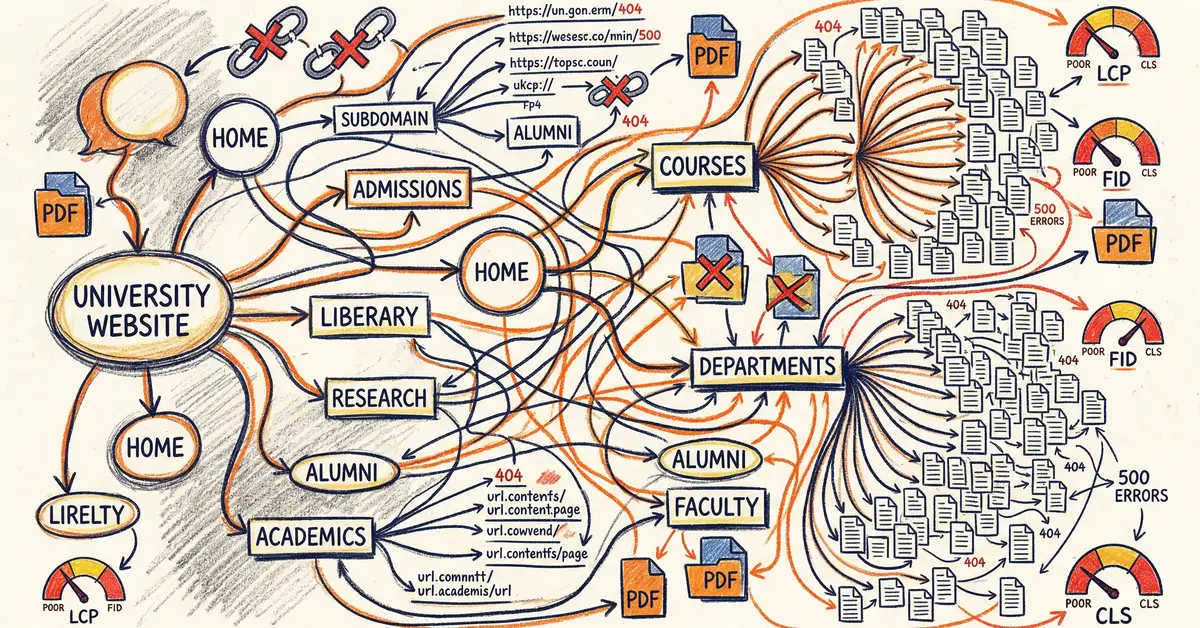
The fix requires a systematic technical audit. Consolidate subdomains into a unified information architecture, implement canonical tags to prevent duplicate content penalties, and migrate PDFs into web-native course pages with proper schema. Most universities add 40–60% more organic traffic within six months of implementing these foundational changes.
Content Strategy Aligned to the UCAS Cycle
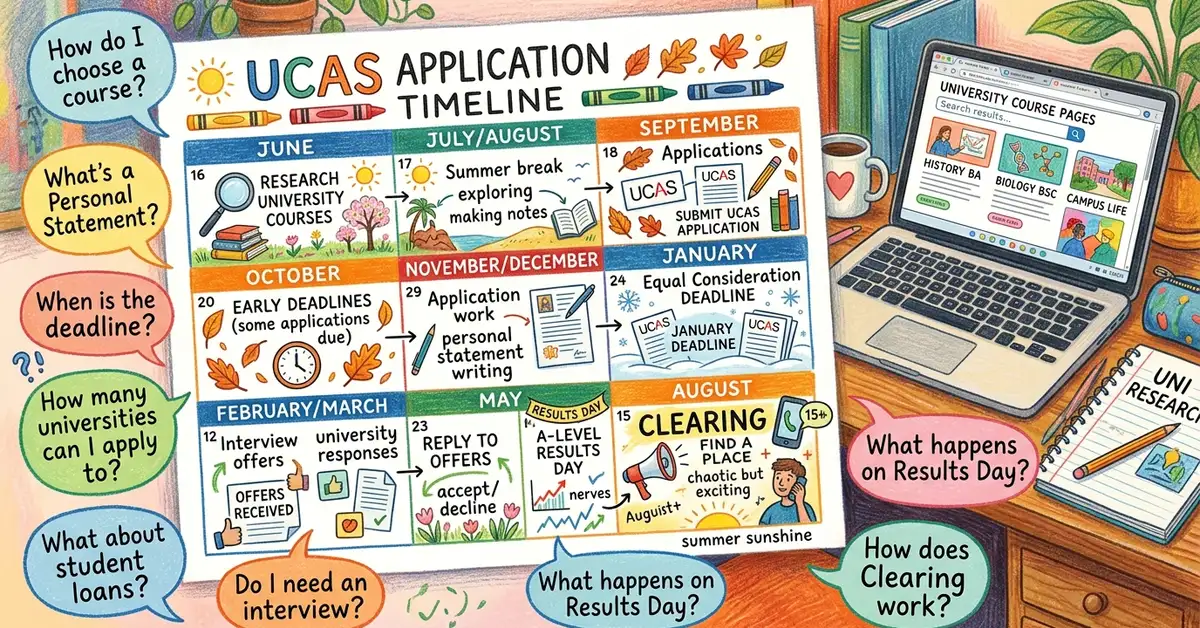
UK student searches follow a predictable annual calendar. The UCAS application cycle drives demand waves that universities must anticipate and target with strategic content publishing.
| Cycle Period | Key Dates | Student Search Behaviour | Recommended Content |
|---|---|---|---|
| Phase 1: Awareness | Jul–Sep (Year N) | High school students exploring options; comparing courses and campus facilities | Comprehensive course pages with embedded videos, virtual campus tours, career outcomes data |
| Phase 2: Consideration | Sep–Oct (Year N) | UCAS portal opens; students researching entry requirements, student life, accommodation | Entry requirements guides, student testimonials, accommodation reviews, social proof |
| Phase 3: Application | Oct–Jan (Year N+1) | Students writing personal statements; researching interview preparation | Personal statement examples (by course), interview tips, subject-specific guides |
| Phase 4: Decision | Mar–Aug (Year N+1) | Offer holders confirming places; prospective students finalising choice | Offer holder guides, fresher week schedules, open day information, financing guides |
Source: UCAS 2025–26 Cycle Timeline
Publishers who align content releases to these cycles see 35–50% higher organic visibility. Start publishing Phase 1 content in June, Phase 2 by early September. The universities winning today are those who publish course comparison guides in July, not January.
Local SEO and Campus Discoverability
Many prospective students start their search not with "university degree in X" but with "universities near me" or "open days [my city]". Local SEO captures this critical early-stage demand.
Google Business Profile Optimisation
Claim all campus locations (main site + satellite campuses). Add opening hours for admissions offices, upload high-resolution campus photos monthly, and collect reviews from student ambassadors. Universities with 40+ reviews see 2.5× more local enquiries.
Multi-Location Schema & Open Days
Implement LocalBusiness schema for each campus location with PostalAddress, telephone, and coordinate data. Create dedicated open day pages with Event schema (date, time, location, ticket URL). This enables Google to surface your events in Maps, local search results, and Google's event carousel.

Universities with optimised GBP listings see 18–22% of traffic attributable to map and local pack features. For student recruitment, this is disproportionately important: students deciding between universities often compare campus experiences directly via Maps before visiting.
SEO Investment: Costs, Timelines, and ROI
Building a sustainable SEO programme requires investment across technology, content, and talent. Here's what universities typically spend:
| Investment Level | Monthly Cost | Components | Expected Student Uplift |
|---|---|---|---|
| Foundational | £2,500–£4,000 | Technical audit, on-page optimisation, quarterly reporting | 15–25% year 1 |
| Growth | £5,000–£8,500 | Content strategy, 8–12 articles/month, link building, GBP management | 35–50% year 1, 60–80% by year 2 |
| Premium | £9,000–£12,000 | Full CMS migration, technical build, 15–20 articles/month, dedicated team, international SEO | 50–70% year 1, 90–110% by year 2 |
Source: Whitehat SEO Higher Education Client Data 2024–2025
The ROI calculation is straightforward. A single international student generates £60,000–£112,500 in fees over their degree (depending on subject and origin). A programme that captures 15–25 additional students per year (conservative for foundational SEO) returns £900,000–£2,812,500 annually against an investment of £30,000–£48,000. ROI: 1,875%–9,375% in year one.
AI Search and Answer Engine Optimisation (AEO)
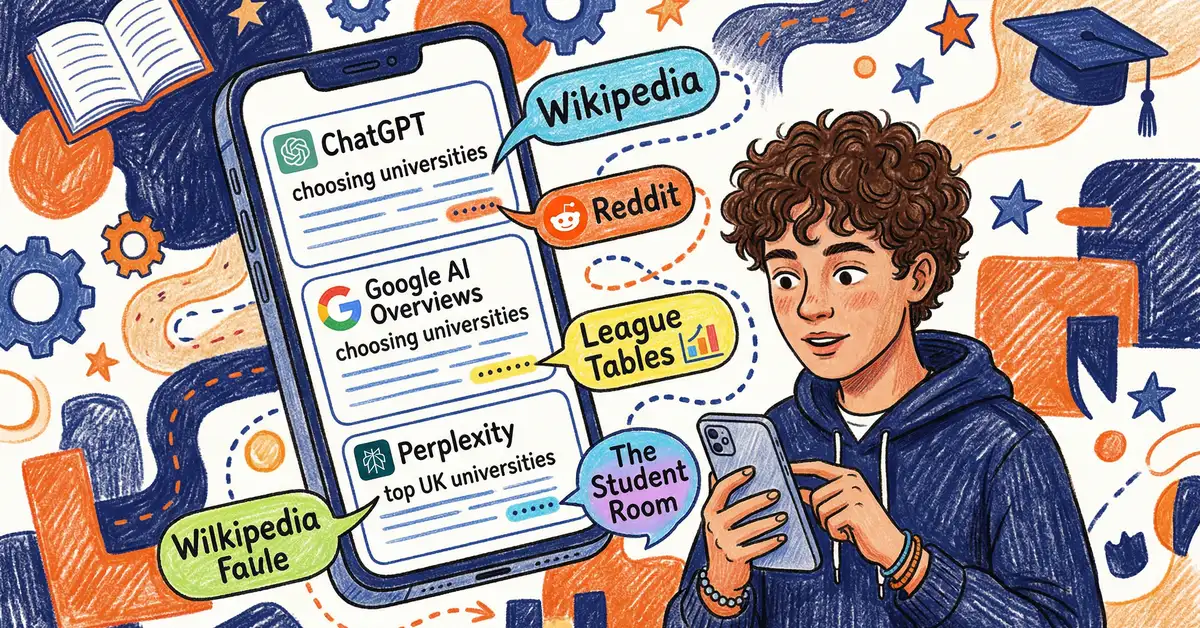
Google's AI Overview, Perplexity Pro, ChatGPT, and Claude are reshaping how students research universities. AI search usage among Gen Z has climbed from 4% in 2023 to 23% in 2025. If your university isn't optimised for AI search, you're invisible to nearly one-quarter of your prospective audience.
The Citation Bias Problem
Common mistake: Universities assume AI systems will cite their official course pages first because they're authoritative.
The reality: AI systems show citation bias toward popular third-party sources — Student Room forums, Reddit threads, YouTube videos, and external review sites often outrank official university content in AI results. Third-party content benefits from higher link authority and social signals that LLMs weight heavily.
To win in AI search, universities must:
Create Direct-Answer Content
Write answer-engine-ready pages that respond to actual student questions: "What are the entry requirements for [Course] at [University]?", "How much does [Degree] cost for international students?", "What's student life like at [University]?". Use exact-match question headers and provide data-rich answers in the first 100 words.
Claim Third-Party Profiles
Claim your university pages on Student Room, Rate My Placement, QS Quacquarelli Symonds, The Complete University Guide, and Guardian University Guide. Verify institutional information to reduce errors and ensure AI systems cite accurate data.
Build Citeability
Earn links from educational authority sites, media mentions, and university rankings. AI systems weight inbound links as a citeability signal. Universities with 200+ referring domains rank in AI results 3–4× more frequently than those with 50–100 domains.
Implement Schema for Rich Citations
Deploy EducationalOccupationalCredential schema (for courses), Course schema (with instructors, duration, cost), and Organization schema. This gives AI systems structured data to cite directly from your site, improving attribution and visibility.
Regulatory Compliance: Legal Requirements for University Marketing
UK universities operate under a complex regulatory landscape. Misrepresenting programmes, entry requirements, or outcomes can result in Office for Students (OfS) sanctions, fines under Competition and Markets Authority (CMA) rules, or complaints to the Advertising Standards Authority (ASA).
| Regulation | Governing Body | Key Requirements | Content Implications |
|---|---|---|---|
| OfS Registration | Office for Students | Accurate course information, genuine student testimonials, transparent entry requirements, no misleading claims | Audit all course pages for factual accuracy. Verify student review quotes are genuine. Remove inflated employment stats not backed by evidence. |
| CMA Consumer Rights | Competition & Markets Authority | No aggressive sales tactics, clear refund/withdrawal policies, transparent fees | Display all costs (tuition, accommodation, materials) upfront. Use neutral language ("explore" not "don't miss out"). Link to withdrawal policy on every course page. |
| ASA Code | Advertising Standards Authority | All advertising claims must be substantiated, testimonials must be genuine, no misleading visuals | Document sources for rankings claims (e.g., "Top 10 in UK"). Ensure campus photos reflect actual facilities. Avoid "guaranteed job placement" language. |
| GDPR & Privacy | Information Commissioner's Office (ICO) | Explicit consent for data collection, clear privacy policies, right to be forgotten | Display privacy notice before any form submission. Implement cookie banners with granular consent. Document processing basis (e.g., "legitimate interest in student recruitment"). |
| WCAG 2.2 | Web Content Accessibility Guidelines | AA compliance (minimum), alt text on images, keyboard navigation, color contrast, form labels | Audit all course pages with axe DevTools. Add descriptive alt text to all images. Use sufficient color contrast (4.5:1 for text). Test with screen readers. |
| Distance Marketing Consumers Regulations | UK Department for Business, Innovation and Skills | Pre-contract information, cooling-off periods for EU students, cancellation rights | Include cooling-off period details on international recruitment pages. Provide pre-enrolment information packages as downloadable PDFs. |
Source: OfS Registration Conditions 2023, CMA Higher Education Consumer Rights Guidance 2024, ASA Higher Education Code 2024
Frequently Asked Questions About University SEO
Here are answers to the most common questions Emma Rodriguez and other education admissions marketers ask about implementing SEO programmes at their institutions.
Universities recruiting internationally need AEO strategies to compete in AI search and technical SEO audits to fix infrastructure problems that traditional rankings ignore.
Get a Technical SEO Audit for Your UniversityReady to reclaim lost revenue through SEO?
The universities winning student recruitment in 2026 are those who invested in SEO in 2024. We help UK universities build sustainable, compliant SEO programmes that drive year-over-year enrolment growth. Our approach combines technical fixes, content strategy aligned to the UCAS cycle, and AI optimisation for the next generation of student search.
Emma Rodriguez
Education Admissions Marketer, Whitehat SEO
Emma leads SEO strategy for UK higher education clients across the Russell Group, million-pound specialist providers, and emerging institutes. With 12 years in education marketing, she specialises in UCAS cycle optimisation, international student recruitment, and compliance-first content strategies. Emma holds CIPL Level 6 certifications in both SEO and higher education law.
Sources: UK Higher Education Statistics Agency (HESA) 2025, Universities UK International Report 2025, QS World University Rankings 2026, Whitehat SEO Case Studies (2024–2025) higher education SEO services