
Marketing Strategy
If you're still building your marketing strategy around third-party cookies, you're already behind. The shift to contextual marketing isn't coming—it's here. And the businesses that master it now will capture market share from those still scrambling to adapt.
Contextual Marketing in 2026: The Complete Strategy Guide
How to deliver privacy-first personalisation that actually converts—without relying on cookies or creeping out your customers.
Key Takeaways
- The market is massive: Contextual advertising is projected to reach £468 billion by 2030, growing at 13.3% annually.
- Privacy wins: 79% of consumers prefer contextual ads over behavioural targeting—and contextual delivers 30% higher conversion rates.
- Personalisation pays: Companies excelling at personalisation generate 40% more revenue from those activities than average performers.
- First-party is essential: Organisations using first-party data achieve 2.9x revenue uplift and 1.5x cost savings.
- AI changes everything: HubSpot's Breeze AI suite now enables personalisation at scale—without the compliance headaches.
The numbers tell a compelling story. The global contextual advertising market has surged past $198 billion and is projected to reach $468 billion by 2030. That's not gradual growth—it's a fundamental restructuring of how brands connect with buyers. For B2B marketers specifically, contextual approaches are delivering 30% higher conversion rates without the compliance risks that keep your legal team up at night.
This guide covers everything you need to implement contextual marketing effectively: how the technology has evolved, what the privacy landscape actually looks like in 2026, which tactics deliver measurable ROI, and how to leverage HubSpot's Smart Content and Breeze AI capabilities to execute at scale.
How Contextual Marketing Has Evolved with AI
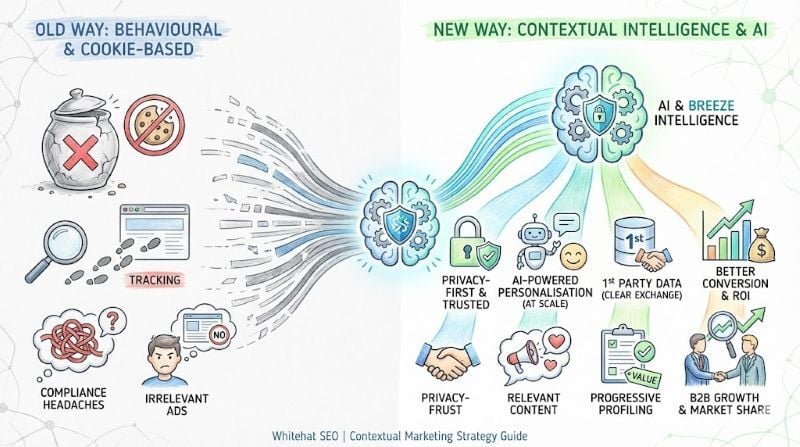
The definition of contextual marketing has fundamentally expanded since 2024. Where it once meant simple keyword matching—show running shoe ads on fitness websites—modern contextual AI now understands sentiment, tone, semantics, and intent. Large language models can label hundreds of millions of web URLs and group sites using virtually unlimited variables. Computer vision analyses video content frame-by-frame for Connected TV advertising.
This shift from "contextual" to "contextual intelligence" represents a qualitative leap. AI-driven real-time bidding systems now evaluate millions of variables instantaneously, delivering up to 30% reduction in cost-per-acquisition compared to traditional programmatic approaches. The agentic AI market—autonomous systems that shape decisions in real-time—is exploding from $7 billion in 2025 to over $93 billion by 2032.
For B2B specifically, Forrester notes that generative AI enables "personalisation into contextualisation"—content that senses and responds to audience context in real-time rather than simply serving pre-built segments. B2B teams pairing GenAI with data-driven personalisation are 1.7x more likely to grow market share.
Contextual vs Behavioural: What's the Difference?
Contextual Marketing
Targets based on immediate environment—page content, device, location, time of day—without requiring personal data. Analyses what you're engaging with right now.
Behavioural Marketing
Tracks users across websites using cookies and device IDs to build historical profiles. Creates a record of where you've been and what you've done.
The practical distinction matters: contextual AI wins on compliance, accuracy, cost-effectiveness, user experience, and scalability. The only advantage behavioural targeting retains is historical depth—and that advantage is eroding as contextual systems become more sophisticated.
The Cookie Situation and Privacy Landscape
Google's dramatic reversal on third-party cookie deprecation reshaped the industry's trajectory. After six years of Privacy Sandbox development and multiple delays, Google announced in July 2024 that it would not eliminate third-party cookies entirely, instead introducing user-controlled settings. In October 2025, Google officially retired the Privacy Sandbox initiative, citing low adoption rates and regulatory concerns.
Yet the industry continues transitioning to privacy-first alternatives regardless of Chrome's status. Safari and Firefox already block third-party cookies by default. More significantly, 70% of digital marketers report feeling "underprepared" for cookie deprecation realities—suggesting most brands recognise cookies' eventual obsolescence even if timelines remain uncertain.
GDPR enforcement has intensified, with European data protection authorities issuing over €2.8 billion in fines since 2018. In the UK, the ICO is taking a nuanced approach while the Data (Use and Access) Act 2025 increased PECR fines to align with GDPR at £17.5 million or 4% of annual worldwide turnover. Critically, the ICO has explicitly positioned contextual advertising as a compliant alternative, noting it "more readily enables compliance with both PECR and UK GDPR obligations."
The regulatory message is clear: contextual targeting that analyses page content rather than user behaviour operates within a fundamentally different compliance framework—one that requires fewer legal gymnastics and less consent infrastructure. For SEO and marketing strategies, this shift creates both challenges and opportunities.
Statistics That Matter for Conversion and ROI
The performance data for contextual and personalised marketing reveals why investment is accelerating. Contextual ads are 50% more likely to be clicked than non-contextual alternatives, with 63% boost in purchase intent and 83% increase in recommendation intent. Perhaps most striking, contextual advertising outperforms demographic targeting by 300% in brand recall.
202%
Better conversion from personalised CTAs vs generic
40%
More revenue from personalisation leaders
£36
Return for every £1 spent on email marketing
77%
Of B2B buyers refuse to purchase without personalisation
HubSpot's research confirms that personalised CTAs achieve 202% better conversion than generic versions—a benchmark that has held consistent through multiple testing cycles. Companies using AI-powered personalisation report 40% lift in conversion rates overall.
The ROI case is compelling: McKinsey found that companies excelling at personalisation generate 40% more revenue from those activities than average players. Personalisation can reduce customer acquisition costs by as much as 50%, lift revenues by 5-15%, and increase marketing ROI by 10-30%.
B2B-specific metrics are particularly relevant. While 77% of B2B buyers refuse to purchase without personalised content, only 25% feel their personalisation expectations are being met—representing a significant opportunity gap for companies that get this right.
HubSpot's Smart Content and Breeze AI Capabilities
HubSpot's personalisation toolkit has matured significantly through 2025. Smart Content (available in Marketing Hub and Content Hub Professional/Enterprise) enables content adaptation based on ad source, country, device type, referral source, preferred language, contact list membership, lifecycle stage, and query parameters. These rules can be applied across website pages, landing pages, email body text, CTAs, and forms.
The Breeze AI suite represents HubSpot's most substantial capability expansion. Breeze Copilot serves as an AI companion across all HubSpot applications, using CRM data for personalised assistance including meeting prep, content creation, and strategic analysis. The memory feature learns user preferences for increasingly personalised outputs.
Breeze Agents operate as AI-powered teammates across hubs:
- Content Agent: Creates blogs, case studies, and landing pages aligned with brand voice
- Social Media Agent: Analyses performance and automates scheduling
- Prospecting Agent: Researches prospects, identifies decision-makers, crafts personalised outreach
- Customer Agent: Provides 24/7 automated support
- Personalisation Agent (beta): Identifies responsive audience segments and creates tailored websites and CTAs automatically
Breeze Intelligence provides B2B data enrichment from 200+ million buyer and company profiles, buyer intent tracking, and smart form shortening. For organisations serious about contextual marketing, proper HubSpot onboarding is essential to configure these capabilities correctly from day one.
First-Party and Zero-Party Data Collection Strategies
With third-party data becoming unreliable, first-party data collection has become the critical capability. Companies using first-party data achieve 2.9x revenue uplift and 1.5x cost savings. The approach requires clear value exchange—65% of customers are willing to share data for personalised experiences when the trade-off is explicit.
Progressive profiling leverages psychology: users who provide minimal data initially are 320% more likely to share more in later interactions. Start with 2-3 essential fields, track customer steps to identify moments for additional requests, and offer clear benefits at each stage. Welcome sequences with post-signup preference centres capture 3x more data than traditional forms.
Zero-party data—information customers intentionally share—outperforms third-party data by 217% in engagement metrics. Effective collection methods include:
- Interactive quizzes achieving 75-80% completion rates versus 35% for basic lead magnets
- Preference centres where customers update preferences voluntarily
- Conversational chatbots that build profiles over time
- Loyalty programmes that trade perks for durable data
Best practices for ethical collection: only ask for data you'll actively use, show customers how preferences affect their experience, make changing preferences simple, and maintain freshness with regular preference checkups.
Optimising for AI Answer Engines
The rise of ChatGPT, Google Gemini, and Perplexity has created a new optimisation challenge. With 800 million weekly active users on ChatGPT alone (doubled from February 2025), AI answer engines are reshaping how B2B buyers discover solutions. For zero-click environments where users never visit your site, success means influence rather than traffic.
The E-E-A-T framework (Experience, Expertise, Authoritativeness, Trustworthiness) has intensified in importance. Share first-hand knowledge, ensure expert review, gain recognition through citations and mentions, and maintain transparent, accurate content with clear provenance. Our comprehensive AEO guide covers how to show up in ChatGPT search in detail.
Practical tactics for AI visibility:
- Develop modular content that can appear across formats
- Optimise for featured snippets—40.7% of voice search answers come from them
- Track brand mentions in AI responses as a primary metric
- Structure content with clear headings and FAQ sections for extraction
- Implement comprehensive schema markup for machine readability
The goal isn't to replace traditional SEO services—it's to complement them. Traditional SEO captures search demand today while AEO positions you for where search is heading.
Future Trends Shaping 2026 and Beyond
Predictive contextual marketing is moving from aspiration to implementation. Modern chatbots handle 80% of routine customer queries without human intervention, analysing on-site behaviour to offer hyper-personalised next steps. By 2029, Gartner predicts agentic AI will autonomously resolve 80% of customer service issues.
Generative AI for personalisation at scale is becoming practical. McKinsey notes that addressing small consumer segments with customised content was historically "cost-prohibitive and practically infeasible"—GenAI drives down costs dramatically. Adobe GenStudio enables "tens of thousands of assets for a single campaign."
Voice and conversational marketing continues rapid growth. 71% of internet users prefer voice search over typing, with voice searches accounting for over 30% of all queries in 2025. For contextual marketing, voice assistants now personalise answers based on user history and preferences—optimisation requires conversational, natural language content structured for featured snippets.
Zero-click search impact is substantial: 80% of consumers rely on zero-click results for at least 40% of their searches. Brands must redefine success metrics from clicks to impressions, AI reach, and influence.
What the Research Shows
Gartner offers a sobering perspective: 48% of personalised communications fail, perceived as either irrelevant or intrusive. Personalised marketing generates negative experiences for 53% of customers when done poorly.
But here's the opportunity: customers who experience effective personalisation are 1.8x more likely to pay premium prices. The lesson isn't to abandon personalisation—it's to do it better.
Strategic Priorities for 2026
The contextual marketing landscape in 2026 rewards organisations that have built three core capabilities:
1. Robust first-party data infrastructure—CDPs, consent management, progressive profiling—that operates independently of third-party cookies and complies with tightening regulations.
2. AI-powered contextual intelligence that analyses content environments, predicts intent, and personalises at scale without crossing the line into intrusive surveillance.
3. AEO-optimised content structured for extraction by AI answer engines while maintaining the depth and authority that builds lasting brand presence.
For B2B marketers using HubSpot, the technical foundation exists. The Breeze AI suite, Smart Content capabilities, and expanding data enrichment tools provide what you need. The key differentiator will be strategic implementation: helping your organisation collect the right first-party data, deploy personalisation that helps rather than annoys, and optimise for the AI-mediated discovery environment reshaping how buyers find solutions.
Ready to Implement Contextual Marketing?
Whitehat helps B2B companies configure HubSpot's Smart Content and Breeze AI capabilities for maximum impact. Let's discuss how to build your contextual marketing engine.
Explore Our Services
References & Further Reading
- Grand View Research – Contextual Advertising Market Size & Share Report, 2030
- McKinsey – The Value of Getting Personalisation Right—or Wrong—is Multiplying
- HubSpot – 15 Call-to-Action Statistics You Need to Know
- McKinsey – What is Personalisation?
- UK Information Commissioner's Office – Cookie Guidance
- HubSpot – 2025 Marketing Statistics, Trends & Data
- Gartner – Marketing Research & Insights
Whitehat SEO Ltd
HubSpot Diamond Partner | London
Whitehat runs the world's largest HubSpot User Group and has been helping B2B companies connect marketing activity to revenue since 2011. We specialise in SEO, Answer Engine Optimisation, and HubSpot implementation for growth-stage businesses.