
On-page SEO best practices in 2026 focus on satisfying user intent through comprehensive content, fast-loading pages with Core Web Vitals compliance, strategic internal linking, and optimisation for AI search visibility. Research shows pages ranking first on Google capture between 22% and 40% of clicks, with content depth now mattering more than keyword density. Whitehat SEO helps UK businesses implement these evidence-based techniques to improve organic rankings and generate qualified leads.
Why Does On-Page SEO Still Matter in 2026?
On-page SEO remains the foundation of organic search success because it directly communicates your content's relevance to both search engines and users. Google's March 2024 Core Update ran for 45 days and reduced low-quality content in search results by 45%, demonstrating the search engine's continued commitment to rewarding well-optimised, valuable pages.
For UK businesses, the stakes are significant. Google commands 93.6% of the UK search market, and the UK SEO services industry is valued at £19.2 billion. Research indicates every £1 invested in SEO generates an average return of £22, making on-page optimisation one of the highest-ROI marketing activities available.
Key Takeaway
What has changed is how Google evaluates on-page factors. The 2025 algorithm updates have intensified focus on E-E-A-T (Experience, Expertise, Authoritativeness, Trust), with expert Marie Haynes noting that "E-E-A-T signals now outweigh traditional link metrics for many query types." This shift means on-page content quality directly influences rankings in ways it hasn't before.
How Do Core Web Vitals Affect Your Rankings?
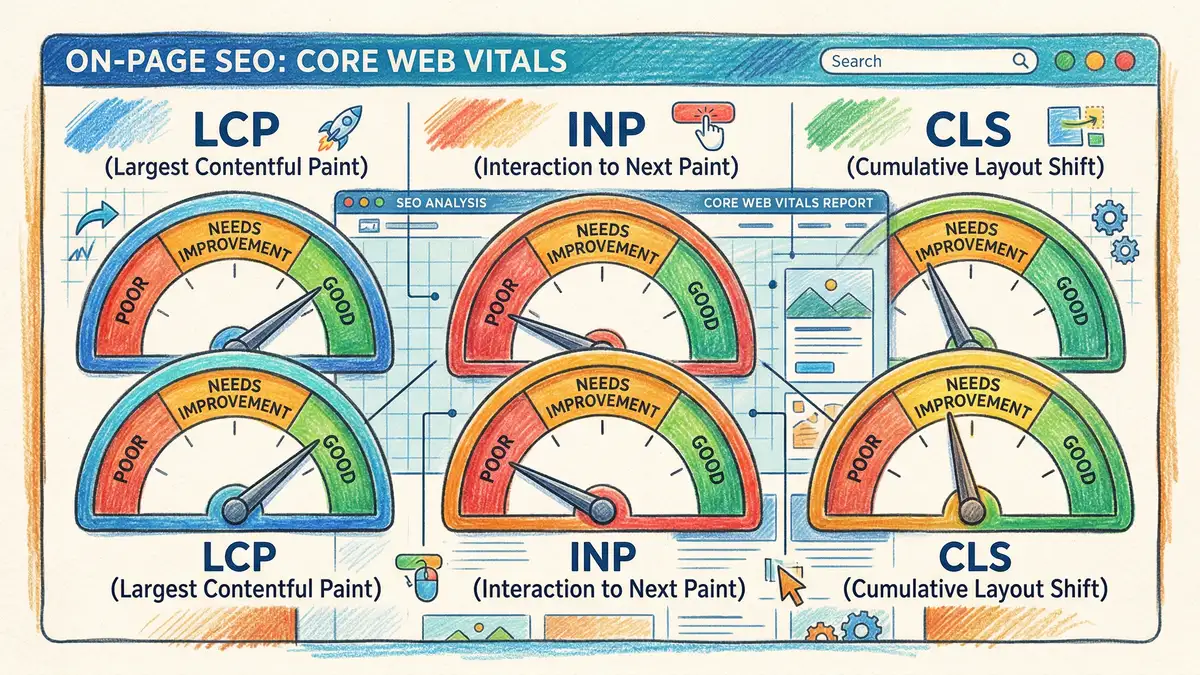
Core Web Vitals measure real-world page performance and directly influence search rankings. In March 2024, Google replaced First Input Delay (FID) with Interaction to Next Paint (INP), requiring pages to respond to user interactions within 200 milliseconds. Currently, 47% of websites fail this new INP threshold.
The three metrics every UK business must monitor are:
- Largest Contentful Paint (LCP): Target under 2.5 seconds—measures loading performance
- Interaction to Next Paint (INP): Target under 200ms—measures responsiveness
- Cumulative Layout Shift (CLS): Target under 0.1—measures visual stability
47%
Websites Failing INP
Don't meet the 200ms threshold
49.7%
Mobile Sites Passing All
All three Core Web Vitals thresholds
57.1%
Desktop Sites Passing All
All three Core Web Vitals thresholds
Sources: Google Search Central, Web Vitals data 2024
Only 49.7% of mobile sites and 57.1% of desktop sites currently pass all three Core Web Vitals thresholds. This represents both a challenge and an opportunity—meeting these benchmarks puts your site ahead of nearly half your competitors. A comprehensive website audit identifies specific performance issues affecting your Core Web Vitals scores.
What Makes an Effective Title Tag and Meta Description?
Title tags and meta descriptions remain crucial for click-through rates, though Google frequently rewrites them. Research shows Google modifies 33.4% of title tags and 62.78% of meta descriptions in search results. Writing these elements well reduces the likelihood of Google intervention whilst maximising clicks.
Title Tag Best Practices
Keep title tags between 50-60 characters to prevent truncation. Position your primary keyword near the beginning, include your brand name for recognition, and create compelling copy that accurately reflects page content. Google is more likely to rewrite titles that don't match user search intent or that appear manipulative.
Meta Description Best Practices
Optimal meta descriptions are 150-160 characters. Include a clear value proposition, incorporate relevant keywords naturally, and add a call-to-action where appropriate. Position 1 in Google captures between 22.4% and 39.8% of clicks depending on the query type—but a compelling meta description can significantly increase your click-through rate even from lower positions.
Ready to optimise your title tags and meta descriptions? Learn our on-page SEO framework used by market leaders.
Explore Our FrameworkHow Much Content Do You Need to Rank?
Content depth matters more than word count alone, but data shows a clear correlation between comprehensive content and rankings. The average word count for first-page Google results ranges from 1,447 to 1,500 words, though this varies significantly by topic and search intent.
More importantly, long-form content earns substantially more backlinks. Articles exceeding 3,000 words generate 77.2% more referring domain links than shorter pieces. This isn't because length itself is a ranking factor—it's because comprehensive content more thoroughly addresses user questions, earning both engagement and links.
The key principle is topic coverage rather than arbitrary word targets. Google's helpful content system evaluates whether your page provides a satisfying experience for someone seeking information on that topic. For UK B2B companies with complex offerings, this typically means creating detailed guides that address multiple related questions within a single, well-structured page.
Whitehat SEO's SEO services include content strategy development that identifies the optimal depth and structure for your target keywords based on competitive analysis and search intent research.
Why Is Internal Linking So Powerful for SEO?
Internal linking is one of the most underutilised on-page SEO techniques, yet the data is compelling. Pages with exact-match anchor text internal links receive five times more organic traffic than those with generic anchors like "click here" or "learn more."
Case studies demonstrate remarkable results from internal linking improvements alone. One analysis showed a single strategic internal link change increased page views by 88%, whilst other pages saw traffic increases of 570% following internal link optimisation. These gains come from helping Google discover, crawl, and understand the relationship between your pages.
| Internal Linking Strategy | Impact Type | Expected Outcome |
|---|---|---|
| Descriptive anchor text | Direct ranking | 5x more organic traffic |
| Linking from high-authority pages | Authority transfer | Accelerated ranking growth |
| Strategic single internal link | Page visibility | 88% increase in page views |
| Internal linking audit | Full optimisation | Up to 570% traffic increase |
| Topic cluster creation | Topical authority | Improved topical relevance |
Sources: Case study analysis from SEO professionals, internal linking research 2024
Effective internal linking follows several principles:
- Use descriptive anchor text that tells both users and search engines what the linked page covers
- Link from high-authority pages to important pages you want to rank
- Include 10-20 internal links per page as a general guideline for comprehensive content
- Create topic clusters linking related content together around pillar pages
- Audit existing content regularly for internal linking opportunities
Does Schema Markup Improve Rankings?
Schema markup is not a direct ranking factor—Google's John Mueller has confirmed this repeatedly. However, structured data significantly improves click-through rates and can increase visibility by up to 40% through rich snippets in search results. This indirect benefit makes schema implementation worthwhile for most sites.
Google recommends JSON-LD format for structured data implementation. The most impactful schema types for UK B2B companies include Article schema for blog posts, Organisation schema for your homepage, and FAQ schema where appropriate. Note that Google restricted FAQ rich results in August 2023 to government and health websites only, though the schema itself can still help search engines understand your content structure.
Research shows pages with schema markup achieve a 36.6% increase in search visibility compared to unmarked pages. For local businesses, LocalBusiness schema is particularly important for appearing in map results and knowledge panels.
How Do You Optimise for AI Search and AI Overviews?
AI Overviews now appear in 15-30% of Google searches, with mobile AI Overview presence increasing 475% year-over-year. This fundamental shift in how search results appear makes AI optimisation essential for on-page SEO in 2025. For comprehensive guidance on this emerging discipline, see our article on SEO in the AI era.
The good news for UK businesses already investing in quality content: 92-99% of AI Overview citations come from pages ranking in the top 10 organic results. This means traditional SEO success correlates strongly with AI visibility.
Critical for AI Visibility
Common mistake: Creating content without considering how AI systems extract and cite information. Avoiding structured data and clear answer paragraphs reduces your chances of AI Overview inclusion.
The reality: Content with clear opening paragraphs, structured headings, tables, and proper schema markup is 2.5 times more likely to be cited in AI Overviews—combining traditional and AI visibility in a single optimised page.
Key on-page factors for AI citation include:
- Direct answers in opening paragraphs: AI systems extract 40-60 word answer capsules from the beginning of content
- Structured content with clear headers: AI can extract and cite specific sections independently
- Tables and comparison data: Content with tables is cited 2.5 times more frequently in AI responses
- Statistics with source attribution: AI systems prefer content with verifiable data points
- Recent publication dates: Content updated within three months is 2.5 times more likely to appear in AI Overviews
What UK-Specific Factors Should You Consider?
UK businesses face specific on-page SEO considerations beyond general best practices. With 54.7% of UK web traffic now coming from mobile devices, mobile-first design isn't optional—it's essential for reaching your audience effectively.
Language consistency matters for UK audiences. Use British English spelling throughout (optimise, not optimize; colour, not color) and maintain consistent terminology. This builds trust with UK readers and helps search engines correctly identify your target geographic market.
For UK B2B companies, understanding buyer behaviour shapes content strategy. Research shows 57% of UK B2B buyers are already 57% through their purchasing decision before contacting suppliers. The typical B2B buying cycle lasts 11 months and involves 9 or more decision-makers. Buyers conduct an average of 12 searches before engaging with a brand's website, and 90% research between 2-7 vendor websites during evaluation.
This means your on-page content must address questions buyers ask throughout their entire decision journey—from problem awareness through to vendor evaluation—rather than focusing solely on bottom-funnel conversion content.
Mobile-First Design
54.7% of UK web traffic comes from mobile devices. Responsive design with fast loading times is essential for reaching your audience and maintaining rankings.
Buyer Journey Mapping
UK B2B buyers complete 57% of their research before contacting suppliers. Address all decision-stage questions across awareness, consideration, and evaluation content.
Frequently Asked Questions
How long does it take to see results from on-page SEO changes?
Most on-page SEO improvements take 4-12 weeks to impact rankings noticeably. Technical fixes like Core Web Vitals improvements can show faster results, whilst content optimisation typically requires several months for Google to reassess your pages. Consistent implementation delivers compounding benefits over time.
Is keyword density still important for on-page SEO?
Keyword density as a metric is outdated. Google's algorithms understand semantic relationships and context rather than counting keyword occurrences. Focus on naturally covering your topic comprehensively, using varied terminology, and satisfying search intent rather than targeting specific keyword percentages.
What is the most important on-page SEO factor in 2025?
Content quality that satisfies search intent is the single most important on-page factor. Google's helpful content system evaluates whether your page provides genuine value to searchers. Technical factors like page speed and mobile-friendliness are prerequisites, but content relevance and depth ultimately determine rankings.
Do I need to optimise differently for Google AI Overviews?
AI Overviews primarily cite pages already ranking well organically, so traditional on-page SEO remains essential. Additional optimisation includes structuring content with clear, extractable answer paragraphs, using tables for comparative data, and keeping publication dates current. Pages meeting AI citation criteria often perform well in both traditional and AI search.
How often should I update existing content for SEO?
Review and update high-priority pages every 6-12 months, or sooner if information becomes outdated. Research shows recently updated content is 2.5 times more likely to appear in AI Overviews. Prioritise pages targeting competitive keywords, those experiencing traffic declines, and content in rapidly changing industries.
What's the relationship between on-page SEO and overall digital marketing?
On-page SEO is the foundation of organic visibility but works best as part of an integrated digital marketing strategy. Combined with technical SEO, link building, content marketing, and paid advertising, on-page optimisation amplifies returns across all channels. For UK B2B companies, aligning on-page content with buyer needs supports both organic rankings and lead generation.
Ready to implement evidence-based on-page SEO?
Whitehat SEO helps UK B2B companies optimise their on-page elements, improve Core Web Vitals, structure content for AI visibility, and achieve sustainable organic growth. Our team combines technical expertise with strategic content development to deliver measurable business results.
Clwyd Probert
CEO & Founder, Whitehat SEO
Founded Whitehat in 2011 and has grown it into the world's largest HubSpot User Group London member company. HubSpot Diamond Partner, guest lecturer at UCL, and strategic advisor on AI implementation. Expert in SEO strategy, technical optimisation, and marketing automation for UK B2B companies.
References
- Google Search Central – March 2024 Core Update announcement
- web.dev – Interaction to Next Paint (INP) documentation
- Backlinko – Google Click-Through Rate Statistics
- Ahrefs – How Long Should Blog Posts Be?
- Moz – Google Title Tag Rewriting Study
- Search Engine Journal – Internal Linking Impact Study
- Google Search Central – Introduction to Structured Data
- Statista – UK Search Engine Market Share 2024
- SoPro – B2B Buyer Statistics and Insights
- Semrush – AI Overviews Research