
AI & Digital Strategy
AI consulting for UK SMEs has reached an inflection point in 2026. The global AI consulting market now exceeds £9 billion, with SMEs representing the fastest-growing segment at 26–36% annual growth. For UK businesses with 20–500 employees, the question has shifted from experimentation to execution: adoption is accelerating, but implementation quality remains poor. According to the Department for Science, Innovation and Technology's January 2026 research, only 16% of UK businesses currently use AI under strict measurement criteria, whilst industry surveys suggest the figure reaches 31–39% when including basic generative AI tools. This gap between hype and reality creates a structural need for specialist guidance.
AI Strategy Consulting for UK SMEs: The 2026 Practical Guide
How to bridge the gap between AI hype and implementation that actually delivers ROI for growing British businesses.
Key Takeaway
UK SME AI adoption has jumped from 9% in 2023 to 35% in 2025, yet 80% of AI projects still fail. The opportunity for specialist consultancies lies in bridging this implementation gap—helping businesses move from "should we use AI?" to "how do we make it actually work?"
Whitehat has been helping UK businesses navigate complex technology decisions since 2011. As a HubSpot Diamond Partner and the organisation behind the world's largest HubSpot User Group, we've seen first-hand how the businesses that succeed with new technology share a common trait: they focus on business outcomes over technical showcasing.
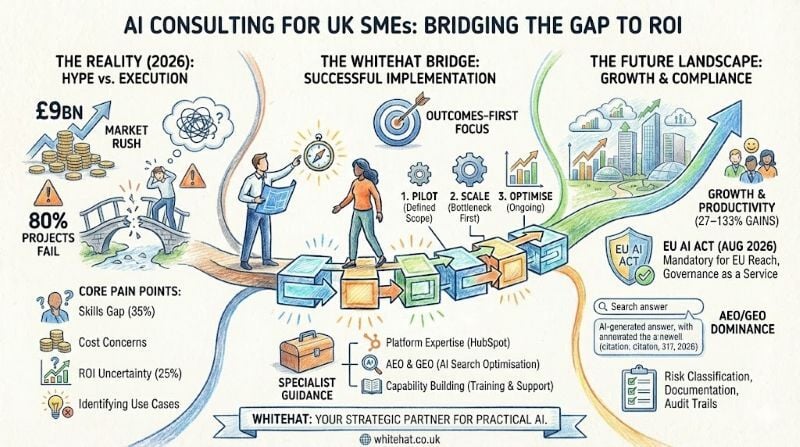
This guide provides practical frameworks for UK SMEs considering AI consulting—whether you're evaluating external advisors or building internal capability. We'll cover market dynamics, common pitfalls, and the emerging disciplines (like AEO and GEO) that are reshaping how businesses get discovered online.
The £9 billion market UK SMEs are rushing into
The numbers tell a compelling story. The UK sits as the world's third-largest AI market (after the US and China), with the sector generating £23.9 billion in revenue in 2024—a 68% increase year-on-year. The UK government has committed £2 billion to sovereign AI capabilities and launched regional AI Adoption Hubs in 2026.
Whilst large enterprises still dominate AI consulting spend (holding 63–69% of the market), SMEs are catching up fast. The British Chambers of Commerce found that 35% of SMEs now use AI, up from 9% in 2023. More significantly, only 33% report having no plans to use AI, down from 43% the previous year. The appetite is there—the challenge is execution.
| Metric | Figure | Source |
|---|---|---|
| UK businesses using AI (strict definition) | 16% | DSIT, January 2026 |
| UK SME AI adoption (industry surveys) | 31–39% | BCC / YouGov, 2025 |
| AI adopters reporting productivity gains | 75% | DSIT, January 2026 |
| Companies abandoning AI initiatives | 42% | S&P Global, 2025 |
| UK AI sector revenue growth YoY | 68% | UK Government, 2024 |
The sectoral disparity is worth noting: B2B service firms (finance, law, marketing) lead adoption at 46%, whilst B2C firms lag at 26%. This suggests the consulting opportunity is strongest in professional services—precisely where Whitehat's B2B marketing services focus.
What UK SMEs actually need from AI—and where they get stuck
The evidence is unambiguous about where businesses want AI help. According to HubSpot's 2025 State of Marketing, content creation is the number-one use case (35% of marketers), followed by data analysis (30%), workflow automation (20%), and AI-powered research (15%). This aligns with what Whitehat sees across our client base: marketing teams want to produce more content, understand their data better, and spend less time on repetitive tasks.
But adoption is riddled with pain points. The DSIT research (surveying 3,500 businesses) found that 80% of UK businesses neither use AI nor plan to. Among those that do adopt, the barriers are consistent:
- Skills and expertise gaps (35%): The ANS/techUK survey found this is the top barrier. PwC reports 96% of UK employers have an AI skills gap, and only 21% of UK workers feel confident using AI tools.
- Cost concerns (30%): Building a small in-house AI team costs £400,000+ annually. Most SMEs can't justify this without proven ROI.
- ROI uncertainty (25%): The ISACA found 49% of organisations struggle to estimate or demonstrate AI value. Without clear metrics, budget approval stalls.
- Identifying use cases: The ONS Management Expectations Survey found this is the single most common barrier. Businesses simply don't know where to start.
The Implementation Gap
University of St Andrews research found UK SMEs achieving AI productivity gains of 27% to 133%. Yet 42% of companies abandoned most of their AI initiatives in 2025, up from 17% the prior year. The gap between success and failure comes down to implementation quality—consultant-led AI implementations succeed 67% of the time versus 33% for internal builds.
This is where specialist guidance proves its value. At Whitehat, we focus on practical implementation rather than theoretical frameworks. Our HubSpot onboarding services now include AI configuration for Breeze tools, ensuring teams capture maximum value from day one.
AEO and GEO: The AI-driven marketing disciplines every SME should understand
The shift from traditional search to AI-powered discovery is no longer theoretical. AI referrals to top websites surged 357% year-on-year between June 2024 and June 2025. Google AI Overviews now appear in nearly half of all searches, and 60% of Google searches end without a click to a website. Gartner's prediction that traditional search volume will drop 25% by 2026 is directionally playing out.
Two new disciplines have emerged to address this shift:
Answer Engine Optimisation (AEO) focuses on structuring content so AI search features (Google AI Overviews, Bing Copilot) can extract direct answers. It's about being the source that appears in the answer box.
Generative Engine Optimisation (GEO) goes further, optimising content so large language models like ChatGPT, Claude, and Gemini cite your business as a trusted source in their generated responses. The practical distinction: AEO targets "answer-first" search results; GEO targets being referenced within synthesised, multi-source AI responses.
HubSpot has moved aggressively into this space. Its AEO Grader (free tool) analyses how brands appear across GPT-4o, Perplexity, and Gemini. The broader Breeze AI suite now includes 15+ agents—from a Customer Agent resolving over 50% of support tickets to a Prospecting Agent running 24/7 personalised outreach. The platform migrated custom agents to GPT-5 in January 2026.
Whitehat's SEO services now incorporate AEO and GEO methodology as standard. We help clients structure content for AI citation, build authority signals AI engines trust, and track visibility in AI-generated responses. This complements traditional SEO—it doesn't replace it.
EU AI Act compliance: The August 2026 deadline UK businesses can't ignore
Regulation is arriving faster than many businesses realise. The EU AI Act's main provisions take effect on 2 August 2026, including rules for high-risk systems, transparency requirements for AI-generated content, and penalties up to €35 million or 7% of global turnover. Prohibited AI practices (like manipulative systems and social scoring) have already been banned since February 2025.
The UK has delayed its own AI Bill to at least summer 2026, maintaining a sector-specific, principles-based approach rather than comprehensive legislation. But here's the critical point: for UK businesses serving EU clients, EU compliance is mandatory regardless of where you're headquartered.
Key obligations taking effect in August 2026 include full requirements for high-risk AI systems (spanning risk management, data governance, technical documentation, and conformity assessment), transparency obligations under Article 50 (requiring disclosure of AI interactions and labelling of synthetic content), and post-market monitoring requirements.
Smart consultancies are already positioning AI governance as a service line—helping clients with risk classification, documentation, and audit trails before enforcement begins. This is particularly relevant for Whitehat's clients in regulated sectors like biotech, medtech, and financial services.
What AI consulting actually costs in the UK market
Pricing in the SME consulting space is crystallising around three models. Understanding these helps you evaluate proposals and set realistic expectations:
| Model | Typical Range | Best For |
|---|---|---|
| Project-based | £10,000–£50,000 (simple) to £200,000+ (comprehensive) | Defined scope implementations |
| Monthly retainers | £2,000–£15,000/month | Ongoing optimisation and support |
| SME packages | £1,500–£3,000 (discovery), £5,000–£15,000 (implementation) | Phased approach with clear milestones |
Whitehat operates on month-to-month agreements with no long-term lock-ins. Retainer services typically range from £2,000–£10,000 per month depending on scope, with project work from £5,000–£75,000. We publish transparent pricing on our website—no hidden fees, no percentage-of-ad-spend models.
What successful AI implementation actually looks like
The consultancies that help SMEs succeed with AI share common characteristics. Based on our experience and industry research, here's what distinguishes effective implementation:
Focus on business outcomes, not technology showcasing. The goal isn't to implement AI for its own sake—it's to solve specific business problems. Before any implementation, define the measurable outcome you're targeting: reduced time on task, increased lead quality, improved customer response times.
Phased implementation rather than overwhelming transformation. The most successful SMEs adopt a phased approach to AI integration, rather than attempting a complete platform overhaul. Identify a single bottleneck—such as lead generation or finance automation—and solve it first before scaling.
Platform expertise matters. HubSpot's ROI Report shows partner-assisted Marketing Hub customers generated 53% more inbound leads than non-partner customers. Partner-led Sales Hub implementations closed three times more deals. The technology isn't the differentiator—implementation quality is.
Address the skills gap through training alongside deployment. The UK government has launched an AI Skills Hub targeting 10 million workers for upskilling by 2030, with over 1 million courses already completed. Effective consulting includes capability building, not just tool configuration.
Frequently asked questions about AI consulting for UK SMEs
How much should a UK SME budget for AI implementation?
A practical AI tool suite for SMEs can start at approximately £69 per month for basic automation, scaling to £25,000–£80,000 for pilot projects and £80,000–£300,000+ for production systems. The average small business invests roughly £9,500 on AI, whilst medium businesses average £380,000 annually. Start with a defined pilot to prove ROI before committing to larger investments.
What's the difference between AEO and traditional SEO?
Traditional SEO aims to rank your website so people click through from search results. AEO (Answer Engine Optimisation) structures your content so AI search features can extract and display your answers directly—often without a click. Both work together: strong SEO builds the authority that AI systems trust, whilst AEO ensures that authority translates into AI citations and recommendations.
Does my UK business need to comply with the EU AI Act?
If you serve EU clients or your AI outputs affect EU citizens, yes—compliance is mandatory regardless of where your business is headquartered. The main provisions take effect on 2 August 2026, with penalties up to €35 million or 7% of global turnover. Start assessing your AI systems now to determine risk classification and documentation requirements.
Why do 80% of AI projects fail?
The RAND Corporation found AI projects fail at higher rates than other IT projects primarily due to unclear objectives, poor data quality, skills gaps, and rushing to technology before understanding business requirements. Consultant-led implementations succeed 67% of the time versus 33% for internal builds because external expertise brings process discipline and lessons from multiple deployments.
How does Whitehat approach AI consulting differently?
Whitehat combines HubSpot Diamond Partner expertise with deep SEO knowledge and emerging AEO/GEO capabilities. We focus on practical implementation tied to measurable business outcomes, operate on month-to-month agreements without long-term lock-ins, and include capability building alongside tool deployment. Our HubSpot onboarding services now include Breeze AI configuration as standard.
Taking the next step
The AI consulting market for UK SMEs sits at an inflection point. Adoption is accelerating but implementation quality remains poor—creating a structural need for specialist guidance. The emergence of AEO and GEO as core marketing disciplines represents a particularly timely opportunity, with AI search reshaping discovery channels faster than most businesses can adapt.
HubSpot's aggressive AI integration (Breeze, AEO tools, GPT-5 migration) makes platform expertise increasingly valuable. And the approaching EU AI Act enforcement deadline of August 2026 creates urgency around governance consulting that didn't exist a year ago.
If you're exploring AI for your marketing, sales, or customer service functions, Whitehat can help you navigate the options and avoid the implementation pitfalls that derail 80% of projects. Book a call to discuss your specific situation—no obligation, just a practical conversation about what might work for your business.
References & Sources
- Department for Science, Innovation and Technology (2026). AI Adoption Research. GOV.UK.
- British Chambers of Commerce (2025). Turning Point As More SMEs Unlock AI.
- techUK / ANS (2025). Major barriers to AI adoption remain for UK businesses.
- HubSpot (2025). State of Marketing Report.
- Skills England (2025). Help for UK businesses to fill £400bn AI skills gap. GOV.UK.
- European Commission (2026). AI Act: Regulatory framework for AI.
- Future of Life Institute (2026). EU AI Act Implementation Timeline.
- UK Government (2026). AI Opportunities Action Plan - 2026 Progress.