
Digital Marketing Strategy
Online reputation management has fundamentally shifted. AI now powers everything from real-time sentiment detection to automated review responses, whilst new regulations from the UK's Competition and Markets Authority (CMA) have made compliance more critical than ever. For B2B companies, this transformation carries particular weight—review platforms have overtaken vendor websites and analyst firms as the primary research destination for software buyers, according to G2's 2024 Buyer Behavior Report.
AI-Powered Reputation Management in 2026: The Complete UK Business Guide
Online reputation management has fundamentally shifted. AI now powers everything from real-time sentiment detection to automated review responses, whilst new regulations from the UK's Competition and Markets Authority (CMA) have made compliance more critical than ever. For B2B companies, this transformation carries particular weight—review platforms have overtaken vendor websites and analyst firms as the primary research destination for software buyers, according to G2's 2024 Buyer Behavior Report.
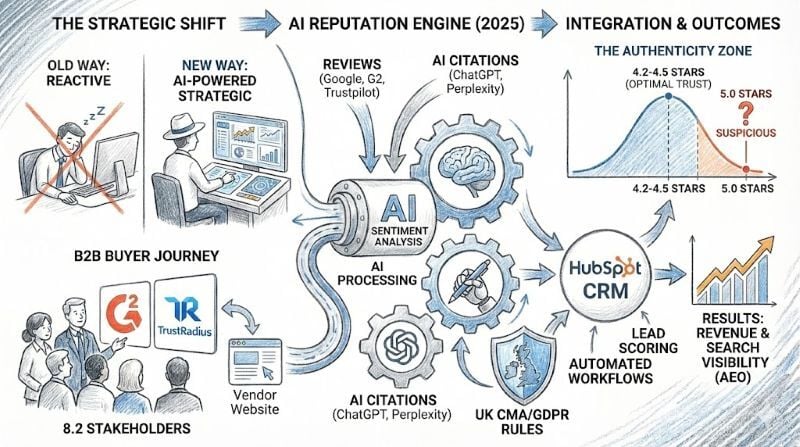
Whitehat SEO's work with B2B technology clients has shown that companies treating reputation management as a strategic function—integrated with their HubSpot CRM workflows and content strategy—consistently outperform those managing reviews reactively. This guide provides the current state of AI-powered reputation management, actionable strategies, and UK-specific considerations for businesses looking to stay competitive.
The Modern AI Reputation Management Toolkit
The AI reputation management market is projected to grow from £11.4 billion in 2025 to £18.8 billion by 2034 (CAGR 5.93%), driven by the integration of large language models and predictive analytics. Today's platforms have evolved from simple monitoring dashboards into autonomous systems that can generate, respond to, and analyse reviews with minimal human intervention.
| Platform | Key AI Features | Best For |
|---|---|---|
| Birdeye | BirdAI with GPT-powered response agents, industry-specific insights | Multi-location businesses |
| Reputation.com | AI Reputation Manager, Voice of Brand tone alignment | Enterprise, healthcare |
| Podium | GPT-5.1-powered AI Employee, 24/7 AI Concierge | Local SMBs, services |
| Brand24 | 95% sentiment accuracy, 6-emotion detection | Social listening, PR |
| ReviewTrackers | Smart Response AI drafts, competitor benchmarking | SMBs, mid-market |
Birdeye has emerged as the highest-ranked AI platform for local brands on G2 with a 99% satisfaction score, serving over 150,000 businesses. Meanwhile, Podium reported 300% year-over-year AI revenue growth since March 2024, deploying AI agents to 10,000+ SMBs—demonstrating the market's appetite for automated reputation solutions.
For businesses already using HubSpot, integrating reputation data into existing workflows creates significant competitive advantage. Whitehat SEO's inbound marketing services include connecting reputation platforms to HubSpot CRM, enabling review activity to trigger automated workflows, segment contacts based on review history, and adjust lead scoring based on sentiment signals.
What Consumer Research Reveals About Reviews in 2025
BrightLocal's 2025 Local Consumer Review Survey—the 15th annual edition surveying 1,026 US consumers—reveals critical shifts that UK businesses must understand. The findings underscore why reputation management has moved from a marketing nice-to-have to a revenue-critical function.
Key Statistics from BrightLocal's 2025 Survey
- 98% of consumers read online reviews at least occasionally before purchasing
- Average time spent: 13 minutes 45 seconds reading approximately 10 reviews
- 88% would use a business that replies to all reviews vs 47% for non-responders
- 46% of shoppers are suspicious of perfect 5-star ratings
- 56% changed their opinion after seeing how a business responded to reviews
Star Ratings: Why Perfection Backfires
Whilst 40% of consumers require at least 4 stars to consider a business, only 3% would consider one with 2 stars or fewer. However, perfect 5-star ratings raise suspicion—46% of shoppers distrust them, rising to 53% among Gen Z. Research from Northwestern University's Spiegel Research Center found that conversion rates actually peak at 4.2-4.5 stars, not 5.0. This counter-intuitive finding means businesses should focus on authenticity rather than perfection.
Response Behaviour Transforms Perception
The data on review responses is compelling. The 88% versus 47% preference gap between businesses that respond to all reviews versus none represents a significant competitive differentiator. Even more striking, 56% of consumers have changed their opinion about a business after seeing how they responded—making response quality as important as review quality itself. For negative reviews specifically, 53% expect a response within one week.
B2B Reputation Management: Different Rules Apply
B2B reputation management follows fundamentally different rules than B2C. Whilst consumer purchases are often quick and emotional, B2B decisions involve 8.2 stakeholders on average (up 21% since 2015), sales cycles averaging 11 months, and purchases that can reach hundreds of thousands of pounds.
G2's 2024 Buyer Behavior Report reveals that public product review websites are now the most consulted information source for 31% of B2B buyers—up from just 13% in 2021. This represents a seismic shift: review platforms have overtaken vendor websites and analyst firms as the primary research destination. The research shows 89% of B2B buyers who use review sites "often" or "always" check them before buying software, whilst 81% have already picked a winner before ever talking to a sales rep.
Platform-Specific Considerations for B2B
G2 dominates B2B software discovery with 100+ million annual visitors and 3+ million verified reviews. Critically for the AI search era, G2 is the most-cited source for B2B software queries across major large language models—2.6x more than other review platforms. Their AI capabilities include Monty, an AI-powered software recommendation agent, and an AI Visibility Dashboard tracking brand mentions in LLMs.
TrustRadius differentiates through its no-pay-to-play model and long-form reviews averaging 400+ words. Acquired by HG Insights in June 2025, vendors with scores of 80+ see a 12% higher conversion rate. Their downstream intent data integrates directly with HubSpot and Salesforce.
LinkedIn's role is often underestimated in B2B reputation. Employee-shared content generates 2.75x more impressions and 5x more engagement than company page posts, with employee networks reaching up to 10x larger audiences. Whitehat SEO's approach to SEO services includes LinkedIn optimisation as part of a comprehensive B2B visibility strategy.
Integrating Reputation Data with HubSpot and Salesforce
For B2B companies running on HubSpot or Salesforce, integrating reputation data into existing workflows creates significant competitive advantage. HubSpot does not have a native reputation management tool, but several third-party solutions have built marketplace integrations that Whitehat SEO helps clients implement.
HubSpot App Marketplace Options
Reputation.com launched its HubSpot integration in December 2022, syncing 10 key metrics including RepScore, average star rating, review volume, recency, spread, response rate, search impressions, listing accuracy, and social engagement. Business location sentiment data flows to HubSpot contacts, enabling analysis of how customer sentiment impacts leads, deals, and revenue by location.
Birdeye offers both native HubSpot and Zapier integrations. Customer data pulls from HubSpot based on triggers like deal closure or case resolution, automatically initiating SMS/email review requests. Review volume trends and sentiment analysis data sync back to HubSpot for centralised management.
REVIEWS.io pushes review data directly to HubSpot contact cards, creating custom properties for segmentation. Review requests can be triggered from within HubSpot Workflows, with VIP lists automatically assigned based on review patterns.
Strategic Workflow Pattern
Whitehat SEO's most valuable integration pattern connects review activity to customer lifecycle management: triggering review requests when deals close, segmenting contacts based on review history, escalating negative reviews for immediate response, and adjusting lead scoring based on sentiment signals. HubSpot's lead scoring tool can incorporate custom properties like review ratings and NPS scores, routing high-satisfaction customers to referral campaigns and low-satisfaction customers to retention workflows.
Our HubSpot onboarding services include workflow configuration that connects reputation management to your broader marketing automation strategy—ensuring review data drives actionable business outcomes rather than sitting in silos.
UK Regulatory Requirements: What You Must Know
The regulatory landscape for online reviews transformed in 2024-2025, with UK authorities implementing comprehensive new rules with substantial penalties. Understanding these requirements is essential for any business operating in the UK market.
UK CMA Guidelines Under the DMCCA 2024
The Digital Markets, Competition and Consumers Act 2024's fake reviews provisions became effective on 6 April 2025, with penalties up to 10% of global annual turnover. The CMA published its Fake Reviews Guidance (CMA208) in April 2025 and completed a compliance sweep of 100+ businesses in July 2025—finding over half potentially non-compliant.
Key CMA Compliance Requirements
- Publish clear fake review policies on your website
- Document approaches to incentivised reviews
- Implement detection systems for fake reviews
- Take "reasonable and proportionate steps" to prevent fake reviews
- Never compensate for specific sentiment (e.g., 5-star reviews only)
- Disclose any insider reviews from employees or family members
Major platforms have already responded—Google gave undertakings in January 2025, Amazon in June 2025. AI-generated review responses present a grey area: whilst no explicit disclosure requirement exists, best practice recommends disclosing AI assistance in customer-facing content. State-level requirements are emerging in other jurisdictions, and 84% of AI experts favour mandatory AI disclosures.
GDPR Considerations for Review Management
Review request emails qualify as "service messages" rather than marketing under ICO 2019 guidance, meaning they can be sent without explicit marketing consent. However, businesses must establish a lawful basis for processing (typically consent or legitimate interest), maintain consent audit trails refreshed every two years, and respond to data subject access requests within 30 days.
Critical for review responses: Never include personal data (order numbers, medical conditions, personal situations) in public responses without express consent. Keep responses generalised and invite private discussion for specific issues. Cross-border data transfer requires attention when using US-based reputation tools—verify that Standard Contractual Clauses or equivalent mechanisms are in place.
How AI Search Engines Are Reshaping Reputation Visibility
Perhaps the most significant shift for reputation management is the rise of AI search engines and their impact on how consumers discover and evaluate businesses. This represents a fundamental change in how reputation translates to visibility.
Google AI Overviews now appear on approximately 16% of all queries (peaking at 24.6% in July 2025), with a particularly high 40.2% presence for local business searches. These AI-generated summaries synthesise information from Google Business Profiles, Google Maps, Reddit, Yelp, and Wikipedia—already decreasing click-through rates by 34.5%.
ChatGPT has reached 800 million weekly users, with 29% of B2B software buyers now starting research via LLMs more often than Google. Citation analysis shows G2 as the most-cited source for B2B software queries across major LLMs.
The Citation Shift
Traditional SEO focused on ranking; AI search requires being selected and cited. Reviews have become "training signals"—not just star ratings, but review content itself influences whether AI systems recommend a business. Notably, 66% of URLs cited in AI Overviews don't rank in traditional search results, creating a new visibility paradigm where businesses are either cited or effectively invisible.
This shift demands a new discipline: Answer Engine Optimisation (AEO). Beyond traditional SEO, businesses must optimise Google Business Profiles comprehensively, build consistent citations across platforms, implement schema markup, and generate authentic reviews with specific service mentions that AI can reference. Whitehat SEO's website audit services now include AI visibility assessment alongside traditional SEO analysis.
UK-Specific Market Considerations
UK businesses face unique consumer behaviour patterns that shape reputation management strategy. According to Trustpilot's UK research, 84% of UK consumers rank independent review platforms as the single most important information source when making purchase decisions—higher than social circles (83%), professional endorsements (68%), or company websites (52%). This makes the UK one of the most review-dependent consumer markets globally.
Platform awareness varies significantly in the UK market: Trustpilot commands 92% recognition among UK consumers, compared to Feefo (39%) and Reviews.io (17%). This awareness differential has practical implications—Trustpilot-badged ads see 2.5x more effectiveness in UK advertising compared to competitors.
UK-Based Platform Options
Feefo (headquartered in Petersfield, Hampshire) operates as a closed/invite-only platform where only verified customers can review. This eliminates fake reviews from competitors but limits review volume. It's particularly strong for enterprise clients in travel, automotive, and insurance sectors.
Reviews.io (UK-founded in 2010) offers flexible open or closed sourcing, transparent month-to-month pricing, and holds a Google Seller Ratings licence. Its 30-day notice period and clear pricing make it attractive for SMEs seeking flexibility.
Best Practices for AI-Powered Reputation Management
Based on current research and Whitehat SEO's experience working with B2B technology clients, businesses should implement the following strategies:
Review Generation and Response
- Time review requests strategically: 48% of food/drink consumers expect requests by the following day, whilst healthcare and professional services customers accept 3 days to a week
- Respond to all reviews within 24-48 hours: The 88% vs 47% preference gap represents a significant competitive differentiator
- Target the 4.0-4.7 star range: Perfect 5.0 ratings trigger suspicion; products with 5+ reviews see 270% higher purchase likelihood
- Use AI-drafted responses with human oversight: In blind tests, 58% of consumers actually preferred AI-written responses to human-written ones
For B2B Companies Specifically
- Prioritise G2 presence given its dominance in AI search citations and B2B buyer research
- Maintain profiles across 3-4 platforms (G2, TrustRadius, Capterra, Gartner Peer Insights) to match different buyer segments
- Integrate downstream intent data from these platforms into your CRM to identify accounts actively researching your category
- Invest in systematic employee advocacy on LinkedIn: Employee content generates 5x more engagement and reaches 10x larger networks
For AI Search Visibility
- Monitor presence in AI Overviews and LLM citations, not just traditional rankings
- Ensure comprehensive Google Business Profile optimisation with consistent NAP (name, address, phone) across platforms
- Implement structured schema markup that AI systems can easily parse
- Generate authentic reviews mentioning specific services and locations—AI systems surface this contextual detail in recommendations
Taking Action on AI-Powered Reputation Management
AI-powered reputation management has evolved from a monitoring function to a strategic capability that directly influences revenue, visibility, and regulatory compliance. The convergence of generative AI tools, stricter fake review regulations, and AI search engines has created both challenges and opportunities for businesses willing to adapt.
The most significant finding from this research is the shift from ranking to citation as the primary success metric. As AI search engines become consumers' primary discovery mechanism, businesses must optimise not just for visibility but for being selected and recommended by AI systems that increasingly rely on review content as training signals.
For B2B companies, the data is unambiguous: review platforms have overtaken vendor websites and analyst firms as the primary research destination, with G2 emerging as the most-cited source across major LLMs. The companies that integrate reputation data into their CRM workflows, maintain active presence across multiple platforms, and comply proactively with evolving regulations will build sustainable competitive advantage.
The UK market presents particular opportunities given exceptionally high consumer trust in reviews and clear regulatory frameworks from the CMA. Businesses operating in this market should leverage Trustpilot's dominant brand recognition whilst ensuring GDPR compliance in review collection and response practices.
Frequently Asked Questions
How quickly should businesses respond to online reviews?
BrightLocal's 2025 research indicates that 63% of consumers expect a review response within 2-3 days to a week, with 53% expecting responses to negative reviews within one week. Best practice is to respond to all reviews within 24-48 hours, as the gap between businesses that respond to all reviews (88% consumer preference) versus none (47%) represents a significant competitive differentiator.
What star rating should businesses aim for?
Research from Northwestern University's Spiegel Research Center found that conversion rates peak at 4.2-4.5 stars, not 5.0. Perfect ratings trigger suspicion—46% of shoppers distrust 5-star ratings, rising to 53% among Gen Z. Focus on authentic feedback and demonstrate responsiveness to criticism rather than pursuing perfection.
How do AI search engines use review content?
AI search engines like ChatGPT, Google AI Overviews, and Perplexity use reviews as "training signals" to determine which businesses to recommend. Review platforms (particularly G2 for B2B software) are among the most-cited sources in AI responses. Reviews mentioning specific services, locations, and outcomes are more likely to be surfaced in AI recommendations than generic positive feedback.
What are the UK CMA requirements for fake reviews?
Under the Digital Markets, Competition and Consumers Act 2024 (effective 6 April 2025), UK businesses must publish clear fake review policies, document approaches to incentivised reviews, implement detection systems, and take "reasonable and proportionate steps" to prevent fake reviews. Penalties can reach 10% of global annual turnover. The CMA's July 2025 compliance sweep found over half of businesses potentially non-compliant.
Can businesses use AI to write review responses?
Yes, with appropriate oversight. BrightLocal's 2025 research found that 58% of consumers actually preferred AI-written responses to human-written ones in blind tests. However, best practice recommends human review before posting and consideration of disclosure, as regulatory attitudes toward AI-generated customer communications are evolving. The key is maintaining authenticity whilst leveraging AI efficiency.
Need Help With Your Reputation Strategy?
Whitehat SEO helps B2B companies integrate reputation management with their HubSpot CRM and SEO strategy. Book a free consultation to discuss how AI-powered reputation management can drive your growth.
Book Your Free ConsultationReferences & Sources
- BrightLocal (2025). Local Consumer Review Survey 2025. brightlocal.com/research/local-consumer-review-survey/
- G2 (2024). 2024 Buyer Behavior Report. research.g2.com/2024-buyer-behavior-report
- Competition and Markets Authority (2025). Fake Reviews Guidance CMA208. gov.uk/government/publications/fake-reviews-cma208
- Northwestern University Spiegel Research Center. How Online Reviews Influence Sales. spiegel.medill.northwestern.edu/online-reviews/
- Trustpilot (2024). UK Consumer Trust Report. business.trustpilot.com/guides-reports
- TrustRadius (2025). B2B Buying Disconnect Report. trustradius.com/vendor-blog/b2b-buying-disconnect