
Building a Strategic Virtual CMO: 2025 Best Practices for AI-Powered Marketing Leadership
Published 28 December 2025 | By Whitehat SEO
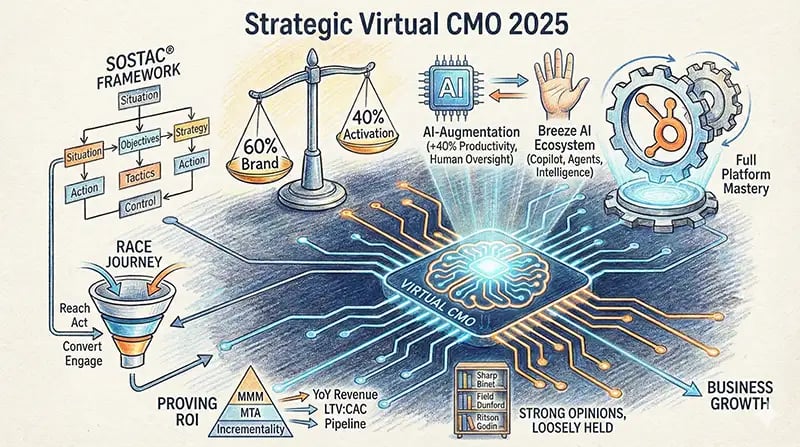
Building a strategic Virtual CMO in 2025 requires mastering three interconnected disciplines: evidence-based frameworks (SOSTAC®, RACE, 60:40 brand-performance allocation), AI-augmented workflows (40% productivity gains with human oversight), and consultative thinking that transforms generic advice into strategic value. For HubSpot Diamond Partners like Whitehat SEO, this means synthesising platform expertise with proven effectiveness principles whilst maintaining the intellectual rigour that separates strategic counsel from surface-level recommendations.
Modern CMO excellence in 2025 demands more than operational competence or channel expertise. The most effective marketing leaders combine rigorous strategic frameworks tested across thousands of campaigns with the emerging capabilities of artificial intelligence, whilst maintaining the human judgement that separates transformative advice from algorithmic pattern-matching.
The challenge facing B2B marketing teams is clear: only 52% of senior marketing leaders have successfully demonstrated marketing's contribution to business outcomes. Meanwhile, 75% of executives expect generative AI to materially change marketing operating models within two years.
Evidence-Based Strategic Frameworks That Actually Work
The most effective CMOs in 2025 rely on a core set of evidence-based frameworks that have survived rigorous academic testing and real-world validation across thousands of campaigns. SOSTAC® (Situation, Objectives, Strategy, Tactics, Action, Control) remains the dominant strategic planning model—voted top three by the Chartered Institute of Marketing.
For tactical execution aligned to customer journeys, the RACE framework (Reach, Act, Convert, Engage) provides measurable stages with clear KPIs. Whitehat SEO applies RACE methodology across HubSpot onboarding projects, ensuring clients understand how each platform capability maps to specific customer journey stages.
Research reveals that integrated campaigns across four or more channels outperform single-channel approaches by 300%, according to Gartner analysis. Account-Based Marketing has matured significantly: organisations with mature ABM programmes report 24% faster revenue growth, 38% higher win rates, and 91% larger deal sizes.
The 60:40 Principle: Brand Building Versus Performance Marketing
Perhaps the most consequential strategic decision CMOs face is the brand-versus-performance allocation. Les Binet and Peter Field's research across the IPA Effectiveness Databank established the 60:40 rule: approximately 60% of marketing investment should fund long-term brand building (broad reach, emotional resonance), with 40% allocated to short-term activation (targeted, rational messaging).
This ratio isn't universal. B2B contexts suggest 46% brand / 54% activation as optimal. First-year businesses should tilt toward 65% performance / 35% brand, whilst mature category leaders can push toward 72% brand / 28% performance. The key insight: as digital activation becomes more efficient, it requires proportionally less budget—making the optimal split shift further towards brand building over time.
The Ehrenberg-Bass Institute's research on mental availability and physical availability reinforces this framework. Since 80-90% of B2B buyers already have vendors in mind before beginning research, the strategic priority is reaching future buyers today through consistent, distinctive brand presence.
Byron Sharp's "How Brands Grow" laws challenge traditional targeting orthodoxy: growth comes primarily from market penetration—reaching light category buyers and non-customers—rather than from loyalty programmes targeting existing heavy users. Distinctive brand assets compound over time, making brands easier to notice, recognise, and remember.
Modern CMO Decision-Making Models
Top CMOs apply several mental models that elevate strategic thinking above tactical execution. First-principles thinking strips problems to fundamental truths rather than accepting inherited assumptions. Second-order thinking considers long-term ripple effects, preventing short-term wins that create downstream damage. Inversion thinking asks "how could we fail?" to surface hidden risks early.
McKinsey research indicates high-performing organisations are 5× more likely to use structured decision-making models consistently. Marketing budgets now average just 7.7% of company revenue, with 59% of CMOs reporting insufficient budget to execute strategy. This constraint forces ruthless prioritisation using portfolio management approaches.
AI-Augmented Marketing: The Human-AI Collaboration Model
The defining operational shift of 2025 is AI integration. Currently, 75% of executives expect generative AI to materially change marketing operating models within two years, with 42% already using GenAI in marketing and sales functions.
The evidence is clear: AI assists humans rather than replacing them. Academic research published in ScienceDirect found that consumers perceive AI-generated content as less engaging when AI replacement is disclosed. However, these negative effects are attenuated when AI augments human work rather than substituting for it.
Best practices treat AI outputs as first drafts requiring human refinement, delivering productivity gains up to 40%. Quality control frameworks are non-negotiable to prevent AI hallucinations. IBM's guidance remains relevant: "Hire for heart and train for AI."
Organisations have expanded marketing jobs by 63% since 2021 as AI-specific functions develop—AI Content Strategists, Prompt Engineers, AI QA Analysts, and Marketing Operations AI Engineers. Whitehat's AI consulting services help clients build this capability systematically.
HubSpot Mastery: The Platform's 2025 Evolution
HubSpot's 2025 platform represents a significant evolution. The Breeze AI ecosystem introduces Breeze Copilot (chat-based AI assistant with full CRM access), Breeze Agents (automated specialists for content, prospecting, customer service, and social media), and Breeze Intelligence (real-time data enrichment and buyer intent signals).
The methodology has evolved from the traditional funnel through the Flywheel to "The Loop": Express (capture attention in high-intent moments), Tailor (personalise at individual level using CRM data), Amplify (distribute across fragmented channels), and Evolve (continuous optimisation with AI insights).
For Diamond Partners like Whitehat SEO, strategic differentiation comes through full platform expertise across Marketing, Sales, Service, and CMS Hubs, inbound methodology foundation (strategy before tactics), agility in adapting to rapid HubSpot updates, and integration capability connecting HubSpot as the central hub with specialised tools.
Marketing Measurement and Proving ROI
Attribution in a privacy-first world requires the "measurement triangle" approach: Marketing Mix Modelling, Multi-Touch Attribution, and Incrementality Testing. Only 52% of senior marketing leaders have successfully demonstrated marketing's contribution to business outcomes. The disconnect: 70% of CEOs measure year-over-year revenue growth, but only 35% of CMOs track it as a top metric.
Closing this gap requires the CMO-CFO partnership, speaking finance language, and connecting marketing activities to financial objectives proactively. Focus on metrics that matter to executives: YoY revenue growth, ROI/ROMI, Customer Acquisition Cost, Lifetime Value, LTV:CAC ratio, pipeline contribution, and incremental revenue.
Thought Leadership Foundations for Strategic Counsel
The Virtual CMO must be grounded in marketing's intellectual canon. Byron Sharp's "How Brands Grow" establishes market penetration and mental availability as growth drivers. Les Binet and Peter Field's "The Long and the Short of It" provides the 60:40 effectiveness framework with IPA database evidence. April Dunford's "Obviously Awesome" delivers the definitive positioning methodology. Mark Ritson's contribution is the relentless focus on strategic fundamentals over "tactification". Seth Godin's philosophy emphasises permission-based engagement and the smallest viable audience.
The productive tension between these thinkers models healthy strategic debate. Ritson and Sharp disagree on specifics whilst agreeing on fundamentals. Binet and Field provide synthesis: "Both mass marketing AND targeting have their place—60:40."
Strategic Advisory: Giving Feedback That Creates Value
Surface-level marketing advice focuses on execution checklists, generic best practices, channel tactics, and activity metrics. Strategic counsel provides frameworks for thinking, context-specific diagnosis, business outcome focus, and value metrics. The "strong opinions, loosely held" framework guides effective advisory: form opinions with conviction based on available evidence, argue passionately for your position, but be willing to change when presented with better arguments or new data.
Characteristics of effective strategic advisors include providing honest, sometimes challenging advice rather than telling clients what they want to hear, offering external perspective that uncovers organisational blind spots, conducting root cause analysis beyond surface symptoms, establishing decision-making frameworks for consistent strategic choices, and maintaining sustained focus on long-term objectives against short-term distractions.
Every recommendation must answer three questions: What specific action should the client take? Why will this action create business value? How will we know if it's working?
Frequently Asked Questions
What strategic frameworks should a Virtual CMO master in 2025?
A Virtual CMO should master SOSTAC® (Situation, Objectives, Strategy, Tactics, Action, Control) for strategic planning, RACE (Reach, Act, Convert, Engage) for customer journey mapping, and the 60:40 brand-to-performance allocation framework from Binet and Field's research. For B2B contexts, the optimal split adjusts to 46% brand building and 54% activation. Additionally, understanding Byron Sharp's market penetration principles, April Dunford's positioning methodology, and the 95-5 Rule (only 5% of B2B buyers are in-market at any time) provides the evidence-based foundation for strategic marketing leadership.
How should CMOs balance brand building versus performance marketing?
According to Les Binet and Peter Field's research across the IPA Effectiveness Databank, the optimal allocation is approximately 60% brand building (broad reach, emotional resonance) and 40% short-term activation (targeted, rational messaging). For B2B companies, this adjusts to 46% brand and 54% activation. First-year businesses should tilt towards 65% performance and 35% brand, whilst mature category leaders can push towards 72% brand and 28% performance. The key insight: as digital activation becomes more efficient, the optimal split shifts further towards brand building over time.
What's the right way to integrate AI into marketing operations?
AI should augment human work rather than replace it. Research published in ScienceDirect found that consumers perceive AI-generated content as less engaging when AI replacement is disclosed, but these negative effects are attenuated when AI augments human work. Best practices include treating AI outputs as first drafts requiring human refinement (achieving productivity gains up to 40%), implementing quality control frameworks to prevent hallucinations, and focusing AI on data processing, content variations, real-time optimisation, and pattern recognition whilst humans lead on strategic vision, emotional intelligence, cultural nuance, brand storytelling, and final quality approval.
How do you prove marketing ROI to the C-suite?
Proving marketing ROI requires the measurement triangle approach: Marketing Mix Modelling for strategic long-term budget allocation, Multi-Touch Attribution for real-time campaign optimisation, and Incrementality Testing for establishing causal ground truth through test versus control methodology. The disconnect to address: 70% of CEOs measure year-over-year revenue growth, but only 35% of CMOs track it as a top metric. Closing this gap requires the CMO-CFO partnership, speaking finance language, and connecting marketing activities to financial objectives proactively.
What HubSpot capabilities matter most for strategic marketing leadership?
HubSpot's 2025 Breeze AI ecosystem represents the strategic capabilities that matter most: Breeze Copilot (chat-based AI assistant with full CRM access), Breeze Agents (automated specialists for content, prospecting, customer service, and social media), and Breeze Intelligence (real-time data enrichment and buyer intent signals). For Diamond Partners like Whitehat SEO, strategic differentiation comes through full platform expertise across Marketing, Sales, Service, and CMS Hubs.
What books should every strategic marketing advisor read?
The essential marketing canon includes Byron Sharp's "How Brands Grow" (establishes market penetration and mental availability as growth drivers), Les Binet and Peter Field's "The Long and the Short of It" (provides the 60:40 effectiveness framework with IPA database evidence), April Dunford's "Obviously Awesome" (delivers the definitive positioning methodology), Mark Ritson's collected Marketing Week columns, and Seth Godin's work on permission-based engagement. The productive tension between these thinkers models healthy strategic debate.
How do you give strategic feedback that creates real value?
Strategic counsel provides frameworks for thinking, context-specific diagnosis, business outcome focus, and value metrics. The "strong opinions, loosely held" framework guides effective advisory: form opinions with conviction based on available evidence, but be willing to change when presented with better arguments or new data. Express uncertainty explicitly, create psychological safety for challenge, and actively seek disconfirming evidence. Effective strategic advisors provide honest advice, offer external perspective that uncovers organisational blind spots, conduct root cause analysis beyond surface symptoms, and maintain sustained focus on long-term objectives.
What's the difference between tactical execution and strategic counsel?
Surface-level marketing advice focuses on execution checklists, generic best practices, channel tactics, and activity metrics. Strategic counsel provides frameworks for thinking, context-specific diagnosis, business outcome focus, and value metrics. Rather than recommending "post more consistently on LinkedIn" (tactical), strategic counsel explains "LinkedIn is where 76% of B2B marketers see best results, and your target personas use it as a primary research channel. A consistent presence builds mental availability with the 95% of buyers not currently in-market." Every recommendation connects to business impact—pipeline, revenue, or strategic positioning.
Build Strategic Marketing Leadership for Your Organisation
Building a Virtual CMO capability requires deep expertise in evidence-based frameworks, HubSpot platform mastery, and AI-augmented workflows. Whitehat SEO's Diamond Partner status and strategic consulting services help B2B organisations implement these best practices systematically.
Whether you need comprehensive HubSpot onboarding, ongoing strategic coaching, or AI integration consulting, our team brings the frameworks and platform expertise that transform marketing from cost centre to revenue engine.
Start the Conversation