
Artificial intelligence is fundamentally reshaping how organisations conduct market research and competitive intelligence gathering. The integration of advanced machine learning algorithms, natural language processing capabilities, and generative AI systems has reduced research project timelines by up to 80 percent whilst simultaneously improving accuracy rates to 95 percent or higher in many applications. Organisations leveraging AI-powered competitive intelligence platforms are detecting market shifts in real-time, automating sentiment analysis across millions of digital conversations, and making data-driven strategic decisions with unprecedented speed and confidence.
Key Insight
Nearly 88 percent of organisations across all sectors are now regularly using artificial intelligence in at least one business function, with competitive intelligence and market analysis representing high-priority implementation areas. However, only 39 percent report enterprise-level bottom-line impact, indicating a significant implementation and value-realisation gap that requires strategic focus on process transformation rather than tool adoption alone.
The Shift from Traditional to AI-Powered Market Research
Traditional market research methodologies operated within clear temporal boundaries, typically requiring weeks or months from research initiation to insight delivery. Organisations would commission research studies, conduct surveys or focus groups, analyse responses manually, generate reports, and only then disseminate findings to decision-makers. This sequential process meant that market insights were often outdated before they reached the executives requiring them for strategic decisions.
The challenge extended beyond timeline constraints. Organisations lacked visibility into competitor activity, customer sentiment, and market trends occurring between formal research cycles. Traditional approaches operated on a discrete, episodic basis rather than continuous monitoring. This temporal limitation meant that competitive threats could emerge, develop, and mature significantly before existing research programmes detected them.
AI-powered market research platforms have eliminated these temporal constraints by enabling continuous monitoring and analysis of digital signals, social media conversations, customer feedback, and competitive positioning information across multiple channels simultaneously. The McKinsey Global Survey on Artificial Intelligence in 2025 reveals that the integration of AI into market research and competitive intelligence has become standard practice, with organisations recognising that real-time, continuous intelligence delivers competitive advantage unattainable through periodic research cycles.
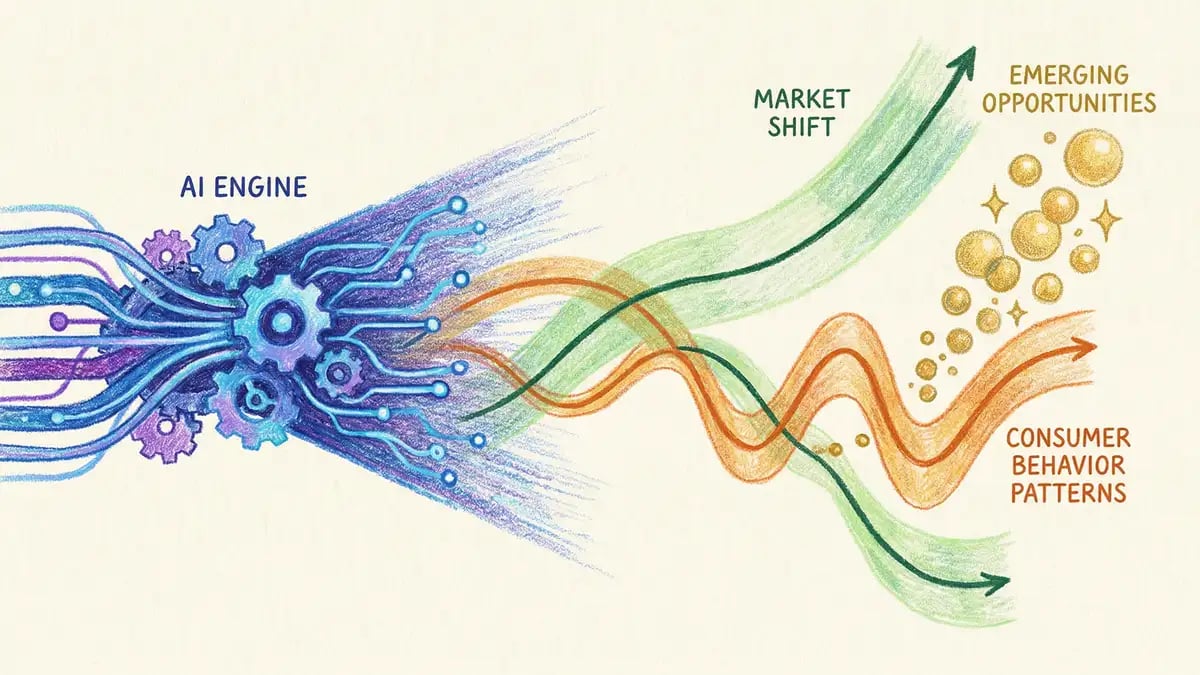
This transformation goes beyond speed. AI systems analyse vast numbers of variables simultaneously, discovering patterns and relationships that human analysts would inevitably miss. Machine learning algorithms identify emerging trends by detecting subtle signals across millions of conversations before they achieve mainstream awareness. Advanced natural language processing extracts nuanced sentiment and intent from unstructured text data. Predictive models forecast market shifts weeks or months in advance, enabling proactive strategic responses rather than reactive adjustments.
AI Social Listening and Sentiment Analysis
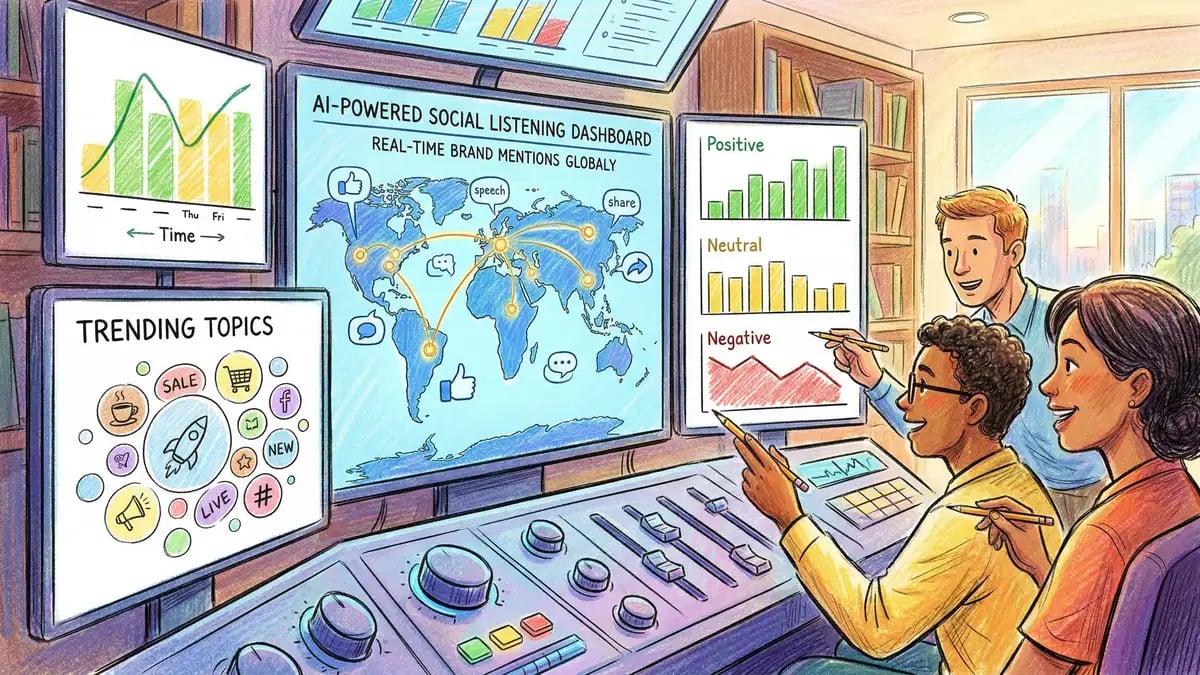
Social listening represents one of the most transformative applications of artificial intelligence within competitive intelligence. Rather than manually monitoring a handful of social media channels, AI-powered platforms analyse conversations across the entire digital ecosystem where customers authentically discuss brands, competitors, and market trends. This capability fundamentally changes the competitive intelligence landscape by providing organisations with visibility into unfiltered customer sentiment and emerging market dynamics.
Brandwatch Consumer Research exemplifies this capability, monitoring social media conversations and analysing consumer behaviour across digital channels to identify emerging trends and track sentiment around brands and competitors. The platform enables businesses to identify market trends by analysing what customers are saying about brands not just on company-controlled channels, but across the entire digital ecosystem where authentic consumer conversations occur. Through sentiment mining capabilities, organisations can identify negative brand mentions in comments and direct messages, surface insights into specific areas requiring improvement, and resolve issues before they escalate into reputational crises.
Sprinklr Insights provides comprehensive real-time consumer and competitor intelligence from over 30 digital channels without the noise that plagues manual monitoring approaches. The platform enables competitive benchmarking across key performance indicators including reach, engagement metrics, impressions, and share of voice. This benchmarking capability sharpens focus on the specific channels, audience segments, and metrics that actually move the needle in competitive positioning rather than requiring organisations to analyse the entirety of digital channels where competitors may or may not be active.
The application of advanced sentiment analysis to competitive intelligence involves more sophisticated analysis than simple positive-negative-neutral classification. Organisations increasingly employ aspect-based sentiment analysis which evaluates customer sentiment towards specific attributes of products or services rather than providing undifferentiated overall sentiment scores. Customers might express positive sentiment regarding a competitor's user interface design whilst simultaneously expressing negative sentiment regarding pricing or customer support responsiveness. This nuanced analysis enables organisations to identify specific competitive vulnerabilities where they might gain advantage by delivering superior performance. Advanced AI techniques can achieve up to 85 percent accuracy in identifying sentiment polarity from text data, though this represents only the baseline capability.
Meltwater operates as a specialist social intelligence platform analysing large volumes of social and web data to provide real-time insights into consumer behaviours, conversations, and emerging trends. Through AI data science and market research capabilities, Meltwater enables organisations to track campaign performance, monitor emerging trends, and identify customer needs or market shifts across digital channels. The platform's real-time social monitoring and trend identification capabilities are particularly valuable for organisations seeking to understand how competitors are being perceived, what customer complaints emerge around competitor offerings, and which emerging trends competitors have yet to address.
AI Competitive Intelligence Platforms
The competitive intelligence tool market has undergone significant consolidation and specialisation, with platforms increasingly offering integrated capabilities spanning data collection, analysis, synthesis, and actionable insight delivery. These specialised platforms represent a fundamental shift in how organisations operationalise competitive intelligence, moving from static reports and dashboards to dynamic, contextual intelligence embedded directly into business workflows.
Crayon has emerged as a specialist competitive intelligence platform specifically designed for go-to-market teams. The platform recently launched what it describes as the first Competitive Intelligence MCP Server enabling seamless integration of competitive content into AI tools and enterprise systems. This innovation reflects a fundamental shift in how competitive intelligence is being consumed. Rather than competitive intelligence insights residing in standalone dashboards or reports accessed only by designated competitive intelligence professionals, intelligence is now being embedded directly into the AI tools and workflows where go-to-market teams actually work, whether that involves customer relationship management systems, messaging platforms, or internal AI assistants.
Klue provides another sophisticated example of AI-driven competitive intelligence specifically optimised for sales and competitive enablement. The platform's Compete Agent operates on two complementary fronts: research and analysis to automatically generate insights from public web data, sales call transcripts, win-loss interviews, and internal documents; and competitive deal support to detect competitor involvement in specific deals, surface buyer pain points, and recommend deal-specific competitive tactics. Rather than requiring sales teams to manually search for competitive information during sales calls, the platform proactively delivers deal-specific insights directly to seller inboxes and stands by in messaging platforms to answer competitive questions in real-time. This represents a fundamental transformation in how competitive intelligence supports revenue generation.
SEMrush provides competitive analysis specifically focused upon digital marketing and search engine optimisation performance, delivering insights into competitor websites, SEO strategies, keyword rankings, and traffic sources. This capability is increasingly important as organisations recognise that competitor visibility in search results and generative AI systems fundamentally impacts market share. The platform incorporates machine learning to detect emerging competitors, identify rising search terms competitors are optimising for, and highlight content gaps where organisations might attract incremental traffic and market share.
| Platform | Primary Specialisation | Key Capabilities | Best For |
|---|---|---|---|
| Brandwatch | Social Listening | Sentiment analysis, trend detection, competitive monitoring across digital channels | Consumer sentiment tracking and market trend identification |
| Sprinklr | Multi-channel Intelligence | Real-time analytics from 30+ channels, engagement metrics, share of voice analysis | Competitive benchmarking across digital channels |
| Crayon | Competitive Intelligence | MCP Server integration, workflow embedding, go-to-market intelligence | Sales teams and go-to-market operations |
| Klue | Sales-Focused Intelligence | Compete Agent, deal detection, real-time support in messaging platforms | Sales enablement and competitive deal support |
| SEMrush | Digital Marketing & SEO | Competitor website analysis, keyword ranking, traffic source identification | Digital marketing and search visibility analysis |
| Meltwater | Web & Social Intelligence | Real-time trend monitoring, consumer behaviour analysis, campaign tracking | Emerging trend identification and market shift detection |
AI Survey and Consumer Insight Tools
AI-powered survey and consumer insight platforms represent a significant evolution in how organisations conduct qualitative and quantitative market research. Traditionally, survey analysis required manual coding of open-ended responses, with researchers reading hundreds or thousands of responses to identify themes, categorise answers, and synthesise insights. This process was time-consuming, prone to subjective bias, and often took weeks or months to complete.
Qualtrics' AI capabilities demonstrate this transformation, with the platform offering automated analysis of open-ended responses, dynamic questioning that adapts based on respondent answers to improve data quality, and automated report generation that surfaces key insights without manual synthesis. This automation reduces turnaround time from weeks or months to hours or days whilst simultaneously improving consistency and reducing subjective bias. Organisations conducting brand tracking studies, customer satisfaction research, or competitive positioning studies can now receive insights continuously as responses arrive rather than waiting for data collection cycles to complete.
Typeform extends this capability by enabling organisations to create sophisticated survey experiences that adapt dynamically based on respondent answers. The platform's AI-powered analysis capabilities help organisations understand not just what respondents say, but why they say it, surfacing underlying motivations and sentiment drivers that inform strategic decisions. By combining dynamic survey design with intelligent analysis, Typeform enables organisations to gather richer insights from the same sample size, improving research efficiency and decision quality.
Advanced implementations incorporate machine learning models trained on domain-specific language and concepts, enabling more sophisticated analysis than generic natural language processing. Remesh exemplifies this approach, enabling real-time, qualitative conversations with large consumer groups simultaneously, using artificial intelligence to immediately analyse responses and surface emerging themes and customer preferences. This approach combines the richness of qualitative research with the scalability and speed of quantitative research, enabling organisations to gather insights from hundreds or thousands of participants whilst maintaining the context and nuance that makes qualitative research valuable.
These platforms enable organisations to conduct continuous customer feedback programmes, gathering insights at scale whilst maintaining the depth and context that inform strategic decisions. Rather than conducting annual customer satisfaction surveys, organisations can implement continuous feedback loops where insights flow continuously from customers into decision-making processes.
Discover how AI can transform your market research strategy and competitive positioning.
Explore AI Marketing Services
AI Trend Forecasting and Predictive Analysis
One of the most transformative applications of artificial intelligence in competitive intelligence involves trend forecasting and predictive analysis. AI systems analyse vast volumes of historical data, social signals, search trends, and market indicators to identify patterns indicating future market developments weeks or months before they achieve mainstream awareness. This capability enables organisations to make proactive strategic decisions rather than reactive responses to market changes.
Machine learning models enable organisations to predict future consumer behaviour and demand patterns through analysis of historical purchasing data, search queries, social media engagement signals, and external market indicators. These predictive capabilities transform demand forecasting from a static quarterly exercise into a continuous, adaptive process that evolves in real-time as new data becomes available. Organisations in consumer goods, retail, and fashion industries increasingly employ AI systems specifically designed for trend forecasting and demand prediction.
Organisations utilising AI for competitive intelligence report 20 to 50 percent improvements in forecast accuracy compared to traditional manual methods, with leading implementations achieving 95 percent accuracy rates. These improvements reflect AI's ability to analyse vast numbers of competitive signals simultaneously, including competitor website changes, social media activity, job postings suggesting expansion into new markets, patent filings indicating new product development directions, and pricing changes. By identifying and synthesising these multiple signals, AI systems can forecast competitive moves with far greater accuracy than manual analysis, which inevitably misses signals or fails to recognise their significance.
Traditional demand forecasting methods typically achieve accuracy below 75 percent. AI-powered forecasting systems consistently achieve 95 percent accuracy or higher, representing a dramatic improvement in forecast reliability. Companies with accurate sales forecasts are 10 percent more likely to grow their revenue year-on-year compared to organisations with poor forecast accuracy. The improvement in forecast accuracy enables organisations to optimise inventory levels, avoiding both the cost of excess inventory and the lost revenue from stock-outs.
95%
Accuracy of AI-powered forecasting systems versus 75% for traditional methods
50-95%
Time savings on research tasks including data collection and analysis
85%
Accuracy of AI sentiment analysis in identifying sentiment polarity
How to Implement AI Market Research
Successful AI market research implementation requires strategic planning, clear objective definition, and focus on transforming core business processes rather than simply deploying new tools. Many organisations adopt AI platforms but fail to achieve enterprise-level business impact because they implement isolated applications rather than fundamentally redesigning how market research and competitive intelligence inform strategic decision-making. The following approach enables organisations to implement AI market research effectively:
Define Clear Business Objectives. Rather than adopting AI tools because competitors use them, organisations should define specific business objectives that AI market research will address. Are you seeking to improve sales forecast accuracy? Reduce time to competitive insight delivery? Identify emerging market opportunities faster than competitors? Improve customer retention through better understanding of satisfaction drivers? Clear objectives guide platform selection and enable measurement of business impact.
Establish Data Governance Foundations. Data quality and governance remain the primary barriers to scaling AI initiatives, with nearly half of business leaders citing concerns about data accuracy and bias as limiting factors in broader AI deployment. Before implementing AI platforms, organisations should establish clear data governance policies, implement data quality controls, and define responsibilities for data accuracy and currency. This foundation enables AI systems to deliver reliable insights rather than amplifying existing data quality issues.
Redesign Business Processes for AI. The organisations reporting significant enterprise-level impact from AI typically employ fundamentally different approaches, focusing AI on growth and innovation rather than solely on efficiency and cost reduction, redesigning workflows to optimise for AI capabilities, and scaling faster than peers. Rather than layering AI into existing processes, successful implementations redesign workflows to leverage AI strengths, such as enabling sales teams to access competitive intelligence directly rather than waiting for marketing to compile battlecards.
Ensure Regulatory Compliance. UK organisations conducting competitive intelligence and market research must navigate a complex regulatory environment governed primarily by the UK General Data Protection Regulation (UK GDPR) and the Data (Use and Access) Act 2025. These regulations impose specific requirements on how organisations collect, process, store, and utilise personal data, with particular implications for AI systems that process personal information or make decisions affecting individuals. Understanding and complying with these regulatory requirements is essential for organisations seeking to implement AI-powered competitive intelligence and market research solutions. The UK Information Commissioner's Office has published guidance specifically addressing how data protection law applies to AI systems.
Measure and Optimise Continuously. Successful implementations establish clear metrics for evaluating business impact, including forecast accuracy improvements, time savings, quality improvements, and revenue impact. Rather than implementing AI platforms once and assuming they deliver value indefinitely, leading organisations continuously optimise platform configurations, retrain models on new data, and adjust processes based on performance data.
Important Consideration
AI systems can amplify existing data quality issues and biases if implemented without proper governance. Organisations must establish clear data quality standards, implement bias detection mechanisms, and maintain human oversight of important decisions. Additionally, when implementing AI systems that process personal data, organisations must ensure compliance with UK GDPR requirements regarding automated decision-making and individual rights.
Frequently Asked Questions
What is the difference between traditional market research and AI-powered market research?
Traditional market research operates on discrete, episodic cycles requiring weeks or months from initiation to insight delivery. AI-powered market research enables continuous monitoring and real-time analysis of millions of conversations, signals, and data points simultaneously. Where traditional approaches might analyse 500 survey responses to understand customer sentiment, AI systems analyse millions of social media conversations, customer reviews, and market signals to identify emerging trends and competitive threats in real-time. This continuous monitoring capability enables organisations to detect market shifts weeks or months before they achieve mainstream awareness, providing significant competitive advantage.
How accurate is AI sentiment analysis for competitive intelligence?
Advanced AI sentiment analysis can achieve up to 85 percent accuracy in identifying sentiment polarity from unstructured text data. However, accuracy varies significantly based on implementation approach. Simple positive-negative-neutral classification represents only baseline capability. More sophisticated implementations incorporate aspect-based sentiment analysis which evaluates customer sentiment towards specific product attributes, emotion detection which identifies underlying emotional drivers, and intent classification which determines whether sentiment indicates purchase likelihood or brand advocacy. Leading implementations incorporate domain-specific language models trained on industry-specific conversations, enabling much higher accuracy than generic approaches.
What platforms should UK organisations prioritise for AI market research?
Platform selection should be driven by specific business objectives rather than generic recommendations. Organisations focused on understanding consumer sentiment and emerging trends should prioritise social listening platforms like Brandwatch or Sprinklr. Sales teams seeking competitive intelligence for deal support should evaluate Klue or Crayon. Organisations conducting customer feedback programmes should consider Qualtrics or Remesh. Digital marketing teams should evaluate SEMrush for competitive analysis. Most organisations benefit from implementing multiple specialised platforms rather than attempting to find a single unified solution, as each platform offers distinct capabilities optimised for specific use cases.
How do UK data protection regulations impact AI market research implementation?
UK organisations must comply with UK GDPR and the Data (Use and Access) Act 2025 when implementing AI market research. These regulations impose specific requirements regarding collection, processing, storage, and utilisation of personal data. Article 22 GDPR limits use of solely automated decisions with legal or similarly significant effects, requiring valid justification such as explicit consent or contractual necessity. For AI systems processing personal information from social media, customer databases, or consumer research, organisations must implement appropriate safeguards including transparent processing, meaningful information provision, human intervention rights, and decision explanation capabilities. Additionally, organisations must conduct data protection impact assessments and consider compliance with specific guidance published by the UK Information Commissioner's Office on AI systems.
What is the typical return on investment for AI market research platforms?
AI market research platforms typically deliver strong financial returns when implemented strategically. Platform costs range from £1,000 to £5,000 monthly depending on organisation size and scope, representing a fraction of traditional CRM implementations. Organisations report time savings of 50 to 95 percent on specific tasks including data collection, analysis, and report generation, freeing teams to focus on higher-value strategic activities. Research demonstrates that AI implementations can reduce sales and marketing expenses by up to 30 percent through task automation and sales cycle optimisation. AI-native companies report 25 percent reductions in customer acquisition costs compared to traditional approaches. However, realising these returns requires more than tool adoption—it requires redesigning business processes and operating models to leverage AI capabilities effectively.
Related Resources
AI in Marketing: Complete Guide
Explore how artificial intelligence is transforming marketing strategy, customer engagement, and revenue generation across all business functions.
Best AI Marketing Tools 2026
Comprehensive review of leading AI tools for marketing, content generation, analytics, and customer relationship management.
AI for Analytics and Reporting
Discover how AI transforms data analysis, insight generation, and business intelligence for strategic decision-making.
AI Copywriting and Content
Master AI-powered content creation, copywriting optimisation, and content strategy for improved engagement and conversion.
Transform Your Competitive Intelligence with AI
Our AI consulting team helps organisations implement market research and competitive intelligence solutions that deliver measurable business impact. From platform selection through to process redesign and ongoing optimisation, we guide your organisation through every step of the AI transformation journey.
Whitehat AI Consulting
Specialist AI consulting firm focused on helping UK organisations implement artificial intelligence for market research, competitive intelligence, and strategic decision-making. Our team combines deep technical expertise in AI systems with marketing and business strategy experience.
Visit our AI marketing services or AI SEO services pages to learn more.
Sources: Research compiled from McKinsey Global Survey on Artificial Intelligence 2025, Oracle demand forecasting research, UK Information Commissioner's Office guidance on AI systems, DataForSEO competitive intelligence platform analysis, and direct platform documentation from Brandwatch, Sprinklr, Crayon, Klue, SEMrush, Meltwater, Qualtrics, Typeform, and Remesh.